Saving for the Emperor: The Occupation's Post Office Savings Drives, 1942–45
On 16 July 1945, a month before Japan surrendered, the Syonan Shimbun carried an advertisement from the Malai Banking Association. “Fourth time!” it announced, offering another round of its “Fixed Deposit with Bonus” scheme, with a savings encouragement prize of $50,000. The banks would take deposits from 1 August to 31 August 1945, and the prize draw was set for 31 October. On the same page the Postmaster-General told readers that money in the Post Office Savings Bank would be “absolutely safe”. For almost three years the Japanese military administration had pressed the people of Singapore and Malaya to save, through post office drives, bank campaigns and prize draws, and by the middle of 1945 more than half a million people had savings accounts. None of the money they deposited during the Occupation was ever recognised after it.

The Fullerton Building across the Singapore River, home of the General Post Office and its savings bank counter from 1928 (date of photograph unknown). (Unknown photographer, Collectie Familie Khouw, KITLV, CC BY 4.0, via Wikimedia Commons)
A savings bank at every post office
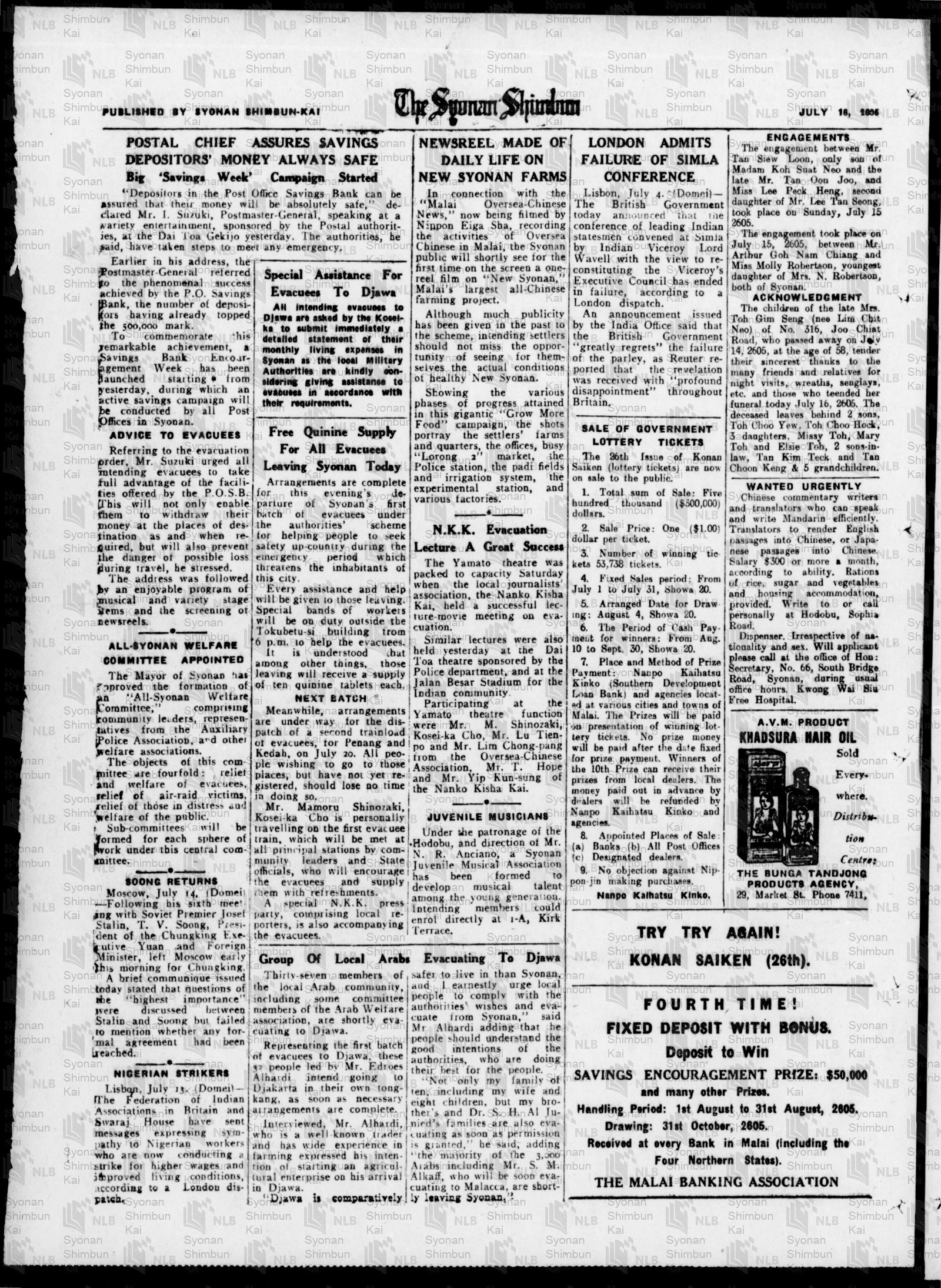 The Syonan Shimbun of 16 July 1945, page 2. The Postmaster-General's assurance is at the top left, and the Malai Banking Association's advertisement for its fourth "Fixed Deposit with Bonus" is at the bottom right. (The Syonan Shimbun, via NewspaperSG, National Library Board Singapore, public domain)
Singapore had had a post office savings bank since 1877, run by the colonial government across the counter of the General Post Office, as described in an earlier post on POSB. Before the war it was a bank of the Straits Settlements only. An account opened in Singapore could not be used in the Federated Malay States, and the other Malay states had their own arrangements or none at all.
When Singapore fell in February 1942, depositors could no longer draw on those pre-war accounts as they pleased. Later in 1942 the Japanese postal authorities let them take out part of their old balances, at first $30 and then $25 every half-year. From 8 December 1942, the first anniversary of the war in the Pacific, the limits were raised to $100 for the first withdrawal and $50 every half-year after that. The announcement came from Seiji Hamada, the Postal Administrator for Malai and Sumatra. Malai was the administration’s name for Malaya, and Singapore had been renamed Syonan.
In September 1942 the administration opened a savings bank of its own at the post offices. It later called it the Dai Nippon Government Post Office Savings Bank of Malai. It paid interest of three per cent a year, which the Syonan Shimbun pointed out was the same rate as before the war, and unlike the old bank it was run as one bank for the whole peninsula, so that an account could be used at any post office in Malaya. In December 1942 the paper’s editorial quoted the Controller of Posts in Syonan, who described savings as “the easiest means for the people living in the Southern Regions to co-operate in the construction of the Greater East Asia Co-Prosperity Sphere”. The editorial went on: “it is indeed the duty of every good citizen to save as much as he or she can afford to put aside out of income.”
The start was slow. The Syonan Shimbun reported that deposits across Malaya reached $500,000 in March 1943, and that they took nearly a year to pass the first $1 million, on 20 August 1943.
Why save money that was being printed
The administration was paying its way with its own new notes, the currency that came to be called banana money, and it printed more of them every year. Money that people spent pushed up prices. Money that they put in a savings account was out of circulation, at least for a while. The same thinking lay behind the government lottery, which had been announced in 1942 as a way of “absorbing excess purchasing power”.
The argument was put plainly in February 1945, in a talk on Radio Syonan by Lim Beng Quan, a member of the Auxiliary Police who had been given a certificate of merit for encouraging savings. According to the Syonan Shimbun’s report, he told listeners that “national savings keep down inflation and help to stabilize prices, thus keeping down the cost of living”. He also acknowledged the obvious objection, that “the average citizen does not earn enough and the high cost of living is mounting”, and suggested that people give up some cinema visits and cigarettes instead.
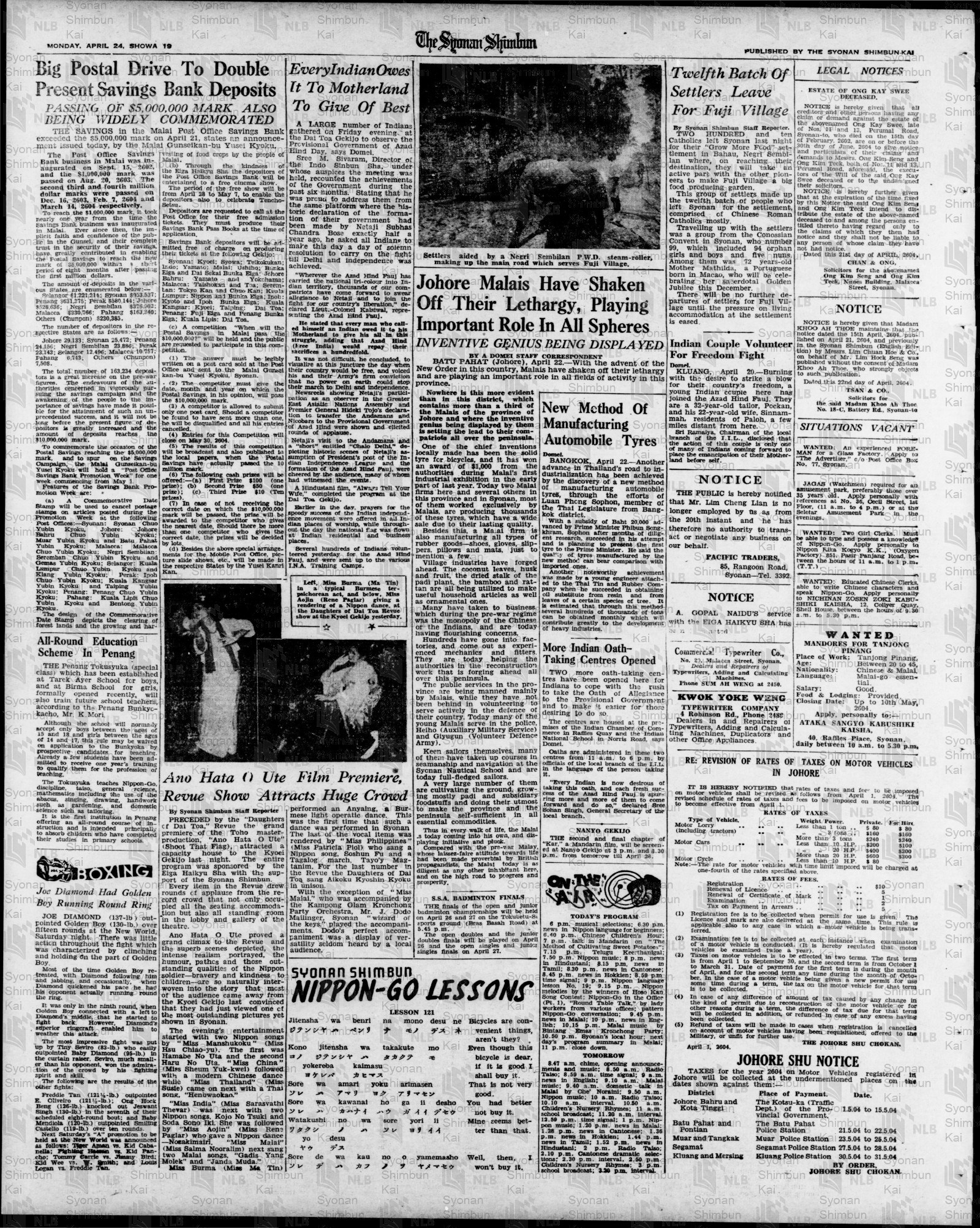 The Syonan Shimbun of 24 April 1944, page 2. The headline at the top left reads "Big Postal Drive To Double Present Savings Bank Deposits". (The Syonan Shimbun, via NewspaperSG, National Library Board Singapore, public domain)
The drives
The first big push came in September 1943. To mark the first million, the postal department of the military administration held a Post Office Savings Bank Promotion Week across Malaya from 1 September. It issued commemorative stamps of 8 and 15 cents, used a special date stamp at the main post offices, and announced the results of a competition for savings posters and slogans. In Syonan a travelling post office toured the island, selling stamps and taking savings deposits at business centres and amusement parks. According to the department’s figures, deposits in September were about three times the monthly average before the campaign, and the total rose from $1.11 million on 3 September to $1.4 million on 11 October.
The banks joined in at the same moment. From 1 September 1943 all 14 member banks of the Malai Banking Association began taking savings deposits as part of what the paper called a “Toa-wide ‘Save for Victory’ move”. Ordinary savings accounts paid two per cent, up from one and a half, and a new kind of fixed savings deposit paid three per cent.
The drives that followed were tied to the administration’s calendar. A second promotion week ran from 15 February to 21 February 1944, the second anniversary of what the administration called the “Birth of New Malai”, the fall of Singapore. Its commemorative date stamp, used on passbooks as well as letters, showed “a Malai father and son on their way to the Syonan Jinja to pay respects”. Picture slides of a farmer setting out early to work and save were shown in the cinemas. When savings passed $5 million on 21 April 1944, depositors who showed their passbooks at the post office were given free tickets to cinema shows from 28 April to 7 May. The notice said the shows were meant “to enable the depositors also to celebrate Tencho Setsu”, the Emperor’s birthday on 29 April. There was also a competition to guess the date on which postal savings would pass $10 million.
The banks’ own campaign used prize draws. Under the Malai Banking Association’s “Fixed Deposit with Bonus” scheme, which ran from 15 February to 15 March 1944, every $100 placed on fixed deposit for a year earned a lottery number. Each block of $2 million in deposits carried prizes of $1,000, $500, $100 and $50, and one number across the whole scheme would win a special prize of $10,000. The association reported that about $8.5 million had come in, more than twice what it had expected, and the numbers were drawn in public at the Kyoei Gekijo, a cinema, on 15 May 1944. A second round followed in October 1944, and by July 1945 the association was advertising its fourth.
As the war turned against Japan, the drives reached further into workplaces. In Penang in October 1944, the Controller of Posts told the managers of large firms, trade associations and amusement and gambling parks that “with the war now reaching a decisive stage” their help “should be increased manifold to ensure final victory”. Under a new group savings system, the managers would collect savings from their staff and stallholders and send the names and amounts to the post office each month. In Syonan, the Lim Beng Quan talk of 1945 urged every member of the Auxiliary Police to keep a savings book “to set a good example to their neighbours and householders”, and told every depositor to pay something in “at least once every month”. By then the travelling post office came “to his very door to collect savings”.
Saving into inflation
On paper, the drives worked. The Syonan Shimbun reported that postal savings across Malaya passed $5 million in April 1944 and $10 million in October. At the end of 1944 they stood at $16.6 million in 404,271 accounts. At the end of June 1945 they stood at $30.2 million in 506,950 accounts, against a pre-war peak, the paper said, of 180,000 depositors. Singapore’s share grew with the rest. In April 1944 it had 25,472 depositors with $953,537 between them, and by the end of June 1945 it had 99,378 depositors with $6.5 million.
Post office savings deposits across Malaya, September 1942 to June 1945 (millions of occupation dollars)
View data as a table
| Date | Deposits ($ millions) |
|---|---|
| 15 September 1942 (bank opens) | 0 |
| March 1943 | 0.5 |
| 20 August 1943 | 1.0 |
| 11 October 1943 | 1.4 |
| 16 December 1943 | 2.0 |
| 7 February 1944 | 3.0 |
| 14 March 1944 | 4.0 |
| 21 April 1944 | 5.0 |
| Reported 25 May 1944 | 6.0 |
| Reported 20 June 1944 | 7.0 |
| Reported 24 July 1944 | 8.0 |
| Reported 9 October 1944 | 10.0 |
| 31 December 1944 | 16.57 |
| 30 June 1945 | 30.19 |
Source: figures announced by the military administration's postal department and reported in the Syonan Shimbun, 1943–45. Where the paper gave no exact date, the date shown is the day it reported the figure. All amounts are in occupation currency, which lost most of its value over the period.
The rising line measured paper money put away, not wealth. The same administration that ran the drives was issuing notes faster every year, and the notes lost value as it did. As the banana money post describes, an egg that had cost 3 cents before the war cost about $100 by the end of the Occupation. Dividing the paper’s own totals by the number of accounts gives an average of about $41 per account at the end of 1944 and about $60 at the end of June 1945. Measured in what they could buy, both sums were far smaller than they look.
“Absolutely safe”
On 16 June 1945 the number of depositors passed 500,000, and the postal department announced a commemoration week from 1 July. A savings encouragement week followed in Syonan in mid-July. On 15 July the Postmaster-General, Mr Suzuki, spoke at an entertainment for depositors at the Dai Toa Gekijo theatre and assured them that “their money will be absolutely safe”. The authorities, he said, “have taken steps to meet any emergency”. The same page of the Syonan Shimbun reported that the first batch of people leaving Syonan under an evacuation scheme would depart that evening, “to seek safety up-country during the emergency period which threatens the inhabitants of this city”. Suzuki urged those leaving to use the savings bank, so that they could draw their money where they were going and avoid losing it on the journey.
The banks’ fourth bonus scheme opened for deposits on 1 August 1945. Japan announced its surrender on 15 August, while deposits were still being taken, and British forces landed back in Singapore on 5 September, eight weeks before the draw was due.
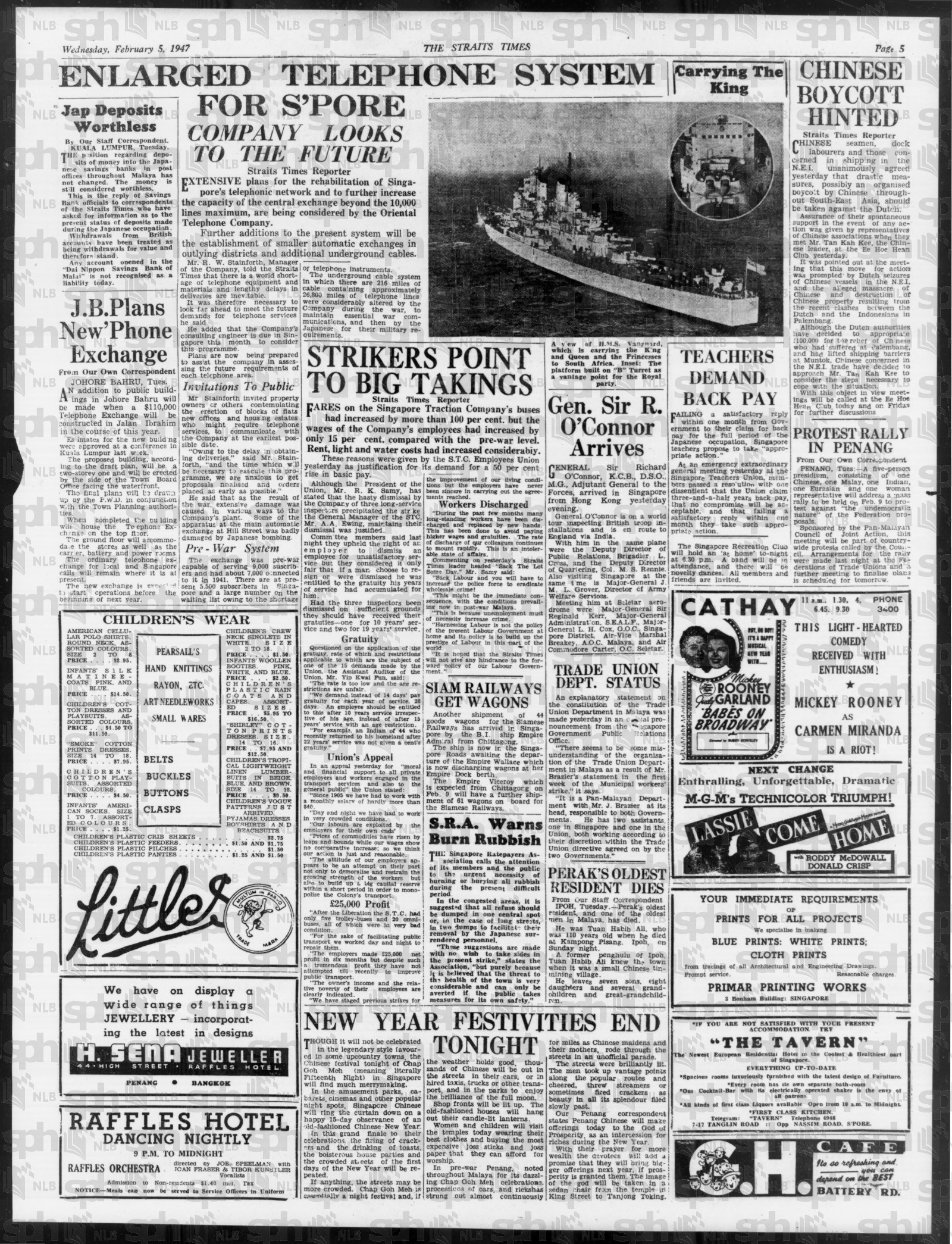 The Straits Times of 5 February 1947, page 5. The short item at the top left, "Jap Deposits Worthless", records that accounts opened in the occupation savings bank were "not recognised as a liability". (Singapore Press Holdings, via NewspaperSG, National Library Board Singapore, public domain)
What happened to the deposits
In September 1945 the British Military Administration declared that banana money would have no value. When the Postal Savings Bank reopened for withdrawals in October 1945, the Straits Times reported that the old pre-war accounts would be honoured, provided depositors could produce their passbooks or other proof. But “no withdrawals or enquiries”, the Straits Times reported, “can be entertained regarding Postal Savings Bank accounts started during the Japanese occupation”.
The position did not change. In February 1947 savings bank officials in Kuala Lumpur told the Straits Times that deposits made during the Occupation were “still considered worthless”, and that any account opened in the “Dai Nippon Savings Bank of Malai” was “not recognised as a liability today”. They added that withdrawals made from the old British accounts during the Occupation had been treated as withdrawals “for value”, so they stood.
That combination hit some depositors twice. A letter to the Straits Times in August 1947, from a reader in Sungei Siput, Perak, described a saver who had $1,000 in the bank when the war began, drew it out early in the Occupation, and later paid $1,000 back in. After the war he found himself with nothing, because his withdrawal counted and his deposit did not. In August 1949 another reader, from Penang, wrote under the heading “A Raw Deal For The Small Man” that the small saver’s “withdrawals during the occupation are treated as withdrawals” while “his deposits during the corresponding period are completely ignored”.
Part of that was eventually put right. In 1950 the Federation of Malaya passed a law to revalue such withdrawals, and on 16 February 1951 Singapore’s Legislative Council passed a bill of its own “for the revaluation of withdrawals from the Post Office Savings Bank during the Japanese occupation”. From May 1951, depositors who had drawn on their pre-war accounts between 1 January 1943 and 5 September 1945 could send their passbooks to the Controller of the Post Office Savings Bank. Their withdrawals were to be revalued on the sliding scale used for other wartime debts, which converted occupation dollars into a smaller number of Straits dollars according to the date, so that each wartime withdrawal counted for less against the pre-war balance. The money paid into the occupation’s own savings bank was never recognised.
The same bank today
The pre-war bank went on. In 1949 Singapore’s Post Office Savings Bank became a separate institution from Malaya’s, and it grew into POSB, which DBS Bank acquired in 1998 and still runs under the POSB name. Today the protection for an ordinary saver is written down in advance. Under the Deposit Insurance Scheme, administered by the Singapore Deposit Insurance Corporation, Singapore-dollar deposits in standard savings, current and fixed deposit accounts are insured up to $100,000 per depositor at each member bank or finance company, and all full banks and finance companies in Singapore are required to be members.

The POSB branch at Newton, 2018. (Deoma12, CC BY-SA 4.0, via Wikimedia Commons)
See 14 more pages, stamps and pictures from the Occupation’s savings drives →
Why it matters today: the savings drives of 1942 to 1945 are a small part of the Occupation’s history, but they show how a wartime government could use the habit of thrift to draw money back out of circulation, and how little protection that left the people who saved. The deposits rose every month in the official figures, while the currency they were counted in lost most of its value and the government that held them disappeared. A savings account is only as safe as the money it holds and the institution that stands behind it, which is why depositors today are told in advance exactly what is protected.
Sources
- The Syonan Shimbun, 12 December 1942, “P.O. Depositors May Draw Out Further $70”, NewspaperSG
- The Syonan Shimbun, 15 December 1942, “Wartime Savings”, NewspaperSG
- The Syonan Shimbun, 18 December 1942, “Postal Savings Reflect People’s Confidence”, NewspaperSG
- The Syonan Shimbun, 23 August 1943, “Peoples Confidence In Postal Savings Bank Demonstrated”, NewspaperSG
- The Syonan Shimbun, 3 September 1943, “Malaian Banks Provide Facilities To Promote ‘Save For Victory’ Drive”, NewspaperSG
- The Syonan Shimbun, 18 October 1943, “Malai Postal Savings Show Big Increase”, NewspaperSG
- The Syonan Shimbun, 8 February 1944, “Special $10,000 Prize, Other Bonuses Provided In Banks’ Scheme To Foster Savings”, NewspaperSG
- The Syonan Shimbun, 10 February 1944, “New Postal Savings Week Being Launched Tuesday”, NewspaperSG
- The Syonan Shimbun, 17 March 1944, “Postal Savings Have Now Exceeded $4,000,000 Mark”, NewspaperSG
- The Syonan Shimbun, 24 April 1944, “Big Postal Drive To Double Present Savings Bank Deposits”, NewspaperSG
- The Syonan Shimbun, 12 May 1944, “Draw For ‘Fixed Deposit With Bonus’ Prizes Next Monday”, NewspaperSG
- The Syonan Shimbun, 15 September 1944, “New ‘Fixed Deposit With Bonus’ Drive To Be Launched”, NewspaperSG
- The Syonan Shimbun, 18 October 1944, “Group Savings System Urged By Postal Chief”, NewspaperSG
- The Syonan Shimbun, 19 January 1945, “Postal Savings Hit New High In Deposits, Depositors In December”, NewspaperSG
- The Syonan Shimbun, 23 February 1945, “Savings Help To Check Inflation, Stabilize Prices, Cost Of Living”, NewspaperSG
- The Syonan Shimbun, 3 July 1945, “Depositors In P.O. Savings Bank Exceed 500,000”, NewspaperSG
- The Syonan Shimbun, 16 July 1945, “Postal Chief Assures Savings Depositors’ Money Always Safe”, NewspaperSG
- The Syonan Shimbun, 25 July 1945, “People’s Confidence In Postal Savings Bank Demonstrated”, NewspaperSG
- The Straits Times, 12 October 1945, “Savings Bank Opens On Monday”, NewspaperSG
- The Straits Times, 5 February 1947, “Jap Deposits Worthless”, NewspaperSG
- The Straits Times, 9 August 1947, “A post office savings bank riddle…”, NewspaperSG
- The Straits Times, 27 August 1949, “A Raw Deal For The Small Man”, NewspaperSG
- Malaya Tribune, 29 July 1950, “Govt. To Revalue Occupation Withdrawals”, NewspaperSG
- The Straits Times, 17 February 1951, “Reserved Areas Bill”, NewspaperSG
- The Straits Times, 9 May 1951, “Revalued Savings Claims”, NewspaperSG
- Post Office Savings Bank (POSB), Singapore Infopedia, National Library Board
- Understanding deposit insurance, MoneySense
- Collectie Familie Khouw, KITLV D14121 (the Fullerton Building), Wikimedia Commons
- POSB Newton Branch, Wikimedia Commons
- Stamp Malaya Japan occupation 1943 3c, Wikimedia Commons
- Stamp Malaya Japan occupation 1943 4c, Wikimedia Commons
- Syonan Jinja stamp (Japanese-occupied Malaya), Wikimedia Commons
- 1942 Fall of Singapore stamps, Wikimedia Commons
- 3d Malaya duty stamps overprinted Dai Nippon 2602, Wikimedia Commons
- Banknote (AM 2004.35.4-1), Japanese Government $10, Auckland War Memorial Museum, Wikimedia Commons
- Street in Shonan, Wikimedia Commons
- Ration book for extra rice, Syonan, 1945, Wikimedia Commons


