Syonan Syoken: The Occupation's Government Lottery, 1942–45
On the afternoon of 10 September 1942, seven months into the Japanese Occupation, a crowd gathered in the old Victoria Theatre to watch a lottery being drawn. Women nominated by the different communities had been chosen to turn the drums, and a million one-dollar tickets were narrowed down to 62 winners. The first prize of $100,000 went to a 33-year-old banker from Kuala Lumpur who had bought 223 tickets. It was the first of more than thirty government lotteries the Japanese military administration put on sale in Singapore and Malaya, and it was announced from the start as a way to take money back out of people’s pockets.

A $1 Konan Saiken ticket for the 21st monthly draw of the Occupation’s government lottery. (Malai Gunseikanbu, photographed at the National Museum of Singapore by Zenwort, public domain, via Wikimedia Commons)
“Absorbing excess purchasing power”
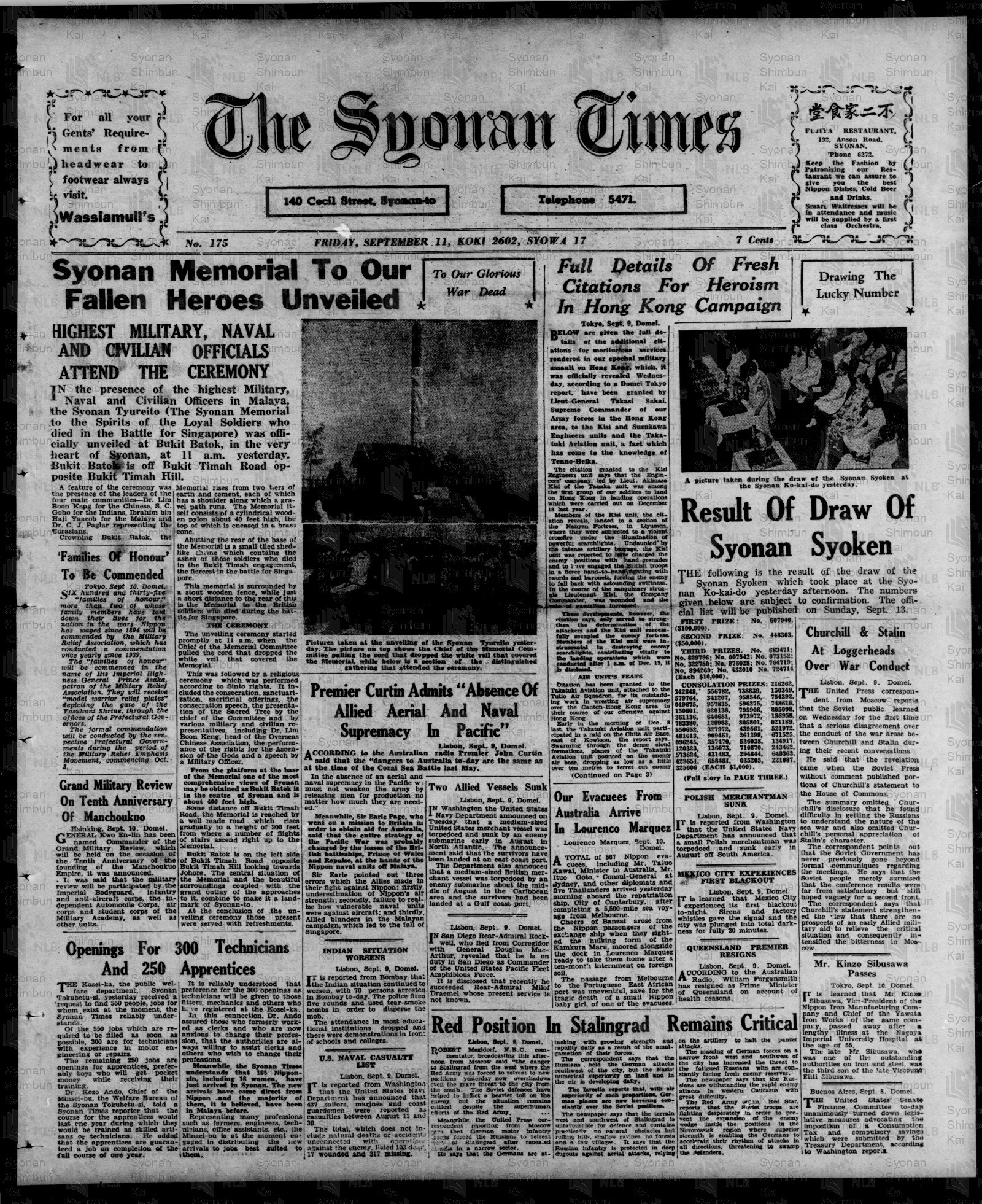 The front page of the Syonan Times, 11 September 1942. The photograph at top right shows the draw of the Syonan Syoken the day before, with the results printed below it. (Singapore Press Holdings, via NewspaperSG, National Library Board Singapore, public domain)
The lottery was first announced on 29 May 1942. According to a Domei news report in the Syonan Times, the Finance Bureau of the military administration would “shortly conduct a $1,000,000 lottery” with “the dual purpose of increasing revenue and absorbing excess purchasing power”. The tickets would cost $1 each and be sold at the City Hall and at the branches of the Yokohama Specie Bank and the Bank of Taiwan. The report gave its reasons plainly. The lottery was “intended to absorb spending money and inflationary tendencies”, which it blamed on the British defence building of the last months before the fall and on speculation by Chinese merchants who had pulled their money out of the stock market.
The announcement came at a hard moment for the city’s money. In the same weeks, the Chinese community was being made to raise the $50 million “gift” demanded by the military, and on 25 June it handed over a cheque that included $22 million borrowed from the Yokohama Specie Bank. The same bank was named as the place where lottery winners would be paid. At the same time the administration was paying its way with its own new notes, the currency that came to be called banana money, printed in ever larger amounts. A lottery that took in a million of those dollars and paid out only part of them was one small way of drawing some of that money back.
How Syonan Syoken worked
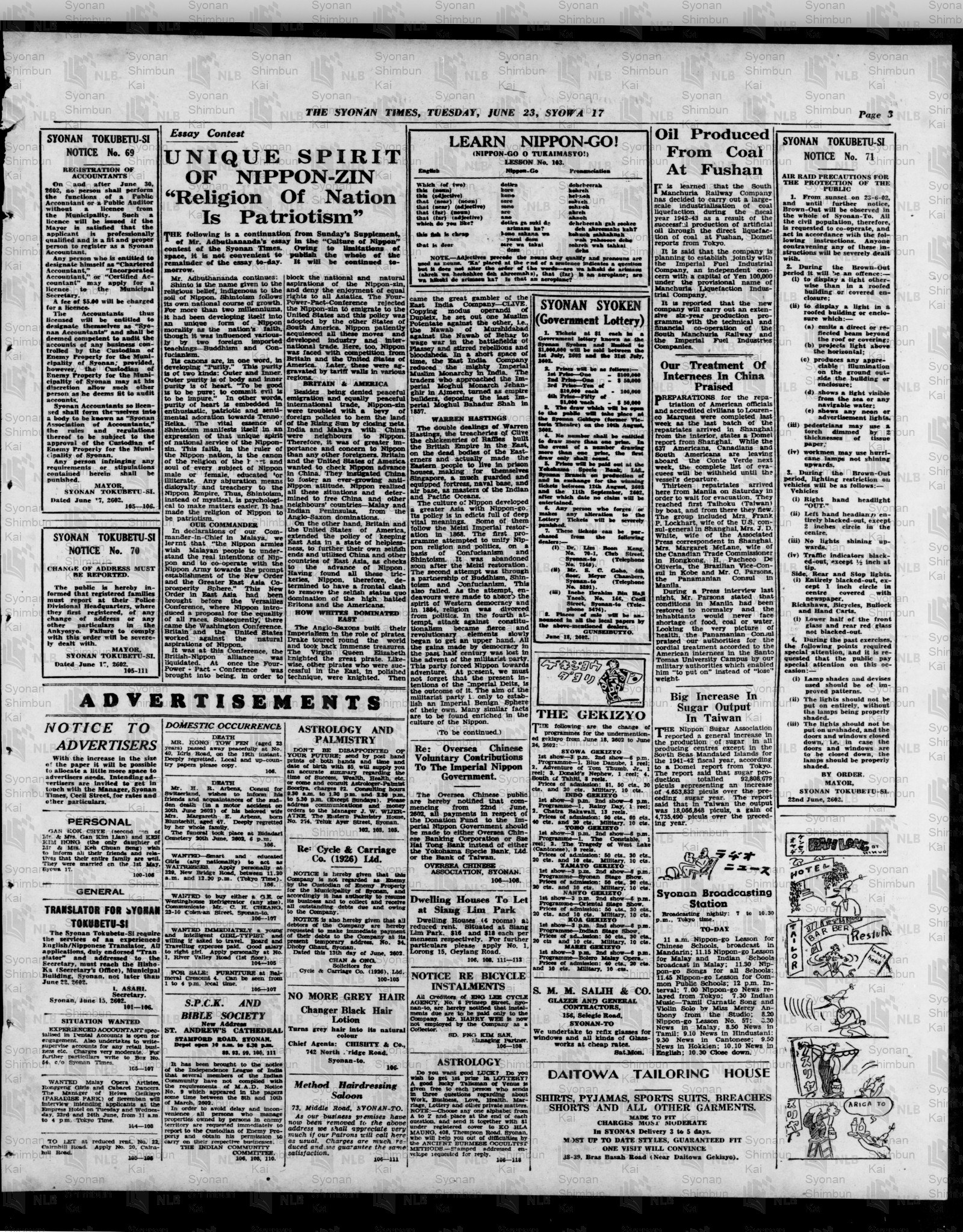 Page 3 of the Syonan Times, 23 June 1942. A notice for the Syonan Syoken, the government lottery, runs in the advertisement columns, on the same page as a notice to Chinese contributors to the $50 million gift. (Singapore Press Holdings, via NewspaperSG, National Library Board Singapore, public domain)
The government lottery was called Syonan Syoken. A notice in the paper on 1 July announced that the tickets were on sale from that day, and an advertisement later that month put the offer simply: “Do you want $100,000 or $50,000 or $10,000 or $1,000? Buy a ticket in our $1,000,000 government lottery and try your luck.” There were 62 prizes, one of $100,000, one of $50,000, ten of $10,000 and fifty of $1,000, worth $300,000 in all. The paper was asked to make it clear that winners would pay no tax, and that all prizes would be paid in cash at the local office of the Yokohama Specie Bank.

The Victoria Theatre and Victoria Memorial Hall on a postcard of about 1930. The lottery draws of the Occupation were held in the theatre. (Unknown author, public domain, via Wikimedia Commons)
The draw was first set for 10 August at the former Victoria Theatre, which had been renamed for the Occupation, and was later moved to 10 September. By then, according to the head of the finance department, a Mr Hara, the whole million tickets had been sold “within a period of only two months”. In a speech before the draw he said the lottery had been “schemed and decided soon after the termination of hostilities in Malaya”, thanked “the three communities in Malaya, namely the Chinese, Indians and the Malays” for their co-operation, and promised that the money would be “spent for most fitting causes such as the relief of distressed people, the improvement of sanitary conditions and other suitable social services”.
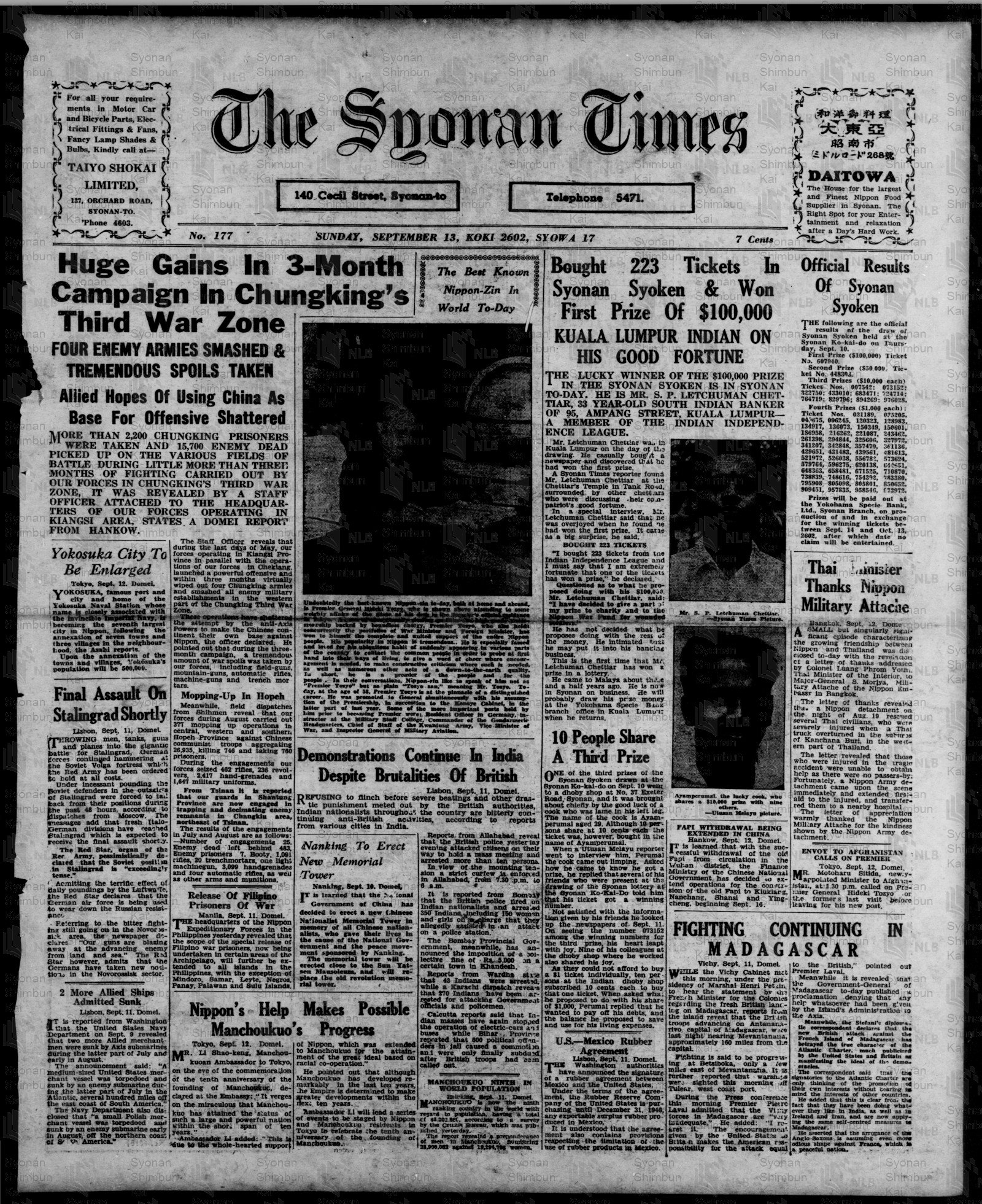 The front page of the Syonan Times, 13 September 1942, with the story of the first prize winner, S. P. Letchuman Chettiar, and his photograph in the centre columns. (Singapore Press Holdings, via NewspaperSG, National Library Board Singapore, public domain)
The winners were reported over the following days. The first prize went to S. P. Letchuman Chettiar of Ampang Street in Kuala Lumpur, who had bought 223 tickets, and a few days later the paper reported that he had given $7,500 of it to a fund for wounded and sick Japanese soldiers. The second prize was won by a Sikh police constable in Negri Sembilan. One of the $10,000 third prizes went to a dhoby shop on Exeter Road, where it was shared by ten people, most of the luck said to have come from the shop’s cook.
On 3 October the Syonan Times reported what would happen to the $700,000 left over. It would be split into four equal parts, for the Chinese Society to help the poor, for leper asylums and mental hospitals, for the Labour Control Bureau and for the Health Department’s preventive work. The official who announced it, a Mr S. Nakahira of the finance department, said $700,000 was “not a very large sum” for so many organisations and asked the people of Malaya to support “any further lotteries”.
Where each $1 lottery ticket went
Cents of every dollar of tickets sold
Sources: Syonan Times, 23 July and 3 October 1942; Syonan Shimbun, 31 July 1943 (NewspaperSG).
View as table
| Lottery | Part | Detail |
|---|---|---|
| Syonan Syoken, 1942 | Prizes 30c | $300,000 in 62 prizes on $1,000,000 of tickets |
| Syonan Syoken, 1942 | Charity and health 70c | The $700,000 balance, announced for four charity and health bodies |
| Konan Saiken, 1943 | Prizes 60c | $240,000 in 3,239 prizes on 400,000 tickets (fourth issue) |
| Konan Saiken, 1943 | Rest 40c | The other $160,000 of the issue; the tickets named health facilities and refugee relief as its causes |
Konan Saiken: a lottery every month
 A ticket for the 9th draw of Konan Saiken. The characters down the left side read "health facilities" and those down the right "refugee relief". (Malai Gunseikanbu, photographed at the National Museum of Singapore by Zenwort, public domain, via Wikimedia Commons)
There were further lotteries, and they came every month. In 1943 the administration began a Malaya-wide lottery, Konan Saiken, a name that roughly means “lottery for the rise of the South”. Its tickets still cost $1, and the first three monthly issues of 300,000 tickets each were reported to have sold out within a few days, with tickets bought by the public changing hands at a premium. From the fourth issue, in August 1943, each lottery was raised to 400,000 tickets, half of them for Singapore, with 3,239 prizes worth $240,000 and a first prize of $50,000. Each ticket carried the stated purpose of the money, printed in Chinese characters down its two sides: health facilities on one side and relief for refugees on the other.
Winners were often reported giving some of their prize away. The winner of an early $50,000 first prize, a public works employee in Malacca, gave $5,000 to charity, and in October 1943 the staff of a Syonan municipal office who had shared a prize gave $600 to the Japanese Red Cross. The draws were held at the same hall, and in May 1943 the paper announced that those who could not get in would be able to hear the results on loudspeakers outside.
What a prize was worth

A $10 note issued by the Japanese government for Malaya in 1942. Its banana design gave the whole currency its nickname. (Scanned by Jacklee, public domain, via Wikimedia Commons)
A lottery prize was a fixed sum in a currency that kept losing value. Banana money was issued at par with the Straits dollar in 1942, but by August 1945 the administration had put out something like $4,000 million of it, against a pre-war circulation for the whole region of about $220 million. According to a National Archives oral history quoted in the National Library’s BiblioAsia journal, an egg that cost 3 cents before the war cost $100 by the end of the Occupation, and a kati of pork that had cost 30 cents cost $1,500. A $100,000 prize in September 1942 was a fortune. A $50,000 prize two years later bought far less, and by 1945 the administration had introduced $100 and $1,000 notes.
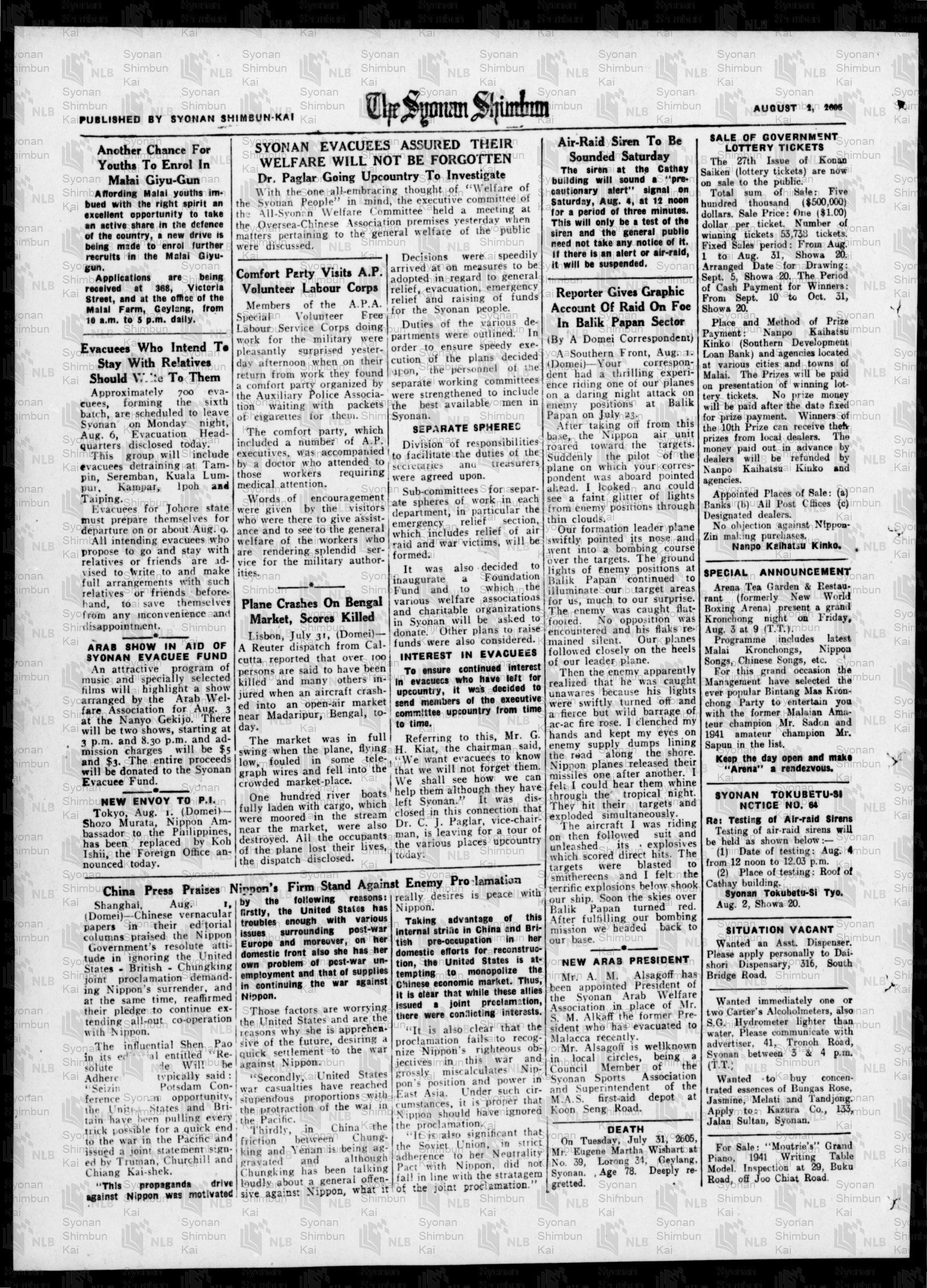 Page 2 of the Syonan Shimbun, 2 August 1945. The notice at top right, "Sale of Government Lottery Tickets", announces the 27th issue of Konan Saiken, to be drawn on 5 September. (Singapore Press Holdings, via NewspaperSG, National Library Board Singapore, public domain)
The lotteries went on to the end. On 1 June 1945 the 25th issue of Konan Saiken went on sale, now 500,000 tickets, still at $1 each, with 53,738 winning tickets. Beside it ran a second “relief lottery”, Engo Saiken, at $5 a ticket, sold at banks, theatres, the Great World and New World amusement parks, community associations and pawnshops. On 2 August the paper carried the notice for the 27th issue of Konan Saiken. The drawing was set for 5 September 1945, and prizes were to be paid between 10 September and 31 October by the Nanpo Kaihatsu Kinko, the Japanese development bank that issued the banana notes, with the warning that “no prize money will be paid after the date fixed”.
Japan surrendered on 15 August, and British troops landed back in Singapore on 5 September, the day the 27th draw was due. In September the British Military Administration declared banana money worthless, so even a prize that had been paid was paid in notes that no longer bought anything. The National Museum of Singapore, which holds several of the tickets, notes that many people who bought them reported that prizes were never paid, and that the money went to fund the war and the military administration. That account comes from the people who bought the tickets, and the published accounts of where the money went come from the administration itself, so neither can be fully checked today.
The Occupation's government lotteries
From the first million-dollar draw to the 27th monthly issue
Sources: Syonan Times and Syonan Shimbun, 1942-1945, via NewspaperSG; National Library Board.
View as table
| Date | Event |
|---|---|
| Feb 1942 | Singapore falls to Japan on 15 February 1942 and is renamed Syonan. |
| May 1942 | On 29 May the military administration announces a $1,000,000 lottery to raise revenue and absorb spending money. |
| Jun 1942 | On 25 June Chinese leaders hand over the $50 million demanded of the community. |
| Sep 1942 | On 10 September the million tickets are drawn at the old Victoria Theatre; the first prize is $100,000. |
| 1943 | A Malaya-wide government lottery, sold in monthly issues of 300,000 to 400,000 tickets at $1. |
| Jun 1945 | A second 'relief lottery' is on sale at $5 a ticket alongside the monthly Konan Saiken. |
| Jul 1945 | The 25th issue, 500,000 tickets, is drawn at the Kokaido on 5 July 1945. |
| Aug 1945 | Japan surrenders on 15 August 1945, while the 27th issue is on sale. |
| Sep 1945 | The 27th issue was due to be drawn on 5 September 1945, the day British troops returned. |
See 12 more photos of the lottery tickets, the Occupation’s banknotes and wartime Syonan →
Why it matters today: Syonan Syoken is a small part of the Occupation’s history, but it shows how a government lottery can serve more than one purpose at once. The administration said openly that it wanted to raise money and to soak up the cash in people’s hands, and it printed its good causes on every ticket, while the currency the prizes were paid in kept losing its value. Singapore Pools was set up in 1968 to give people a legal alternative to illegal gambling. Its surplus now goes to the Tote Board, a statutory board that funds charities and community projects and reports its grants publicly each year. The wartime lottery is a reminder of why that kind of public accounting matters when the proceeds of a lottery are said to go to good causes.
Sources
- The Syonan Times, 29 May 1942, “Million Dollar State Lottery In Syonan-to”, NewspaperSG
- The Syonan Times, 23 June 1942, page 3, NewspaperSG
- The Syonan Times, 1 July 1942, “Syonan Syoken: Government Lottery”, NewspaperSG
- The Syonan Times, 16 July 1942, “Syonan Syoken: No Tax On Prizes”, NewspaperSG
- The Syonan Times, 23 July 1942, page 2, NewspaperSG
- The Syonan Times, 5 September 1942, “Million Dollar Lottery: Draw Open To Public”, NewspaperSG
- The Syonan Times, 11 September 1942, page 1, NewspaperSG
- The Syonan Times, 11 September 1942, “Address By Zaimubu-tyo”, NewspaperSG
- The Syonan Times, 13 September 1942, page 1, NewspaperSG
- The Syonan Times, 15 September 1942, “Sikh Policeman Wins Second Prize In Syonan Syoken”, NewspaperSG
- The Syonan Times, 19 September 1942, “Lottery Winner’s Gift To Our Sick And Wounded”, NewspaperSG
- The Syonan Times, 3 October 1942, “Lottery Money Earmarked For Charity, Health”, NewspaperSG
- The Syonan Shimbun, 22 May 1943, “Lottery Draw Will Be Announced On Loud Speakers”, NewspaperSG
- The Syonan Shimbun, 5 June 1943, “Malacca Man Wins $51,000 Lottery Prizes”, NewspaperSG
- The Syonan Shimbun, 12 June 1943, “First-Prize Lottery Winner Gives $5,000 To Charity”, NewspaperSG
- The Syonan Shimbun, 31 July 1943, “More Konan Saiken Tickets Will Be Sold In Syonan”, NewspaperSG
- The Syonan Shimbun, 23 October 1943, NewspaperSG
- The Syonan Shimbun, 1 June 1945, NewspaperSG
- The Syonan Shimbun, 2 August 1945, page 2, NewspaperSG
- National Heritage Board, Roots: Photograph of a Japanese lottery ticket
- National Heritage Board, Roots: A $1 ‘Syonan Shoken’ lottery ticket
- Lee Geok Boi, “Wartime Victuals: Surviving the Japanese Occupation”, BiblioAsia (2019)
- Paul H. Kratoska, “Banana Money: Consequences of the Demonetization of Wartime Japanese Currency in British Malaya”, Journal of Southeast Asian Studies (1992)
- Wikipedia: Singapore Pools
- Tote Board
- Wikimedia Commons: JapLotteryTicket-SIN-Occupation SINMuseum 20171213 02.jpg
- Wikimedia Commons: Victoria Theatre and Victoria Memorial Hall - c 1930.jpg
- Wikimedia Commons: JapLotteryTicket-SIN-Occupation SINMuseum 20171213 04.jpg
- Wikimedia Commons: Ten dollar note issued by the Japanese Government during the occupation of Malaya, North Borneo, Sarawak and Brunei (1942, obverse).jpg
- Wikimedia Commons: JapLotteryTicket-SIN-Occupation SINMuseum 20171213 05.jpg
- Wikimedia Commons: JapLotteryTicket-SIN-Occupation SINMuseum 20171213 08.jpg
- Wikimedia Commons: JapLotteryTicket-SIN-Occupation SINMuseum 20171213 09.jpg
- Wikimedia Commons: JapLotteryTicket-SIN-Occupation SINMuseum 20171213 03.jpg
- Wikimedia Commons: One dollar note issued by the Japanese Government during the occupation of Malaya, North Borneo, Sarawak and Brunei (1942, obverse).jpg
- Wikimedia Commons: One hundred dollar note issued by the Japanese Government during the occupation of Malaya, North Borneo, Sarawak and Brunei (1944, obverse).jpg
- Wikimedia Commons: MAL-M10b-Malaya-Japanese Occupation-1000 Dollars ND (1945).jpg
- Wikimedia Commons: RationBook SIN 1942 20171213.jpg
- Wikimedia Commons: ST3February1943.jpg
- Wikimedia Commons: Street in Shonan.JPG
- Wikimedia Commons: SyonanSingapore.jpg
- Wikimedia Commons: 1942 Fall of Singapore for Japanese stamps.JPG


