Syonan Jinja: The Forest Shrine the Japanese Army Burned Down on the Day It Surrendered
On 15 August 1945 — the day Emperor Hirohito’s broadcast ended the Pacific War — retreating Japanese soldiers in Singapore did something specific with their last hours in charge: they set fire to their own shrine. Syonan Jinja, deep in the forest at MacRitchie Reservoir, had been built by thousands of Allied prisoners of war to be the grandest Shinto shrine anywhere in occupied Asia outside Tokyo. Its builders burned it rather than let the returning British see it standing.

Syonan Jinja under construction at MacRitchie Reservoir, photographed in October 1942, five months after the foundation stone was laid. (Photo: Mainichi Newspapers Company, from Showa History Vol. 10 / Wikimedia Commons, public domain)
Construction was announced within weeks of Singapore’s fall on 15 February 1942, once the British colony had been renamed Syonan-to, “Light of the South.” On 7 May 1942, Lieutenant-General Tomoyuki Yamashita — the “Tiger of Malaya,” who had accepted the British surrender himself ten weeks earlier — laid the shrine’s foundation stone in the reservoir forest. Major Yasuji Tamura, commander of the Japanese 5th Division’s engineers, designed it in the shinmei style used at Japan’s most sacred site, Ise Jingu, and dedicated it to Amaterasu Omikami, the sun goddess from whom the Japanese emperor claimed direct descent. The stated ambition was for Syonan Jinja to be the finest Shinto shrine anywhere in Japan’s wartime empire, second only to the Meiji Shrine in Tokyo. It had a wartime companion, too: the Syonan Chureito war memorial obelisk raised simultaneously at Bukit Batok for Japan’s own dead, which met an identical fate in 1945.
The labour came from almost 10,000 British and Australian prisoners of war, marched in from the internment camps at Changi, Sime Road and Adam Park. They cleared the forest, cut a 94-step granite staircase up the hillside, and built a wooden “Divine Bridge” across an arm of the reservoir to the shrine approach, along with a stone purification basin where visitors were meant to wash before entering.
Syonan Jinja was enshrined on 15 February 1943 — deliberately, the first anniversary of Singapore’s fall — in a ceremony presided over by Shigeo Odate, the city’s first Japanese-appointed mayor. For the two and a half years that followed, it hosted the occupation’s key ceremonial dates, New Year’s Day and the Emperor’s birthday among them, along with repeated public displays of loyalty in which local representatives and schoolchildren were marched across the Divine Bridge and up the granite steps to bow toward the shrine — a piece of State Shinto theology exported wholesale, tying obeisance at the shrine directly to reverence for a living emperor descended from its resident goddess.

Japanese army and navy officers visit Syonan Jinja, 1943. Local representatives and schoolchildren were compelled to attend similar ceremonies as a show of allegiance. (Photo: Cabinet Information Bureau / Wikimedia Commons, public domain)
That theology is exactly why the shrine didn’t survive the occupation’s end. As defeat became certain in August 1945, Japanese authorities in Singapore chose to destroy Syonan Jinja themselves — an act of sacrilege by their own religion’s standards — rather than let the returning British see it standing, or risk its desecration. On 15 August, the day of the formal surrender, they set the shrine’s wooden halls and gate ablaze. Only the granite and concrete — the steps, the platforms, the bridge foundations, the purification basin — proved too solid to burn.
Those remnants are still there, buried in the Central Catchment Nature Reserve forest near the junction of Lornie and Sime Roads, gazetted as a historic site by the National Heritage Board in 2002. There’s no marked trail and no public access; the terrain and the reservoir’s currents make the area unsafe to open up. What’s left exists today mostly as coordinates hikers trade online — a flight of moss-covered granite steps climbing toward nothing, in a forest most joggers on MacRitchie’s boardwalk pass without ever knowing it’s there.
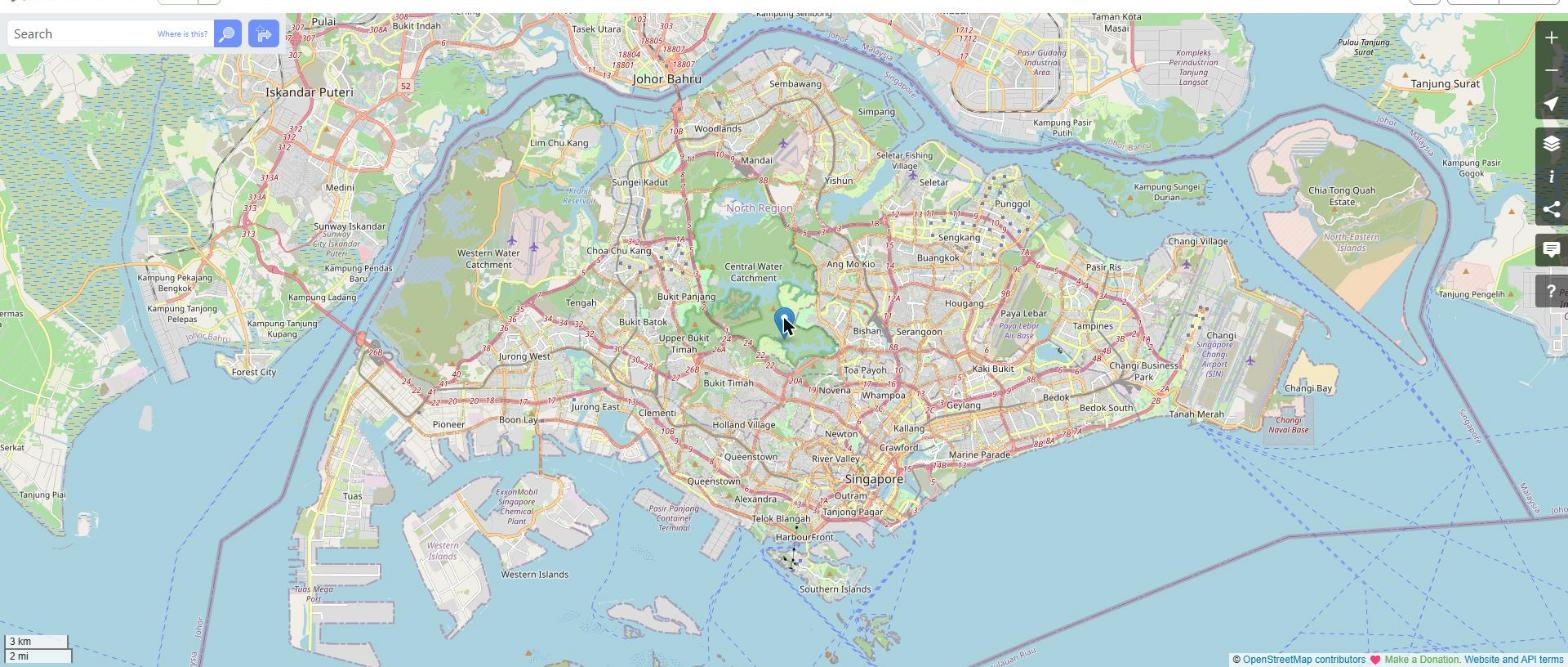
The Syonan Jinja ruins sit in forest near the middle of Singapore island, in the Central Water Catchment between MacRitchie and Lower Peirce reservoirs — geographically central, but unmarked and inaccessible. (Map data: © OpenStreetMap contributors)

What remains of the Divine Bridge leading to Syonan Jinja, photographed in MacRitchie Reservoir’s forest in 2022. (Photo: Wzhkevin / Wikimedia Commons, CC BY-SA 4.0)
See four more historical photos related to this post →
Where it fits in the bigger story: Singapore has preserved plenty of memorials to what the occupation cost its people — Kranji War Cemetery, the Civilian War Memorial, Reflections at Bukit Chandu — but the shrine built to compel the loyalty of the entire occupied population sits unmarked and off-limits in a reservoir forest, a monument to Japanese rule that even its own builders chose to erase before anyone else could.
Sources:
- Syonan Shrine — Wikipedia
- Syonan Jinja — Roots.gov.sg, National Heritage Board
- Syonan Jinja — Infopedia, National Library Board
- Exploring the Ruins of Syonan Jinja at MacRitchie Reservoir — Remember Singapore
- Syonan Jinja (Shinto Shrine at MacRitchie Reservoir) — My Mind is Rojak
- File:Shinto shrine in Shonan (Singapore) - 194210.jpg — Wikimedia Commons
- File:昭南神社-陸海将星の参拝.jpg — Wikimedia Commons
- File:Remains of Divine Bridge leading to Synonan Jinja at MacRitchie Reservoir, Singapore, 1 - 2022-07-02.jpg — Wikimedia Commons
- File:Remains of Divine Bridge leading to Synonan Jinja at MacRitchie Reservoir, Singapore, 2 - 2022-07-02.jpg — Wikimedia Commons
- File:Remains of Divine Bridge leading to Synonan Jinja at MacRitchie Reservoir, Singapore, 3 - 2022-07-02.jpg — Wikimedia Commons
- File:Syonan Shrine in Singapore, Djawa Baroe, Vol. 1, Iss. 11 (1943-06-01), p31.jpg — Wikimedia Commons
- File:昭南神社邮票(日治马来).jpg — Wikimedia Commons
- Syonan Jinja (node) — OpenStreetMap


