The Bank That Spent a Century Teaching Singapore to Save
For a couple of generations of Singaporean schoolchildren, the first bank account was a small book filled a little at a time with ten-cent stamps, bought at the school bookshop and pasted into printed rows of squares. The stamps, the passbook, the queue in the school hall on collection day all belonged to the Post Office Savings Bank, an institution whose entire purpose, from 1877 onward, was to get ordinary people into the habit of putting money aside.

A POSB branch inside a suburban shopping mall in Punggol. POSB still runs one of the largest branch networks in Singapore, concentrated in the housing estates. (Photo: Deoma12 / Wikimedia Commons, CC BY-SA 4.0)
A counter at the post office
The Post Office Savings Bank opened on 1 January 1877, set up by the colonial government of the Straits Settlements — Singapore, Penang and Malacca — and run across the counter of the General Post Office. It was modelled on Britain’s own Post Office Savings Bank, created in 1861 on the theory that a bank attached to the post office, with very low minimum deposits and a branch in every town, could reach the small savers that commercial banks had no interest in serving. Day-to-day operations sat with the Postmaster-General; policy was set by a group of trustees appointed by the Governor. In its first year the bank had 211 depositors and $19,864.90 on deposit, paying 5 per cent interest. By 1940 it held around 57,000 accounts and $14.3 million.

Raffles Place around 1910. The General Post Office, and with it the savings bank counter, stood at the seaward end of this square before moving into the Fullerton Building in 1928. (Photo: C. J. Kleingrothe, c. 1910, KITLV / Leiden University Library via Wikimedia Commons; public domain)
The war, and the 1949 split
 The cover of a Post Office Savings Bank passbook from the Federation of Malaya, the sibling institution to Singapore's own bank. The two were separated in 1949 from a common 1877 root, and the passbook design on either side was much the same. (Image: Lousysofa / Wikimedia Commons, public domain)
The Japanese occupation broke the thread. Depositors who had trusted their savings to the bank found the money largely out of reach, and the grievance outlasted the war. In August 1949 a letter to The Straits Times, headed “A Raw Deal For The Small Man,” argued that the small saver who had “kept his mite in the Post Office Savings Bank” through the occupation had been left to carry the loss.
The bank’s shape changed in 1949 as well. On 17 December 1948 the Federal Legislative Council in Kuala Lumpur passed the Post Office Savings Bank Ordinance, described by the Attorney-General as a measure to amalgamate the various post office savings banks of the Federation of Malaya into one. Singapore, by then a separate Crown Colony, was left with its own. The Morning Tribune recorded on 1 January 1949 that the ordinance “comes into force today.” From that point there were two institutions with a common origin — the Federation of Malaya’s and Singapore’s — linked for years by a two-way facility that let a depositor withdraw in either territory, an arrangement that finally ended in 1973.
The drift, and the reforms
Through the 1950s the Singapore bank grew steadily, from about $27 million in deposits in 1949 to roughly $58 million by 1955. Then it drifted. Between 1957 and 1966 deposits fell back to around $37 million, as inflation ate into the value of a savings account and commercial banks began courting the customers the post office bank had once had to itself. In 1966 the Finance Minister, Goh Keng Swee, appointed a committee to review the bank. The changes that followed were practical ones: withdrawal limits were raised from $200 every seven days to $500 every three, opening hours were extended, interest on deposits was made tax-free, and the bank began accepting passbook signatures in Chinese and other non-romanised scripts. New accounts rose sharply the next year.
Stamps in the classroom
 A 1945 National Savings poster from Britain. Singapore was inside the same imperial savings movement, and the post office savings bank was its local arm; the schools campaign of 1969 carried the idea into a new generation. (Image: National Savings Committee, London, 1945 / Imperial War Museums via Wikimedia Commons; public domain)
In 1968 the government instructed the bank to actively promote domestic saving, and in 1969 it took that instruction into the schools. The National School Savings Campaign gave every pupil a card printed with rows of squares. Ten-cent stamps bought at school were pasted in until the card was worth two dollars, at which point it was handed in and credited to a Post Office Savings Bank account. Within two years the campaign had reached full participation in primary schools. A relaunch in 1983 added the mascot most people now remember, Smiley the Squirrel.
The institution itself was reconstituted on 1 January 1972, when an Act of Parliament turned it from a government department into a statutory board — first under the Ministry of Communications, then, from 1974, under the Ministry of Finance. Its first chairman was Tan Chok Kian.
Where the savings went
What the bank did with the deposits was the point of the exercise. A savings bank of this kind pools a very large number of small balances and lends them, at low risk, to a single borrower — here, the government. POSB money went into Singapore Government securities, and from 1974, through a subsidiary called Credit POSB, into housing loans for buyers of Housing and Development Board flats. The bank built to teach thrift had become one of the quiet sources of finance for public housing.
The deposit base grew accordingly. It passed one million depositors and one billion dollars in 1976, and ten billion dollars in 1986.
Post Office Savings Bank of Singapore — total deposits, 1877–1998 (logarithmic scale)
View data as a table
| Year | Total deposits |
|---|---|
| 1877 | $19,865 |
| 1940 | $14.3 million |
| 1948 | $18.6 million |
| 1949 | $27.4 million |
| 1955 | $57.6 million |
| 1966 | $37.4 million |
| 1969 | $57.7 million |
| 1976 | $1.0 billion |
| 1986 | $10.0 billion |
| 1998 | $25.5 billion |
Deposits in current dollars. The Straits, Malayan and Singapore dollars were issued at par across the 1939 and 1967 currency changes, so the figures are shown as a single nominal series. Sources: annual reports of the Postmaster-General, the Department of Statistics yearbooks, contemporary press reports and POSB. Figures before 1949 are for the Straits Settlements / Singapore branch. The series ends at the November 1998 transfer to DBS Bank, after which POSB kept no separate balance sheet.
The bank on every corner
Part of the reason the bank could gather so much was that it was, physically, almost everywhere. Because savings ran through the post office, POSB had a counter wherever there was a post office — in the town centre, in the older shophouse districts, and, as public housing spread, in the void decks and neighbourhood centres of every new estate. It opened its first automated teller machine at its Newton branch in 1981 and, within a year, was announcing branches run by machines alone. By the late 1990s it operated more than 170 branches and over 950 ATMs, the largest such network in the country.
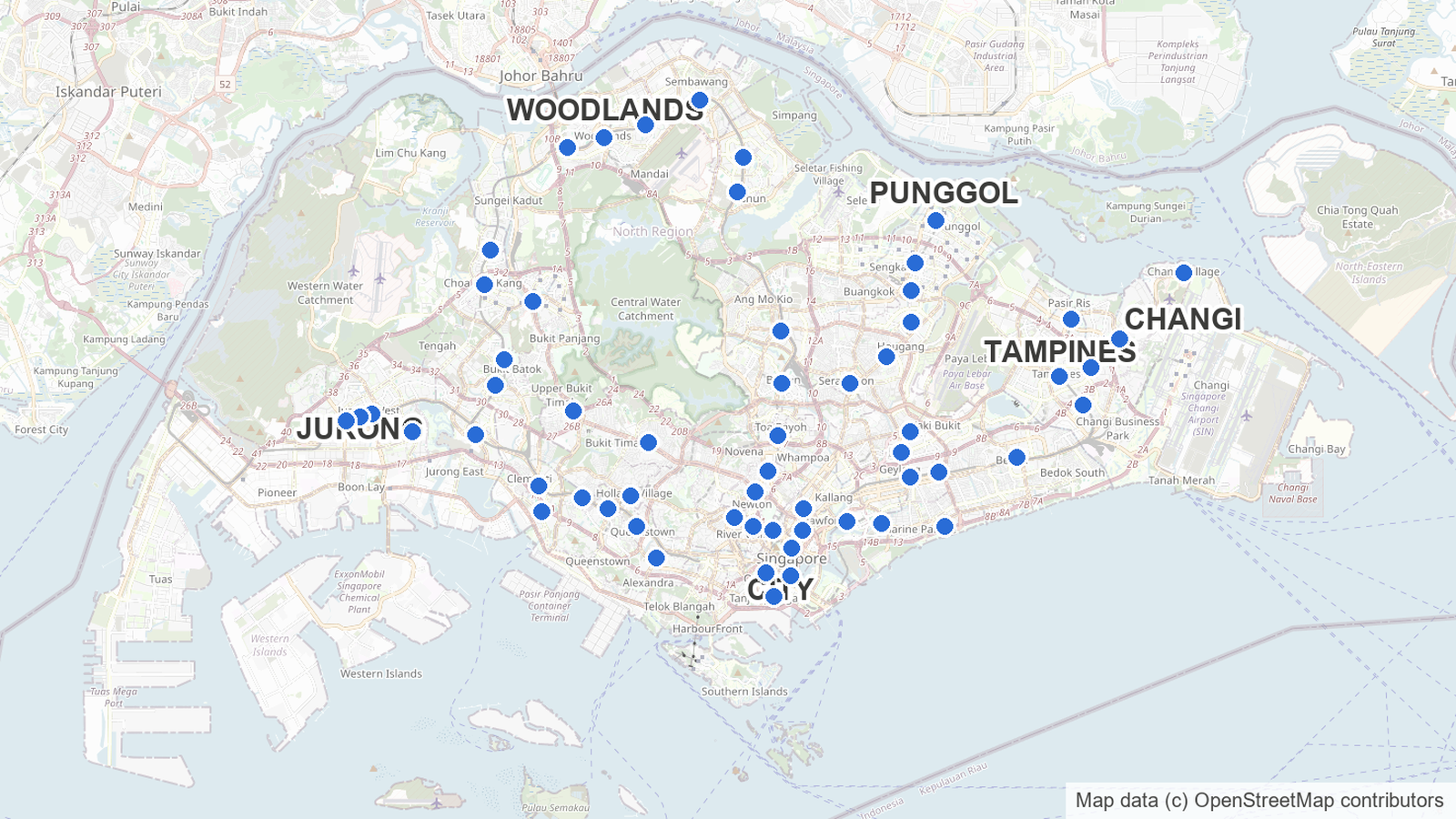
One marker for each neighbourhood in Singapore that has a POSB branch — about fifty in all, placed at the approximate centre of each rather than at a street address. The point is the spread: the network reaches into nearly every housing estate. (Map data © OpenStreetMap contributors)
POSBank, and then DBS
 The former POSB Bank Centre on Bras Basah Road, the bank's headquarters from 1983. It now houses the NTUC Trade Union House. (Photo: Deoma12 / Wikimedia Commons, CC BY-SA 4.0)
The bank was renamed POSBank in 1990. Eight years later it was absorbed. On 24 July 1998 the Finance Minister, Richard Hu, announced that DBS Bank would acquire POSBank for $1.6 billion; the transfer was completed on 16 November. At that point POSBank held about $25.5 billion in deposits and $26.9 billion in assets, with more than 3.3 million customers — in a country of about 3.9 million people. The government’s stated reasoning was that a combined bank would be better placed to compete with full commercial banks at home and abroad, part of a wider push to consolidate Singapore’s local banks into fewer, larger institutions.
The POSB name was kept. DBS runs it as its retail and heartland brand, still with the line it adopted in the 1990s, “Neighbours first, bankers second,” and still with the largest branch and ATM network in Singapore. The tax exemption on POSB deposit interest, one of the 1966 reforms, was phased out by the end of 2004.
See more photographs and archive references related to this post →
Where it fits in the bigger story: the habit of saving that Singapore is now known for was not purely a matter of culture. It was taught, deliberately and at scale, by a 121-year-old institution that reached into classrooms and void decks — and that most people under forty have only ever known as four letters on a bank branch that belongs to someone else.
Sources:
- Post Office Savings Bank (POSB) — Singapore Infopedia, National Library Board
- Establishment of the Post Office Savings Bank — NLB Singapore History
- National School Savings Campaign — Singapore Infopedia, National Library Board
- POSB Bank — Wikipedia
- “Neighbours first, bankers second: The POSB story” — DBS Bank heritage
- “DBS Bank to acquire POSBank” — DBS Bank news release, 24 July 1998
- “The Post Office Savings Bank” — The Singapore Daily Times, 13 November 1877 (NewspaperSG)
- “Report of the Postmaster-General for the Year 1876” — The Singapore Daily Times, 7 May 1877 (NewspaperSG)
- “Savings Banks To Be Amalgamated” — The Straits Times, 17 December 1948 (NewspaperSG)
- “Post Office Savings” — Morning Tribune, 1 January 1949 (NewspaperSG)
- “Post Office Savings Are Soaring” — The Straits Times, 17 February 1949 (NewspaperSG)
- “Malayans are saving more” — The Straits Times, 21 August 1949 (NewspaperSG)
- “A Raw Deal For The Small Man” — The Straits Times, 27 August 1949 (NewspaperSG)
- “End of Savings Bank two-way facility” — The Straits Times, 23 August 1973 (NewspaperSG)
- File:POSB Waterway Point branch.jpg — Wikimedia Commons
- File:KITLV - 79892 - Kleingrothe, C.J. - Medan - Raffles Place, Singapore - circa 1910.tif — Wikimedia Commons
- File:Federation of Malaya Post Office Savings Bank (POSB) Bankbook, Cover.png — Wikimedia Commons
- File:Plan Your Future - Save With a Plan Art.IWMPST16368.jpg — Wikimedia Commons
- File:NTUC Trade Union House.jpg — Wikimedia Commons
- OpenStreetMap — Singapore (base map tiles for the branch-location map; map data © OpenStreetMap contributors)
- File:The Fullerton Hotel, Singapore.jpg — Wikimedia Commons (gallery)
- File:Photographic Views of Singapore Plate 03 Raffles’ Square.jpg — Wikimedia Commons (gallery)
- File:Federation of Malaya Post Office Savings Bank (POSB) Bankbook, Inner Front Cover & First Page.png — Wikimedia Commons (gallery)
- File:Federation of Malaya Post Office Savings Bank (POSB) Bankbook, Last Page & Inner Back Cover.png — Wikimedia Commons (gallery)
- File:POSB Newton Branch.png — Wikimedia Commons (gallery)
- File:POSB Newton Branch Entrance.png — Wikimedia Commons (gallery)
- File:POSB Taman Warna.JPG — Wikimedia Commons (gallery)
- File:POSB Bugis MRT Station ATM.jpg — Wikimedia Commons (gallery)


