The $50 Million 'Gift' of 1942
On 25 June 1942, four months into the Japanese Occupation, the 72-year-old Lim Boon Keng led a delegation of Chinese community leaders from Singapore and Malaya to present a cheque for $50 million to General Tomoyuki Yamashita, the commander of the army that had taken the island. The next day the Syonan Times reported it as a “voluntary gift” from the Chinese, made to mark “their loyalty, sincerity and co-operation.” The money had in fact been demanded of them, under a levy that fell on every Chinese household and business of means, and when the community could not raise all of it, close to half was borrowed from a Japanese bank.

General Tomoyuki Yamashita (centre), commander of Japan’s 25th Army, in Singapore in 1942. (Unknown photographer, public domain, via Wikimedia Commons)
Why it was demanded
The Chinese of Singapore and Malaya had spent the years before the war raising money for China’s fight against Japan. Relief funds led by the rubber magnate Tan Kah Kee had collected donations from rich and poor alike, and in 1939 some 3,200 young volunteers from the region had gone to drive lorries on the Burma Road, as told in an earlier post on the Nanyang volunteers. When Singapore fell on 15 February 1942, the Japanese military treated the Chinese community as hostile. In the Sook Ching screening that followed, Chinese men were rounded up and many thousands of them were killed.
In the middle of this, a Japanese civilian official, Mamoru Shinozaki, brought together a group of Chinese leaders who had stayed behind. On 2 March 1942 they formed the Oversea Chinese Association at the Chinese Chamber of Commerce building on Hill Street. Lim Boon Keng, a doctor, reformer and the former president of Amoy University in China, was made its chairman, with the businessman S. Q. Wong as vice-chairman and Shinozaki as its adviser. The association was presented as a body that would speak for the community to its new rulers. Its first large task was to raise money for them. The military administration called on the Chinese to give $50 million, presented as an atonement for their support of China, with $10 million to come from Singapore and $40 million from the rest of Malaya.
Raising the money
The deadline was first set for 20 April, then moved to 20 May and finally to 25 June. To share out the burden, the association set a levy of 8 per cent on the property of every Chinese person whose property was worth more than $3,000, and 5 per cent on the assets of Chinese-owned companies. Lim Boon Keng himself, according to an article in the National Library’s BiblioAsia journal, was assessed at $2,200. A Malaya-wide body, the Malayan Overseas Chinese General Association, was set up on 6 June to coordinate the collection across the peninsula.
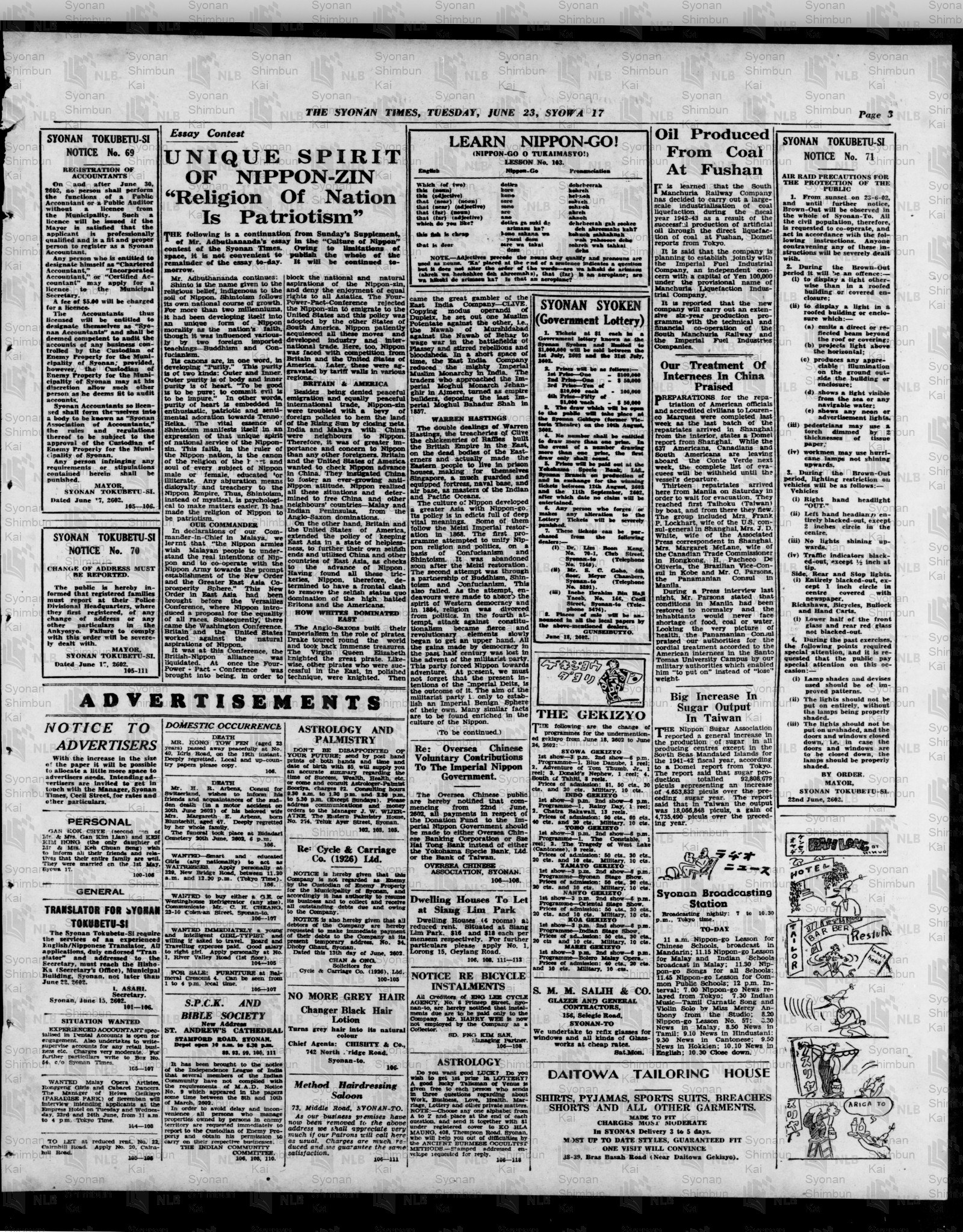 Page 3 of the Syonan Times, 23 June 1942. The notice in the centre columns, "Re: Oversea Chinese Voluntary Contributions To The Imperial Nippon Government", tells contributors where to pay. (Singapore Press Holdings, via NewspaperSG, National Library Board Singapore, public domain)
Collecting the levy in a country that had just been invaded proved hard, which is why the deadline kept moving. By 20 June, five days before the final deadline, about $28 million had been raised. Two days later, on 23 June, a notice in the Syonan Times told contributors they could still pay at the Oversea-Chinese Banking Corporation or the Sze Hai Tong Bank.
The loan
To make up the remaining $22 million, the association borrowed it from the Yokohama Specie Bank, Japan’s main foreign-exchange bank, which had reopened in Singapore in March in the building of the interned Hongkong and Shanghai Bank (see the earlier post on the Yokohama Specie Bank). According to BiblioAsia, it was a secured loan at 6 per cent interest, to be repaid within a year. In effect, the Chinese community paid part of the “gift” to the Japanese government with money lent to it by a Japanese bank, and then owed that bank the money with interest.
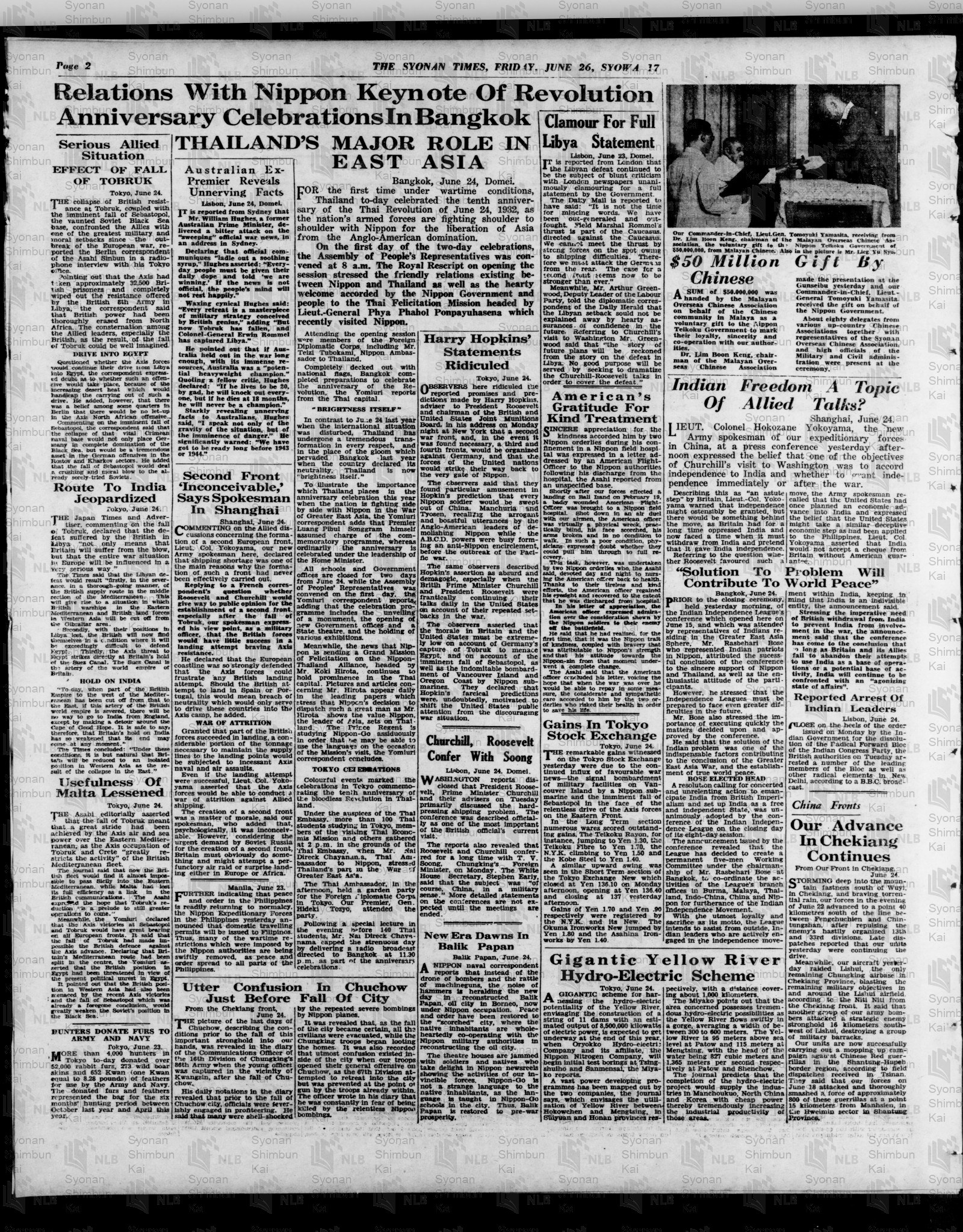 Page 2 of the Syonan Times, 26 June 1942, reporting the "$50 Million Gift By Chinese". The photograph at top right shows Yamashita receiving the cheque from Lim Boon Keng. (Singapore Press Holdings, via NewspaperSG, National Library Board Singapore, public domain)
The cheque was handed over on 25 June. The Syonan Times of the next day carried the story on page 2 under the headline “$50 Million Gift By Chinese”, with a photograph of Yamashita receiving the cheque from Lim Boon Keng. The report described the money as a voluntary gift. It said nothing of the levy, the extended deadlines or the loan.
What $50 million meant
To give a sense of scale, the National Library Board’s account of the Oversea Chinese Association notes that all the currency in circulation in Malaya at the time, including the reserves held by banks, came to about $220 million. The sum demanded from one community was close to a quarter of that.
The $50 million against all the money in Malaya
Millions of Straits dollars, 1942
Source: National Library Board, Infopedia, "Oversea Chinese Association". Currency figure includes reserves held by banks.
View as table
| Row | Part | Detail |
|---|---|---|
| All currency in Malaya | $220m | About $220 million of currency in circulation in Malaya, including reserves held by banks |
| Sum demanded | Singapore $10m | $10 million from the Chinese in Singapore |
| Sum demanded | Rest of Malaya $40m | $40 million from the Chinese in the rest of Malaya |
| How it was paid | Raised $28m | $28 million raised by 20 June 1942, after three extensions |
| How it was paid | Borrowed $22m | $22 million borrowed from the Yokohama Specie Bank at 6 per cent |
 A one-dollar note issued by the Japanese government for Malaya in 1942, front and back. (National Museum of American History, public domain, via Wikimedia Commons)
At the same time, the Japanese authorities were bringing in their own currency for occupied Malaya, issued at first at par with the Straits dollar. Over the next three years the military administration printed so much of it that its value collapsed, as described in the post on banana money. In the middle of 1942 that collapse still lay ahead, so the $50 million was a heavy sum in real terms.
Afterwards
 Lim Boon Keng in the 1930s. (Lee Brothers Studio, public domain, via Wikimedia Commons)
What became of the $22 million loan is not recorded in any of the sources consulted for this post. The Yokohama Specie Bank itself was closed after Japan’s surrender in 1945, and its business passed to a successor, the Bank of Tokyo.
The men who led the association lived with the episode for the rest of their lives. After the war, some in the community saw the association as having worked for the Japanese, while others regarded its leaders as hostages who had done what they could to protect the community under threat. Lim Boon Keng, who had been one of the best-known Chinese public figures in Singapore before the war, was said to have drunk heavily during the Occupation. He lived quietly after 1945 and died on 1 January 1957. The association’s secretary, Tan Yeok Seong, published his own account of how the money was raised in the Journal of the South Seas Society in 1946.
Shinozaki was a witness at the war crimes trials in Singapore and was sent back to Japan in 1948. In his memoir, published in English in 1975 as “Syonan—My Story”, he wrote that the association and the safety passes he issued, which became known as “Good Citizen’s Tickets”, saved many lives. Historians have generally read the memoir with caution, since it presents its author in a very favourable light.
Another $50 million
Two decades later, the same figure appeared again. After mass graves of Occupation victims were found around Singapore in 1962, the community pressed Japan to pay what came to be called a “blood debt”. On 25 October 1966, the governments of Singapore and Japan agreed on a settlement of $50 million, half as a grant and half as a loan, as told in the post on the Civilian War Memorial. The memorial on Beach Road, unveiled in February 1967, holds the remains recovered from those graves.

The Civilian War Memorial on Beach Road, which holds the remains of victims of the Occupation, in 2015. (CEphoto, Uwe Aranas, CC BY-SA 3.0, via Wikimedia Commons)
The two sums were alike in size but were arrived at in very different ways. The first was set by an occupying army, collected from a community under threat and partly paid with borrowed money. The second was negotiated and agreed between two sovereign governments.
See 13 more historical photos related to this post →
Why it matters today: The $50 million “gift” is remembered far less than the Sook Ching that came before it, yet it shows how the Occupation reached into almost every Chinese household of means in Singapore and Malaya, and how a demand made under threat could be recorded in the newspapers of the day as a voluntary act.
Sources
- Oversea Chinese Association, Singapore Infopedia, National Library Board
- The Singapore Chinese Community During the Japanese Occupation, BiblioAsia, National Library Board, 2022
- Of Towchangs and the “Republic Beard”: Dr Lim Boon Keng’s Life and Achievements, BiblioAsia, National Library Board, 2007
- Operation Sook Ching, Singapore Infopedia, National Library Board
- “Blood debt” rally is held at City Hall, Singapore History, National Library Board
- The Civilian War Memorial, BiblioAsia, National Library Board, 2011
- Mamoru Shinozaki, Wikipedia
- Lim Boon Keng, Wikipedia
- Yokohama Specie Bank, Wikipedia
- Japan–Singapore relations, Wikipedia
- The Syonan Times, 23 June 1942, page 3, NewspaperSG
- The Syonan Times, 26 June 1942, page 2, “$50 Million Gift By Chinese”, NewspaperSG
- File:Yamashita_e_Suzuki.jpg, Wikimedia Commons
- File:MAL-M5c-Malaya-Japanese_Occupation-One_Dollar_ND_(1942).jpg, Wikimedia Commons
- File:Lim_Boon_Keng,_1930s.jpg, Wikimedia Commons
- File:Singapore_Civilian-War-Memorial-01.jpg, Wikimedia Commons
- File:林文慶.jpg, Wikimedia Commons (gallery)
- File:Gravestone_of_Lim_Boon_Keng_and_Grace_Pek_Ha_Yin,Bidadari_Garden,_Singapore-_20121008.jpg, Wikimedia Commons (gallery)
- File:Singapore_Chinese_Chamber_of_Commerce_&_Industry_Building,_Aug_06.JPG, Wikimedia Commons (gallery)
- File:Yamashita_Tomoyuki.jpg, Wikimedia Commons (gallery)
- File:Tomoyuki_yamashita_malaya.png, Wikimedia Commons (gallery)
- File:1942_Fall_of_Singapore_for_Japanese_stamps.JPG, Wikimedia Commons (gallery)
- File:SyonanSingapore.jpg, Wikimedia Commons (gallery)
- File:Commemoration_of_anniversary_of_occupation_in_Asia_Raya_theatre,Singapore(Syonan),Djawa_Baroe,_Vol._1,_Iss._5(1943-03-01),_p31.jpg, Wikimedia Commons (gallery)
- File:’Celebration’of_Japanese_victory_in_Singapore(Syonan),Djawa_Baroe,_Vol._1,_Iss._7(1943-04-01),_p28.jpg, Wikimedia Commons (gallery)
- File:MAL-M6c-Malaya-Japanese_Occupation-Five_Dollars_ND_(1942).jpg, Wikimedia Commons (gallery)
- File:MAL-M8b-Malaya-Japanese_Occupation-100Dollars_ND(1944).jpg, Wikimedia Commons (gallery)
- File:MAL-M10b-Malaya-Japanese_Occupation-1000Dollars_ND(1945).jpg, Wikimedia Commons (gallery)
- File:War_crimes_trials_at_Singapore.jpg, Wikimedia Commons (gallery)


