The Yokohama Specie Bank: Japan's Bank in Prewar Singapore
On 20 March 1942, five weeks after the British surrender, the Yokohama Specie Bank reopened for business in Singapore, now renamed Syonan. It did not go back to its own office in Meyer Chambers. A notice in the Syonan Shimbun gave its new address as the “Late Hongkong and Shanghai Banking Corp.”, the building of the British bank whose staff had just been interned. The Yokohama Specie Bank had been in Singapore since 1916, financing the colony’s trade with Japan from a corner of Raffles Place, and for most of that time it was simply one of the foreign exchange banks in the square. Its story shows how closely a bank could be tied to the fortunes of its government.

Collyer Quay around 1910. During the Occupation the Yokohama Specie Bank worked from 21 Collyer Quay, in the former Hongkong and Shanghai Bank building. (C. J. Kleingrothe, KITLV 79887, public domain, via Wikimedia Commons)
Japan’s exchange bank
The Yokohama Specie Bank was founded in Yokohama in 1880 and opened offices in New York that year and in London the next. Its name came from specie, the silver coin then used to settle payments between traders. It was a quasi-governmental bank that acted as the Japanese government’s financial agent abroad, and its business was foreign exchange: financing Japan’s imports and exports. By the 1920s it handled nearly half of the foreign exchange for Japan’s trade, and by 1929 it had 37 offices outside Japan and its colonies.

The bank’s head office in Yokohama after the Great Kanto Earthquake of 1923. The building survived and is now the Kanagawa Prefectural Museum of Cultural History. (Unknown photographer, public domain, via Wikimedia Commons)
An agency on Kling Street, 1916
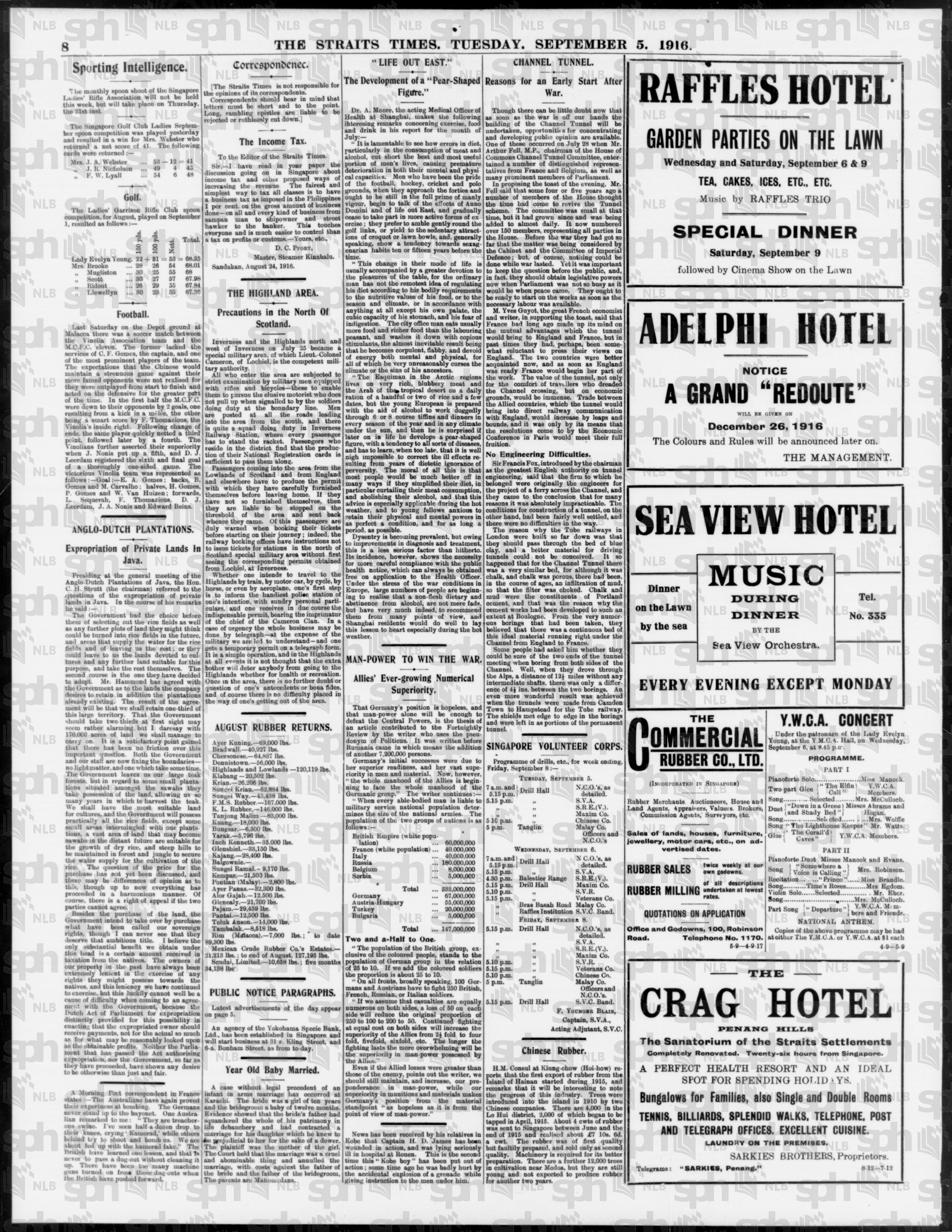 Page 8 of The Straits Times, 5 September 1916. The notice of the bank's new Singapore agency is under "Public Notice Paragraphs", in the second column. (Singapore Press Holdings, via NewspaperSG, National Library Board Singapore, public domain)
The Straits Times announced the bank’s arrival in a single sentence on 5 September 1916: “An agency of the Yokohama Specie Bank, Ltd., has been established in Singapore and will start business at 31-a, Kling Street, and 6-a, Bonham Street, as from to-day.” The address was the Bonham Building, at the corner facing Raffles Place. Kling Street was renamed Chulia Street in 1922, and in 1935 the same address, 31-A Chulia Street, became the first office of the United Chinese Bank, today’s United Overseas Bank, which is the subject of an earlier post.
The bank arrived in the middle of the First World War. Its Singapore business was the same as everywhere else: financing trade with Japan for the Japanese merchants, shipping lines and companies in the colony, alongside the British, Dutch and American exchange banks around Raffles Place.

The Bonham Building, at the corner of Chulia Street and Bonham Street, on a postcard of 1907. The Yokohama Specie Bank had its Singapore office here from 1916 to 1933. (Unknown photographer, public domain, via Wikimedia Commons)
Meyer Chambers, 1933
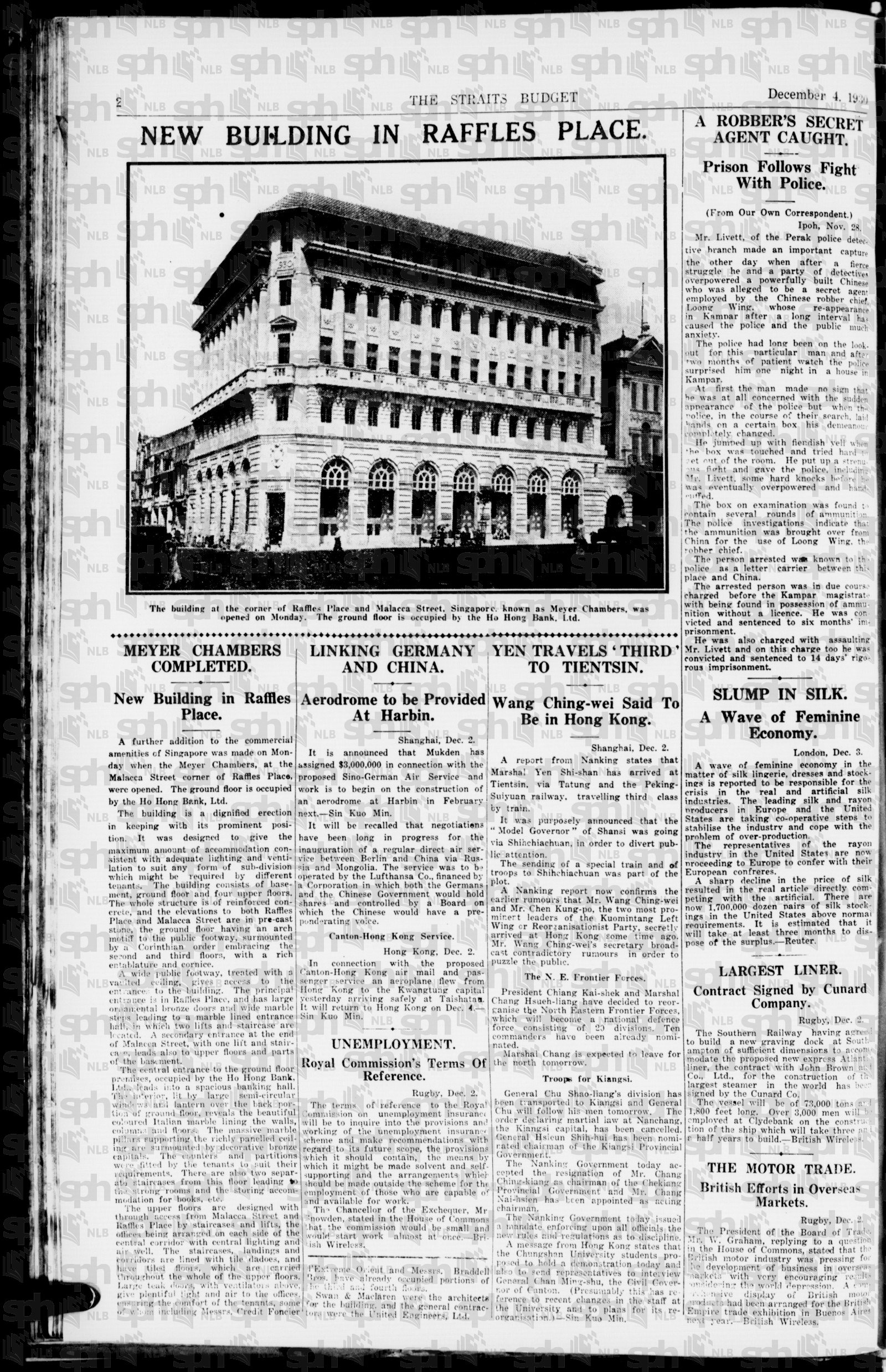 Page 2 of The Straits Budget, 4 December 1930: "New Building in Raffles Place," with a photograph of the newly completed Meyer Chambers. (Singapore Press Holdings, via NewspaperSG, National Library Board Singapore, public domain)
The branch’s managers were posted from the bank’s other offices and moved on after a few years. In 1927 the bank sent Mr Nakamura, the sub-manager of its New York branch, to replace Jukichi Okada, who had been transferred to Surabaya, and in 1930 H. Unagami took over. In September 1931 Unagami spoke to the Rotary Club of Singapore about Japan’s economic crisis and its efforts to stay on the gold standard.
On 3 April 1933 the bank moved out of the Bonham Building to Meyer Chambers, a new five-storey building at the corner of Raffles Place and Malacca Street, completed in December 1930. Its advertisements in the 1930s gave its capital as 100 million yen, fully paid up, and listed branches from Alexandria and Bombay to Hamburg, Los Angeles and Paris, with the Singapore branch at “Meyer Chambers, Raffles Place.”
The freeze and the war, 1941
In July 1941 Britain froze Japanese assets. In August the Straits Times reported that only “a few thousand sterling” of the frozen funds would be available to the Japanese for trade, against a normal peacetime Anglo-Japanese trade of about £7 million.
On 8 December 1941, as Japanese forces landed in Malaya, the colonial authorities in Singapore arrested Japanese residents of the colony. According to a 2021 study by the historians Christine de Matos and Rowena Ward, about 2,700 civilians from across British South and South-East Asia, most of them from Singapore and Malaya, were shipped to internment camps in India, at the Purana Qila in New Delhi and later at Deoli, where many stayed until 1946.
Syonan, 1942–1945
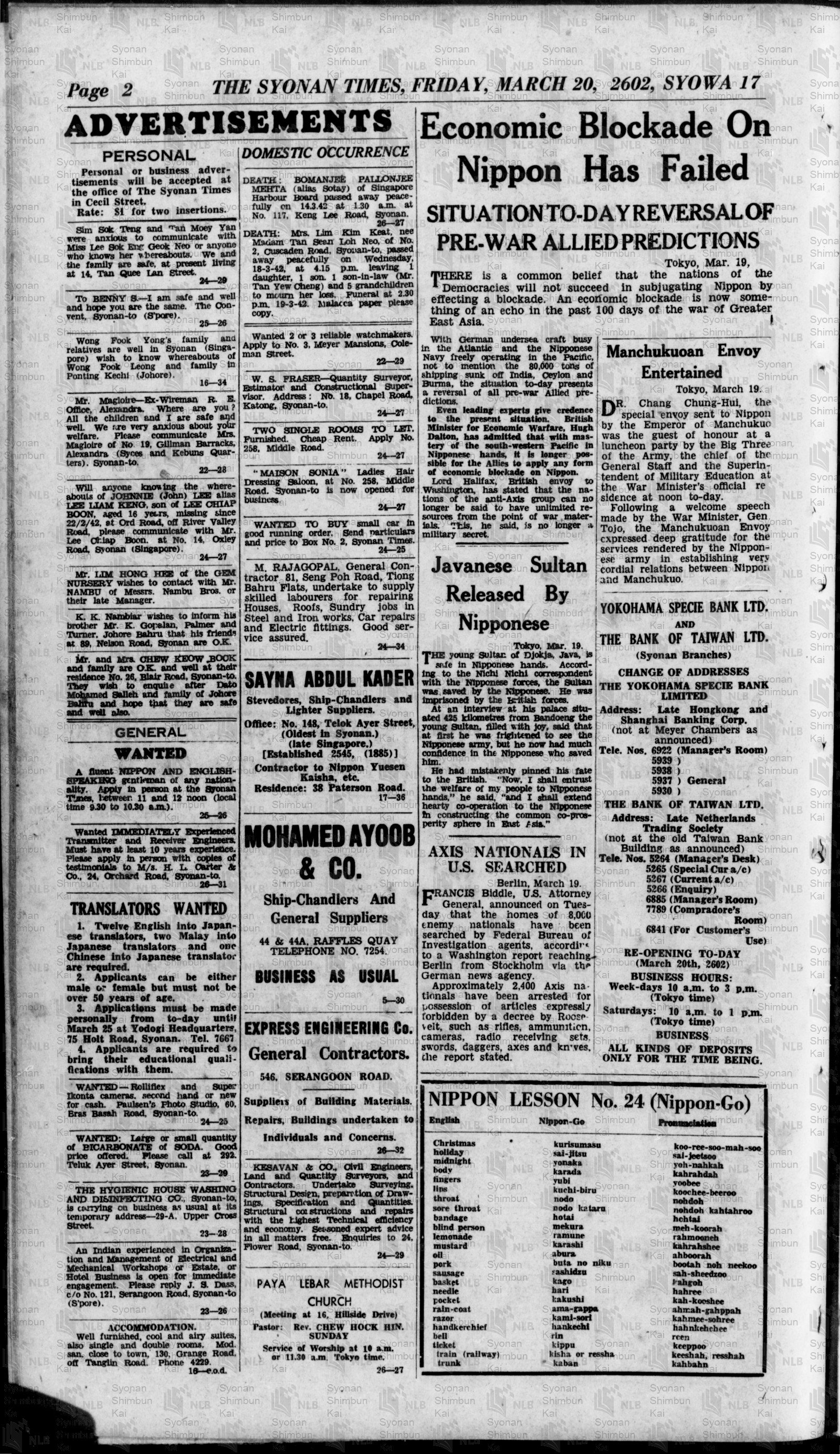 Page 2 of The Syonan Times, 20 March 1942. The notice of the Yokohama Specie Bank and the Bank of Taiwan, in the right-hand column, gives their new addresses and announces "Re-opening to-day." (The Syonan Shimbun, via NewspaperSG, National Library Board Singapore, public domain)
Singapore surrendered on 15 February 1942. A month later, on 17 March, the Syonan Shimbun announced that the Yokohama Specie Bank and the Bank of Taiwan, another Japanese bank, would reopen on 20 March “at their former buildings in Raffles Place”, working from 10 a.m. to 3 p.m. Tokyo time. On the day itself, a notice changed the plan. The Yokohama Specie Bank would be at the former Hongkong and Shanghai Banking Corporation, “not at Meyer Chambers as announced”, and the Bank of Taiwan at the former Netherlands Trading Society.
By early 1943 the bank’s advertisements gave its address as 21 Collyer Quay, Syonan, with S. Mutoh as manager, and listed its “branches in the Southern Regions”: twelve in Malaya, from Penang and Ipoh to Kota Bahru and Kuala Trengganu, ten in Sumatra, six in Borneo, and offices in Burma, Java, the Philippines, Thailand and French Indochina. In November 1942 the military administration named it as one of four banks handling the exchange of Malayan dollars and Dutch guilders, alongside the Southern Regions Development Bank, which issued the occupation currency. That currency, the “banana money”, is the subject of another post.
The bank also handled the money left behind by the British banks. In September 1944 the military administration’s notice No. 52 ordered a partial repayment to depositors of the “enemy banks”, provided they were not themselves enemy nationals. The Yokohama Specie Bank was to pay the depositors of the Hongkong and Shanghai Bank, the Chartered Bank, the Mercantile Bank, Thomas Cook and American Express. Deposits below $100 would be paid in full, and larger deposits would be paid 100 per cent up to $100 and 20 per cent of the rest.

Staff of the Yokohama Specie Bank’s branch at Api (Jesselton, now Kota Kinabalu) in North Borneo, photographed on 22 September 1942. The branch was in the old post office building. (Japanese government, public domain, via Wikimedia Commons)
Four addresses in forty years
The chart shows where the bank’s Singapore office was in each period, and when its successor came back.
Where the bank was in Singapore, 1916 to 1957
The Yokohama Specie Bank's Singapore office in each period, and its successor's return
Sources: The Straits Times, 5 September 1916 and 20 January 1957; Singapore Free Press, 1 April 1933 (via Wikipedia, "Bonham Building"); The Syonan Shimbun, 20 March 1942 and 11 February 1943.
View as table
| Office | From | To |
|---|---|---|
| Bonham Building (31-A Kling Street and 6-A Bonham Street) | 5 September 1916 | 3 April 1933 |
| Meyer Chambers, Raffles Place | 3 April 1933 | December 1941 |
| 21 Collyer Quay (former Hongkong and Shanghai Bank) | 20 March 1942 | 1945 |
| Bank of Tokyo, Phillip Street | 19 January 1957 | — |
Closed, and back as the Bank of Tokyo
After Japan’s surrender in 1945, the Yokohama Specie Bank was closed by the American occupation authorities in Japan, and in July 1947 the Singapore Free Press reported that the Japanese government had designated it a “closed institution” to be liquidated. Its business passed to a new bank, the Bank of Tokyo.
It took more than a decade for a Japanese bank to return to Singapore. In March 1955 the Bank of Tokyo’s representative, Yasuo Ishii, had been in the colony for three months studying whether a branch could be opened, and the Singapore Free Press reported that there were “difficulties”. In August 1956 the Straits Times reported that the bank hoped to recruit some of its staff from local employees of the Yokohama Specie Bank’s prewar branch. The branch opened in Phillip Street on 19 January 1957, after two and a half years of negotiation, with more than 500 guests at the reception. The Straits Times noted that it was the first Japanese bank to reopen in Malaya since the Liberation.

A ten-dollar note issued by the Japanese government during the Occupation of Malaya and Borneo, printed with a banana tree. The Yokohama Specie Bank was one of the banks that exchanged the old currencies for it. (Scanned by Jacklee, public domain, via Wikimedia Commons)
What changed
The Bank of Tokyo later merged into what is now MUFG Bank, which traces its international business back to the Yokohama Specie Bank. Japanese banks are again a familiar part of Singapore’s financial centre, alongside banks from many other countries. Before the war the Yokohama Specie Bank was an exchange bank serving its country’s trade, and during the Occupation it became part of the military administration’s financial system. Today a foreign bank in Singapore is licensed and supervised by the Monetary Authority of Singapore, whatever its country of origin.
See more historical photos related to this post →
Where it fits in the bigger story: For a quarter of a century the Yokohama Specie Bank was one of the foreign banks of Raffles Place, a few doors from the British exchange banks, financing Singapore’s trade with Japan. Its story follows the arc of Japan’s relationship with the colony: it arrived with the trade of the First World War, was frozen out in 1941, ran the British banks’ leftover deposits during the Occupation, and came back in 1957 under another name.
Sources
- Yokohama Specie Bank, Wikipedia
- Bonham Building, Wikipedia
- “The Bank of Tokyo, Ltd. (1880),” MUFG Bank
- Christine de Matos and Rowena Ward, “Forgotten Forced Migrants of War: Civilian Internment of Japanese in British India, 1941–6,” Journal of Contemporary History (2021)
- “Public Notice Paragraphs,” The Straits Times, 5 September 1916, page 8, NewspaperSG
- “New Manager of Yokohama Specie Bank Appointed,” Singapore Free Press, 19 May 1927, NewspaperSG
- “Local Appointment,” The Straits Times, 29 March 1930, NewspaperSG
- “New Building in Raffles Place,” The Straits Budget, 4 December 1930, page 2, NewspaperSG
- “Story of Japan’s Crisis: Rotary Address,” Singapore Free Press, 10 September 1931, NewspaperSG
- “The Yokohama Specie Bank, Limited” (advertisement), The Malaya Tribune, 10 March 1936, page 5, NewspaperSG
- “Strong Attack on Suggestion of Barter Pact With Japan,” The Straits Times, 21 August 1941, NewspaperSG
- “Reopening of Banks,” The Syonan Times, 17 March 1942, page 4, NewspaperSG
- “Yokohama Specie Bank Ltd. and the Bank of Taiwan Ltd.: Change of Addresses” (notice), The Syonan Times, 20 March 1942, page 2, NewspaperSG
- “Arrangements for Currency Exchange,” The Syonan Shimbun, 4 November 1942, NewspaperSG
- “Yokohama Specie Bank, Syonan Branch” (advertisement), The Syonan Shimbun, 11 February 1943, page 2, NewspaperSG
- “Malai Kokuji No. 52,” The Syonan Shimbun, 29 September 1944, page 2, NewspaperSG
- “Y.S.B. Is Liquidated,” The Singapore Free Press, 1 July 1947, NewspaperSG
- “Bank of Tokio Seeking Branch in Singapore,” The Singapore Free Press, 5 March 1955, NewspaperSG
- “Bank of Tokyo Looks for Staff,” The Straits Times, 6 August 1956, NewspaperSG
- “Japanese Bank Opens Branch in Colony,” The Straits Times, 20 January 1957, NewspaperSG
- “Japan Bank Opens Branch,” The Straits Times, 22 January 1957, NewspaperSG
- File:KITLV - 79887 - Kleingrothe, C.J. - Medan - Collyer Quay, Quay in Singapore - circa 1910.tif, Wikimedia Commons
- File:Yokohama shokin bank Kanto Daishinsai.jpg, Wikimedia Commons
- File:Bonham Building 1907.jpg, Wikimedia Commons
- File:Yokohama Specie Bank branch in Api (Jesselton).jpg, Wikimedia Commons
- File:Ten dollar note issued by the Japanese Government during the occupation of Malaya, North Borneo, Sarawak and Brunei (1942, obverse).jpg, Wikimedia Commons
- File:Photographic Views of Singapore Plate 05 Hongkong and Shanghai Bank.jpg, Wikimedia Commons (gallery)
- File:Collyer Quay, Singapore 1900s.jpg, Wikimedia Commons (gallery)
- File:KITLV A1112 - Haven van Singapore, KITLV 142600.tiff, Wikimedia Commons (gallery)
- File:Yokohama Specie Bank 03.jpg, Wikimedia Commons (gallery)
- File:Shookin Bank Nagasaki.jpg, Wikimedia Commons (gallery)
- File:Wooden Cash Box of Yokohama Specie Bank Ltd., Hankow Branch in the Early 20th Century.jpg, Wikimedia Commons (gallery)
- File:Honolulu-Yokohama-Specie-Bank.JPG, Wikimedia Commons (gallery)
- File:Yokohama Specie Bank during World War II.JPG, Wikimedia Commons (gallery)
- File:MAL-M5c-Malaya-Japanese Occupation-One Dollar ND (1942).jpg, Wikimedia Commons (gallery)
- File:Kanagawa Prefectural Museum of Cultural History 2009.jpg, Wikimedia Commons (gallery)
- File:Old Yokohama Bank-Bund.jpg, Wikimedia Commons (gallery)


