The Nanyang Volunteer Drivers of the Burma Road, 1939
On 18 February 1939, the Nanyang Siang Pau told its readers that a group of Singapore’s motor drivers would leave that day “to return to the homeland and serve.” They were the first 80 of about 3,200 young men, and a few women, who left Singapore, Malaya and the rest of South-East Asia that year to drive and repair the lorries on the Burma Road, the mountain route that had become China’s last open supply line in its war with Japan. Around a third of them died. Their story is usually told as one of loyalty to China. It is also the starting point of a change in where the Chinese of Singapore thought of as home.

Lorries on the Yunnan-Burma Road in 1940. (Xiao Qian and Kuang Guang, public domain, via Wikimedia Commons)
A war that reached the Nanyang
When fighting broke out between China and Japan in July 1937, the Chinese of the Nanyang, the Chinese name for South-East Asia, responded with money. In Singapore, community leaders led by the rubber magnate Tan Kah Kee set up the Singapore China Relief Fund Committee on 15 August 1937. According to the National Archives of Singapore, its leadership cut across the dialect groups, and rich and poor gave, from thousands of dollars to a few cents, while students sold paper flowers and drama troupes put on shows to raise funds. In October 1938, delegates from across the region met at the Chinese High School in Singapore and formed a region-wide federation of relief funds, with Tan Kah Kee as its chairman.
 Tan Kah Kee (left) with Lee Kong Chian and Tan Lark Sye in about 1946. (Tan Kah Kee Memorial Museum, public domain, via Wikimedia Commons)
By then Japan held most of China’s coast. Shanghai and Amoy had fallen, and the loss of Canton in October 1938 cut the last major sea route. China’s government turned to an overland route: the Burma Road, built in about nine months by labourers in Yunnan, which ran 1,146 kilometres through the mountains from the railhead at Lashio in Burma to Kunming. Supplies shipped to Rangoon could travel north by rail to Lashio and then by lorry into China. What China lacked were enough trained drivers and mechanics to run the convoys, and it asked Tan Kah Kee to find them.
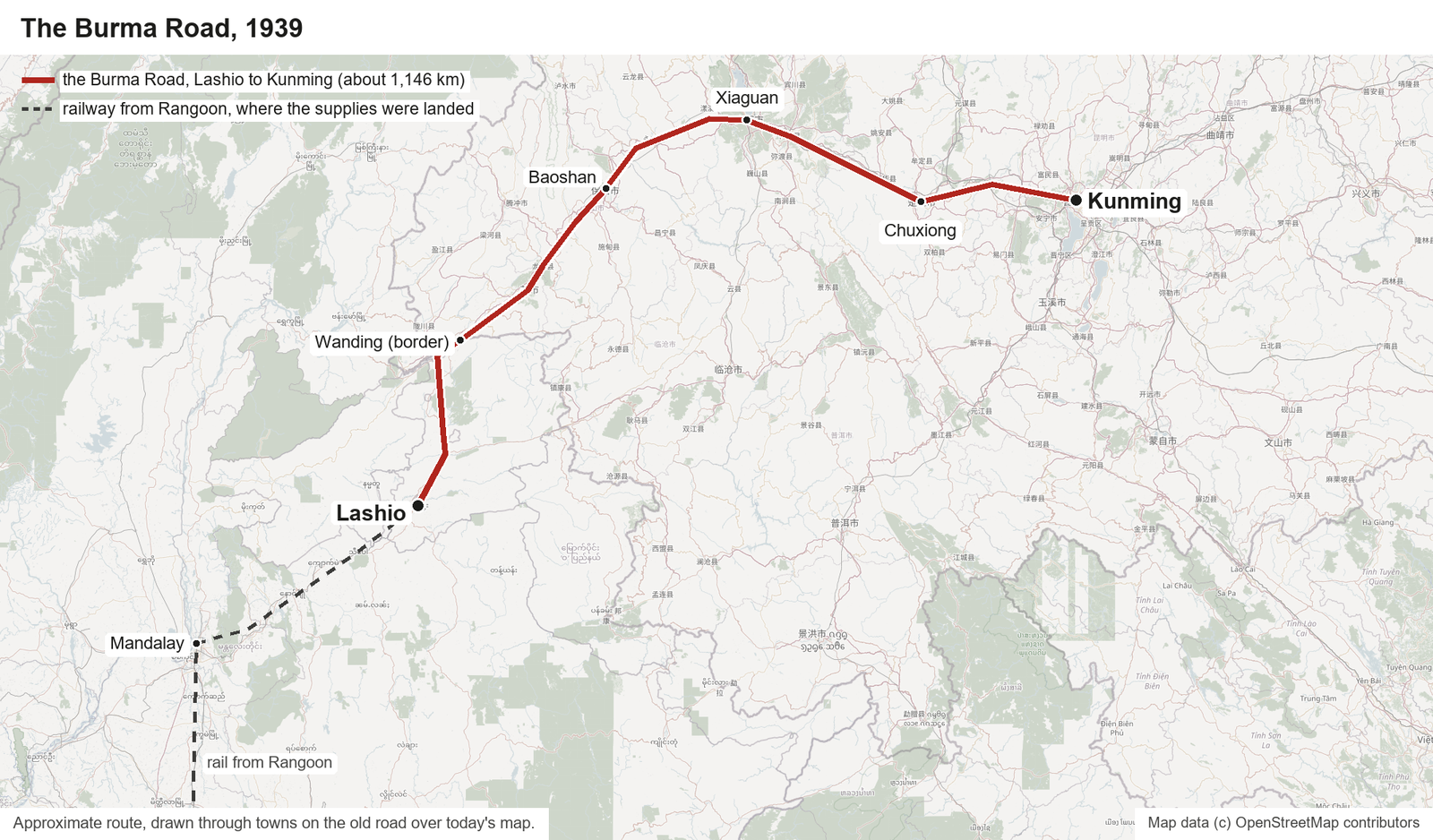
The Burma Road from Lashio to Kunming, drawn approximately through towns on the old route over today’s map. (Map data © OpenStreetMap contributors)
The volunteers
The appeal went out in February 1939, and the response was quick. The first group, 80 men, left Singapore on 18 February, and by August about 3,200 volunteers had gone in successive batches. The National Archives of Singapore counts nine batches; Chinese archival records count fifteen. Almost nine in ten came from British Malaya, which then included Singapore. Many were experienced drivers and mechanics who gave up better-paid work and the comforts of home to go. Accounts also record a small number of women, among them Li Yuemei, who was praised as a modern Hua Mulan, after the legendary woman who disguised herself as a man to fight, and a few non-Chinese volunteers, including Sikh brothers from Taiping in Perak.
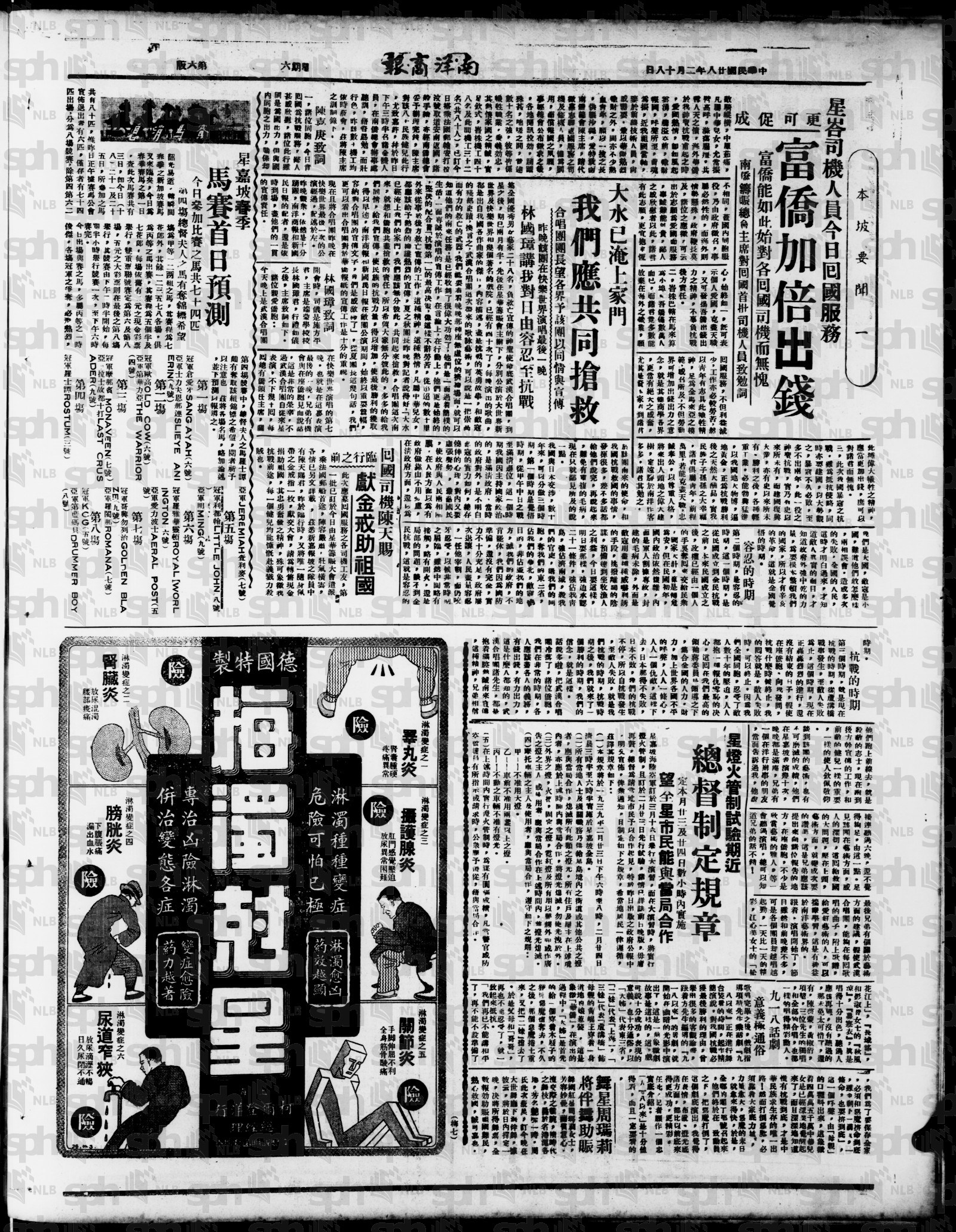 Page 6 of the Nanyang Siang Pau, 18 February 1939. The headline at top right reports that Singapore's drivers return to serve the homeland that day. (Singapore Press Holdings, via NewspaperSG, National Library Board Singapore, public domain)
The Nanyang Siang Pau of 18 February 1939 reported the first group’s departure on its local news page, beside a speech by Tan Kah Kee to the departing drivers. Its headline suggested that their example might move the wealthy to give twice as much. Two days later, the paper described how the first group had organised itself, with its own leaders and its own officers for finance, records and publicity.
The road
In China the volunteers had about a month of training in assembling and repairing vehicles, along with basic military drill, and then went to work on the road. It wound over mountain passes and across the gorges of the Salween and Mekong rivers, much of it unpaved, and it was prone to landslides in the rainy season. Malaria was common in the river valleys, and Japanese aircraft bombed the road and its bridges. By 1940 the road was carrying an average of about 20,000 tons of goods a month into China, according to the historian Rana Mitter.

Drivers on the Burma Road stop to help when a lorry overturns, 1941. (Unknown photographer, public domain, via Wikimedia Commons)
Sources differ on how many volunteers died. One volunteer recalled that a third of them died in service, the figure most histories now use, and some accounts put the toll at nearly half. Accidents, disease and air raids all took their share.
When Japan occupied Burma in May 1942, the road was cut. Some volunteers went on to work on the airlift from India into China, and others joined the Chinese army or Allied intelligence. By the end of the war, about a third of the volunteers had died, about a third later returned to South-East Asia, the first of them in 1946, and the remaining third stayed in China.
When the war came to Malaya
The war the volunteers had gone to fight reached their home in December 1941. At the colonial government’s request, Tan Kah Kee formed the Singapore Chinese Mobilisation Council, and from it came Dalforce, a volunteer force named after its British commander, Lieutenant Colonel John Dalley. According to the National Library Board, between 2,000 and 4,000 people volunteered, among them labourers, students and rickshaw pullers, although there was time to form only eight companies of about 150 each. Dalforce units went into position from 5 February 1942 at places such as Jurong Road, Lim Chu Kang and Woodlands, and fought alongside Allied troops in the battle for Singapore.
After the surrender on 15 February 1942, the Japanese military carried out the Sook Ching, a screening of Chinese men aged 18 to 50 from 21 February to 4 March. Among its targets were people on lists of anti-Japanese suspects, and the community’s support for China’s war, including the relief fund, was one reason it was singled out. Many thousands were killed. Estimates of the number vary widely. Tan Kah Kee himself had left before the fall and spent the Occupation in hiding in Java.
 The Civilian War Memorial on Beach Road, which holds the remains of victims of the Occupation, in 2015. (CEphoto, Uwe Aranas, CC BY-SA 3.0, via Wikimedia Commons)
Choosing a home
After the war, the question of where home lay became practical. Tan Kah Kee went back to China in 1949, returned to Singapore in February 1950 and left again in May 1950. The colonial authorities then refused to let him back in. He died in Beijing in 1961. Other families, including many who had given to the relief fund, chose to stay.
In 1957 the Singapore Citizenship Ordinance opened citizenship to most of the roughly 220,000 Chinese residents who had been born in China. When the registration drive closed on 31 January 1958, more than 320,000 people had registered as citizens of Singapore. Among the community leaders who took it up was Lien Ying Chow, who had himself spent the war in Chongqing and was one of the first to become a citizen, as told in the post on his life.
How Singapore remembers them
For decades after the war the volunteers were largely forgotten, in China as well as in South-East Asia. Researchers began to rediscover them in the 1980s, and their story returned to wide public view in the 2000s and 2010s. In 2009 the National Archives of Singapore staged an exhibition on them with archives in China, drawing on its own oral history interviews with surviving volunteers, and material from it went into its Second World War gallery at the Former Ford Factory. In 2013, Singapore Chinese community organisations funded a sculpture of the volunteers in the grounds of the Sun Yat Sen Nanyang Memorial Hall, with the government’s support.

The memorial sculpture to the Nanyang volunteers at the Sun Yat Sen Nanyang Memorial Hall, 2013. (Angbinmarist, CC BY-SA 3.0, via Wikimedia Commons)
See 12 more historical photos, pages and maps related to this post →
Where it fits in the bigger story: The Nanyang volunteers are usually remembered for what they did for China. Their generation is also the one whose sense of belonging changed, as the war that began in China arrived in Malaya and families who had once thought of themselves as overseas Chinese chose to make Singapore their country. The volunteers who answered Tan Kah Kee’s appeal in 1939 belong to that history too.
Sources
- NAS launches Nanqiao Jigong exhibition, press release and factsheet, National Archives of Singapore, 20 October 2009
- Ngeow Chow Bing, Vincent K L Chang and Frank N Pieke, “The Nanyang Volunteers: A Shared Memory of China, Malaysia and Singapore,” EAI Background Brief No. 1849, East Asian Institute, National University of Singapore, 24 October 2025
- The Archives of Nanyang Volunteer Drivers and Mechanics (Nanqiao Jigong), UNESCO Memory of the World Asia-Pacific register nomination
- Nanyang Volunteer, FamilySearch
- Honouring Nanyang’s unsung volunteer drivers and mechanics, Free Malaysia Today, 18 April 2026
- Malayan Hero’s Story: Col. Dara Singh, Nanyang Volunteers, SikhNet
- Nanyang Siang Pau, 18 February 1939, page 6, NewspaperSG
- Nanyang Siang Pau, 20 February 1939, page 8, NewspaperSG
- Dalforce, Singapore Infopedia, National Library Board
- Operation Sook Ching, Singapore Infopedia, National Library Board
- Singapore Citizenship Ordinance of 1957, Singapore Infopedia, National Library Board
- Tan Kah Kee, Singapore Infopedia, National Library Board
- Tan Kah Kee, Wikipedia
- Song Ong Siang, One Hundred Years’ History of the Chinese in Singapore (1923; annotated edition 2020), on Tan Kah Kee and the Chinese High School
- Map data © OpenStreetMap contributors
- File:滇缅公路01.jpg, Wikimedia Commons
- File:Tan_Kah_Kee,_Lee_Kong_Chian,_and_Tan_Lark_Sye,_1946.png, Wikimedia Commons
- File:滇缅公路运输情况01.jpg, Wikimedia Commons
- File:Singapore_Civilian-War-Memorial-01.jpg, Wikimedia Commons
- File:南侨机工纪念雕塑.jpg, Wikimedia Commons
- File:ABMAC_trucks_on_Burma_Road_-DPLA-_5753369dd3963972687f72522b10540f.jpg, Wikimedia Commons (gallery)
- File:China-bound_convoy_travels_Burma_Road.jpg, Wikimedia Commons (gallery)
- File:滇缅公路-推土机.jpg, Wikimedia Commons (gallery)
- File:Aerial_view_of_Burma_Road.jpg, Wikimedia Commons (gallery)
- File:Japanese_truck_and_tankette_in_Burma_Road.jpg, Wikimedia Commons (gallery)
- File:Kumming’s_Cuihu_from_the_east,_circa_1940s.jpg, Wikimedia Commons (gallery)
- File:Dianchi_boats_1940s.jpg, Wikimedia Commons (gallery)
- File:Tan_Kah_Kee_and_Sun_Yat-sen.jpg, Wikimedia Commons (gallery)
- File:View_from_the_Bell_tower_in_the_50s.JPG, Wikimedia Commons (gallery)
- File:The_Hump_and_Burma_Road.png, Wikimedia Commons (gallery)
- File:Sun_Yat_Sen_Nanyang_Memorial_Hall,_July_2022.jpg, Wikimedia Commons (gallery)


