Lien Ying Chow, the Banker Who Escaped to Chongqing
In the last days before Singapore surrendered to the Japanese in February 1942, a Blue Funnel cargo liner called the Gorgon left the harbour for Australia with more than 350 refugees on board. One of them was Lien Ying Chow, the 35-year-old president of the Singapore Chinese Chamber of Commerce, who was carrying some cash and two diamonds hidden in the lining of his clothes. The ship survived a Japanese dive-bombing attack on the way and reached Fremantle on 20 February. Seven years later, Lien opened the first new bank in postwar Singapore, Overseas Union Bank, and for half a century it was one of the island’s four big local banks.

Raffles Place in about 1963. Overseas Union Bank’s first office was in Meyer Chambers, on the corner of Raffles Place and Malacca Street. (David Pirmann, CC BY 2.0, via Wikimedia Commons)
From Dapu to Robinson Road
Lien was born on 2 August 1906 in the village of Dapu, in Guangdong province, where his grandfather was the village head. He was Teochew. His mother died in 1916 and his father died of plague the following year, and Lien went to live with a great-granduncle. In 1918 he moved to Hong Kong, where he worked for two years, and in 1920, with the help of a relative and savings of HK$10, he bought a ticket to Singapore.
According to the National Library Board’s account, which is based on his 1992 memoir, he arrived with a singlet, a pair of short trousers and a samfu, the loose tunic and trousers worn by working people in southern China. A family friend found him a job as an assistant at Kian Thye, a ship chandler on Robinson Road, for $10 a month. A ship chandler supplies ships with provisions and equipment. The owner, Tay Woo Seng, took him under his wing and made him an assistant shipping clerk at 16, and Lien rose to assistant manager on $120 a month.
He left in 1927 with $5,000 in savings and started his own chandlery, which he closed after six months. In 1929 he tried again with a partner, How Wan Hong, and formed Wah Hin & Co., in which he held 60 per cent. Wah Hin supplied provisions to the British armed forces, first in Singapore and then in Penang, Kuala Lumpur and Ipoh, and by the late 1930s Lien was one of the most successful businessmen in Singapore. In 1941, at 34, he became the youngest president of the Singapore Chinese Chamber of Commerce.
The escape and Chongqing
As Chamber president, Lien helped to organise relief work when Japanese aircraft began bombing Singapore in December 1941. As the Japanese army advanced down Malaya and across the Johor Strait, he left on the Gorgon, one of the ships that carried civilians out in the final week before the surrender on 15 February. Its passenger list on arrival in Fremantle, on the coast of Western Australia, names 357 people, 56 of them with Chinese names.
From Australia, Lien made his way to China, where his family was, and to Chongqing, the wartime capital of the Chinese government under Chiang Kai-shek. Chongqing lay far up the Yangtze River, beyond the reach of the Japanese army but not of its aircraft, which bombed the city repeatedly between 1938 and 1943. Lien met Chiang and was appointed to the government’s wartime political council to represent the overseas Chinese of Singapore, Malaya and South-East Asia.

A street in Chongqing after a Japanese air raid in 1941. (Unknown photographer, public domain, via Wikimedia Commons)
He also went back into business. In 1943 he gathered business leaders from Singapore, Malaya, Burma and India who were also in Chongqing and formed the Overseas Chinese Union Bank, with Lien as its executive president. Many of its customers were Chinese who had fled the war in South-East Asia, as its founders had. The bank opened several branches in China. After the war, civil conflict and runaway inflation made banking in China very difficult, and the bank closed its business there.
A new bank in Raffles Place
Lien returned to Singapore in October 1945 and worked with the British Military Administration as an adviser on the economy, food supplies and relief. In 1947 he began planning a new bank in Singapore, and it opened at 9 a.m. on Saturday, 5 February 1949, in Meyer Chambers on Raffles Place. The same ground floor had been the Singapore office of the Yokohama Specie Bank from 1933 until December 1941.
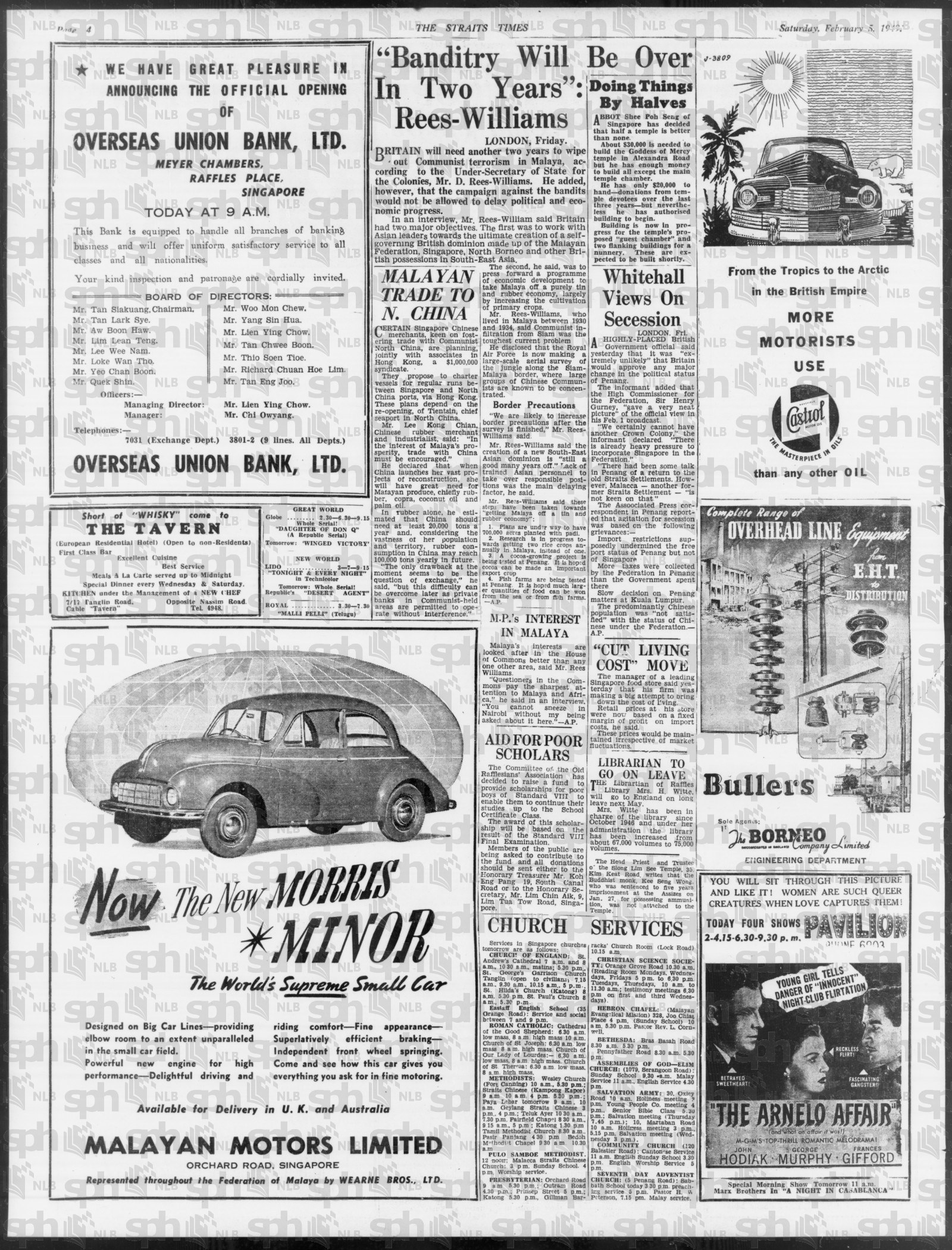 Page 4 of The Straits Times, 5 February 1949. The bank's opening announcement, top left, lists its board, with Lien Ying Chow as managing director and Chi Owyang as manager. (Singapore Press Holdings, via NewspaperSG, National Library Board Singapore, public domain)
The new bank was called Overseas Union Bank. It had $2 million in paid-up capital and 27 staff, including Lien and its general manager, Chi Owyang, who had run the Chongqing bank. The Straits Times noted the day before it opened that there were “more than a dozen multi-millionaires” on its 15-man board. The chairman was Tan Sia Kuang, a banker and rubber company owner, and Lien was managing director. The board also included Aw Boon Haw, the maker of Tiger Balm, the rubber magnate Tan Lark Sye and the cinema owner Loke Wan Tho. Raffles Place had until then been the preserve of established European and American banks and trading houses, and the new bank paid $4,000 a month for its ground floor and basement.
More than 1,000 people, mostly businessmen, came to the opening. The Sunday Times reported it on its front page the next day under the headline “People’s Bank Opened,” and said the bank aimed “to offer all classes of people and nationalities a uniform service.”
Its first niche was the rice trade. Singapore depended on imported rice, much of it from Thailand. The bank built ties with Thai banks and rice exporters, and up to the mid-1950s it financed about 80 per cent of the rice imported into Singapore. By the end of its third year it had paid shareholders a dividend of 5 per cent.
One of the big four
From the mid-1950s the bank opened branches in Malacca, Penang, Kuala Lumpur and Hong Kong, and in the 1960s in Tokyo and London. By 1968 it had 32 branches in Singapore and deposits of more than $300 million. In 1973 it became the first Singapore bank to open a branch in New York, and in 1975 it was listed on the stock exchange. By then it was one of Singapore’s four big local banks, alongside DBS, OCBC and UOB.
Lien had other ventures beside the bank. In 1964 he began planning a large hotel on Orchard Road. The bank’s general manager did not want the bank to carry the risk, so a separate company, Overseas Union Enterprise, was set up to build it. The Mandarin Singapore opened in 1971.

Orchard Road seen from the revolving rooftop restaurant of the Mandarin hotel in 1973 or 1974, two or three years after it opened. (Rainer Halama, CC BY-SA 4.0, via Wikimedia Commons)
 The OUB Centre at 1 Raffles Place in 2006, before it was renamed One Raffles Place. (SpLoT, CC BY 2.5, via Wikimedia Commons)
The project he followed longest was a headquarters. In 1948, a year before the bank opened, Lien began buying land at 1 Raffles Place, plot by plot, and it took him more than three decades to assemble the whole site. The OUB Centre, a 60-storey, 280-metre tower designed by the Japanese architect Kenzo Tange, was completed in 1986 and officially opened in 1988, the year Lien was named Businessman of the Year. It cost S$500 million and, according to its owners, was then the tallest building outside the United States.
Lien Ying Chow and his bank, 1906 to 2004
Dated events in his life, with the Japanese Occupation and the life of Overseas Union Bank shaded
Sources: National Library Board, Infopedia articles on Lien Ying Chow and Overseas Union Bank; The Straits Times, 5 February 1949.
View as table
| Year | Event |
|---|---|
| 1906 | Born on 2 August 1906 in the village of Dapu, Guangdong province. |
| 1920 | Arrives with HK$10 of savings and joins the ship chandler Kian Thye on $10 a month. |
| 1929 | Forms Wah Hin & Co., which supplies provisions to the British forces in Malaya. |
| 1941 | Becomes, at 34, the youngest president of the Singapore Chinese Chamber of Commerce. |
| 1942 | Leaves Singapore on the Gorgon days before the surrender; it reaches Fremantle on 20 February. |
| 1943 | Forms the Overseas Chinese Union Bank in Chongqing, for Chinese who had fled South-East Asia. |
| 1949 | Overseas Union Bank opens on 5 February 1949 in Meyer Chambers, with $2 million of capital and 27 staff. |
| 1971 | The Mandarin Singapore opens on Orchard Road, built by Overseas Union Enterprise. |
| 1973 | The first Singapore bank to open a branch in New York. |
| 1988 | The 60-storey OUB Centre at 1 Raffles Place, on land he began buying in 1948, is officially opened. |
| 1995 | Retires as chairman and director, aged 88. |
| 2001 | UOB wins more than 90 per cent acceptance for its S$10 billion offer, backed by Lien. |
| 2004 | Dies on 6 August 2004. |
His public roles were as varied as his business. Lien served as a municipal commissioner in the 1950s and as Singapore’s High Commissioner to Malaysia from 1966, after the two countries separated. He helped to found Nanyang University and Ngee Ann College, now Ngee Ann Polytechnic, and he was the first chairman of the council of the National University of Singapore. In 1972 he became the first chairman of the Preservation of Monuments Board. In 1980 he gave almost half his wealth to set up the Lien Foundation, a philanthropic foundation that is still active.
The end of the name
Lien retired as chairman and director of the bank in 1995, aged 88. In the 1990s it grew faster than any of the other three local banks, but it remained the smallest of them, and when the local banks came under pressure to consolidate in the early 2000s it became a takeover target. In June 2001 DBS made a hostile bid of S$9.4 billion. UOB answered with a bid of S$10 billion that had the support of the bank’s board and of Lien, whose family held about 15.7 per cent of its shares. In September 2001 UOB won more than 90 per cent acceptance, and by the end of 2003 the last branches had been converted and the name Overseas Union Bank was gone. The story of the buyer is told in the post on UOB.
Lien died on 6 August 2004, a few days after his 98th birthday. The tower he took decades to build still stands at 1 Raffles Place, renamed One Raffles Place in 2012.
Could a bank’s customers be stranded again?
Lien could carry his savings out of Singapore in 1942 in his clothes. Most people with money in a bank could not, and in a war or a bank failure, depositors in that period had no protection beyond the bank’s own soundness. Today, Singapore has a deposit insurance scheme, which began in 2006 and is run by the Singapore Deposit Insurance Corporation. If a member bank or finance company fails, each depositor’s insured deposits with it are covered up to S$100,000, a limit raised from S$75,000 on 1 April 2024. The Monetary Authority of Singapore said the higher limit would fully cover 91 per cent of depositors. The scheme does not cover everything, and amounts above the limit and some kinds of product are outside it, but it means that an ordinary saver no longer depends on the fate of a single bank.
See 15 more historical photos and pages related to this post →
Where it fits in the bigger story: Lien Ying Chow is remembered mainly through the institutions he left behind, a tower in Raffles Place and a foundation that bears his name. The bank he built has already disappeared into another. Its origin is less known: a refugee bank in wartime Chongqing, run by people who had fled South-East Asia, which became the first new bank of postwar Singapore.
Sources
- George Lien Ying Chow, Singapore Infopedia, National Library Board
- Overseas Union Bank (OUB), Singapore Infopedia, National Library Board
- Lien Ying Chow, Wikipedia
- “New Bank Tomorrow,” The Straits Times, 4 February 1949, page 5, NewspaperSG
- Overseas Union Bank opening announcement, The Straits Times, 5 February 1949, page 4, NewspaperSG
- “People’s Bank Opened,” The Sunday Times, 6 February 1949, page 1, NewspaperSG
- The M.V. Gorgon, COFEPOW
- Women and Children Evacuees and Escapees from Singapore up to 15th Feb 1942, COFEPOW
- One Raffles Place history, OUB Centre Limited
- Launch of Deposit Insurance Scheme in Singapore, Monetary Authority of Singapore, 2006
- Deposit insurance limit goes up to $100,000 from today, Singapore Deposit Insurance Corporation, 1 April 2024
- Yokohama Specie Bank timeline (Meyer Chambers, 1933 to 1941), Lesser Known Singapore
- “New Building in Raffles Place,” The Straits Budget, 4 December 1930, page 2, NewspaperSG (gallery)
- File:SG_Singapore_Raffles_Square_-1963(W63-K27-15).jpg, Wikimedia Commons
- File:Chongqing_bomb.jpg, Wikimedia Commons
- File:Singapore-Orchard_Road-Mandarin_Hotel-1973-74-WUS08142.jpg, Wikimedia Commons
- File:OUB_Centre_Skyward.JPG, Wikimedia Commons
- File:Hong_Kong_Connaught_Road_1920s.jpg, Wikimedia Commons (gallery)
- File:Fremantle_Harbour,_WW2.PNG, Wikimedia Commons (gallery)
- File:Chiang_Kai-shek_in_the_40s.jpg, Wikimedia Commons (gallery)
- File:Chungking_bomb6.jpg, Wikimedia Commons (gallery)
- File:重慶城墻1940s.jpg, Wikimedia Commons (gallery)
- File:Korean_Provisional_Government_(대한민국_임시정부,_大韩民国_臨時政府)_Third_Office_in_Chongqing,_1941-1945.jpg, Wikimedia Commons (gallery)
- File:Japanese_surrender_at_Singapore,_1945.jpg, Wikimedia Commons (gallery)
- File:Hu_Wenhu.jpg, Wikimedia Commons (gallery)
- File:Tan_Lark_Sye,_1950.jpg, Wikimedia Commons (gallery)
- File:Loke_Wan_Tho,1947(cropped).jpg, Wikimedia Commons (gallery)
- File:Singapore-Mandarin_Hotel-1973-74-WUS08139.jpg, Wikimedia Commons (gallery)
- File:Singapore_Chinese_Chamber_of_Commerce_&_Industry_Building,_Aug_06.JPG, Wikimedia Commons (gallery)
- File:Mandarin_Orchard,_Singapore_in_2014.jpg, Wikimedia Commons (gallery)


