UOB: The United Chinese Bank of 1935 and the Family That Built It
On the morning of 1 October 1935, a new bank opened its doors at the corner of Chulia Street and Bonham Street, facing Raffles Place, in premises formerly occupied by the Yokohama Specie Bank. It was called the United Chinese Bank, it had seven founders and $1 million of paid-up capital, and it was set up to serve Singapore’s Hokkien merchants in the middle of the Great Depression. Ninety years later, as United Overseas Bank, it is one of Singapore’s three big local banks. Much of that growth came from buying other banks, one of them older than itself.

Raffles Place, the commercial square the United Chinese Bank faced, in the early twentieth century. (Unknown photographer, KITLV 87929, CC BY 4.0, via Wikimedia Commons)
Seven founders, 1935
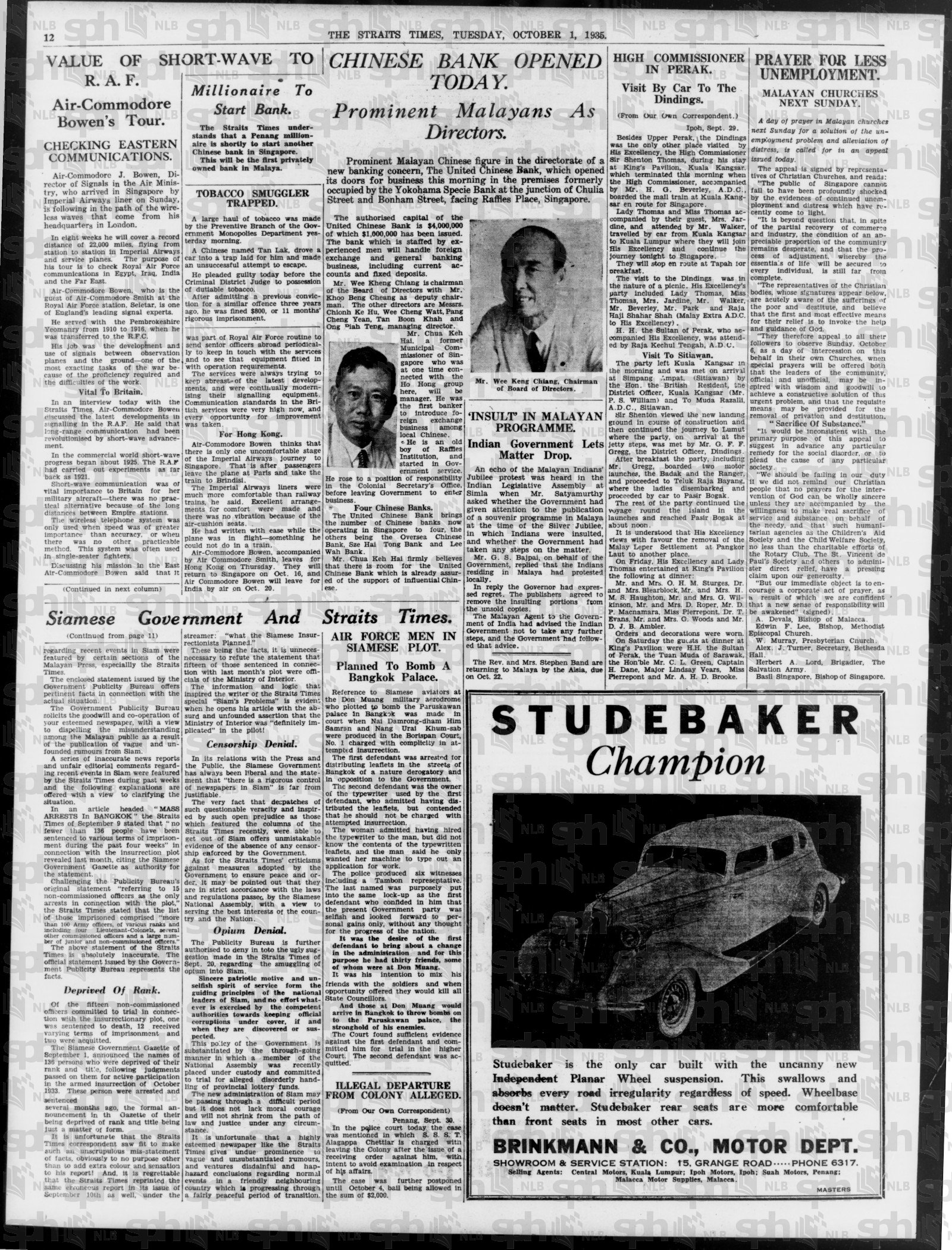 Page 12 of The Straits Times, 1 October 1935: "Chinese Bank Opened Today," with photographs of the chairman, Wee Kheng Chiang, and the manager, Chua Keh Hai. (Singapore Press Holdings, via NewspaperSG, National Library Board Singapore, public domain)
The United Chinese Bank was incorporated on 6 August 1935 by a group of seven Hokkien businessmen led by Wee Kheng Chiang. Wee was born in Kuching, Sarawak, in 1890, and had already founded a bank there, the Bian Chiang Bank, in 1924. He was the largest shareholder and became the new bank’s chairman.
The Straits Times reported the opening on 1 October under the headline “Chinese Bank Opened Today.” The bank had an authorised capital of $4,000,000, of which $1,000,000 had been issued, and it intended to handle foreign exchange as well as ordinary banking, current accounts and fixed deposits. Ong Piah Teng was managing director, and there were five other directors. The manager, Chua Keh Hai, was a former municipal commissioner, and the paper described him as the first banker to introduce foreign exchange business among the local Chinese.
The bank’s own advertisement, which ran in the Malaya Tribune the next day, gave its address as 31-A Chulia Street, in the Bonham Building. It was a single office, and its customers were mainly Hokkien traders looking for short-term credit. It joined a crowded field. Singapore already had a number of Chinese banks, each tied to a dialect group, and three of them had merged in 1932 to form the Oversea-Chinese Banking Corporation.

The Bonham Building at the corner of Chulia Street and Bonham Street, on a postcard of 1907. The United Chinese Bank rented its first office here. (Unknown photographer, public domain, via Wikimedia Commons)
The second generation
Little has been published about how the bank fared during the Japanese Occupation. Wee Kheng Chiang’s fourth son, Wee Cho Yaw, born in 1929, spent most of the Occupation with his family in Karimun, in what is now Indonesia. In 1958 he joined the bank’s board as its youngest director. On 1 July 1960, when his father stepped down as managing director, Wee Cho Yaw took over the post. He was 31.
In the late 1950s and early 1960s the bank grew in small steps. It drove its first mobile branch in 1958, opened its first branch outside the head office, on Beach Road, in 1959, and in 1962, by its own account, became the first bank to focus on women as customers.
A new name, 1965
On 23 January 1965 the United Chinese Bank became United Overseas Bank. The change avoided confusion with another United Chinese Bank in Hong Kong, where the bank opened its first overseas branch the same year.
Growing by buying, 1971 to 2001
From 1971 the bank grew mainly by acquiring other banks, each an independent bank with its own founders and customers. The first was Chung Khiaw Bank, founded by the Tiger Balm magnate Aw Boon Haw and opened in 1950. UOB bought a majority stake in it in 1971, after the Aw family’s holding company had passed to the British investment group Slater Walker, and Chung Khiaw went on trading under its own name until 1999. In 1973 UOB acquired Lee Wah Bank, a Cantonese bank founded in 1920 and older than UOB itself. It took a majority interest in Far Eastern Bank, founded in 1958, in 1984, and in the Industrial & Commercial Bank, founded in 1953, in 1987.
In 1974 Wee Kheng Chiang retired and Wee Cho Yaw became chairman as well as chief executive. The same year the bank moved into a new 30-storey building on the site of the Bonham Building, where it had rented its first office. The taller UOB Plaza One, on the same block, opened in 1995.
 UOB Plaza (right) and the OUB Centre, the former headquarters of Overseas Union Bank, in 2006. (Terence Ong, CC BY 2.5, via Wikimedia Commons)
The largest purchase came in 2001. Overseas Union Bank had been founded by Lien Ying Chow and opened on 5 February 1949, the first new bank in postwar Singapore, and by the 1970s it was one of the four big local banks. In June 2001, when local banks were under pressure to consolidate, the Development Bank of Singapore made a hostile bid of S$9.4 billion for it. UOB answered with a bid of S$10 billion that had the support of OUB’s board and of Lien himself. In September 2001 UOB announced that it had won acceptances for more than 90 per cent of OUB’s shares, and the deal made it the largest local bank in Singapore, with about S$115 billion in assets. The OUB name was gone by the end of 2003.
Wee Cho Yaw stepped down as chief executive in 2007, handing the post to his eldest son, Wee Ee Cheong, who still holds it. He retired from the board in 2018 and died in February 2024, aged 95.
The banks that became UOB
The chart shows the five banks that UOB acquired in Singapore, from the year each opened to the year UOB took control of it.
The banks that became part of UOB
From the year each bank opened to the year UOB took control of it
Sources: UOB corporate milestones; National Library Board (Overseas Union Bank); Wikipedia (Chung Khiaw Bank); founding years of Lee Wah, Far Eastern and Industrial & Commercial banks from Remember Singapore.
View as table
| Bank | Opened | Became part of UOB |
|---|---|---|
| Lee Wah Bank | 1920 | 1973 |
| United Chinese Bank (UOB from 1965) | 1935 | — |
| Overseas Union Bank | 1949 | 2001 |
| Chung Khiaw Bank | 1950 | 1971 (majority stake) |
| Industrial & Commercial Bank | 1953 | 1987 (majority interest) |
| Far Eastern Bank | 1958 | 1984 (majority interest) |
What changed
In 1935 the United Chinese Bank was one of many small Chinese banks in Singapore, most of them serving a single dialect community from a single office. Today Singapore has three large local banks, UOB, OCBC and DBS, and several of the banks of that earlier era survive only inside them. Mergers and acquisitions did that over seven decades, and the last big round, in 2001, left the three that remain.
See more photos related to this post →
Where it fits in the bigger story: UOB is one of the most familiar names in Singapore, but its origin, a single rented office in a Depression-era building run for Hokkien merchants, is rarely told. Its history is also a history of the smaller banks it absorbed, from a Cantonese bank of 1920 to the Tiger Balm family’s bank, whose names have largely been forgotten.
Sources
- Our Corporate Milestones, United Overseas Bank Annual Report 2021
- Our Story Over 80 Years, United Overseas Bank Annual Report 2015 (PDF)
- United Overseas Bank, Wikipedia
- Wee Kheng Chiang, Wikipedia
- Wee Cho Yaw, Wikipedia
- Chung Khiaw Bank, Wikipedia
- “Overseas Union Bank (OUB),” Singapore Infopedia, National Library Board Singapore
- “Money Never Sleeps: A Brief History of Banking in Singapore,” Remember Singapore
- “Chinese Bank Opened Today,” The Straits Times, 1 October 1935, page 12, NewspaperSG
- “The United Chinese Bank, Limited” (advertisement), The Malaya Tribune, 2 October 1935, page 3, NewspaperSG
- File:KITLV A723 - Raffles Place te Singapore, KITLV 87929.tiff, Wikimedia Commons
- File:Bonham Building 1907.jpg, Wikimedia Commons
- File:UOBnOUB.JPG, Wikimedia Commons
- “New bank opens,” The Malaya Tribune, 2 October 1935, page 13, NewspaperSG (gallery)
- File:Katz Bros. Bonham Street 1902.png, Wikimedia Commons (gallery)
- File:Kling Street in Singapore, RP-F-AA3188-BM.jpg, Wikimedia Commons (gallery)
- File:KITLV - 79892 - Kleingrothe, C.J. - Medan - Raffles Place, Singapore - circa 1910.tif, Wikimedia Commons (gallery)
- File:Raffles Place c. 1920.jpg, Wikimedia Commons (gallery)
- File:Raffles Place Singapore, KITLV 1404977.tiff, Wikimedia Commons (gallery)
- File:The Chartered Bank aan Raffles Place te Singapore, KITLV 104795.tiff, Wikimedia Commons (gallery)
- File:Boat Quay Singapore, KITLV 1404940.tiff, Wikimedia Commons (gallery)
- File:153 Singapore, Jan 1978 (52023517826).jpg, Wikimedia Commons (gallery)
- File:Former Overseas Union Bank, near Robertson Quay, Singapore.jpg, Wikimedia Commons (gallery)
- File:Oub-uob-towers cropped.jpg, Wikimedia Commons (gallery)
- File:United Overseas Bank Plaza One.jpg, Wikimedia Commons (gallery)
- File:United Overseas Bank History Plaque.jpg, Wikimedia Commons (gallery)


