Interned in India: Singapore's Japanese Civilians, 1941–46
In the early hours of 8 December 1941, as Japanese bombs fell on Pearl Harbor and Singapore, the police in Singapore began rounding up every Japanese resident on the island. Shopkeepers, photographers, dentists, bank clerks, fishermen and their families were taken from their homes, and within weeks most of them were on their way to India, where about 2,700 civilians from Singapore, Malaya and the rest of British Asia spent the war behind the walls of a sixteenth-century fort in Delhi and then in a desert camp in Rajasthan. Few of them were ever allowed to make Singapore their home again.

The ramparts of the Purana Qila, Delhi’s sixteenth-century Old Fort, where the internees from Singapore lived in tents in 1942. (Varun Shiv Kapur, CC BY 2.0, via Wikimedia Commons)
The night of the arrests
Fukuda Kurahachi had come to Singapore in 1916, at the age of 13, to work at Echigoya, a Japanese textile store that sold kimono. By 1941 he was its manager. With war expected, he had planned to leave for Japan at the end of the year, and on Sunday, 7 December, he closed the business and held a small farewell dinner. In the diary he kept through his internment, he recorded that the raids began at 3.15 the next morning. He was arrested at 6 am.
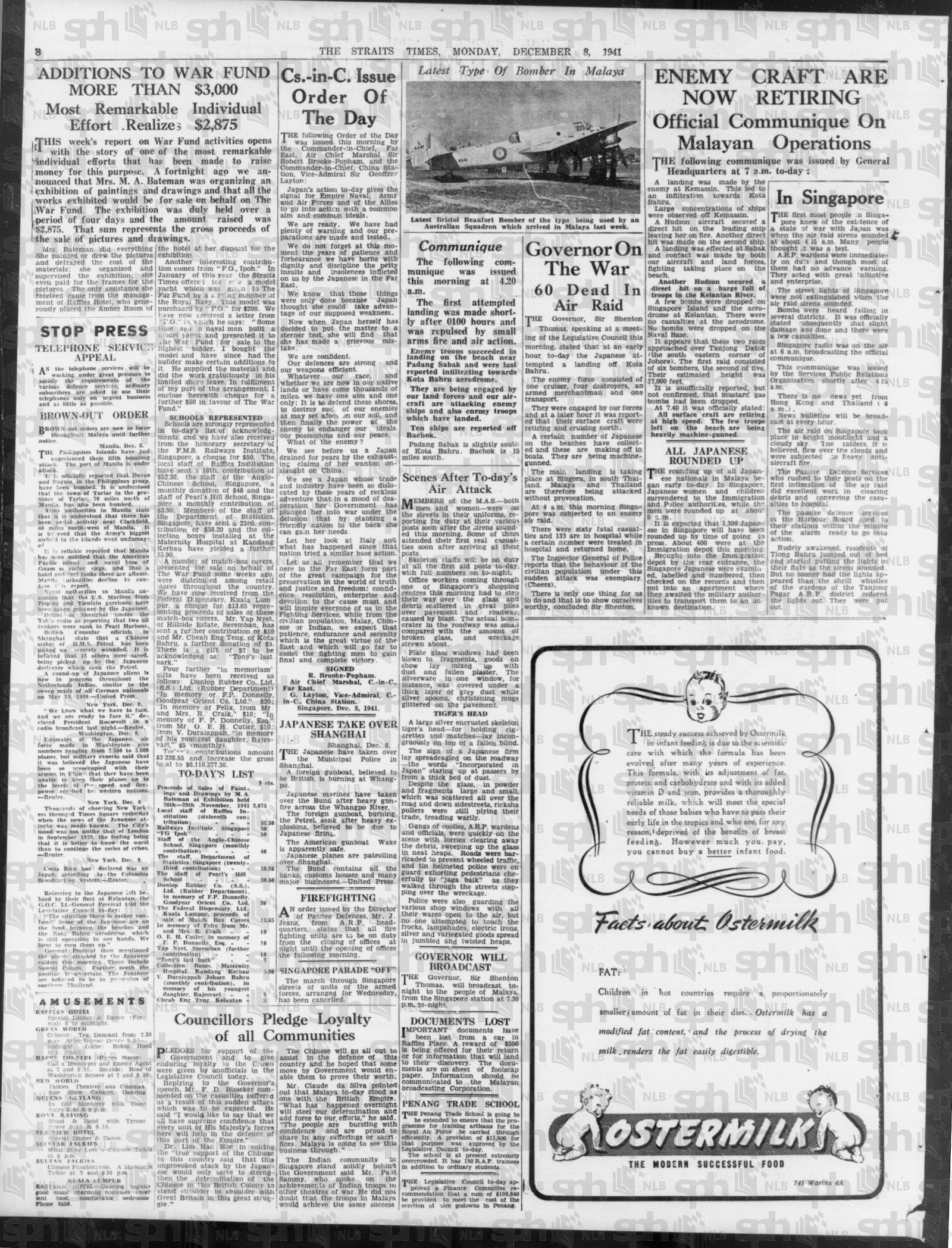 Page 8 of the Straits Times, 8 December 1941. "All Japanese Rounded Up" is in the right-hand column, beside reports of the first air raid on Singapore. (Singapore Press Holdings, via NewspaperSG, National Library Board Singapore, public domain)
The Straits Times reported the round-up the same day. Japanese women and children surrendered to the immigration and police authorities, while the men were rounded up at about 5 am. About 400 were at the immigration depot by the morning, where they were examined, labelled and numbered, and the paper expected 1,300 Japanese in Singapore to have been taken by the time it went to press. The colonial government had been planning this since at least 1940, and in September 1941 the Governor of the Straits Settlements had asked the Government of India whether it would take Malaya’s Japanese internees if war came, about 2,000 men and 750 women, with the Malayan governments paying the costs.
The men were taken to the immigration depot at Singapore’s East Wharf and shipped on the SS Klang to the quarantine station at Port Swettenham, the port for Kuala Lumpur, arriving on 9 December. Eleven days later, as the Japanese army advanced down the peninsula, they were brought back on the SS Perak and locked up in Changi Prison. The women and children were taken to the quarantine station on St John’s Island, where they slept in long sheds and cooked outside. A British missionary, Norah Inge, was appointed to guard them.

Changi Prison in 1936, the year it opened. The Japanese men arrested in Singapore were held here in late December 1941 before being shipped to India. (The Straits Times, public domain, via Wikimedia Commons)
Japanese, or Singaporean?
Almost all of them were Japanese by nationality, and that is how the British treated them. There was no Singapore citizenship until 1957, and when Japan went to war with Britain its nationals here became enemy aliens overnight. The round-up also took in people from Japan’s empire: Taiwanese and Koreans, who were then Japanese subjects, as well as a few Chinese and Malays. When the camp in India was counted in May 1943, its 2,101 internees were made up of 1,889 Japanese, including Okinawans, 184 Taiwanese, 10 Chinese, 7 Thais, 5 Malays, 5 Koreans and one Russian. The Malays were mostly women, probably the partners of Japanese men.
Who was in the camp at Deoli, May 1943
Internees by origin, 2,101 in all; linear scale
Source: camp return of May 1943 (National Archives, Kew, FO 916/776), as given in de Matos and Ward (2021). Most internees had come from Singapore and Malaya.
View as table
| Origin | Internees |
|---|---|
| Japanese (including Okinawans) | 1,889 |
| Taiwanese (subjects of Japan's empire) | 184 |
| Chinese | 10 |
| Thai (held after Thailand declared war) | 7 |
| Malay (mostly women, likely with Japanese partners) | 5 |
| Korean (subjects of Japan's empire) | 5 |
| Russian | 1 |
| Total | 2,101 |
Many of them had lived in Singapore and Malaya for a long time. Official estimates put the number of Japanese in Malaya at about 3,600 in August 1941, after many families had left ahead of the war. They ran photographic studios, chemists, hotels and shops around Middle Road, which was known as Little Japan, and the internee lists in India show more than 70 photographers, more than 60 barbers and hairdressers and about 45 dentists. The largest single group was more than 400 Okinawan fishermen who had worked out of Singapore, part of the fleet described in an earlier post on the Japanese fishermen. There were also managers from the Yokohama Specie Bank, the Bank of Taiwan, Mitsui and Mitsubishi. Fukuda had been educated at the Anglo-Chinese School, and his firm was the only Japanese company in Singapore to give money to the British War Fund in 1941. The historians who have studied the camp lists note that new generations had been born here, though the records do not say how many of the internees were Singapore-born.
To India
On 7 January 1942 the men in Changi were put on a steamer without being told where they were going. They reached Bombay on 19 January and were taken north in third-class railway carriages to Delhi, where the Government of India had prepared a temporary camp inside the Purana Qila, the Old Fort. The women and children sailed separately, guessing from the ship’s southward course that they might be going to Australia. They landed at Calcutta. One child died on the voyage, which took almost two weeks, and another was born on the wharf on arrival.
They were joined by Japanese and others from India, Burma, Ceylon and even Iran, and at its fullest the camp held 2,689 people: 1,718 men, 725 women and 246 children. The Japanese consuls from across British Asia were not interned with them but kept under house arrest in the hill station of Mussoorie.
Life in the Old Fort
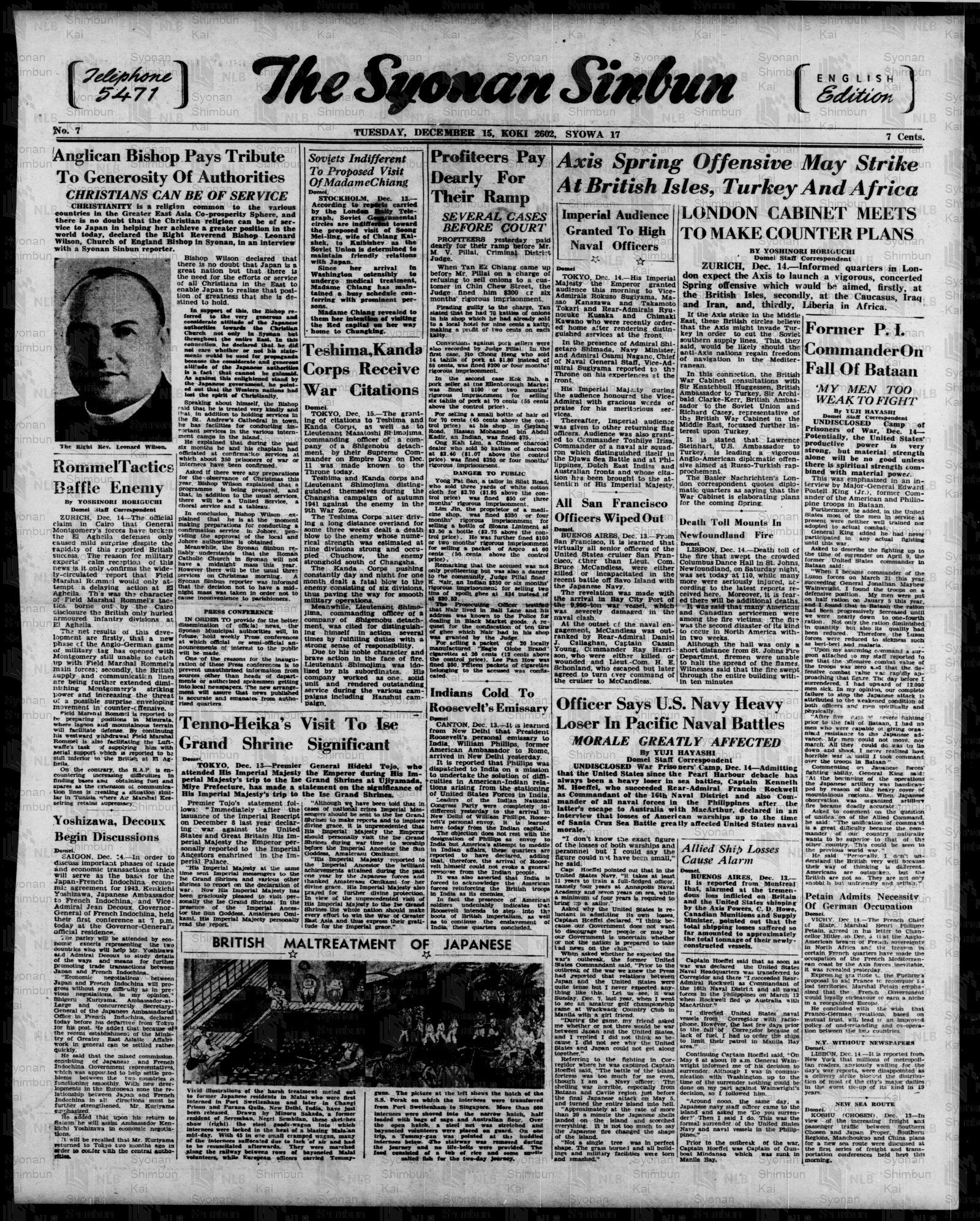 Page 1 of the Syonan Sinbun, as the Occupation's English-language paper spelt its name then, 15 December 1942. The strip of drawings along the bottom, by a former internee from Seremban, depicts the transfer of the internees and their treatment as Japan's propaganda wished to show it. (Syonan Shimbun, via NewspaperSG, National Library Board Singapore, public domain)
The Purana Qila was meant to be a transit camp, so the men lived in about 300 army tents, six to eight to a tent, while the women and children were housed in the arcades along the fort’s walls, divided by curtains. The internees organised themselves almost at once, electing councils and wing leaders and setting up night patrols, kitchen shifts, a tailoring department and a barber. A baseball season began on 20 February 1942, and baseball scores are, after the weather, the subject Fukuda recorded most often in his diary.
The weather was the first hardship. The internees had come from the tropics into a Delhi winter, and a Thai internee, Karuna Kusalasaya, later remembered hands, feet and lips cracked and blistered by the cold. By June the temperature in the tents reached 115 degrees Fahrenheit, or 46 degrees Celsius. Disease followed: dysentery and malaria in the monsoon months, and from October 1942 beriberi, caused by a lack of vitamin B1 in the diet. By the end of 1942, 106 internees had died in the camp, 55 men, 42 women and nine children. One was a 14-year-old boy, George Sakai, who died of appendicitis, and the internees named a baseball prize after him.
Japan’s government protested about the tents, the food and the sanitation through Switzerland, the neutral power that looked after its interests. The authorities in India answered that the camp was the same as the accommodation given to Indian troops, but in London one official wrote privately that tents in India were “hardly good enough”. The British authorities then added barley to the rations and enlarged the medical facilities.
The exchange of 1942
In mid-1942 Britain and Japan agreed to exchange some of the civilians each held, at Lourenço Marques in Portuguese East Africa, now Maputo in Mozambique. The exchange of August and September 1942 sent about 1,800 Japanese home from across the British Empire, including about 720 from the Purana Qila. The list was drawn up by the Japanese consuls, a committee of camp leaders and the officials negotiating the exchange. Consular staff came first, then the managers of the banks, rubber companies, newspapers and trading houses and their families, then teachers and the sick and elderly. Fukuda was number 480 on a list of 784.
There was not a fisherman or a tailor on the list. Some of the Okinawans and Taiwanese who were left behind attacked members of the selection committee, accusing them of choosing only their own class, and in the nights before the departure some of those leaving hid from them. Fukuda went back to Singapore, now Syonan, in September 1942, working for the occupation forces as a buyer of goods.
Deoli
In March and April 1943, after a year of delays, the remaining internees, about 2,100 people, were moved to permanent barracks at Deoli, near Ajmer in Rajasthan, which had been used for German prisoners of war. The barracks were whitewashed brick with stone-tiled roofs, about 700 internees to each wing, with barbed wire between the wings. Conditions were better. The camp had a hospital with Japanese, European and Indian doctors, a school for the children with ten teachers, sports, religious services and a lake nearby where internees could go to fish and bathe, 100 at a time. Visitors from the International Committee of the Red Cross counted about 230 rock gardens that the internees had made in front of their quarters.
A second exchange was negotiated, and 934 names were put forward from Deoli, but after several postponements it never took place. The internees were still at Deoli when Japan surrendered in August 1945.
After the surrender
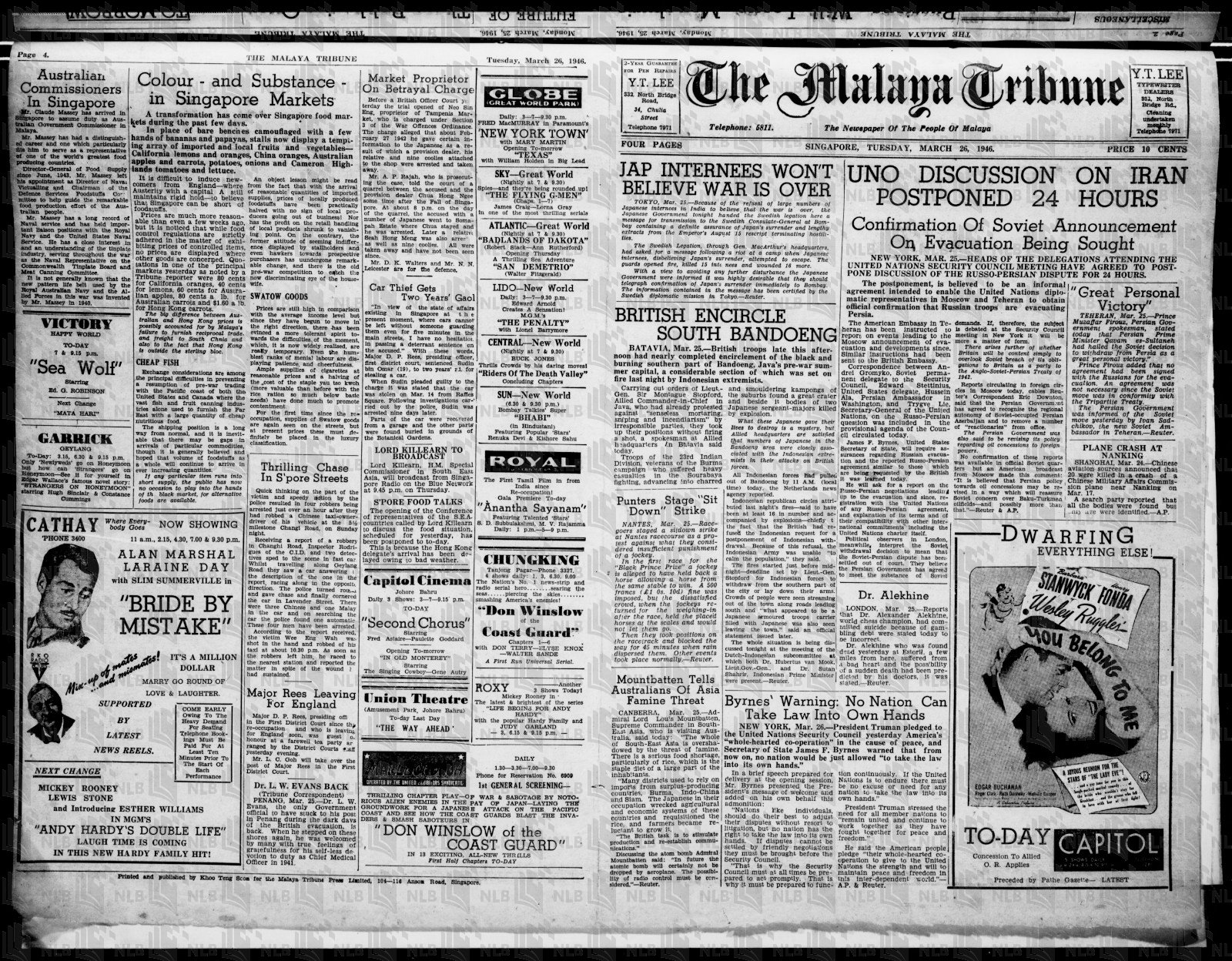
Page 1 of the Malaya Tribune, 26 March 1946 (right, with page 4 on the left as scanned). The lead story reports that the Japanese government had sent internees in India confirmation of Japan’s surrender after a riot at their camp. (Malaya Tribune, via NewspaperSG, National Library Board Singapore, public domain)
The end of the war split the camp. Many internees refused to believe that Japan had lost and accused the British of printing fake newspapers. They became known as the kachi-gumi, the “victory group”, and they turned on the smaller make-gumi, the “defeat group”, who accepted the news. On 20 February 1946 about 80 internees asked the camp authorities for protection. When the commandant then tried to arrest the ringleaders, internees in one wing drove out the staff and refused to take roll call. Troops were called in, and on 26 February 1946 they opened fire. A Reuters report at the time described a riot by internees who did not believe in the surrender and said 15 had been killed and 16 wounded. Later Japanese accounts put the final toll at 19 dead, including women and a child, though the figures in different sources range from 14 to about 20. Japan’s government sent a message to the camp through the Swedish legation, with extracts from the Emperor’s broadcast of 15 August 1945, to confirm that the war was over.
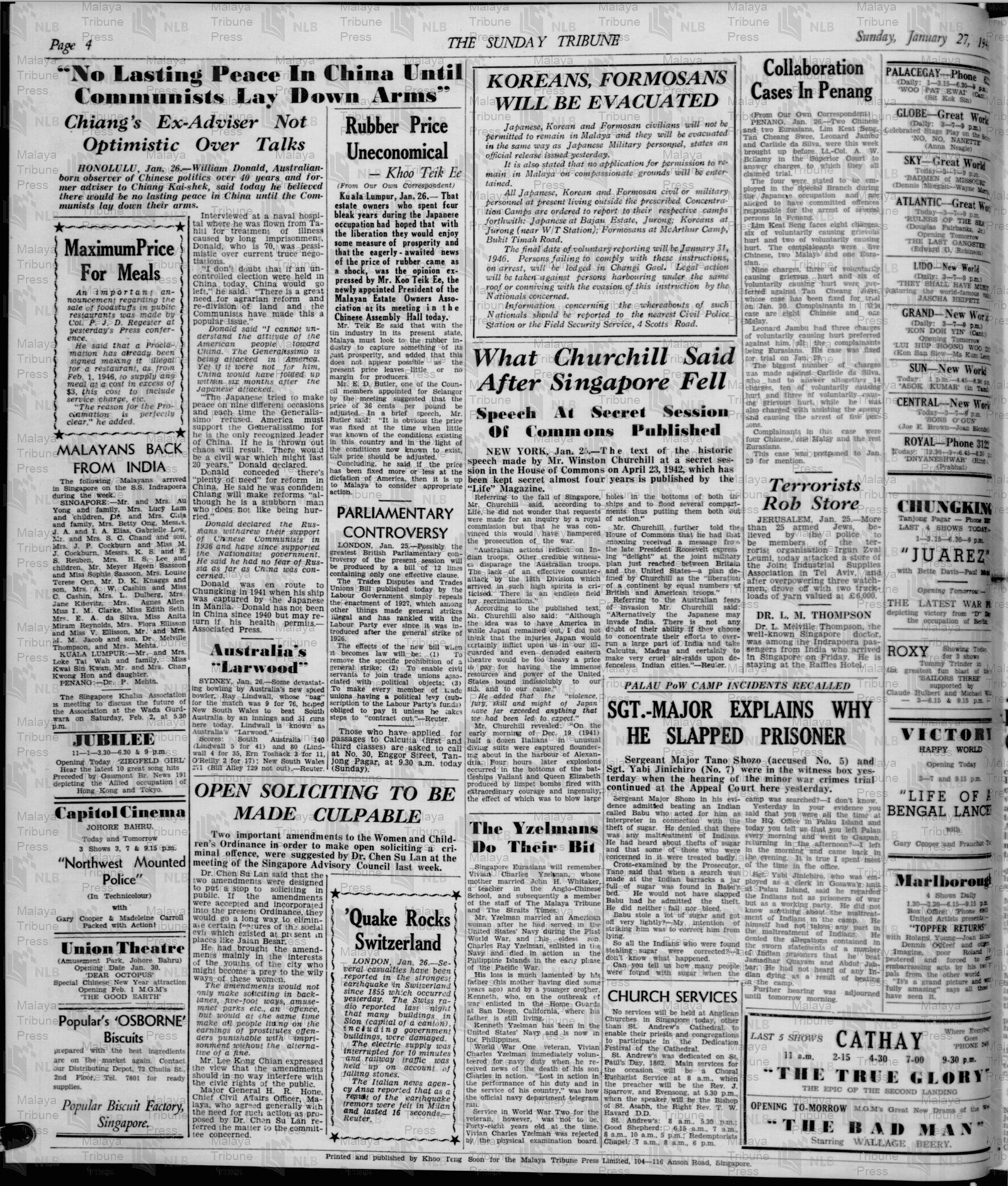 Page 4 of the Sunday Tribune, 27 January 1946. The boxed notice at top centre says Japanese, Korean and Formosan civilians would not be allowed to stay in Malaya, and names their camps at Jurong and on Bukit Timah Road. (Sunday Tribune, via NewspaperSG, National Library Board Singapore, public domain)
The internees finally left Deoli in May 1946, nine months after the surrender. They were not allowed to go home to Singapore. An official notice in January 1946 had announced that Japanese, Korean and Taiwanese civilians would not be permitted to remain in Malaya and would be evacuated in the same way as Japanese troops, and that no applications to stay on compassionate grounds would be considered. The returning internees were held in Singapore while they waited to be shipped on, the Japanese in a camp at Jurong and the Taiwanese at Bukit Timah, and were then sent to Japan, Taiwan and elsewhere.
Who paid
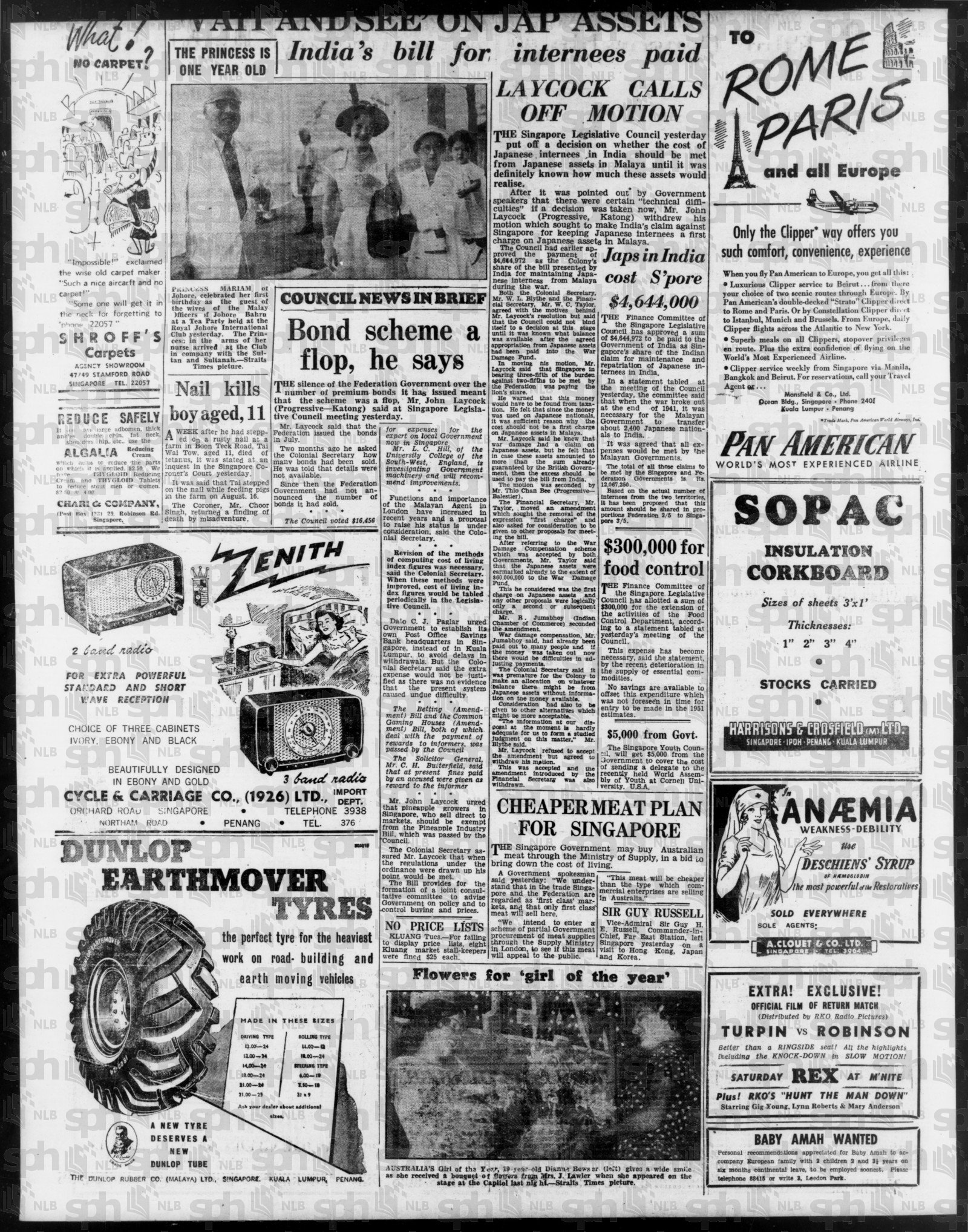 Page 4 of the Straits Times, 19 September 1951. "India's bill for internees paid", at top centre, reports Singapore's share of the cost. (Singapore Press Holdings, via NewspaperSG, National Library Board Singapore, public domain)
The bill came later. In May 1951 India presented the Malayan governments with a claim for 12.7 million rupees, about $8.1 million, for keeping the Japanese internees, and the Indian Home Minister, C. Rajagopalachari, told Parliament in New Delhi that he hoped the amount would be “received soon”. Malaya argued that Britain should pay, since the internees had been sent to India at its instance, but in September 1951 the Finance Committee of Singapore’s Legislative Council approved $4,644,972 as Singapore’s share. The committee’s statement said that about 2,400 Japanese nationals had been transferred from Malaya to India, that it had been agreed in 1941 that the Malayan governments would meet all the expenses, and that the claim would be split according to how many internees had come from each territory: three-fifths for Singapore and two-fifths for the Federation of Malaya.
Coming back
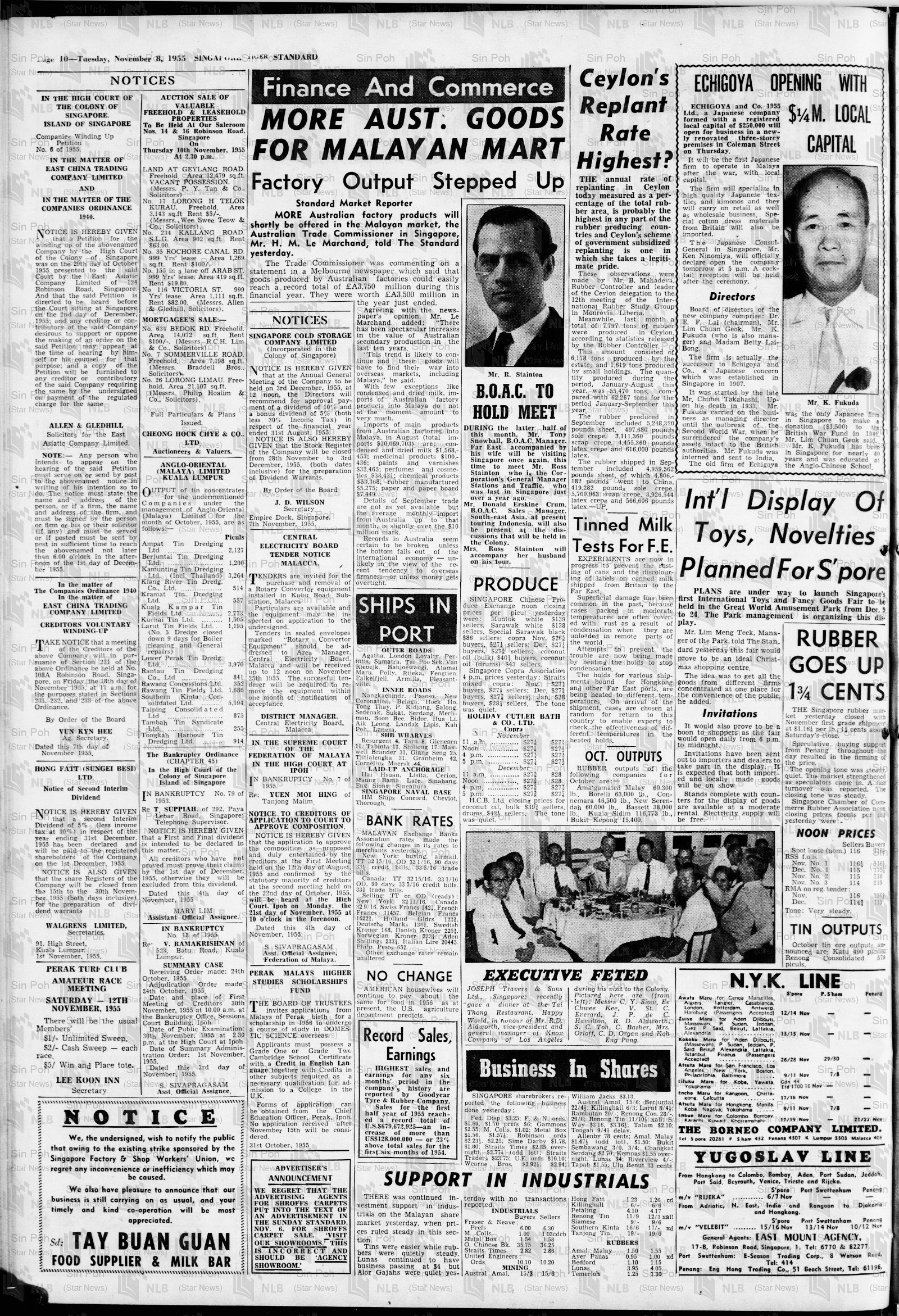 Page 10 of the Singapore Standard, 8 November 1955. "Echigoya opening with $¼m. local capital", top right, carries a photograph of Fukuda Kurahachi. (Singapore Standard, via NewspaperSG, National Library Board Singapore, public domain)
Some of the internees did come back. Fukuda returned to Singapore in 1954, and in November 1955 he reopened Echigoya in a renovated three-storey building on Coleman Street, as Echigoya and Co. 1955 Ltd., with $250,000 of local capital. The Singapore Standard called it the first Japanese firm to operate in Malaya after the war with local capital, and noted that Fukuda had lived in Singapore for nearly 40 years and that, when the war broke out, he had surrendered the company’s assets to the British authorities intact. He ran the business until it closed in 1977.
Interned in India, 1941-46, and after
From the arrests in Singapore to the Deoli camp, and what followed in Singapore
Sources: de Matos and Ward (2021); Straits Times, 8 Dec 1941 and 19 Sep 1951; Malaya Tribune, 26 Mar 1946; Singapore Standard, 8 Nov 1955.
View as table
| Date | Event |
|---|---|
| Sep 1941 | The Governor of the Straits Settlements asks the Government of India whether it would receive Malaya's Japanese internees if war came, about 2,000 men and 750 women, at the Malayan governments' expense. |
| 8 Dec 1941 | Hours after the attack on Pearl Harbor, police round up Japanese nationals across Malaya. The Straits Times expects 1,300 to have been taken in Singapore by the time it goes to press. |
| Jan 1942 | The men sail on 7 January 1942 and reach Bombay on the 19th, then go by train to the Purana Qila, Delhi's old fort. The women and children sail separately to Calcutta. |
| Aug 1942 | About 720 internees from Purana Qila are sent home in the Anglo-Japanese civilian exchange at Lourenco Marques, mostly consuls, bank and company managers and teachers. |
| Mar-Apr 1943 | The remaining internees, about 2,100, move to brick barracks at Deoli, near Ajmer. |
| Aug 1945 | Japan surrenders. Many internees refuse to believe it, and the camp splits between those who accept the news and those who do not. |
| Feb 1946 | On 26 February 1946 troops open fire during a confrontation in the camp. Reuters reported 15 internees killed and 16 wounded; later accounts put the deaths at 14 to about 20. |
| May 1946 | The internees leave Deoli in May 1946, nine months after the surrender, and are sent on to Japan, Taiwan and elsewhere. |
| Sep 1951 | Singapore's Legislative Council approves $4,644,972 as its share of India's bill for keeping the internees, three-fifths of the total. |
| Nov 1955 | Fukuda Kurahachi, interned in 1941, reopens the Echigoya store on Coleman Street as the first Japanese firm in Malaya after the war with local capital. |
See 12 more pictures related to this post →
Why it matters today: The internment of Singapore’s Japanese residents was largely forgotten in all three countries involved: in Britain, beside the suffering of its own prisoners of war; in India, beside the struggle for independence; and in Japan, where the internees seldom spoke of it. When it happened, no international treaty set rules for civilians held in wartime, and the warring powers broadly agreed to apply the relevant parts of the 1929 Geneva Convention on prisoners of war to them instead; in Delhi the authorities admitted that the makeshift camp meant even those principles could not be applied in full. The Fourth Geneva Convention of 1949 now sets out how enemy civilians may be interned and how they must be housed, fed and released, and Singapore has been a party to it since 1973. The internment of Fukuda and his fellow residents shows the gap those rules were written to close.
Sources
- The Straits Times, 8 December 1941, “All Japanese Rounded Up”, page 8
- Syonan Sinbun, 15 December 1942, “British Maltreatment of Japanese”, page 1
- Sunday Tribune, 27 January 1946, “Koreans, Formosans Will Be Evacuated”, page 4
- Malaya Tribune, 26 March 1946, “Jap Internees Won’t Believe War Is Over”, page 1
- The Straits Times, 8 May 1951, “India Sends Bill For Keeping Japs”, page 8
- The Straits Times, 19 September 1951, “Japs in India cost S’pore $4,644,000”, page 4
- Singapore Standard, 8 November 1955, “Echigoya Opening With $¼M. Local Capital”, page 10
- Christine de Matos and Rowena Ward, “Forgotten Forced Migrants of War: Civilian Internment of Japanese in British India, 1941–6”, Journal of Contemporary History 56, 4 (2021), via ResearchOnline@ND
- Journal of Contemporary History: the same article (publisher’s page)
- International Review of the Red Cross: Accession to the Geneva Conventions by the Republic of Singapore (1973)
- Wikipedia: Tatsuta Maru (the 1942 exchange at Lourenço Marques)
- Wikimedia Commons: Purana Qila ramparts, Delhi.jpg
- Wikimedia Commons: Changi Prison in 1936.jpg
- Wikimedia Commons: Old Fort(purana qila) Delhi.jpg
- Wikimedia Commons: Purana Qila, Delhi 2.jpg
- Wikimedia Commons: Purana Qila in Delhi 03-2016 img1.jpg
- Wikimedia Commons: John Edmund Taylor, St. John’s Island & the Sisters. From Tanjong Katong Singapore (1879, Wellcome V0037483).jpg
- Wikimedia Commons: St. John’s Island (Singapore).jpg
- Wikimedia Commons: Port Swettenham And Vicinity.jpg
- Wikimedia Commons: 006 1940 - Bombay Harbour, India.jpg
- Wikimedia Commons: Kidderpore dock No. 1 in 1885 - looking towards river, showing temporary railway lines for removal of spoil.jpg
- Wikimedia Commons: KITLV - 103764 - Lambert & Co. - Japanese women in Singapore - circa 1890.tif
- Wikimedia Commons: Japanese Cemetery Park.jpg
- Wikimedia Commons: Japanese war memorial, Japanese Cemetery Park, Singapore - 20070526.jpg


