The Japanese Fishermen Who Fed Prewar Singapore
In the 1930s, Japanese fishermen supplied 40 to 50 per cent of the fresh fish sold at Singapore’s municipal markets, even though there were only about a third as many of them as local Chinese and Malay fishermen. Within a few years, licence limits, a boycott and growing suspicion had cut the fleet down to a fraction of its size, and by December 1941 it was gone.

Fishing stakes and small boats at Pasir Puteh, around 1910. Local Chinese and Malay fishermen worked mostly from small unpowered boats, using stationary stake nets, drift nets and lines. (Photo: C.J. Kleingrothe, KITLV, Leiden University Library, public domain, via Wikimedia Commons)
Men from Itoman
Japanese had been trying to fish from Singapore since the late nineteenth century, but according to the historian Hiroshi Shimizu, none of the early attempts succeeded. That changed after 1913, when Tokyo’s Ministry of Agriculture and Commerce sent a fishery expert, Takayama Itarō, to survey the waters. His report pointed to the lack of severe fishing restrictions, the large demand for fresh fish and the existence of established fish markets. Japanese fishing firms followed in the early 1920s, among them Ishizu Gyogyō Kōshi in 1921 and Taichong Kongsi in 1922.
The men who crewed them came mostly from Okinawa, and many from a single town, Itoman, on the southern part of the main island. Shimizu, citing an earlier Japanese study, puts the share at about 80 per cent of the fishermen employed by Taichong and Ishizu. Itoman had almost no farmland, and its fishermen had developed a method called muro-ami. By 1920 the fishing grounds around Okinawa were depleted and the island’s interwar economy was weak, while Southeast Asia offered warm coral waters, open sea and a large market for fresh fish. The number of Okinawan men in Singapore rose from 292 in 1926 to 1,035 in 1937.
Muro-ami was a team effort. A crew of 40 to 50 fishermen worked from two carrier boats and four small wooden boats called sabani. Divers located a shoal of reef fish, mainly of the genus Caesio, and drove it into a large bag net, which the men on the boats then closed and hauled in. The divers were often boys. Shimizu, drawing on Japanese sources, describes how Itoman fishermen took boys from poor families on Okinawa’s outlying islands in return for an advance payment to their parents, and kept them as indentured apprentices for about ten years. In 1929, muro-ami accounted for 600 of the 801 Japanese fishermen counted in Singapore, and for roughly 90 per cent of their catch.
The firms financed the move. They recruited in Okinawa, advanced money for travel and supplied boats and nets, so a skilled fisherman with no capital could still go. A Japanese-style fishing boat cost about $700 in Singapore, and a carrier boat about $2,000. At Taichong Kongsi, the profit after expenses was split 40 per cent to the company and 60 per cent to the fishermen.
Why they out-fished everyone
The local fishermen, mainly Chinese and Malay, worked closer to shore in small unpowered boats. They used stationary stake nets called kelongs, drift nets and lines. The Japanese used both powered and unpowered boats with modern gear, and packed their catches in ice to keep them fresh. A 1933 report by the colonial Director of Fisheries, W. Birtwistle, gave the average catch of a Chinese or Malay drift-net fisherman as 15 katties of fish a day, against 150 for the Japanese. A katti is about 680 grams. The colonial Blue Book for 1936 and the Malayan Year Book for 1939 both put the Japanese share of the fish sold at Singapore’s municipal markets at 40 to 50 per cent.
Japanese fishermen grew from 200 to about 1,000 in eighteen years
Fishermen in Singapore, 1920–1938, by community
Local figures are from the colonial Blue Book for the four years shown. Japanese figures for 1929 and 1936 come from a table in a 1991 study by Kataoka and the others from the Blue Book, all as compiled by the historian Hiroshi Shimizu, so small differences in counting are possible.
View data as table
| Year | Local fishermen | Japanese fishermen |
|---|---|---|
| 1920 | 2,550 | 200 |
| 1927 | 3,383 | 490 |
| 1929 | – | 801 |
| 1933 | 3,327 | 903 |
| 1936 | – | 1,038 |
| 1937 | – | 1,478 |
| 1938 | 3,016 | 1,083 |
The Depression hit the fleet hard. In the early 1930s, fish prices fell to about a quarter of their earlier level, partly because of a Chinese boycott, and the average monthly income of a muro-ami fisherman dropped from $70 in the late 1920s to $25 in 1932. Firms shifted toward drift-net fishing for Spanish mackerel, whose price fell less steeply, and several went under. Ishizu Gyogyō Kōshi went bankrupt in 1936. Taichong Kongsi took over boats, gear and men from the failing firms, and by 1936 it employed 671 of the 1,038 Japanese fishermen in Singapore. It built an ice factory and cold-storage plant in 1935. In 1937 its owner, Eifuku Tora, reorganised the business as a holding company that also covered ironworks, shipbuilding and a farm, and he built a pier with oil tanks at Tanjong Rhu.
The Japanese community in Singapore had begun with a very different group, the karayuki-san women of the late nineteenth century, whose story is told in our post on the Japanese Cemetery Park.
The suspicion
As war in Asia approached, the colonial authorities grew more concerned about Japanese nationals in Malaya. British officials had suspected since the 1920s that Japanese fishing boats might be gathering military information around Singapore’s naval base and airfields. Japanese sources cited by Shimizu record 40 cases between 1935 and 1940 in which Japanese fishing vessels strayed into British territorial waters.
The evidence for spying is harder to pin down. Japanese intelligence activity in prewar Malaya is documented, but the historian Max Everest-Phillips found that the scale of the threat was never clearly established, and the National Library Board’s account of the period notes that accusations against the fishermen were rarely, if ever, proven. The suspicion nevertheless shaped policy.
The squeeze
The restrictions came in steps. From February 1937, no new licences were issued to Japanese fishing boats. In 1938, the licences of 30 of about 150 Japanese-owned boats were not renewed, and Japanese owners were barred from registering boats under the names of local residents. In February 1939, the licences of 20 power boats and three sailing boats belonging to Eifuku’s group and seven other firms were not renewed. The authorities then gave notice that licences expiring from July 1939 would not be renewed either. Thirty Japanese fishing companies had operated in 1938. In 1940 only three remained: Taichong Kongsi, Ōshiro Gumi and Kaneshiro Gumi.
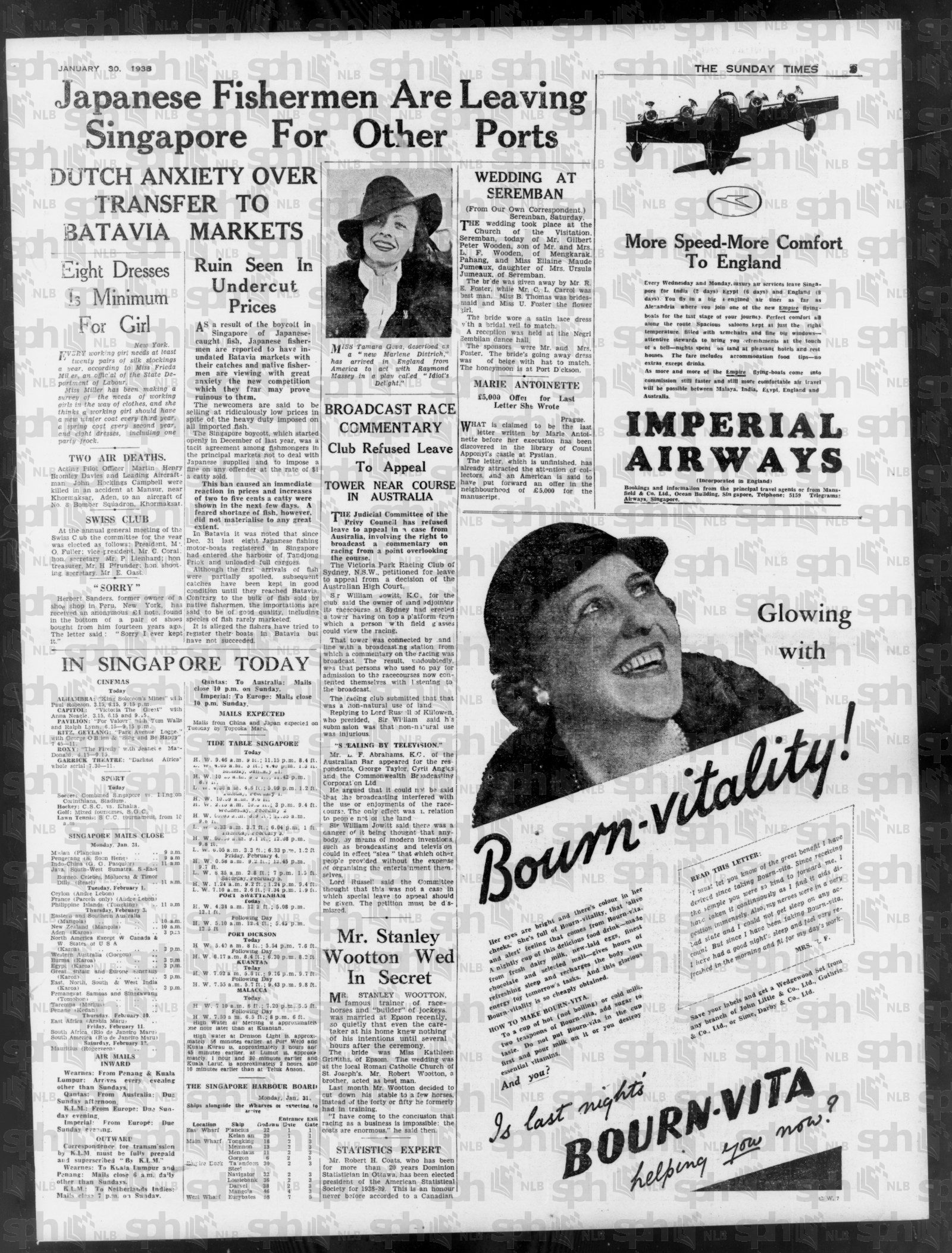 Page 3 of The Sunday Times, 30 January 1938, whose main headline reads "Japanese Fishermen Are Leaving Singapore For Other Ports." (Singapore Press Holdings, via NewspaperSG, National Library Board Singapore, public domain)
A trade dispute ran alongside the licensing. After the Sino-Japanese War began in 1937, Singapore’s fishmongers began openly boycotting Japanese-caught fish in December of that year. On 30 January 1938, The Sunday Times reported that Japanese boats were taking their catches to Batavia instead, and that fish prices in Singapore had risen by a few cents a catty, but that the feared shortage had not materialised.
Fishermen and firms felt the effect quickly. According to a petition reported in The Sunday Times on 2 April 1939, the Japanese had supplied half of Singapore’s fish before the boycott and still supplied more than a quarter. The number of Japanese fishermen had fallen from about 1,400 to about 900 within a year, and their power boats from about 100 to about 50. Some of the boats had gone to Japanese waters and some of the men to work in Malayan mines. The petitioners asked the government to lift the licence restriction and said it favoured domiciled Chinese and Malay fishermen. The government’s own line, in the Director of Fisheries’ annual report, was that licences for local fishing methods were to be confined to local fishermen.
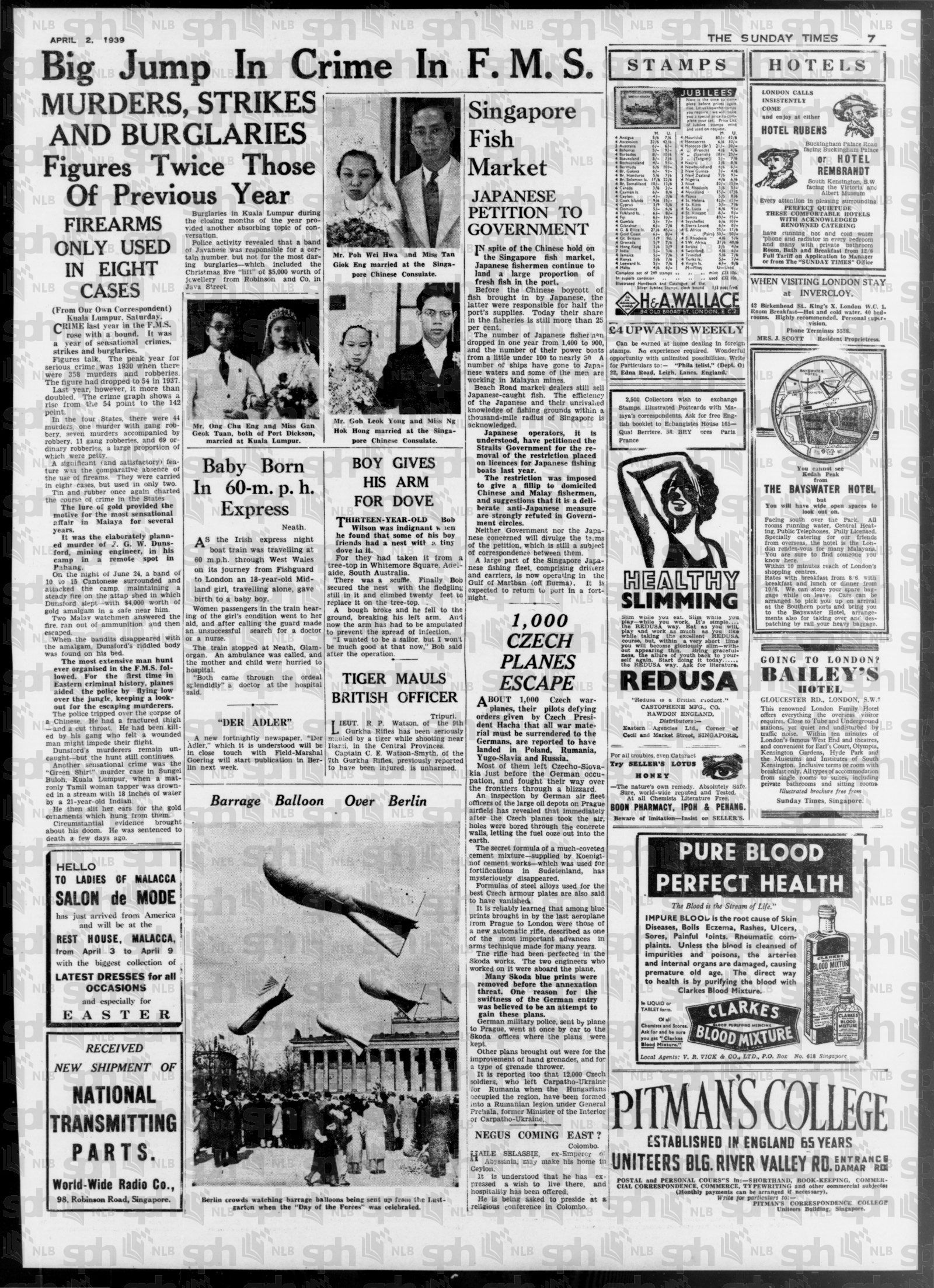 Page 7 of The Sunday Times, 2 April 1939, which carries the article "Singapore Fish Market: Japanese Petition to Government." (Singapore Press Holdings, via NewspaperSG, National Library Board Singapore, public domain)
Some of the displaced men found other work. By late 1938, more than 500 Japanese fishermen were employed at the Bukit Besi iron mine at Dungun, on the Malayan east coast, run by Nippon Kōgyō. Some 2,300 Chinese miners had quit it in protest at the Sino-Japanese War, and the company needed replacements. Others left Singapore for other ports, and by 1940 the fleet that had supplied close to half the city’s fresh fish was a small remnant.
December 1941, and one boat that stayed in the story
When war reached Malaya in December 1941, Japanese civilians in Singapore were interned. According to the historians Christine de Matos and Rowena Ward, nearly 2,700 Japanese civilians and colonial subjects, mainly from Singapore and Malaya, were held in camps in British India between December 1941 and May 1946.
One boat from the fleet had a remarkable afterlife. Kofuku Maru, a Japanese fishing vessel built in 1934 and based in Singapore, was captured by the American destroyer USS Edsall in 1941. In Allied hands, she carried more than 1,100 people from sunken ships off Sumatra to safety, made her way to Australia by way of Ceylon and India, and was renamed Krait. In September 1943 she carried commandos of the Z Special Unit to the waters near Singapore, disguised as a Japanese fishing boat, in the operation known as Jaywick. Their canoeists raided the harbour, and the raid is credited with sinking seven ships. A Japanese fishing boat had been an ordinary sight in those waters only a few years earlier.

The Krait, formerly the Japanese fishing boat Kofuku Maru of Singapore, at Darwin after her purchase by the Australian military. (Photo: unknown author, Australian War Memorial, public domain, via Wikimedia Commons)
See more historical photos related to this post →
Why it matters today: The Japanese fishing fleet rarely appears in the story Singapore tells about its own food supply and its prewar economy, although for a few years it supplied close to half the fish at the city’s markets. It also shows how the approach of war reshaped an ordinary trade. Within about three years, licence limits, a boycott and suspicion had cut roughly 30 firms to three, and a boat from the same fleet ended up on the Allied side.
Sources:
- Shimizu, Hiroshi, “Theories of Migration and the Okinawan Fishermen in Colonial Singapore,” Research on Contemporary Society 3 (2008), Aichi Shukutoku University (PDF)
- British restrict Japanese fishing in Singapore — National Library Board Singapore
- Everest-Phillips, Max, “The Pre-War Fear of Japanese Espionage: Its Impact and Legacy,” Journal of Contemporary History (2007)
- Whatever Happens to the Pre-war Japanese Community in Singapore? — Lam Pin Foo
- de Matos, Christine and Rowena Ward, “Forgotten Forced Migrants of War: Civilian Internment of Japanese in British India, 1941–6,” Journal of Contemporary History (2021)
- MV Krait — Wikipedia
- “Japanese Fishermen Are Leaving Singapore For Other Ports,” The Sunday Times, 30 January 1938, p. 3 — NewspaperSG
- “Singapore Fish Market: Japanese Petition to Government,” The Sunday Times, 2 April 1939, p. 7 — NewspaperSG
- “Japanese in Singapore: Fishing Licences Controversy,” The Straits Times, 3 October 1939, p. 10 — NewspaperSG
- File:KITLV - 79910 - Kleingrothe, C.J. - Medan - Pasir Puteh at Singapore - circa 1910.tif — Wikimedia Commons
- File:Krait (AWM 067338).jpg — Wikimedia Commons
- File:KITLV - 79908 - Kleingrothe, C.J. - Medan - Rochor, Singapore proa harbor - circa 1910.tif — Wikimedia Commons
- File:KITLV - 79919 - Kleingrothe, C.J. - Medan - Prao harbour in Singapore, presumably in the Singapore River - circa 1910.tif — Wikimedia Commons
- File:Krait-crew.jpg — Wikimedia Commons
- File:Admiralty Chart No 2586 Eastern Portion of Johore Strait (Singapore Old Strait) Pulo Ubin to Sungi Kranji, Published 1924.jpg — Wikimedia Commons


