The Chinese Banks That Became OCBC
On the morning of 20 November 1913, a crowd gathered outside the Kwong Yik Bank on Kling Street to find a notice pinned to its doors: the bank could not pay its depositors. Singapore’s first Chinese bank had lasted ten years. Over the next two decades, more Chinese banks opened, most of them run by and for one dialect community, until the Great Depression pushed three of them into the merger that created OCBC in 1932.

Kling Street, where the Kwong Yik Bank opened in 1903, in a postcard of 1907. It was renamed Chulia Street in 1922. (Image: New York Public Library, public domain, via Wikimedia Commons)
Why Chinese merchants wanted their own banks
When the European banks arrived from 1840, most of their Chinese customers reached them through a comprador, a local intermediary who vouched for them. By the early 1900s, Singapore’s Chinese merchants were running rubber estates, shipping lines and trading houses of their own, and some of them wanted banks that would lend to their own community on their own terms.
Kwong Yik, 1903–1913
The first was the Kwong Yik Bank, which opened at 26 Kling Street in 1903. It was founded by Cantonese businessmen led by Wong Ah Fook, a building contractor and gambier planter, and it offered ordinary banking, mortgages and loans to a mostly Chinese clientele.
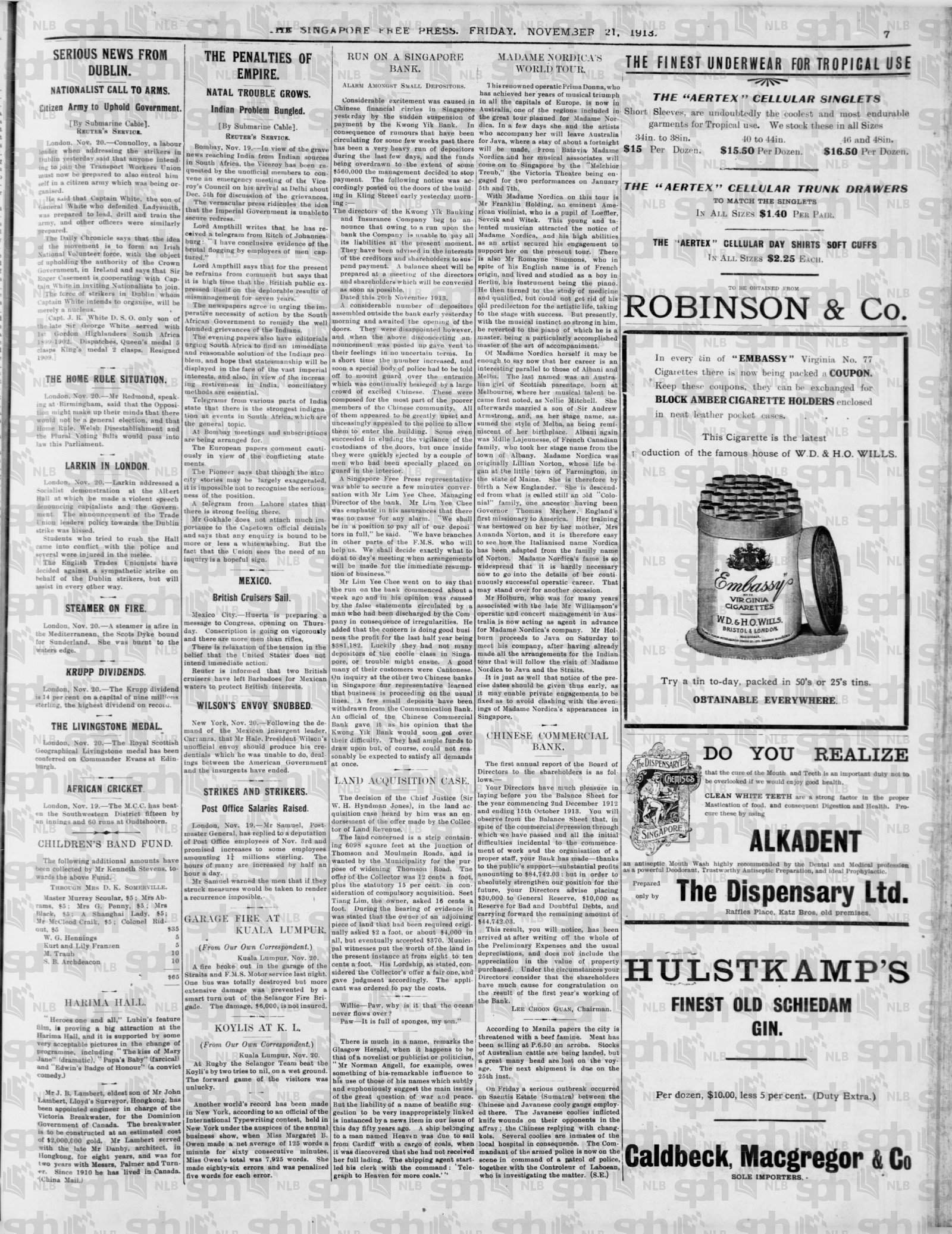 Page 7 of the Singapore Free Press, 21 November 1913, which reported the run on the Kwong Yik Bank. (Singapore Free Press and Mercantile Advertiser, via NewspaperSG, National Library Board Singapore, public domain)
In November 1913, after weeks of rumours, depositors ran on the bank. According to the Singapore Free Press, its funds were overdrawn by about $560,000 when the directors decided to stop payment, and a notice was posted on the doors early on 20 November. A crowd gathered outside, most of them, the paper said, from the poorer members of the Chinese community, and a special body of police had to guard the entrance. The bank went into liquidation, and its liquidators exposed irregular record-keeping and financial malpractice in its management. In 1915 the colony amended its Companies Bill to restrict the loans a bank could make to its own directors and officers.
One bank per community
 Lim Boon Keng, who helped found all three of Singapore's early Hokkien banks, in the 1930s. (Photo: Lee Brothers Studio, public domain, via Wikimedia Commons)
The next banks followed dialect lines. The Teochew community’s Sze Hai Tong Banking and Insurance Company was established in January 1907 on Kling Street, staffed mainly by Teochews. The Hokkien community’s first bank, the Chinese Commercial Bank, opened on 2 December 1912 with $2 million in issued capital, and is credited with popularising cheques among Chinese traders. Its first chairman was Lee Choon Guan and its vice-chairman Lim Boon Keng, and its managing director was Lim Peng Siang, who went on to found a second Hokkien bank, Ho Hong Bank, in 1917.
Each bank drew its directors, staff and depositors mostly from its own community, and when trouble came, that community mattered. On 4 August 1914, when war broke out in Europe, a panicking public drew about $260,000 from the Chinese Commercial Bank, and it had to suspend payment. The government examined its accounts, declared that its assets exceeded its liabilities, and helped it reopen in September. According to Song Ong Siang, the Teochew business community stood by Sze Hai Tong through the same panic, and its largest shareholder, Low Peng Yam, put $500,000 into the bank.
The rubber boom bank
 Lim Nee Soon, one of the rubber magnates behind the Oversea-Chinese Bank. (Image: from Song Ong Siang's One Hundred Years' History of the Chinese in Singapore, CC BY-SA 4.0, via Wikimedia Commons)
The boom after the First World War brought the third Hokkien bank. The Oversea-Chinese Bank was formed in 1919 with $5.25 million in paid-up capital, backed by the rubber magnates Lim Nee Soon and Tan Ean Kiam, and its fortunes were tied closely to rubber. Lim Boon Keng persuaded Oei Tiong Ham, the wealthy Hokkien industrialist of Java, to buy shares, and Chinese merchants in Rangoon backed it too. It opened branches in Penang, Rangoon, Kuala Lumpur, Malacca, Amoy and Sumatra, and much of its business was remittances from Southeast Asia to China.
The Cantonese community tried again as well. In March 1920 Eu Tong Sen, the tin and medicine magnate, opened the Lee Wah Bank on South Canal Road to serve the Cantonese, and its staff were expected to speak Cantonese.
Singapore’s first Chinese banks, by community
Each bar is a bank’s life under its own name; the three Hokkien banks merged into OCBC in 1932. Hover or tap a bar for details.
Dates and capital figures from the Infopedia articles cited below the post.
View as table
| Bank | Community | Years |
|---|---|---|
| Kwong Yik | Cantonese | 1903–1913 |
| Lee Wah | Cantonese | 1920–1973 |
| Sze Hai Tong | Teochew | 1907–1972 |
| Chinese Commercial | Hokkien | 1912–1932 |
| Ho Hong | Hokkien | 1917–1932 |
| Oversea-Chinese | Hokkien | 1919–1932 |
| OCBC | Hokkien | 1932– |
The Depression and the merger
The Depression hit the Chinese banks hard, because many of their customers were rubber planters and dealers. In 1932 the Oversea-Chinese Bank’s Rangoon branch suffered a run after local Chinese leaders fell out with the bank over its remittance service, and although the bank survived it, it could not ride out the slump alone. Its directors opened confidential talks with Ho Hong Bank, and the Chinese Commercial Bank was then invited to join.
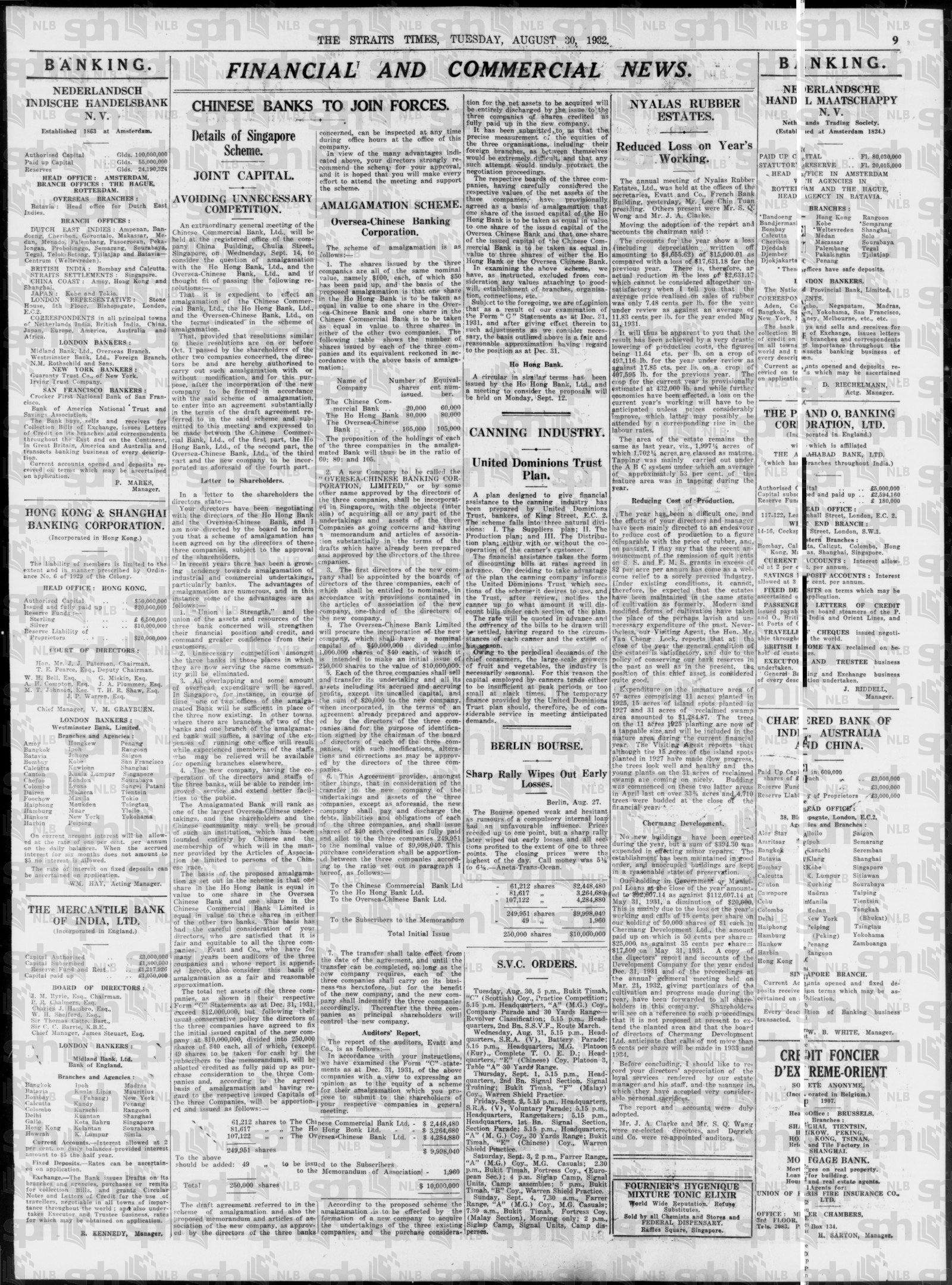 Page 9 of the Straits Times, 30 August 1932, with the article “Chinese Banks to Join Forces”. (Singapore Press Holdings, via NewspaperSG, National Library Board Singapore, public domain)
On 30 August 1932 the Straits Times printed the scheme. The directors’ letter to shareholders listed its advantages, beginning with “Union is Strength”: the merged bank would have a stronger financial position, overlapping offices could be closed, and “unnecessary competition amongst the three banks in those places in which they are now serving the same community” would end. One share in the Chinese Commercial Bank was valued at three shares in either of the other two.
The Oversea-Chinese Banking Corporation was incorporated on 31 October 1932, with $10 million in paid-up capital, and opened for business at the start of 1933 in the China Building on Chulia Street, the old Kling Street, where Kwong Yik had failed nineteen years earlier. The talks that created it were led by Tan Ean Kiam of the Oversea-Chinese Bank and Lee Kong Chian of the Chinese Commercial Bank, and Lee went on to chair OCBC from 1938 to 1964.
What happened to the others
The merger joined the three Hokkien banks, but not the others. The Teochew bank kept its independence for another four decades. Renamed Four Seas Communications Bank in 1964, it was taken over by OCBC in 1972. The Cantonese Lee Wah Bank was acquired by UOB in 1973.

OCBC’s Art Deco building on Beach Street, George Town, Penang, one of the bank’s branches outside Singapore. (Photo: LEE 003, CC BY 4.0, via Wikimedia Commons)
See more historical photos related to this post →
Where it fits in the bigger story: OCBC is usually remembered as one of Singapore’s big local banks. It began as three banks that belonged to one community, formed after a decade in which Chinese banks were founded along dialect lines and the first of them failed in a single morning on Kling Street.
Sources
- Kwong Yik Bank is founded, National Library Board
- Sze Hai Tong Banking & Insurance Company Limited, Infopedia (National Library Board)
- Chinese Commercial Bank, Infopedia (National Library Board)
- Oversea-Chinese Bank is formed, National Library Board
- Oversea-Chinese Banking Corporation is incorporated, National Library Board
- Eu Tong Sen, Infopedia (National Library Board)
- Kwong Yik Bank, Wikipedia
- “Run on a Singapore Bank”, Singapore Free Press, 21 November 1913, page 7, NewspaperSG
- “Chinese Banks to Join Forces”, The Straits Times, 30 August 1932, page 9, NewspaperSG
- File:Kling Street, Singapore (NYPL Hades-2359713-4044478).jpg, Wikimedia Commons
- File:Lim Boon Keng, 1930s.jpg, Wikimedia Commons
- File:Lim Nee Soon.png, Wikimedia Commons
- File:OCBC Art Deco Beach St.jpg, Wikimedia Commons
- File:Kling Street in Singapore, RP-F-AA3188-BM.jpg, Wikimedia Commons (gallery)
- File:25 stereographs depicting Singapore town views Or. 27.423 - photo 007.tif, Wikimedia Commons (gallery)
- File:KITLV - 79893 - Kleingrothe, C.J. - Medan - Raffles Place and King Street in Singapore - circa 1910.tif, Wikimedia Commons (gallery)
- File:Lee Choon Guan.png, Wikimedia Commons (gallery)
- File:Oei Tiong Ham.jpg, Wikimedia Commons (gallery)
- File:Eu Tong Sen.jpg, Wikimedia Commons (gallery)
- File:Lee Kong Chian, 1946.png, Wikimedia Commons (gallery)
- File:Oversea-Chinese Banking Corporation Building, Beach Street, George Town, Penang.jpg, Wikimedia Commons (gallery)


