Lim Peng Siang, the Man Singapore Called Its Greatest Magnate
In July 1936, a reporter for a Singapore Sunday paper called Lim Peng Siang one of “the greatest magnates living in Singapore.” He had built a rice mill and an oil mill into a group that spanned shipping, banking and cement, and for a few decades he was one of the most important Chinese businessmen in the colony. Today his name is almost unknown, attached to little more than a minor quay near the port his ships once used.

The Boat Quay, Singapore, photographed between about 1890 and 1910, the kind of working waterfront on which Lim Peng Siang built his first business. (Photo: Rijksmuseum, Amsterdam, CC0, via Wikimedia Commons)
Rice and oil, 1904
 Lim Peng Siang, from Song Ong Siang's 1923 book. (Photo: Song Ong Siang, One Hundred Years' History of the Chinese in Singapore, 1923, CC BY-SA 4.0, via Wikimedia Commons)
Lim Peng Siang was born in Amoy (now Xiamen), in Fujian province, in 1872, the sixth son of the merchant Lim Ho Puah. His mother was the daughter of Wee Bin, founder of Wee Bin & Co., one of the major Straits Chinese shipping firms of the mid-nineteenth century, and Lim Ho Puah himself went on to run that same firm. Lim Peng Siang grew up, in other words, in a family already deep in Singapore’s shipping trade before he built anything of his own.
His own start was smaller and different. In 1904, he and his brother Lim Peng Mau founded Ho Hong Co. on a loan of $50,000, going into rice and coconut oil rather than ships. Ho Hong’s rice mill processed up to 100 tons of parboiled rice a day, and its oil mill, powered by a 250-horsepower engine, could turn out up to 130 tons of coconut oil a week. It was a modest, industrial beginning: milling, not trading, and machinery bought outright rather than capital borrowed against a name.
The 1911 auction
 Wee Bin, Lim Peng Siang's maternal grandfather and founder of Wee Bin & Co. (Photo: Song Ong Siang, One Hundred Years' History of the Chinese in Singapore, 1923, CC BY-SA 4.0, via Wikimedia Commons)
That name mattered more than Lim probably expected. In 1911, Wee Bin & Co., the firm his father had run and his grandfather had founded, was liquidated. At the public auction of its assets, Lim Peng Siang bought four of its steamships, the firm’s most valuable remaining property, and folded them into a new shipping department inside Ho Hong.
 The Tanjong Rhu shipyard, Singapore, in 1932, the same area that gave one of Lim's steamships its name. (Photo: unknown author, public domain, via Wikimedia Commons)
Two years later he formalised the business as the Ho Hong Steamship Co. Ltd., and the fleet grew quickly: by 1926 it ran fourteen vessels, some of them named, fittingly, after Singapore places, Tanjong Rhu and Tanjong Kling among them.
Buying a bankrupt rival’s ships at auction is an ordinary enough business move, but this was also, quite literally, buying back the family trade. The firm he was absorbing had been founded by his own grandfather.
Banking and cement complete the group
 Ho Hong Bank's own building, its name over the door, behind a road crew asphalting the square in front of Batavia's Kota railway station in 1929. (Photo: unknown photographer, Nationaal Museum van Wereldculturen, public domain, via Wikimedia Commons)
Ho Hong kept adding pieces through the 1910s. Lim co-founded the Chinese Commercial Bank in 1912, with $2,000,000 in issued capital, and in 1917 he helped found Ho Hong Bank itself, alongside Lim Boon Keng, a name readers of our post on Song Ong Siang will recognise as Song’s own collaborator. Ho Hong Bank opened with $1,750,000 in paid-up capital, and expanded fast beyond Singapore, opening branches in Batavia and Palembang, in the Dutch East Indies, within its first few years. By the early 1920s a Portland cement works, also under the Ho Hong name, was turning out cement at Ulu Pandan with some $3,000,000 in capital behind it.
From a $50,000 loan to a $3,000,000 cement works
Capital of the Ho Hong group's core ventures, at founding
Figures are Straits dollars, as reported at each venture's founding, drawn from Song Ong Siang (1923) and a 2023 academic study of Lim Peng Siang's enterprises. They are not directly comparable across years, since prices and the value of money shifted over this period.
View data as table
| Venture | Year | Capital | Basis |
|---|---|---|---|
| Ho Hong Co. | 1904 | $50,000 | a $50,000 loan to start |
| Ho Hong Bank | 1917 | $1,750,000 | paid-up capital |
| Chinese Commercial Bank | 1912 | $2,000,000 | issued capital |
| Ho Hong Portland Cement Works | 1921 | $3,000,000 | capital |
Rice, oil, shipping, banking and cement under one roof was an unusual combination for a Chinese-owned business in colonial Singapore, where firms more often specialised or spread through simple trading houses. A 2023 academic study of Lim’s enterprises argues that businessmen like him were already building modern, technically ambitious industrial companies well before the postwar period usually credited with Singapore’s industrialisation.
A public man
Lim’s standing outside Ho Hong grew alongside it. He served as president of the Singapore Chinese Chamber of Commerce from 1913 to 1916, sat on the Chinese Advisory Board from 1921 until the Japanese invasion in 1941, and chaired the Hong Kong Fujian Chamber of Commerce with his brother from 1930. He was made a Justice of the Peace and was offered a seat on the Legislative Council more than once, which he turned down each time.
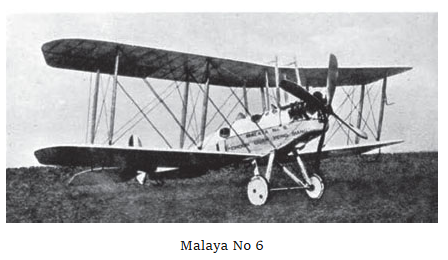 Malaya No. 6, the biplane Lim Peng Siang and Lee Choon Guan helped fund. (Photo: Song Ong Siang, One Hundred Years' History of the Chinese in Singapore, 1923, public domain)
During the First World War, he and the businessman Lee Choon Guan jointly donated a fighter aircraft to the British Air Force. The plane, one of several bought by public subscription in Malaya, was named Malaya No. 6 and carried the donors’ own names, Choon Guan Peng Siang, painted on its side. It was this kind of standing, decades in the building, that the Sunday paper was pointing to in 1936 when it called him one of Singapore’s greatest magnates.
The fall, and the merger that erased two of his banks
The Depression broke the momentum. Fish and rubber prices collapsed across Malaya in the early 1930s, and Ho Hong was not spared: Lim sold his shipping interests to the Straits Steamship Company for $900,000, reorganised the oil mills in 1931, and closed the cement works the following year.
The heavier blow came from banking.
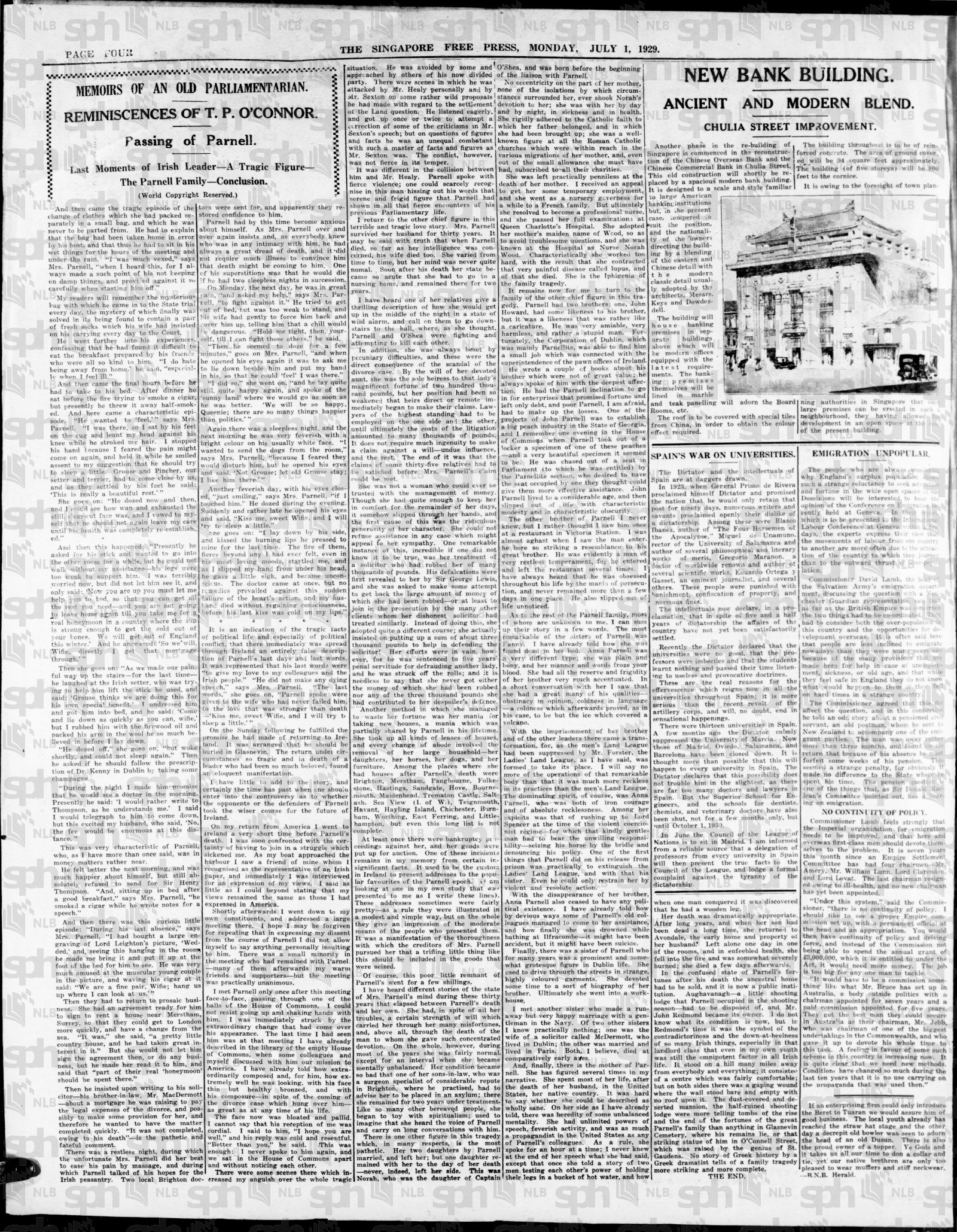 Page 4 of the Singapore Free Press, 1 July 1929. Its article "New Bank Building" describes the Chinese Commercial Bank rebuilding its Chulia Street premises alongside the Oversea-Chinese Bank next door. (Singapore Free Press and Mercantile Advertiser, via NewspaperSG, National Library Board Singapore, public domain)
Three years earlier, in 1929, the Chinese Commercial Bank had rebuilt its own premises on Chulia Street, a reinforced-concrete building of five storeys, going up alongside a similar new building for the Oversea-Chinese Bank next door. Neither bank’s board can have known it at the time, but they were modernising for a future that would fold them into the same institution. On 31 October 1932, the Chinese Commercial Bank and Ho Hong Bank, the two banks Lim had helped build, merged with the Oversea-Chinese Bank to form the Oversea-Chinese Banking Corporation, now known simply as OCBC. The merger is remembered today as the work of Tan Ean Kiam and Lee Kong Chian, the men who led it and whose names survive in OCBC’s own institutional history. Lim Peng Siang, who had put up two of the three banks that made the merger possible, is not part of that story as it is usually told.
 Song Ong Siang's 1923 book profiled Lim Peng Siang while Ho Hong was still near its peak. (Photo: Song Ong Siang, One Hundred Years' History of the Chinese in Singapore, 1923, public domain, via Wikimedia Commons)
He had already been profiled, at length, in Song Ong Siang’s 1923 book, One Hundred Years’ History of the Chinese in Singapore, written while Ho Hong was still near its peak. That record, and the 1936 newspaper profile that followed it, are largely what a researcher has to work with today. A 2023 study of his career notes plainly that Lim Peng Siang has drawn far less scholarly attention than contemporaries such as Tan Kah Kee, even though his group was, for a time, one of the larger Chinese-owned industrial concerns in the region.
Lim Peng Siang died in Singapore on 21 March 1944, during the Japanese Occupation. His name lives on in Peng Siang Quay, a short stretch of waterfront near Tanjong Pagar, not far from the harbour his steamships once sailed out of.
See more historical photos related to this post →
Why it matters today: OCBC, formed in 1932 out of three separate Chinese-owned banks, is one of Singapore’s oldest and most prominent institutions, but its own prehistory has been flattened into the story of the men who arranged the merger. Two of the three banks that went into it belonged to a man once called one of Singapore’s greatest magnates, and almost nobody today could tell you his name.
Sources:
- Lim Peng Siang — Wikipedia
- Goh, Jeremy and Koh Keng We, “Industrialisation and Chinese big business in colonial Singapore, Malaya, and China: The transnational enterprises of Lim Peng Siang (1904–41),” Journal of Southeast Asian Studies 54, no. 1 (2023): 89–115
- Wee Bin & Co. — Wikipedia
- OCBC Bank — Wikipedia
- Singapore’s Grandfathers’ Roads – Legacies of Our Pioneers — Remember Singapore
- Song Ong Siang, One Hundred Years’ History of the Chinese in Singapore (1923)
- Ho Hong Bank — Wikipedia
- File:Lim Peng Siang.png — Wikimedia Commons
- File:Wee Bin.jpg — Wikimedia Commons
- File:Collectie NMvWereldculturen, TM-60032202 — Wikimedia Commons
- “New Bank Building: Ancient and Modern Blend, Chulia Street Improvement,” Singapore Free Press and Mercantile Advertiser, 1 July 1929, page 4 — NewspaperSG
- File:One Hundred Years’ History of the Chinese in Singapore.png — Wikimedia Commons
- File:Binnenhaven van Singapore, The boat quay Singapore — Wikimedia Commons
- File:Tanjong Rhu shipyard in 1932.png — Wikimedia Commons
- File:Amoy town and harbour seen from Kalangsu Wellcome L0034288.jpg — Wikimedia Commons


