Before the Banks: How Singapore's Merchants Kept Their Money
For its first twenty-one years, Singapore was one of the busiest free ports in Asia and had no bank at all. Its merchants still borrowed, lent, paid and kept their money, through the trading firms known as agency houses, through moneylenders, and through credit extended from one trader to the next. When the first bank finally opened a branch in 1840, it joined that system rather than replacing it.

Battery Road around 1910, by which time it was lined with banks and trading firms. (Photo: Carl Josef Kleingrothe, KITLV/Leiden University Library, public domain, via Wikimedia Commons)
Money without banks
In the port’s early years, the work that a bank would do was done by the agency houses, European trading firms such as Guthrie & Co. that bought and sold goods on commission for merchants elsewhere. They held money for their clients, advanced credit against goods, and moved funds between Singapore, India and Europe. According to the National Library Board’s history of money lending, agency houses later went further, financing factories, sawmills, tin mines and rubber estates.
Trade itself ran on silver coins, mostly the Spanish dollar, and on credit between traders. Goods changed hands on the promise of payment after the next voyage, and much of the port’s business depended on who could be trusted to pay.
1840: the first bank
 A ten-dollar note of the Oriental Bank Corporation, issued in Singapore in 1885. The Oriental Bank opened in Singapore in 1846. (Photo: Osama Shukir Muhammed Amin, CC BY-SA 4.0, via Wikimedia Commons)
The first bank in Singapore was a branch of the Union Bank of Calcutta, opened in 1840. It offered merchants advances on goods to be imported, up to three-quarters of their value at 9 per cent interest, and loans against bullion of up to 90 per cent at 7 per cent. It also issued the first banknotes with the word “Singapore” printed on them. Its parent bank in Calcutta collapsed in 1848.
The foreign banks arrive
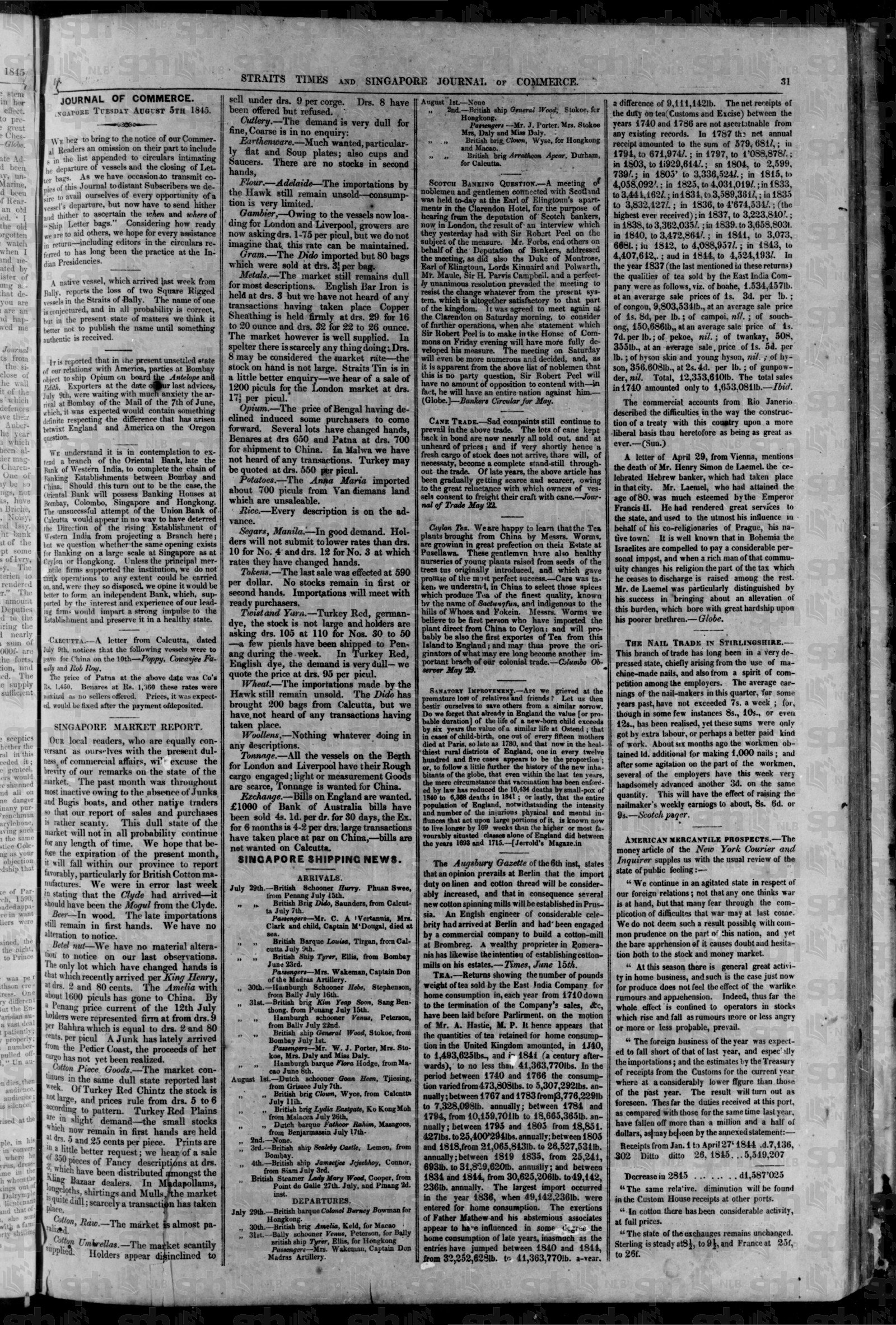 Page 7 of The Straits Times, 5 August 1845, which carried the short note that a Singapore branch of the Oriental Bank was planned. (Singapore Press Holdings, via NewspaperSG, National Library Board Singapore, public domain)
A year before the Oriental Bank opened, The Straits Times of 5 August 1845 reported that a Singapore branch was “in contemplation”, to complete the chain of banking establishments between Bombay and China.
Other banks followed, each based elsewhere and each opening a Singapore branch for the trade that passed through the port. The Oriental Bank came in 1846, the Mercantile Bank of India in 1855, the Dutch trading company the Nederlandsche Handel-Maatschappij in 1857, and the Chartered Bank of India, Australia and China in 1859. The Hongkong and Shanghai Bank did business in Singapore through an agency from the mid-1860s and, according to the bank’s own history, opened its first Singapore office in 1877.
These were European banks, and most of their Chinese customers reached them through a comprador, a local intermediary who, in the National Library Board’s words, “was responsible for every Chinese account opened” and who also recruited the bank’s local staff. The comprador vouched for the customers he brought in, and the bank relied on his judgement of who could be trusted.

The Hongkong and Shanghai Bank’s building in Singapore around 1900. (Photo: G.R. Lambert & Co., KITLV/Leiden University Library, public domain, via Wikimedia Commons)
The Chettiars
 The Sri Thendayuthapani Temple on Tank Road, built by the Chettiar community in 1859 and gazetted as a national monument in 2014. (Photo: Shesmax, CC BY-SA 4.0, via Wikimedia Commons)
Alongside the banks, many borrowers who could not get a bank loan went to the Chettiars, professional moneylenders from South India. The National Library Board’s account describes how they drew capital from wealthy investors in India, from local depositors and from the European banks themselves, which lent to them on demand notes. The banks found the arrangement safe enough, because their losses in dealing with the Chettiars were relatively small. The Chettiars’ terms could be expensive for borrowers: according to the same account, interest was charged on the full amount of the promissory note rather than the sum actually received, and unpaid amounts were rolled over into a new note at a higher rate.
The community’s standing in the town shows in the temple it built. The Sri Thendayuthapani Temple on Tank Road, better known as the Chettiars’ Temple, was built in 1859, the same year the Chartered Bank opened its branch.
What changed, and what didn’t
The foreign banks gave Singapore’s trade access to large amounts of capital and to London and the other ports of the East, and by the end of the century their buildings stood along Raffles Place, Battery Road and the waterfront. But they did not replace the older ways of keeping and lending money. The agency houses, the compradors and the Chettiars all went on working alongside the banks, and in the early 20th century Singapore’s own Chinese-owned banks began to open alongside them.
When the banks came, 1819–1877
Linear scale, 1815–1885
Dates from the sources cited below the post.
View as table
| Date | Event |
|---|---|
| 1819 | Singapore was founded as a free port in 1819 and had no bank until 1840; agency houses and moneylenders filled the gap. |
| 1840 | The Union Bank of Calcutta opened a branch in 1840, the first bank in Singapore, and issued the first notes printed with the name Singapore. |
| 1846 | The Oriental Bank opened a Singapore branch in 1846. |
| 1848 | The Union Bank in Calcutta collapsed in 1848. |
| 1855 | The Mercantile Bank of India opened in Singapore in 1855. |
| 1857 | The Dutch trading bank, the Nederlandsche Handel-Maatschappij, opened in 1857. |
| 1859 | The Chartered Bank of India, Australia and China opened in Singapore in 1859. The Chettiars' temple on Tank Road was built the same year. |
| 1877 | HSBC did business in Singapore through an agency from the mid-1860s and opened its own office in 1877. |
See more photos related to this post →
Where it fits in the bigger story: Singapore’s financial history is usually told from the bank buildings of Raffles Place and Battery Road. For the first two decades there were none, and the port still ran on trust, credit and silver through agency houses and moneylenders. When the banks came, from 1840, they settled into that system, and the people who connected them to their customers, the compradors and the Chettiars, are the part of the story that is easiest to overlook.
Sources
- Money Lending: A Short History, BiblioAsia (National Library Board)
- History of Currency in Singapore, Monetary Authority of Singapore
- The Union Bank (1828), Wikipedia
- Oriental Bank Corporation, Wikipedia
- Untitled report of the planned Oriental Bank branch, The Straits Times, 5 August 1845, page 7, NewspaperSG
- About HSBC, HSBC Singapore
- Sri Thendayuthapani Temple, Wikipedia
- File:KITLV - 79890 - Kleingrothe, C.J. - Medan - Battery Road at Singapore - circa 1910.tif, Wikimedia Commons
- File:10 dollar note, Oriental Bank Corporation, Singapore, 1885. On display at the British Museum in London.jpg, Wikimedia Commons
- File:KITLV - 50198 - Lambert & Co., G.R. - Singapore - Building of the Hong Kong and Shanghai Bank in Singapore - circa 1900.tif, Wikimedia Commons
- File:Singapore. Sri Thendayuthapani Temple. 2013-10-09 15-10-07.jpg, Wikimedia Commons
- File:The Chartered Bank aan Raffles Place te Singapore, KITLV 104795.tiff, Wikimedia Commons (gallery)
- File:Photographic Views of Singapore Plate 05 Hongkong and Shanghai Bank.jpg, Wikimedia Commons (gallery)
- File:KITLV - 1404900 - Johnston’s Pier and H. M. Bank. Singapore - 1895-1906.tif, Wikimedia Commons (gallery)
- File:1789 Charles IV Spanish dollar countermarked with Chinese words meaning “Singapore”.jpg, Wikimedia Commons (gallery)
- File:Mexico Carlos III Pillar Dollar of 8 Reales 1771.jpg, Wikimedia Commons (gallery)


