The Padang and the Cricket Club: The Field That Was Ordered to Stay Empty
In the middle of Singapore’s civic district, in front of the old City Hall, lies 4.3 hectares of grass that has never been built on. Armies have camped on it, kings’ birthdays have been saluted across it, a surrender was signed in the chamber above it, and a nation’s first cabinet was sworn in within sight of it — but for two hundred years the field itself has stayed empty, by order. In 2022 the emptiness itself was made a national monument. This is the story of the Padang, and of the two Victorian sports clubs that guard its ends.

The Padang in 2011, looking across the grass to the former Supreme Court (left) and City Hall — the two buildings that now form the National Gallery Singapore. (Dayou_X, CC BY-SA 2.0, via Wikimedia Commons)
An open square, by instruction
“Padang” is simply the Malay word for a field or open plain, and the plain was old before Singapore was. The Sejarah Melayu, the Malay Annals, calls it “the plain near the mouth of the river” at Temasek, and legend in the same text has Sang Nila Utama spotting his lion on this shore in the 13th century — legend, but the right shore. When Raffles and William Farquhar landed at the Singapore River mouth on 28 January 1819, it was Farquhar who picked the open plain for the camp: the ground was cleared, the Union Jack raised the next morning, and the treaty with the Sultan and the Temenggong followed on 6 February.
The field’s survival was decided three years later. Raffles returned in 1822 to find European merchants building on land he had ordered kept for public purposes. He stopped the building, and the town plan drawn by Lieutenant Philip Jackson under his instructions — the plan whose authorship this blog has untangled elsewhere — marks the field plainly as an “Open Square”. It was first the Sepoy Lines and the Cantonment, then simply the Plain; from 1831 it was the Esplanade, a name it kept until “Padang” took over in 1907.
What the square was for, Singapore decided for itself: everything outdoors. An artillery salute for the King’s birthday crossed it in April 1824. From the 1830s and 1840s the New Year brought a regatta on the water and sports on the grass — tug-of-war, foot races, pony races, sack races, rickshaw races, and, the record insists, a race after a pig. By 1845 the crowd needed managing: fearing for children’s safety, the Municipal Committee ringed the green with bollards and chains to protect it “from the incursions of pony-racing drunken sailors”. At the field’s northern end a small knoll, once mounted with guns against attack from the sea, became the place where colonial society gathered to exchange news, and was named, with feeling, Scandal Point. Fourteen centuries of the town lie under the grass, as the 1984 Fort Canning dig and a 2003 excavation at one corner of the cricket ground both showed — but the surface stayed grass.

The Esplanade, Singapore’s promenade, in an albumen print of about 1870 to 1900 — the field in its first career, as the town’s front lawn. (G. R. Lambert & Co., CC0, via Wikimedia Commons)
Two clubs, two ends, one colour line
Cricket came early and stayed. The game was being played on the field by 1837 — the earliest mention is a complaint about Europeans playing on Sundays. In October 1852 a meeting formally established the Singapore Cricket Club; the first two matches arranged both failed to raise full sides, the first eleven-a-side fixture came in March 1853, and 28 members signed on that year. The club is Singapore’s second-oldest, a decade younger than the Turf Club.
Its pavilion grew with it, at the field’s southern end. First, in the 1860s, came a simple wooden hut under the angsana trees at the Esplanade’s western corner. A single-storey bungalow followed in 1877, when membership stood at 98. In 1884 the club built on its present site the pavilion that still forms the core of today’s clubhouse; membership reached 378 by 1891, an addition followed in 1907, and in 1922 the northern and southern wings completed the building much as it stands. Cricket was only the start: an annual tennis tournament from 1875, lawn bowls from the 1870s, hockey from 1892, and football and rugby planted in Singapore in the 1880s with the club’s help. Touring sides made the Padang a stop on the cricket map — Charles Macartney’s Australian XI in 1927, Sir Julien Cahn’s XI in 1937, the first English team to visit, and a Commonwealth XI with Garfield Sobers in 1964.

The cricket ground in 1890: the pavilion of the Singapore Cricket Club on its field by the sea, in a Photoglob photochrome published by the Library of Congress. (Photoglob Co., Public domain, via Wikimedia Commons)

The pavilion of 1884, with its 1907 addition, photographed for the KITLV album published about 1910. (Kelly & Walsh Ltd., CC BY 4.0, via Wikimedia Commons)
But the club at the southern end was, in practice, for Europeans only — club membership, as Roots puts it, was “exclusively for British and Europeans residents in Singapore”, and it was opened to Asians only after the Second World War. So the field acquired a second club as an answer. On 23 June 1883 some thirty Eurasian men founded the Singapore Recreation Club, and the government granted it the Padang’s northern end for its cricket; its first pavilion was completed there in November 1885, a second clubhouse opened in 1905, and the present seven-level clubhouse in 1997. The SRC’s own colour line lasted eighty years: only on 11 February 1963 did its members vote, overwhelmingly, to open membership to all communities. Two clubs, one field, and for most of a century a line drawn down the middle of the grass that nobody had painted.
The stage set of empire
The field reached its present shape around 1890, when reclamation pushed the shoreline out and roughly doubled it; the new road between field and sea was renamed Connaught Drive in 1907. What rose behind it turned a sports ground into a stage. In 1926 the Municipal Commission began its new headquarters on part of the old Hotel de l’Europe site: designed by the municipal architect S. D. Meadows and, from 1925, his successor Alexander Gordon, the Municipal Building was completed in 1929 at a cost of about two million Straits dollars and opened by Governor Sir Hugh Clifford on 23 July 1929. Renamed City Hall in 1951, when Singapore became a city, it gave the Padang its backdrop and its steps. Beside it in 1939 rose the domed Supreme Court, on the site of the Grand Hotel de l’Europe, whose guests had watched the parades from its verandahs — that building’s story is told in that post.
 The Raffles statue on the Padang about 1890, three years after its unveiling — close enough to the cricket to be hit by stray footballs. (Unknown photographer, Public domain, via Wikimedia Commons)
The field’s most famous piece of furniture arrived on 27 June 1887, when Governor Frederick Weld unveiled Thomas Woolner’s bronze statue of Raffles at the centre of the sea side, the highlight of Queen Victoria’s Golden Jubilee. It stood in the line of fire: stray footballs hit it often enough that in February 1919, for the centenary of the founding, it was moved to Empress Place, where it stands today. The Padang kept escaping the planners — a governor’s idea of selling it in the 1830s, a proposal in the 1850s to move St Andrew’s Cathedral into its centre, and a 1930s scheme to pave it into a plaza, dropped after the public objected. King George V’s Silver Jubilee was celebrated on the grass in 1935, and then the stage was struck by war.

The Municipal Building a year or so after its 1929 opening — the backdrop the Padang had lacked for a century. (Anonymous, CC BY 4.0, via Wikimedia Commons)
Occupation
On 17 February 1942, two days after the fall of Singapore, the Japanese used the Padang as an assembly ground: the European population, civilians and prisoners of war, was held and interrogated on the field before being marched off to internment — the civilians to Changi Prison, whose own story this blog told yesterday. On 3 March the Eurasian community was assembled in front of the Recreation Club’s clubhouse, which served as a registration centre; those of British or Dutch parentage were sent to the camps. The Municipal Building became the headquarters of the Syonan Tokubetsu-si, the Japanese municipal administration, and the Padang its parade ground. The Cricket Club’s pavilion became a Japanese restaurant, the Yamoto, and its clubhouse the Syonan-ko Tonan Club, an officers’ tearoom. On 6 July 1943 Prime Minister Tojo Hideki and Subhas Chandra Bose reviewed a parade of Indian National Army troops on the field before a crowd reported at some 25,000. By 1944, with food scarce, the Padang had been dug up and planted with tapioca — part of the same Grow More Food drive that sent settlers to Endau. In July 1945 Bose laid the foundation stone of an INA memorial at the field’s southern edge; it was built that August and demolished within weeks, on Mountbatten’s orders, after the British returned. A marker stands on the site today.
The chamber and the steps
The Padang’s most retold moment is usually told wrong. The Japanese surrender of 1945 was not signed on the City Hall steps. It was signed inside, in the Municipal Building’s chamber, at 11.10 in the morning on 12 September 1945, when Lord Louis Mountbatten, Supreme Allied Commander South East Asia, accepted the surrender of Japanese forces in the region. General Seishiro Itagaki signed the Instrument of Surrender on behalf of Field Marshal Count Terauchi, who had suffered a stroke; eleven copies were signed, for the British, American, Chinese, French, Dutch, Australian, Indian and Japanese governments, the King, the Supreme Commander and the record. Some 400 spectators watched, among them Malayan community leaders, the Sultan of Johore and released prisoners of war. The steps and the field got the ceremony around the signing: four guards of honour, a fleet band, a seventeen-gun salute, Mountbatten’s address from the steps, and a victory parade across the Padang — after which Japanese prisoners, never officially called prisoners, were set to cleaning the city, the Municipal Building among the first buildings they scrubbed. In January 1946 Mountbatten was back on the field, decorating sixteen Malayan resistance leaders led by Chin Peng — eleven of whom silently answered with clenched-fist salutes. In December 1950 the field saw the other face of civic life when the Maria Hertogh riots erupted in front of the Supreme Court: eighteen dead in three days.
 Mountbatten inspects the naval guard of honour outside the Municipal Building before the surrender ceremony, September 1945. (Lt C. Trusler, Royal Navy official photographer, Public domain, via Wikimedia Commons)
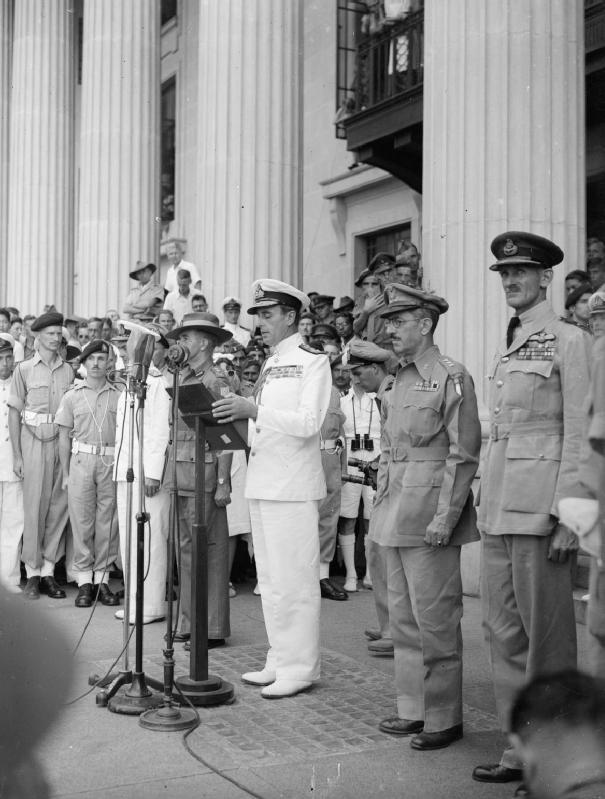 After the signing inside, the steps: Mountbatten delivers his address on 12 September 1945, with Slim, Wheeler and Park beside him. (Lt C. Trusler, Royal Navy official photographer, Public domain, via Wikimedia Commons)
The chamber then had a second life. On 3 June 1959 the People’s Action Party held its victory rally on the Padang before a crowd Lee Kuan Yew put at some 50,000, and Lee used the field itself as his text. His party had wanted to hold night rallies there, he said, but “a small group of Europeans who were given this field by the former Colonial Government, refused it, although they only use it in the day time for a few people to play games”. “Well,” he concluded, “times have changed, and will stay changed.” Two days later, on 5 June 1959, Lee and his eight ministers were sworn in inside City Hall — in the same chamber where Mountbatten had taken the surrender — deliberately breaking protocol to be sworn in there rather than at Government House, and wearing the party’s open-necked white shirts and trousers instead of lounge suits. That December, in the same building, Yusof Ishak became the first Malayan-born Yang di-Pertuan Negara and the flag and anthem were unveiled, a story this blog has told in full. In August 1963 a rally on the Padang demanding Japanese war reparations drew a crowd reported at some 120,000, among the largest gatherings in Singapore’s history; a month later, on 16 September 1963, Lee proclaimed Singapore’s merger into Malaysia from the same field.
The people’s parade ground
On 9 August 1966, at nine in the morning, Singapore held its first National Day Parade on the Padang: over 23,000 participants, the Straits Times reported, among them six People’s Defence Force contingents and four government ministers marching as officer cadets. The Padang remained the parade’s only home until the parades were decentralised in 1975; the first National Stadium parade followed in 1976. The parade that fixed the field in the national memory was 1968’s, which went ahead in pouring rain and became the emblem of the “rugged society” the young republic meant to be. Parades moved to the evening from 1973, and from 1984 the Padang came back into rotation — every five years from 1995, and for the milestone years: 2010, SG50 in 2015, the bicentennial in 2019, and 2023, 2024 and SG60 in 2025.
 A People's Association contingent marches at the National Day Parade of 1968 — the rain-soaked parade that became a national parable. No freely licensed photograph of the first parade, in 1966, exists; this is the earliest the blog can show. (Lama Jey Tsong Kapa, CC BY-SA 2.0, via Wikimedia Commons)
The monument that is a field
The field’s modern life runs on the same double track as its old one: ceremony and sport. On 28 September 2008 the first Formula 1 night race ran down St Andrew’s Road, past the Padang and City Hall, on its way to Anderson Bridge. In 2015 the two buildings behind the field reopened as the National Gallery Singapore. And the sports never left: cricket is still played on the Padang — the Cricket Club’s square is, Sport Singapore notes, the only cricket square in Singapore — the SCC’s international rugby sevens is held on the field, the Recreation Club runs its weekly soccer and softball, and the Singapore Marathon starts and finishes there. The two clubs now describe themselves as the field’s co-custodians.

Cricket on the Padang in June 2018, photographed from the National Gallery steps — the 1852 club’s game, still on the 1822 square, with Marina Bay Sands for a sightscreen. (Basile Morin, CC BY-SA 4.0, via Wikimedia Commons)
What protects it now is the strangest entry on Singapore’s monument list. The Padang was announced for gazetting in August 2019, but the law had to change first: the Preservation of Monuments Act was amended in November 2021 to let a monument be an open site, not only a building. On 9 August 2022, National Day, the Padang became Singapore’s 75th National Monument — the first green, open space on the list. The gazette, the Minister for Culture, Community and Youth said, “will protect it, as it is now, from alteration and change which would affect its character and significance, while allowing it to continue to be a social and community space.” A month later the Padang and its ring of monuments were put forward as the Padang Civic Ensemble on UNESCO’s World Heritage Tentative List.
See more photos of the Padang and the Cricket Club
Every city keeps a field it cannot bring itself to build on; Singapore is the one that wrote the order down in 1822, watched empires, occupiers and a new nation all obey it, and in 2022 made the emptiness itself a monument — a lesser-known national treasure precisely because there is nothing there.
Sources:
- National Library Board, Infopedia — The Padang
- National Library Board, Infopedia — Singapore Cricket Club
- National Library Board, Infopedia — Singapore Recreation Club
- National Library Board, Infopedia — Former City Hall
- National Library Board, Infopedia — Japanese surrender
- National Library Board, Infopedia — The first cabinet is sworn in; 1959 Legislative Assembly General Election
- Kevin Y. L. Tan — A History of the Padang, BiblioAsia (National Library Board), April–June 2022
- National Heritage Board — media release, 8 August 2022: The Padang to be gazetted as Singapore’s 75th National Monument
- Ministry of Culture, Community and Youth — The Padang Gazetted as Singapore’s 75th National Monument
- Roots (National Heritage Board) — The Singapore Cricket Club and the Supreme Court; Indian National Army Memorial
- Sport Singapore — Singapore Cricket Club; Singapore Recreation Club
- Singapore Cricket Club — Heritage, Design and Culture; Singapore Recreation Club — About
- Singapore GP — 2008 fast facts (the first night race, 28 September 2008)
- UNESCO World Heritage Centre — The Padang Civic Ensemble, Tentative List
- Image file pages: Wikimedia Commons (each image is credited under its photograph)