New Syonan: The Endau Settlement, 1943
On the afternoon of 1 February 1944, about 300 people left occupied Singapore for a stretch of newly cleared jungle near Endau, about 150 kilometres up the east coast of Johor. The Syonan Shimbun called them “pioneers in every sense of the word”. They were some 20 families, most of them from the Bukit Timah district, 46 girls from the Po Leung Kok home, and a party of labourers and technicians, sent to grow food at a settlement that had been named New Syonan. Within a year the paper was reporting more than 7,000 settlers there. The settlement was an answer to a simple problem: Singapore under the Japanese did not have enough to eat.

Endau, on Johor’s east coast, in February 1964, two decades after the wartime settlement nearby. (Don Christie, CC BY-SA 4.0, via Wikimedia Commons)
Why Syonan was hungry
Before the war, Singapore and Malaya fed themselves largely with imported rice, much of it shipped in from Burma and Thailand. The Japanese invasion destroyed most of the civilian shipping that had carried it, and the war at sea kept supplies short for the rest of the Occupation. According to the National Library’s BiblioAsia journal, the rice ration in Syonan started at 20 katis, about 12 kilograms, per person per month. Towards the end of the Occupation it had fallen to 8 katis for men, 6 for women and 4 for each child, and people had to queue for it in small amounts whenever supplies arrived.
The administration ran a “Grow More Food” campaign, with exhibitions, cheap seeds and radio talks on how to plant. Tapioca, sweet potato and ragi, a kind of millet, became everyday staples, and school fields and even the Padang were turned into vegetable and tapioca plots. It was not enough. In late 1943 the military administration announced a plan to move large numbers of people out of the city to farm the land, with a goal, according to the historian Clay Eaton, of sending as many as 300,000 people from Syonan to rural Malaya.
The plan
The task of carrying out the scheme went to Mamoru Shinozaki, the Japanese welfare official who had earlier brought together the Oversea Chinese Association, as told in the post on the $50 million “gift” of 1942. Two sites were chosen. The association was given responsibility for a settlement for Chinese families at Endau, on the coast of Johor, while a second settlement at Bahau, in Negri Sembilan, was planned for Eurasians and Chinese Catholics under the Eurasian Welfare Association and the Catholic Bishop of Malacca, Adrien Devals.
 Lim Boon Keng, who chaired the committee that built New Syonan, in the 1930s. (Lee Brothers Studio, public domain, via Wikimedia Commons)
The association put up $2 million to build the farms, and a construction committee was formed under its chairman, Lim Boon Keng. Inspection parties travelled up to survey the site through late 1943, and a flag was raised over it on 14 December 1943, the date later marked as the settlement’s founding. To persuade families to go, Shinozaki is said to have promised that the Japanese army would not interfere, and that rice would be supplied until the farms could feed the settlers. The settlement was run by the Chinese themselves. According to a 2020 study of the settlers’ oral histories by Huang Qiuhong, there were no restrictions on people’s movement in and out of Endau, unlike at Bahau, where settlers needed a permit to leave.
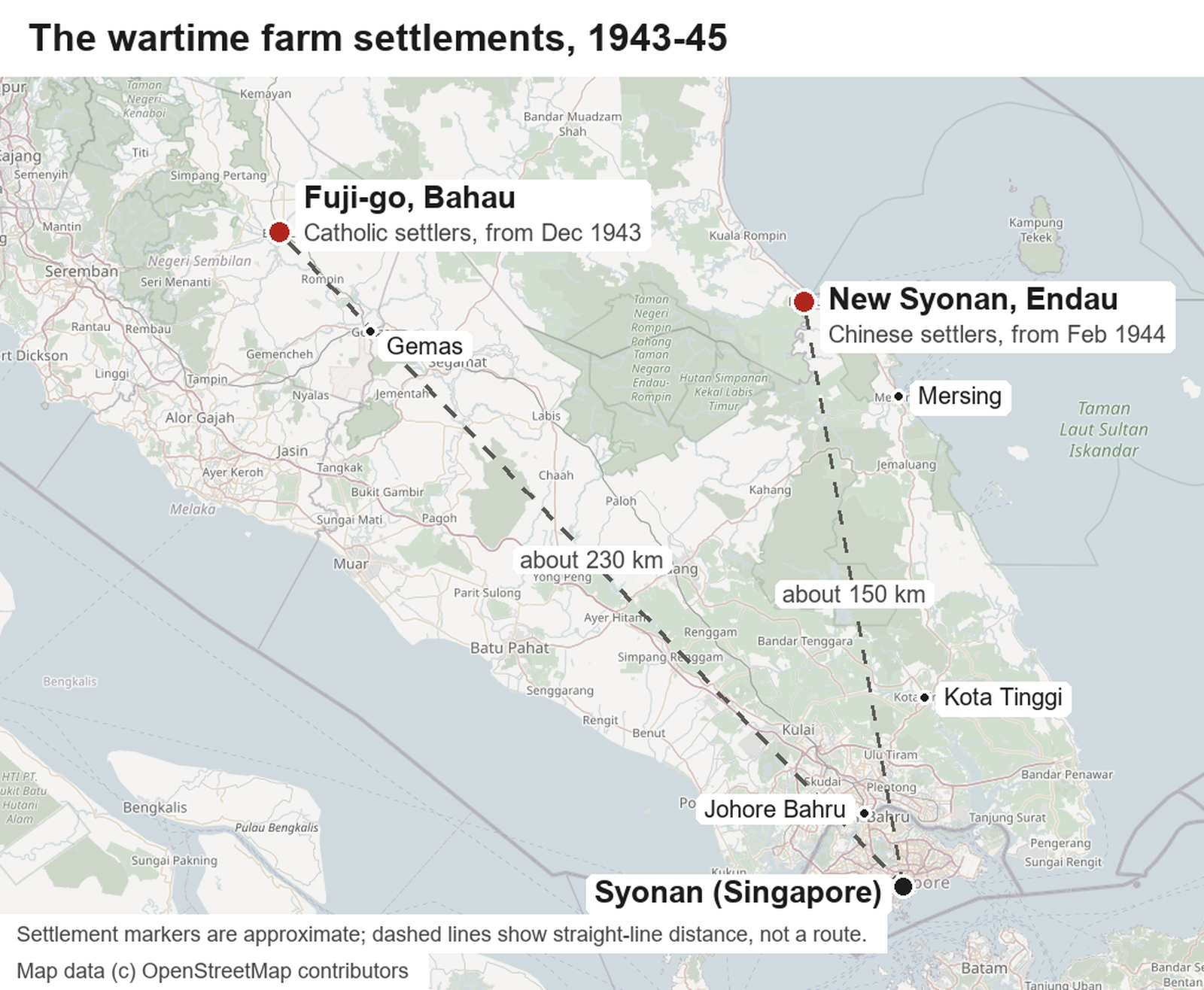
The two wartime farm settlements, marked over today’s map. (Map data © OpenStreetMap contributors)
Building a town in the jungle
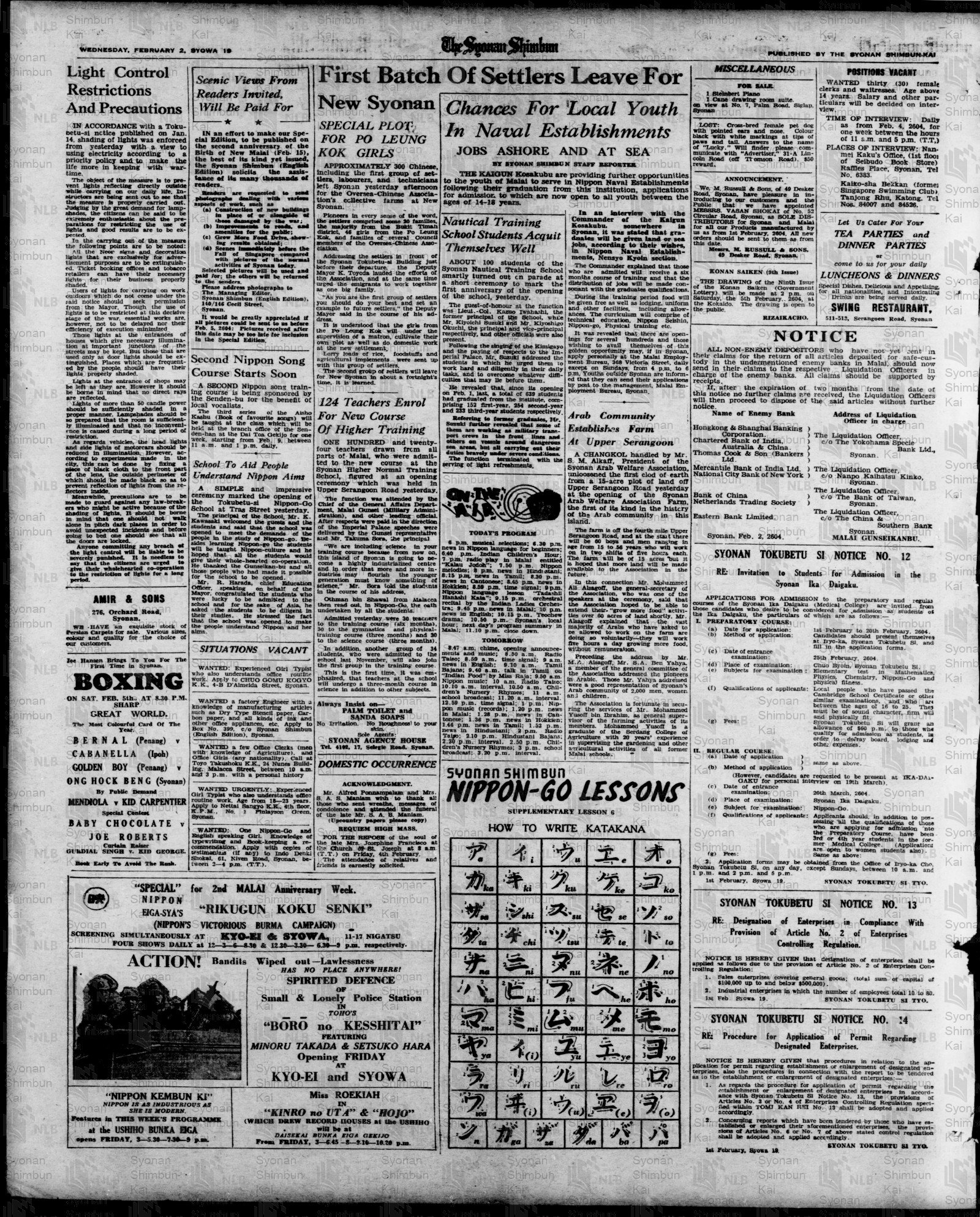 Page 2 of the Syonan Shimbun, 2 February 1944. The headline across the top reports that the first batch of settlers had left for New Syonan. (Singapore Press Holdings, via NewspaperSG, National Library Board Singapore, public domain)
The first party left from the municipal building in Syonan, where the deputy mayor told them to set an example for the settlers who would follow. Lorry loads of rice, foodstuffs and farming tools went with them, and a second group was due to leave about a fortnight later. Many of the settlers who followed were city people with little experience of farming or building.
On arrival, families lived in longhouses shared by five to ten families each. Each family was then given about three acres, half of it dry land and half wet land for rice, and could choose to stay in the longhouse or build a home of its own. Settlers grew rice, tapioca, sweet potatoes and vegetables such as kangkong, spinach and tomatoes. The settlement hospital handed out medicines free, and its staff later recalled that what everyone asked for was quinine, against malaria.
At first, the association gave each settler 18 katis of rice a month. Later, according to the settler Wan Leong Gay’s interview with the National Archives of Singapore, it could no longer supply that much, and the ration fell to only 4 or 5 katis. Settlers traded with nearby Malay villages, and barbers, pawnshops and small medicine shops opened in people’s homes.
Rice for one person for a month
Katis of rice per person per month (1 kati is about 0.6 kg)
Sources: Lee Geok Boi, BiblioAsia (2019); Wan Leong Gay, oral history, National Archives of Singapore, via Huang (2020).
View as table
| Row | Value | Detail |
|---|---|---|
| Syonan, early Occupation | 20 | The rice ration in Syonan started at 20 katis a person a month |
| Endau, first months | 18 | Endau settlers were given 18 katis a month for the first few months |
| Syonan, later: men | 8 | Later in the Occupation the Syonan ration fell to 8 katis for men |
| Syonan, later: women | 6 | 6 katis for women |
| Endau, later | 4-5 | At Endau the ration later fell to 4 or 5 katis a month |
| Syonan, later: children | 4 | 4 katis for each child |
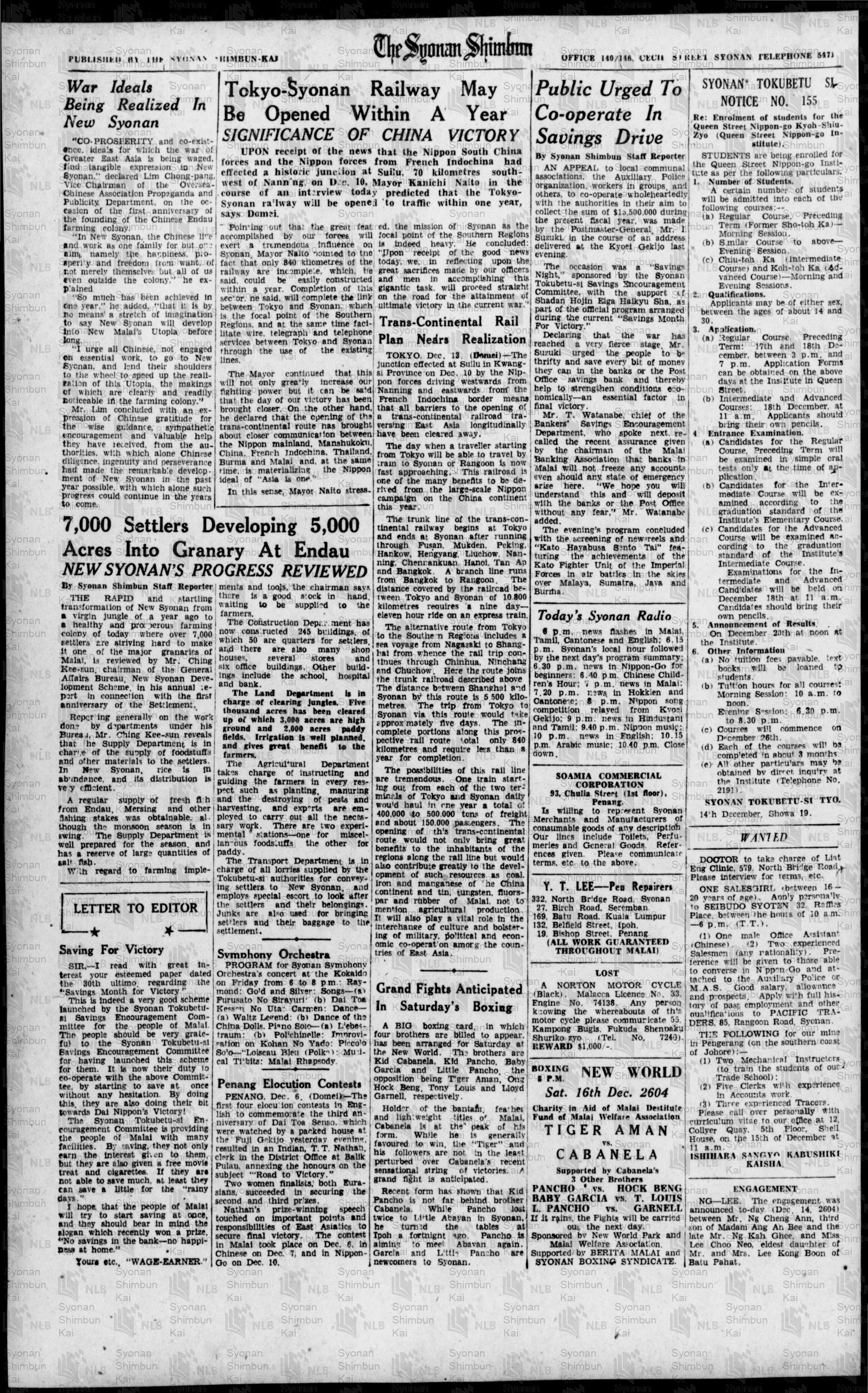 Page 2 of the Syonan Shimbun, 14 December 1944. The report on the left marks New Syonan's first anniversary: "7,000 Settlers Developing 5,000 Acres Into Granary At Endau". (Singapore Press Holdings, via NewspaperSG, National Library Board Singapore, public domain)
On 14 December 1944, the settlement’s first anniversary, the Syonan Shimbun published an annual report from its administrators. It described a “virgin jungle of a year ago” turned into a farming colony of more than 7,000 settlers. It listed 245 buildings, 50 of them settlers’ quarters, along with a school, a hospital and a bank, and 5,000 acres of cleared land, of which 2,000 acres were rice fields. The report also said that rice was “in abundance”. That claim sits uneasily beside the settlers’ own later accounts of the shrinking ration, and the newspaper was an instrument of the occupation government, so its figures are best read as the official picture. Later accounts put the settlement’s population as high as 12,000.
Caught between two sides
The Malayan People’s Anti-Japanese Army, the guerrilla force led by the Malayan Communist Party, regarded the association’s leaders as collaborators. Convoys travelling between Syonan and Endau were ambushed. On 19 April 1944, guerrillas attacked an association party visiting the settlement and killed several of its officials, among them Tan Ean Teck, a 42-year-old rubber trader who had given to China’s war relief before the Occupation. He was buried at Bukit Brown four days later. Settlers also later recalled officials being killed inside the settlement itself. In the end, according to Eaton, it was Shinozaki, rather than the association, who negotiated a truce with the guerrillas, reportedly by offering them rice in return for leaving the settlement alone.

Guerrillas of the Malayan People’s Anti-Japanese Army’s 4th Regiment, the Johor regiment, march past at their disbandment ceremony in Johore Bahru after the war. (Sergeant W. A. Morris, No 9 Army Film and Photographic Unit, public domain, via Wikimedia Commons)
Bahau, and the end
The Bahau settlement, which the Japanese called Fuji-go, began a month earlier, when its first 150 pioneers left Syonan on 28 December 1943. It fared much worse. Its clay soil was hard to farm, malaria spread through the settlement within months, and malnutrition made it worse. Bishop Devals died in January 1945, and by the end of the war an estimated 500 of Bahau’s roughly 2,000 to 3,000 settlers had died. Endau, on the coast, had less malaria and more fertile ground, and the association had not rushed its settlers out as fast. Bahau’s story deserves a post of its own.
When Japan surrendered in August 1945, the settlers of New Syonan returned to Singapore, and the settlement was abandoned.
Food, then and now
Singapore still imports most of what it eats. According to the Singapore Food Agency, more than 90 per cent of its food came from abroad in 2025, from more than 180 countries and regions, up from about 140 two decades earlier. In March 2019, the government set the “30 by 30” goal of producing 30 per cent of the country’s nutritional needs locally by 2030. In November 2025, that goal was replaced by a new plan, the Singapore Food Story 2, with the government citing high operating costs, limited land and farm closures. The new plan aims for local farms to be able to supply 20 per cent of the fibre (vegetables, beansprouts and mushrooms) and 30 per cent of the protein (eggs and seafood) that Singapore consumes by 2035. It sets local farming alongside three other measures: buying from a wider range of countries, keeping stockpiles, and international partnerships.
How much of its food Singapore grows
Share of what Singapore eats that is produced locally
Source: Singapore Food Agency, Singapore Food Statistics 2025. Fibre: vegetables, beansprouts, mushrooms. Protein: eggs, seafood.
View as table
| Row | Value | Detail |
|---|---|---|
| Fibre, 2025 | 8% | About 8% of the fibre Singapore ate in 2025 was grown locally |
| Fibre, 2035 target | 20% | Target: 20% of fibre from local farms by 2035 |
| Protein, 2025 | 25% | About 25% of the protein (eggs and seafood) was produced locally in 2025 |
| Protein, 2035 target | 30% | Target: 30% of protein from local farms by 2035 |
The difference from 1944 is in how the problem is handled. The wartime answer, once the ships stopped coming, was to move people out of the city to grow their own food. Today’s plan is designed so that no single source of food can fail, by spreading imports across many countries, holding reserves and growing a share at home.
See 12 more historical photos related to this post →
Why it matters today: New Syonan is little remembered beside the darker stories of the Occupation, yet it shows how close Singapore came to running out of food when its supply lines were cut, and why food security remains a standing concern for an island that grows only a small part of what it eats.
Sources
- Clay Eaton, “Communal Welfare Associations and the Agricultural Settlements of Wartime Singapore”, Tokyo University of Foreign Studies
- Huang Qiuhong, “The Japanese Occupation of Singapore: Examining the Success of the Endau Settlement”, Emory Journal of Asian Studies, 2020
- Lee Geok Boi, “Wartime Victuals: Surviving the Japanese Occupation”, BiblioAsia, National Library Board, 2019
- Fiona Hodgkins, “Bahau: A Utopia That Went Awry”, BiblioAsia, National Library Board, 2016
- Vivian Blaxell, “New Syonan and Asianism in Japanese-era Singapore”, The Asia-Pacific Journal: Japan Focus
- Tan Ean Teck, Endau and WW2, bukitbrown.com
- Endau settlement, Wikipedia
- Singapore Food Statistics 2025, Singapore Food Agency
- Singapore revises food security goal, new fibre and protein targets set for 2035, Asia Pacific Food Industry, 2025
- Singapore’s 30 by 30 strategy, RSIS Commentary, 25 March 2019
- The Syonan Shimbun, 2 February 1944, page 2, “First Batch Of Settlers Leave For New Syonan”, NewspaperSG
- The Syonan Shimbun, 14 December 1944, page 2, “7,000 Settlers Developing 5,000 Acres Into Granary At Endau”, NewspaperSG
- The Syonan Shimbun, 14 December 1943, “Lucky Flag Hoisted Over Endau Site”, NewspaperSG
- Map data © OpenStreetMap contributors
- File:Endau_Malaya_February_1964.jpg, Wikimedia Commons
- File:Lim_Boon_Keng,_1930s.jpg, Wikimedia Commons
- File:The_British_Reoccupation_of_Malaya_SE5878.jpg, Wikimedia Commons
- File:Djohor_Baru_Bridge_in_Singapore_(Syonan),Djawa_Baroe,_Vol._1,_Iss._4(1943-02-15),_pp18-19.jpg, Wikimedia Commons (gallery)
- File:Downtown_Singapore_(Syonan),Djawa_Baroe,_Vol._1,_Iss._4(1943-02-15),_p18.jpg, Wikimedia Commons (gallery)
- File:KITLV_A1363_-_Weg_van_Djohor_Bahru_naar_Singapore,_KITLV_78456.tiff, Wikimedia Commons (gallery)
- File:林文慶.jpg, Wikimedia Commons (gallery)
- File:Cassava_harvesting.jpg, Wikimedia Commons (gallery)
- File:The_British_Reoccupation_of_Malaya_SE5882.jpg, Wikimedia Commons (gallery)
- File:The_British_Reoccupation_of_Malaya_SE5883.jpg, Wikimedia Commons (gallery)
- File:Japanese_Surrender_in_Malaya,_1945_IND4845.jpg, Wikimedia Commons (gallery)
- File:Liberation_banner.jpg, Wikimedia Commons (gallery)
- File:Endau_River-02-Faehre-1976-gje.jpg, Wikimedia Commons (gallery)
- File:Endau_River-04-Faehre-Landeplatz-1976-gje.jpg, Wikimedia Commons (gallery)
- File:Endau_River-06-Faehre-Warteschlange-1976-gje.jpg, Wikimedia Commons (gallery)


