The Post Office Riot of 1876
On the morning of Friday the 15th of December 1876, a small shop at 81 Market Street opened for business as Singapore’s new Chinese sub-post office. It had been set up by the colonial government to carry Chinese workers’ letters and savings home to their families in China, cheaply and safely. Soon afterwards a crowd wrecked it, and by the end of the day the police had fired on rioters at two police stations and three men were dead.

The Post Office and the Exchange building in Singapore, photographed before 1880. The Chinese sub-post office moved into the General Post Office in 1877. (Unknown photographer, KITLV, public domain, via Wikimedia Commons)
Letters with money
For decades, a Chinese labourer in Singapore who wanted to send money home had no post office to use. He gave his letter and a few dollars to a trusted man from his own district, who carried them back to China on the junks, or to one of the remittance houses run by Chinese merchants. I wrote about that trade in an earlier post. By the 1870s, the business of collecting these letters and sending them on had come to be dominated by a few merchants, most of them Teochew.

Swatow harbour, in the Teochew country of Guangdong, photographed by John Thomson around 1869. Letters from the new sub-post office were to go through Swatow and Amoy. (John Thomson, Metropolitan Museum of Art, CC0, via Wikimedia Commons)
From 1873, officials in Singapore began to look at how the government could offer the labourers a cheaper and safer way to send their letters and savings. After talks with London, the British minister in Peking, the consuls in China and the Hong Kong authorities, they settled on a plan. A notice in the Government Gazette, dated the 5th of December 1876, announced that a Chinese sub-post office would open at 81 Market Street on the 15th of December, with another at Beach Street in Penang.
The notices and the placards
On the 11th of December the Postmaster-General, Henry Trotter, issued a second notice in Chinese to explain the plan. The small post offices, it said, were “for the benefit especially of all you coolies.” They would send letters to Swatow and Amoy, and from there to any town or village in the interior, and bring the replies back. They could also carry money, at fixed charges set out in a table, with no extra fees allowed. One line of the notice said that when the system was in good working order, all letters would have to go through the government post office.
The merchants who had run the letter business saw the plan as a threat to it. Within days, placards went up around the town. One, dated the 13th of December, called the men behind the post office “red rats” who had schemed to make a fortune from the coolies’ savings, and cursed them and their families. It ended by offering a reward of 100 taels “for the heads of the Post Office Farmers.” A rumour spread among the labourers that every man who wanted to send money home would first have to pay 30 dollars to the post office.
The government told the leading Chinese merchants that the office was meant for the convenience of the poorer classes, and the police took precautions. On the morning the office opened, it was not enough.
Friday, the 15th of December
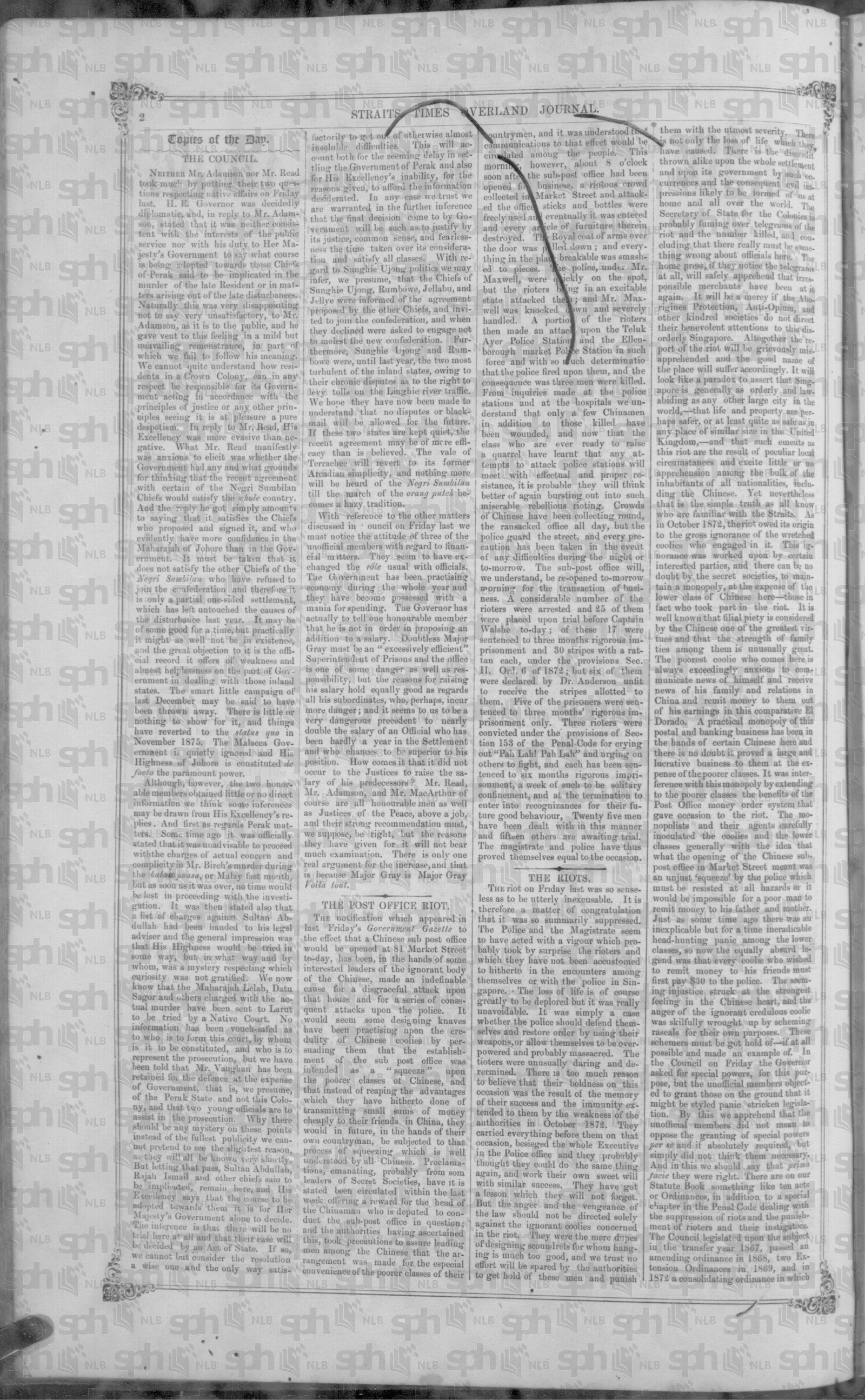 The Straits Times Overland Journal of the 27th of December 1876, page 2, with the reports "The Post Office Riot" and "The Riots." (Singapore Press Holdings, via NewspaperSG, National Library Board Singapore, public domain)
At about eight o’clock, soon after the office opened, a crowd gathered in Market Street and attacked it. Sticks and bottles were thrown, and then the crowd broke into the shop, smashed every piece of furniture and pulled down the royal coat of arms over the door. The police under their superintendent, R. W. Maxwell, arrived quickly, but the crowd turned on them, and Maxwell was knocked down and badly beaten.
Part of the crowd then attacked the police station at Telok Ayer and the one at Ellenborough Market, across the river. At both, the police fired on them. Three men were killed and several were wounded. Crowds stood around the wrecked office for the rest of the day, while a police guard held the street.
The Straits Times was blunt. It called the riot “so senseless as to be utterly inexcusable,” and it argued that the ordinary labourers in the crowd had been “the mere dupes” of the men who stood to lose the letter trade.

The corner of Market Street and Robinson Road in the late 1920s. The sub-post office stood in a small Chinese shop on Market Street. (Unknown photographer, public domain, via Wikimedia Commons)
The weekend
Within a day, many of the rioters were brought before the magistrate, Captain Walshe, at the Police Court. Of the first 25, seventeen were sentenced to three months’ rigorous imprisonment and 30 strokes of the rattan, though the colonial surgeon found six of them unfit for the strokes. Three men who had shouted to the others to fight were given six months, including a week in solitary confinement. More men were tried over the following days.

The Police Court on South Bridge Road, around 1885. (G. R. Lambert and Co., KITLV, public domain, via Wikimedia Commons)
The town did not settle at once. Over the weekend, business stopped at Ellenborough Market and many provision shops closed. A notice posted near the market told traders not to sell food to the “barbarians.” The shopkeepers said they would reopen only if the towkays, the merchant bosses, who were being held at the police station were released.
The government’s answer was to send twelve of them out to sea. Soldiers of the 80th Regiment marched them from the Central Police Station along Boat Quay to Johnston’s Pier, between two columns of troops, with crowds of Chinese watching, and a boat took them out to the government steamer Pluto, which anchored three miles out in the harbour. They were to stay there, the Straits Times reported, “until all signs of rioting or disobedience shall have disappeared.” At the same time, about 600 marines and sailors from the navy’s squadron were paraded on Collyer Quay. The Colonial Secretary, John Douglas, called in other towkays and warned them to open their shops.

Johnston’s Pier, the town’s landing place, around 1890. The arrested towkays were taken from here to the steamer Pluto. (Unknown photographer, KITLV, public domain, via Wikimedia Commons)
Years later, the merchant W. H. Read recalled a scene that he believed belonged to these disturbances. The north-east monsoon was blowing, and from the shore he watched the steamer pitch and roll in the heavy sea. After about two days, he wrote, the men were brought ashore “pale, prostrate and penitent.” On Monday the 18th of December, the Postmaster-General reopened the sub-post office himself, with the Colonial Secretary and other officials there to watch.
What came of it
 William Pickering, Singapore's first Protector of Chinese, from his 1898 memoir. (British Library, public domain, via Wikimedia Commons)
In 1877 the sub-post office moved from Market Street into the General Post Office, under the Postmaster-General’s direct control, and the labourers slowly came to trust it. About 80,000 Chinese letters went through it in 1880, and by 1889 the number had risen to about 280,000 a year. The private letter shops did not disappear. They were brought under the Post Office’s supervision, and in 1887 there were 49 of them in Singapore.
| Dialect group | Offices |
|---|---|
| Teochew | 34 |
| Hokkien | 11 |
| Hakka | 2 |
| Cantonese | 1 |
| Other | 1 |
| Total | 49 |
Source: T. A. Melville, “The Post Office and Its History”, in Makepeace et al., One Hundred Years of Singapore (1921), vol. 2.
The next year, the government set up a new office to deal with the Chinese community. William Pickering, an official who spoke several Chinese languages and had translated the Colonial Secretary’s warning to the traders during the disturbances, was appointed the first Protector of Chinese on the 3rd of May 1877, with an office in a shophouse on North Canal Road. The Chinese Protectorate dealt with the arrival of labourers from China, the secret societies, and the rescue of women forced into prostitution.
Who was really behind the riot has been argued over ever since. Officials and the newspapers of the day blamed the secret societies, and the Ghee Hin among them. Some historians have argued since that it was the owners of the remittance businesses themselves who stirred up the crowd, to defend their trade against a government that wanted to regulate it. Writing years later, the Straits Chinese doctor Lim Boon Keng used the riot as an example of how much trouble between the Chinese and the Europeans “has arisen from misunderstanding.”
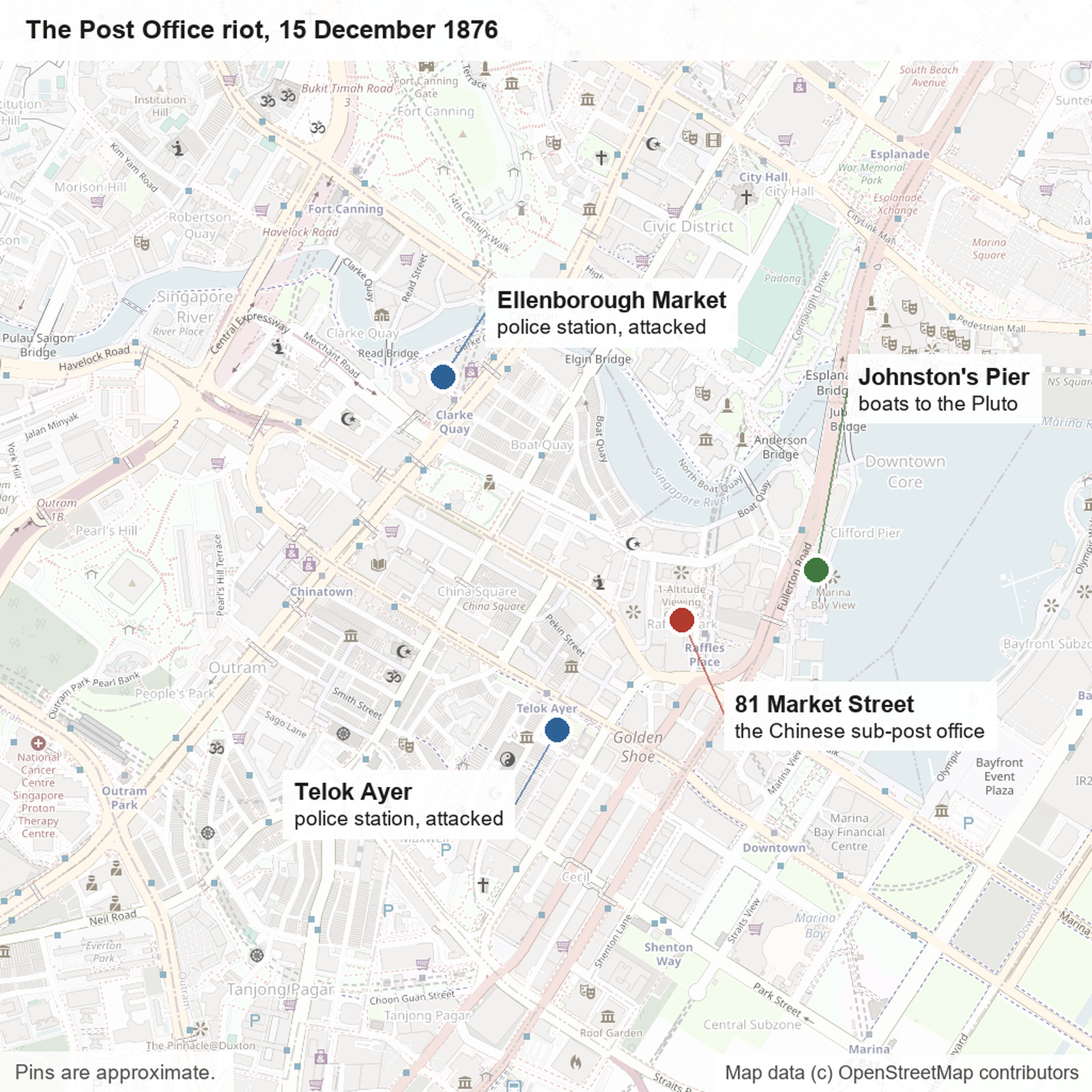
The places in the riot, plotted on today’s map. Pins are approximate. (Map data © OpenStreetMap contributors)
Sending money home today
Singapore’s migrant workers still send part of their pay home. The money now goes by bank transfer, by mobile app, or through the money changers and remittance counters in neighbourhoods like Chinatown. Since 2020, businesses that send money abroad have been licensed and supervised by the Monetary Authority of Singapore under the Payment Services Act, so the question the government was trying to answer in 1876, of how to make sending money home cheap and safe, is still part of its work.

Shophouses on Pagoda Street in Chinatown, with a money changer’s sign, in November 2019. (Dietmar Rabich, CC BY-SA 4.0, via Wikimedia Commons)
See more historical photos of the riot’s Singapore and the ports the letters went to →
Where it fits in the bigger story: The Post Office riot is usually remembered, if at all, as one more secret-society disturbance, but it was really a fight over who would carry the savings of Singapore’s poorest workers home to China. It began with a public notice and a rumour about what that notice meant, and it ended with a post office that the labourers came to use in their hundreds of thousands. It is a reminder that a scheme meant to help people can fail at first if the people it is meant for do not trust it.
Sources:
- T. A. Melville, “The Post Office and Its History”, in Walter Makepeace, Gilbert E. Brooke and Roland St J. Braddell (eds), One Hundred Years of Singapore (London: John Murray, 1921), vol. 2, pages 133-139, quoting the Postmaster-General’s notice of 11 December 1876 and the placard of 13 December 1876
- Song Ong Siang, One Hundred Years’ History of the Chinese in Singapore (1923; annotated edition, 2020), chapter 7, on the riot, the trials and W. H. Read’s account of the steamer
- “The Post Office Riot” and “The Riots”, Straits Times Overland Journal, 27 December 1876, page 2 (NewspaperSG)
- “The Late Riots”, Straits Times Overland Journal, 27 December 1876, page 3 (NewspaperSG)
- Chinese Post Office Riots, Singapore Infopedia, National Library Board
- Lane J. Harris, “The 1876 Chinese post office riot in Singapore”, The Newsletter (International Institute for Asian Studies), no. 63, Spring 2013
- William Alexander Pickering, Singapore Infopedia, National Library Board
- Chinese Protectorate, Singapore Infopedia, National Library Board
- William A. Pickering, Wikipedia
- List of riots in Singapore, Wikipedia
- Payment Services Act 2019, Monetary Authority of Singapore
- Map data © OpenStreetMap contributors
- File:KITLV - 89905 - Post office, Exchange building and square in Singapore - before 1880.tif
- File:View of Swatow Harbour MET DP165632.jpg
- File:Corner of Market St and Robinson Rd Singapore, 1925-1930.jpg
- File:KITLV - 103754 - Lambert & Co. - Court of the police at South Bridge Road, Singapore - circa 1885.tif
- File:KITLV - 103750 - Johnston’s pier at Singapore - circa 1890.tif
- File:Portrait of Pickering, William Alexander.jpg
- File:Singapore (SG), China Town, Pagoda Street – 2019 – 4507.jpg
- File:Swatow MET DP165628.jpg
- File:Island of Koolansoo and Amoy by Lai Afong, c1870.jpg
- File:Ellenborough Market 1910.jpg
- File:KITLV - 38150 - Johnston’s pier at Singapore - circa 1890.tif
- File:Boat Quay aan de Singaporerivier in Singapore, RP-F-AA3188-BK.jpg
- File:Collier Quay in Singapore, RP-F-AA3188-BL.jpg
- File:Kling Street in Singapore, RP-F-AA3188-BM.jpg
- File:Woningen aan een straat in Singapore, RP-F-AA3188-BI.jpg
- File:John Edmund Taylor, A Chinese Soup Seller Trading in Singapore (c 1880, Wellcome V0037508).jpg
- File:KITLV - 106516 - Singapore - circa 1870.tif
- File:KITLV - 106515 - Harbor yard in Singapore - circa 1870.tif


