Letters with Money: Singapore's Remittance Houses and the Savings Sent Home to China
For more than a century, a Chinese labourer in Singapore who wanted to send part of his wages to his family in China did not go to a bank. He went to a remittance house, often a tea merchant, a medicine hall or a grocer in the back streets near the river, which took his money and his letter, sent them to his home village in Fujian or Guangdong, and weeks later brought him back a reply. The letter that travelled with the money was called a qiaopi, and Singapore was the hub of the trade for the whole of Southeast Asia, with more remittance houses at one point than the rest of the region combined. When the colonial government tried to take the business over in 1876, it set off one of the town’s most serious riots.

A qiaopi, a letter that travelled with money, addressed to a mother in Chao’an, in the Teochew country of Guangdong, and recording a remittance of 900 Hong Kong dollars. (三猎, CC BY-SA 4.0, via Wikimedia Commons)
Before the shops: letters by junk
Singapore’s early Chinese settlers came mostly from the coasts of Fujian and Guangdong, and almost all of them had families at home who depended on what they sent back. In 1847 the merchant Seah Eu Chin described the season for remittances in the Journal of the Indian Archipelago. Each year, when the junks were about to sail back to China, the streets of the business quarter filled with labourers from the gambier and pepper plantations who had come into town to send their annual letters and money home. Some gave their savings to a friend going home, but most used a man who made a business of it, travelling on the junks with letters and money from people from his own district. He was paid a commission of ten per cent, or he was allowed to buy goods with the money, sell them in China at his own risk, and pay the family out of the proceeds.
By Seah’s estimate the total sent in a year ranged from about 30,000 to 70,000 Spanish dollars, depending on trade and on the price of gambier, which set the plantation workers’ wages. These couriers came to be called shuike, or “water guests”, and by 1849 there were about 200 of them in Singapore.

A street letter-writer, who also told fortunes, in Shanghai between 1900 and 1919. Singapore’s letter-writers worked from the same kind of table at the side of the street. (Unknown photographer, Yale Divinity School Library, public domain, via Wikimedia Commons)
Many of the labourers could not write. Seah described the public letter-writers who sat at the side of the street, in the verandahs or in the shade of a wall, with a small rough table, a bundle of paper, a brush and ink, writing down what each customer dictated. At the height of the season, he wrote, forty to fifty of these stalls could be counted along the streets in a single morning. In later years, Singapore’s letter-writers typically charged three to six cents a letter, depending on its length.
How a remittance house worked
 A qiaopi envelope sent from 石叻, an old Hokkien and Teochew name for Singapore, to a wife in Chao'an, with 50 Hong Kong dollars enclosed. (三猎, CC BY-SA 4.0, via Wikimedia Commons)
From the 1830s, some merchants with capital to spare began setting up remittance houses, known in Chinese as qiaopiju. Most were sidelines of other businesses: tea merchants, medicine halls, printers, bakers and grocers took in remittances alongside their main trade. Each house served its own people. A Hokkien labourer used a Hokkien house and a Hainanese labourer a Hainanese one, partly because he trusted people from his own district and partly because he could speak to them in his own dialect, and the clerks would write his letter for him if he needed it.
The larger houses had a head office in Singapore and branches in Hong Kong and in the towns near their customers’ home villages. A collector went round the plantations and settlements gathering letters and small sums. The letters were made up into a single “clubbed” packet and sent to the branch in China, and the money followed by bank draft or, in the early years, as goods. In China, the branch delivered each letter and its money to the family’s door, and the family sent back a short reply, the huipi, which served as a receipt. A collector usually made three or four round trips a year.
The houses made money less from their fees than from holding the money in between. The historian Lane J. Harris has shown how, by the 1870s, they used the remittances as short-term capital, buying goods in Southeast Asia to sell in Hong Kong or China, or dealing in the exchange rates between the currencies of Southeast Asia, Hong Kong and China, before paying the families. The return receipt protected the sender, since it confirmed that the money had arrived.
The Post Office riot of 1876
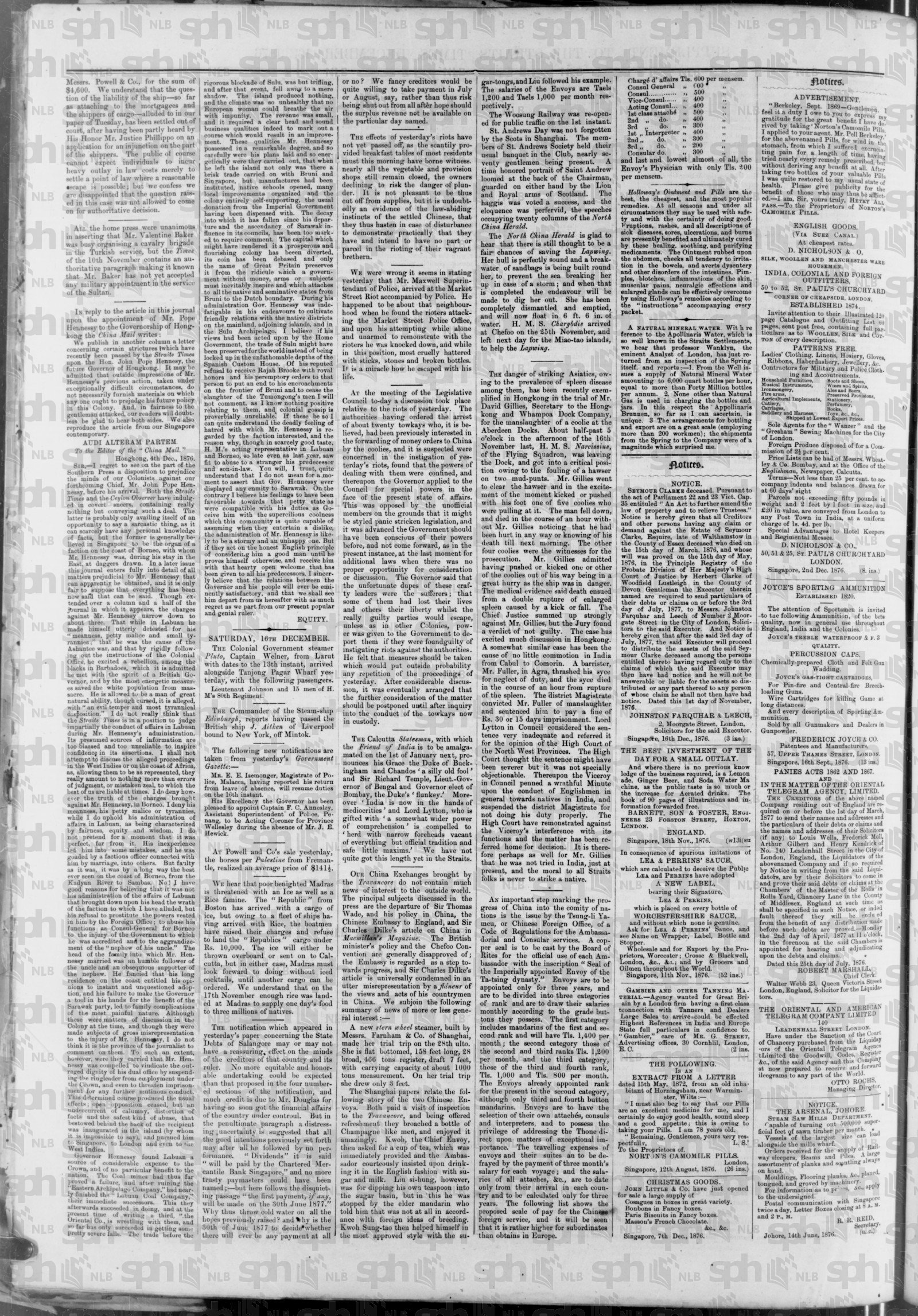 Page 5 of The Straits Times, 16 December 1876, the day after the riot. The columns on the right report "the effects of yesterday's riots" and the arrest of the towkays. (Singapore Press Holdings, via NewspaperSG, National Library Board Singapore, public domain)
The colonial government took a growing interest in the trade. From 1872 the Postmaster-General, Henry Trotter, argued that the private remittance houses were infringing the government’s postal monopoly and taking revenue that should have gone to the state. Two Straits-born Chinese remittance merchants from Penang, Ong Kong Chang and Ong Kong Teng, offered to run the business for the Post Office. In 1876 Governor Sir William Jervois made them salaried sub-postmasters and arranged to open a Chinese Sub-Post Office at 81 Market Street. Under the scheme, any Chinese firm could still collect remittances, but letters had to be stamped and sent through the government’s sub-post office or the General Post Office, at a fixed scale of charges, by way of Swatow or Amoy.
The remittance merchants read this as an attack on their business, since it took away their control over how and when the money travelled. Placards went up around the town claiming that all letters would now have to go through the government, and one offered a reward of 100 taels for the heads of the two “Post Office farmers”. On the morning of 15 December 1876, the day the sub-post office opened, a crowd gathered outside it. Someone threw a brick, and the office was wrecked and the royal arms torn down. The rioters then attacked the police station at the Ellenborough New Market, where the police fired on the crowd, killing three people. The Superintendent of Police, R. W. Maxwell, was stoned, knocked down and badly beaten.
Forty rioters were arrested, and most were caned and imprisoned. That afternoon, soldiers of the 80th Regiment took the towkays who had run the letter and remittance business and put them on board the government steamer Pluto, three miles out in the harbour. The next day the Chinese shops closed in protest. The towkays were brought back two days later, after agreeing to give bonds for their good behaviour, and the government deported Lim Ah Tye, the head of the Teochew branch of the Ghee Hin secret society, whom it blamed for the trouble. On Monday 18 December the sub-post office reopened. At the time, officials and the newspapers blamed the secret societies. Harris argues that the remittance merchants themselves, using the secret societies to organise the protest, were defending their way of doing business against a state that did not understand how they made their money.
Singapore becomes the hub
The government did not drive the remittance houses out. In 1877 the Chinese Sub-Post Office moved into the General Post Office, and over the following years the private houses came under the Post Office’s supervision while carrying on their own business. Their clubbed packets of letters were sent through the post, with the postage cut from six cents to three cents a letter in 1888. The number of letters climbed steadily.
Letters home to China through Singapore's post office
Chinese letters sent each year through the Chinese Sub-Post Office, in thousands
Source: T. A. Melville, in W. Makepeace et al., One Hundred Years of Singapore (1921), vol. 2. 1914 and 1917 reported only as over a million.
View as table
| Row | Value | Detail |
|---|---|---|
| 1880 | about 80,000 | About 80,000 Chinese letters went through the sub-post office in 1880 |
| 1881 | about 77,000 | About 77,000 in 1881 |
| 1882 | 90,876 | 90,876 in 1882 |
| 1886 | about 180,000 | About 180,000 in 1886 |
| 1889 | about 280,000 | About 280,000 in 1889 |
| 1914 | over a million | In 1914 the letters in clubbed packets exceeded a million |
| 1917 | over a million | Still over a million in 1917 |
In 1887 Singapore had 49 Chinese letter offices. Thirty-four of them were Teochew and eleven Hokkien, and the first Cantonese, Hainanese and Hakka offices had opened that year. The trade was not without risk for the senders. Two houses failed in 1890 and 1891, and two more in 1907 after gambling on the exchange rate, losing money that labourers had entrusted to them for their families. By the early twentieth century, according to the historian Zhang Huimei, Singapore had about 200 remittance houses, more than the rest of Southeast Asia combined, and letters and money from across the region passed through Singapore on their way to China. By 1937 there were 42 Hokkien houses of various sizes, and more than 50 Teochew houses had been set up in the 1920s and 1930s.
War, boom and control
The Pacific War cut the link. From December 1941 letters and money could no longer reach China, and although the Japanese administration allowed some remittances through Taiwan and Japanese banks, very few people used the route and it was soon closed. Families in China who depended on money from Singapore went without for the rest of the war.
After the war came the trade’s golden years. In November 1945 the banks and remittance houses agreed an exchange rate, and a flood of delayed remittances followed. In March 1946 the houses formed the Nanyang Chinese Remittance Association, and by the late 1940s, at the peak, Singapore had more than 200 remittance houses. The colonial government, however, now controlled foreign exchange. From 1946 remittances to China had to go through banks or approved agents, and one family could receive no more than 45 Straits dollars a month. From October 1948 the remittance houses had to be licensed, with a deposit of $10,000 for a house that sent letters directly to China and $2,000 for one that worked through another house.
Decline and legacy
After the founding of the People’s Republic of China in 1949, the business changed again. A stable currency in China took away much of the profit from exchange dealing, the new government cracked down on black-market remittances, and fewer overseas Chinese wanted to invest in property at home. More slowly, Singapore’s Chinese population was changing too. More of them were born in Singapore, with families of their own here rather than in China. By the 1970s about 60 remittance houses were left, and the trade faded away from the late 1970s as banks and the post office took over what remained of it.
 The Shantou Qiaopi Museum in Guangdong, which collects the letters that Teochew migrants sent home. (Lhzss8, CC BY 4.0, via Wikimedia Commons)
The letters themselves survived in huge numbers, kept by families in China and later gathered by archives, collectors and museums. In 2013 the qiaopi documents held in the provincial archives of Guangdong and Fujian were inscribed on UNESCO’s Memory of the World register, as a record of Chinese migration and of the families it divided. In Singapore, the National Library holds the letters in the Koh Seow Chuan collection, most of them written by Teochew men in Singapore between the 1950s and the 1970s, and showed them in its 2012 exhibition Money by Mail to China. The letters also gave the recent film Dear You its story, as told in the post on Dear You and the Teochew dialect.
The need behind the remittance houses has not gone away. Many of the migrant workers who live in Singapore today send part of their wages home to their families, now through banks, mobile apps and remittance shops that must be licensed by the Monetary Authority of Singapore under the Payment Services Act.
See 19 more historical photos related to this post →
Why it matters today: The remittance houses are easy to overlook because they were mostly a sideline of tea shops and grocers, but for more than a century they carried the savings of Singapore’s labourers home, and when the colonial government tried to take their business, they showed how much it was worth to them.
Sources
- Lane J. Harris, “The 1876 Chinese post office riot in Singapore”, The Newsletter (International Institute for Asian Studies), no. 63, Spring 2013
- Lee Meiyu, “Money by Mail to China”, BiblioAsia, National Library Board, October-December 2012
- “Warm Tidings in a Cold War”, BiblioAsia, National Library Board, January-March 2018
- Zhang Huimei, “The qiaopi network and Singapore’s hub position”, Culturepaedia, Singapore Chinese Cultural Centre
- “Qiaopi: Remittance letters from Chinese migrants”, Culturepaedia, Singapore Chinese Cultural Centre
- T. A. Melville, “The Post Office and Its History”, in Walter Makepeace, Gilbert E. Brooke and Roland St J. Braddell (eds), One Hundred Years of Singapore (London: John Murray, 1921), vol. 2, pages 133-139, quoting Seah Eu Chin in the Journal of the Indian Archipelago (1847)
- The Straits Times, 16 December 1876, page 5, NewspaperSG
- “Teochew letters”, Wikipedia (on the 2013 UNESCO Memory of the World inscription)
- Payment Services Act, Monetary Authority of Singapore
- File:侨批1.jpg, Wikimedia Commons
- File:侨批2.jpg, Wikimedia Commons
- File:A man working as a combination letter-writer and fortune-teller … Shanghai, ca.1900-1919, Wikimedia Commons
- File:Shantou_Qiaopi_Museum.jpg, Wikimedia Commons
- File:Seah_Eu_Chin.jpg, Wikimedia Commons (gallery)
- File:Portrait_of_Governor_Jervois(GN02384).jpg, Wikimedia Commons (gallery)
- File:Amoy_Harbour_MET_DP165636.jpg, Wikimedia Commons (gallery)
- File:Amoy_town_and_harbour_seen_from_Kalangsu_Wellcome_L0034288.jpg, Wikimedia Commons (gallery)
- File:Amoy_-Džunka_ulazi_u_luku_Amoy~_1898..jpg, Wikimedia Commons (gallery)
- File:John_Edmund_Taylor,Chinese_Junks_in_a_Squall._Singapore.(1879,_Wellcome_V0037495).jpg, Wikimedia Commons (gallery)
- File:566._Chinese_Junk_caring_Firewood,_Tanjong_Katon,_Singapore,_KITLV_1404877.tiff, Wikimedia Commons (gallery)
- File:COLLECTIE_TROPENMUSEUM_Chinese_koelies_uit_Shantou … TMnr_10001445.jpg, Wikimedia Commons (gallery)
- File:KITLV_-29169-_Chinese_street_in_Singapore … 1860.tif, Wikimedia Commons (gallery)
- File:KITLV_-103742-Lambert%26Co.-Thian_Hock_Keng_Temple_in_Singapore-_circa_1890.tif, Wikimedia Commons (gallery)
- File:KITLV_-103776-Chinese_street_vendor_in_Singapore-_circa_1890.tif, Wikimedia Commons (gallery)
- File:KITLV_-43317-Lambert%26Co.,_G.R.-Singapore-The_North_Bridge_Road,_Singapore-_circa_1900.tiff, Wikimedia Commons (gallery)
- File:Photographic_Views_of_Singapore_Plate_09_Boat_Quay.jpg, Wikimedia Commons (gallery)
- File:Singapore_Boat_Quay_ca._1900.jpg, Wikimedia Commons (gallery)
- File:KITLV_-50215-Lambert%26Co.,_G.R.-Singapore-Port_in_Singapore-_circa_1900.jpg, Wikimedia Commons (gallery)
- File:General_Post_Office_Singapore_1900.jpg, Wikimedia Commons (gallery)
- File:20260606-利源侨批局旧址.jpg, Wikimedia Commons (gallery)
- File:中山永安侨批局旧址.jpg, Wikimedia Commons (gallery)
- File:Purvis_Street,_Dec_05.JPG, Wikimedia Commons (gallery)


