The Ghee Hin and the 1890 Ban on the Secret Societies
On the 1st of January 1890, a new law came into force in the Straits Settlements, and with it the oldest Chinese society in Singapore, the Ghee Hin, had to close. For more than sixty years the secret societies had taken in new arrivals from China, found them work, settled their quarrels and fought each other in the streets, and by 1888 they counted some 65,000 members in Singapore alone. Within months, the headmen of the ten societies the government had declared dangerous handed in their seals, flags and books.

North Bridge Road around 1900. Some 3,000 men fought along this road in the riots of 1854. (G. R. Lambert and Co., KITLV, CC BY-SA 4.0, via Wikimedia Commons)
Brotherhoods from China
The societies grew out of the Tiandihui, the Heaven and Earth Society, a sworn brotherhood that began in Fujian in the mid-1700s. Its members swore to overthrow the Qing dynasty and restore the Ming, and as Chinese migrants spread across Southeast Asia they took its lodges, oaths and rituals with them. New members were initiated in an elaborate ceremony and learned secret signs, passwords and ways of arranging teacups by which they could recognise one another.
 A Ghee Hin membership certificate, from the William Stirling Collection. (National Museum of Singapore, CC BY-SA 4.0, via Wikimedia Commons)
The Ghee Hin, whose name means “the rise of righteousness,” is regarded as Singapore’s first secret society. It was set up in the 1820s, soon after the British settlement was founded, with its headquarters on Rochor Road. At first it was a mutual aid society, and it even helped the police by turning in lawbreakers. Rival societies formed in the 1840s, among them the Ghee Hok, started by former Ghee Hin members, and others split along the lines of the main dialect groups, the Hokkiens, the Teochews, the Cantonese and the Hakkas.
What the societies did
Singapore’s Chinese population grew fast. In 1824 there were about 3,300 Chinese in a town of about 10,700 people, and by 1860 there were about 50,000 in a population of about 82,000. Many arrived alone, with no family here to turn to. The societies met them off the ships, gave them a brotherhood, lent them money, found them work and settled their disputes, and in return they took dues and demanded loyalty.
The colonial government had few ways of reaching these men. Until 1871 it had no European officer who spoke Chinese well, and its police force was tiny: in 1831 it had 18 men for a population of about 16,000. The societies filled the gap, and from the 1830s they also controlled much of the pepper and gambier planting, the rice trade, gambling, opium and prostitution. As I wrote in the post on opium, the colony’s own revenue depended on some of the same trades.

A Chinese street decorated with banners hailing “our Sailor Prince,” beside the signs of the opium and spirit farms. KITLV dates the photograph to 1860, but the banners point to the visit of Prince Alfred, a naval officer, in 1869. (Unknown photographer, KITLV, public domain, via Wikimedia Commons)
Riots
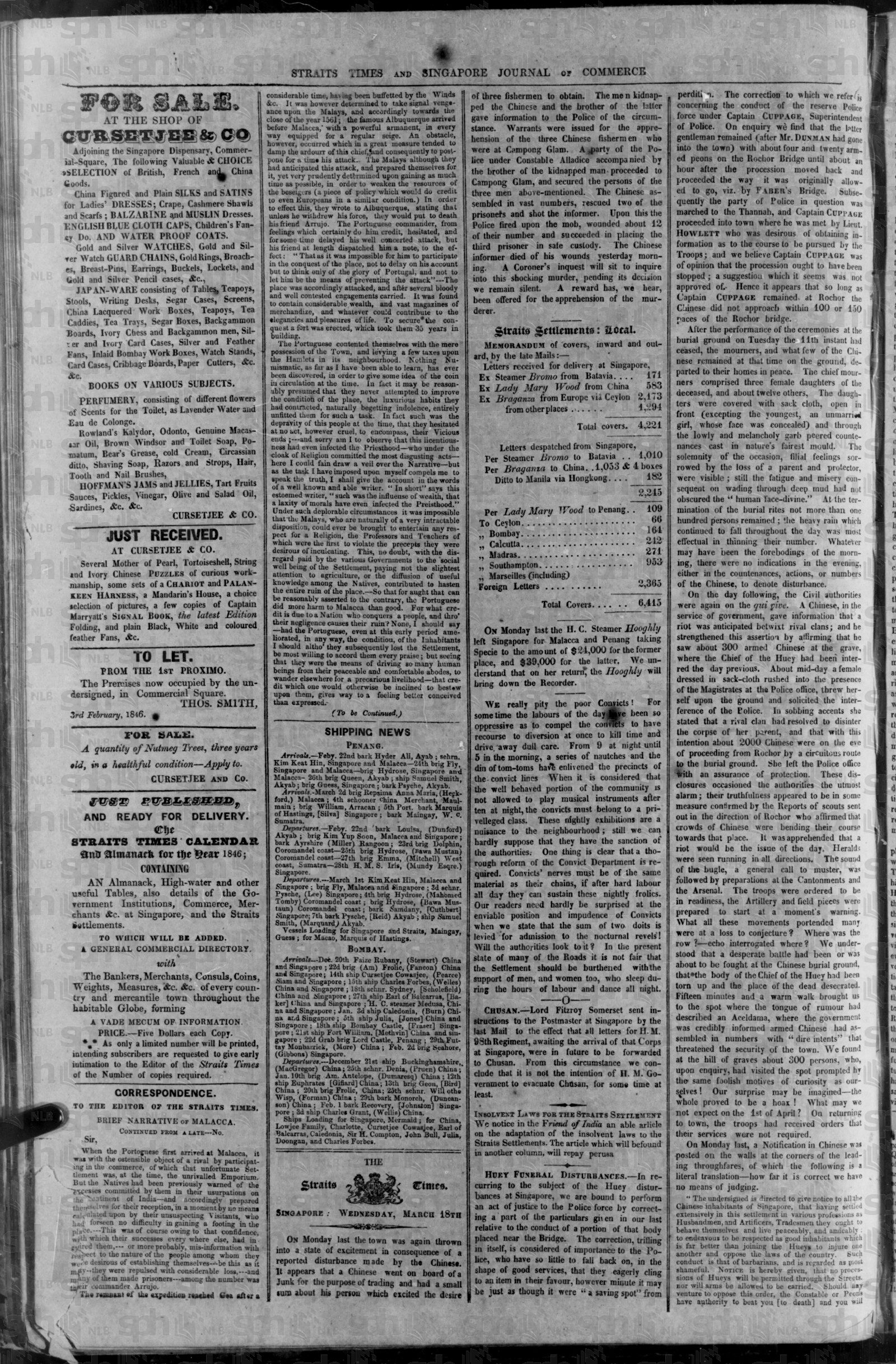 The Straits Times of the 18th of March 1846, page 2, with its report on the "Huey Funeral Disturbances." (Singapore Press Holdings, via NewspaperSG, National Library Board Singapore, public domain)
The rivalry between the societies often turned violent. In March 1846, when the head of the Ghee Hin, Ho Ah Yam, died, about 6,000 members marched in his funeral procession, and two to three thousand armed men of the Ghee Hok gathered to confront them. The police, backed by troops, kept the two sides apart. In February 1851, Ghee Hin men attacked the plantations of Chinese Christians for about a week, and nearly 500 people were killed.
The worst riots came in May 1854, between Hokkiens and Teochews, and between the Ghee Hin and the Ghee Hok. They began on the 5th of May with a quarrel over the price of a few catties of rice. The chronicler Charles Burton Buckley wrote that the real cause was the Hokkiens’ refusal to contribute to a fund for rebels who had been driven out of Amoy, in China, and that the fighting had been planned in the societies. For ten or twelve days it spread from the town to the country districts, from Rochor to Paya Lebar, Geylang, Siglap, Tanglin and the roads to Bukit Timah and Thomson. Buckley counted more than 400 dead and about 300 houses burnt. In June a special criminal session of the court tried the men arrested.
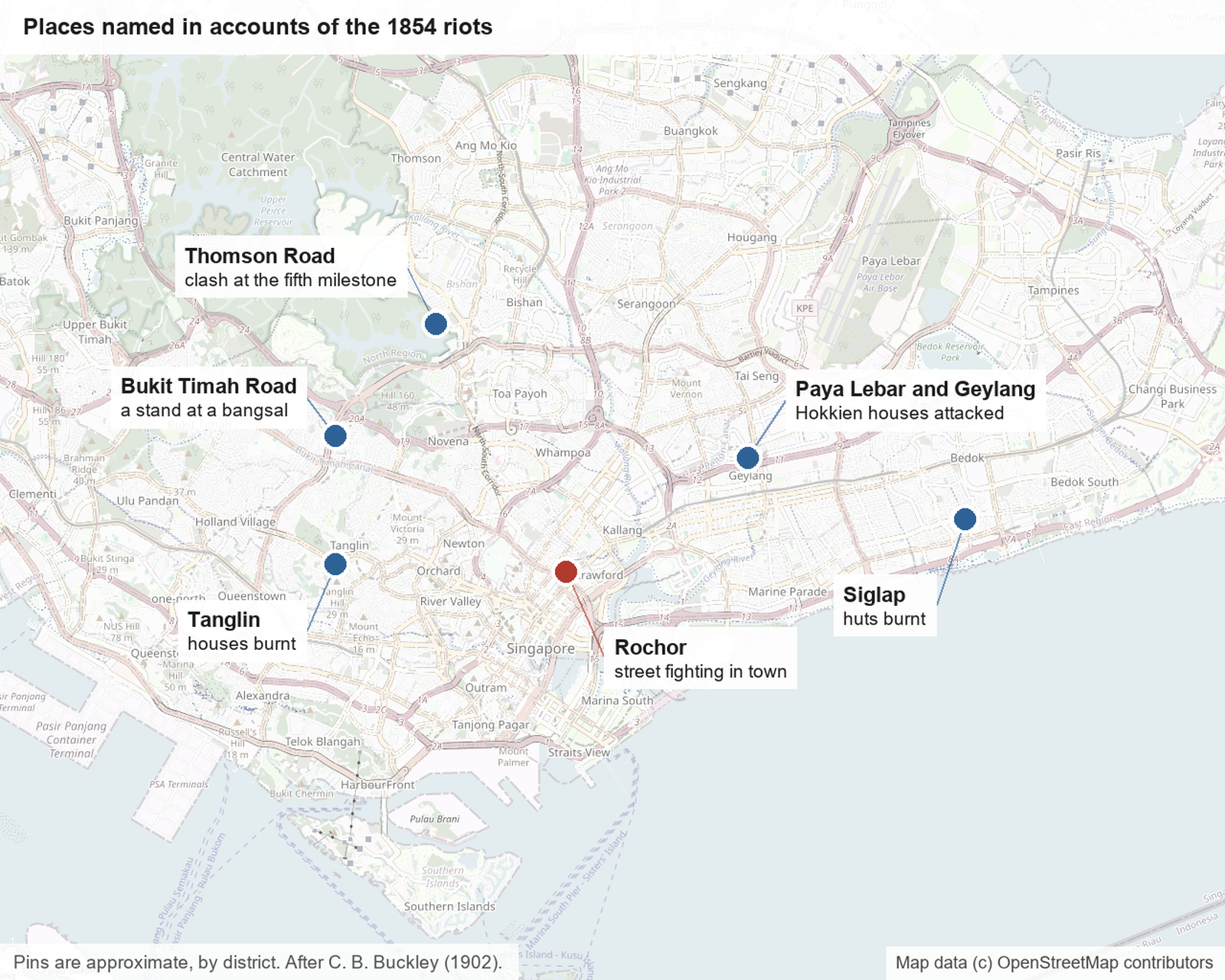
Places named in Buckley’s account of the 1854 riots, plotted on today’s map. Pins are approximate, placed by district. (Map data © OpenStreetMap contributors)
Smaller outbreaks followed for decades. In December 1876, Teochew merchants opposed to a new government sub-post office for letters and money sent home to China, which threatened their own business, stirred up a riot on the day it opened, and three people died.
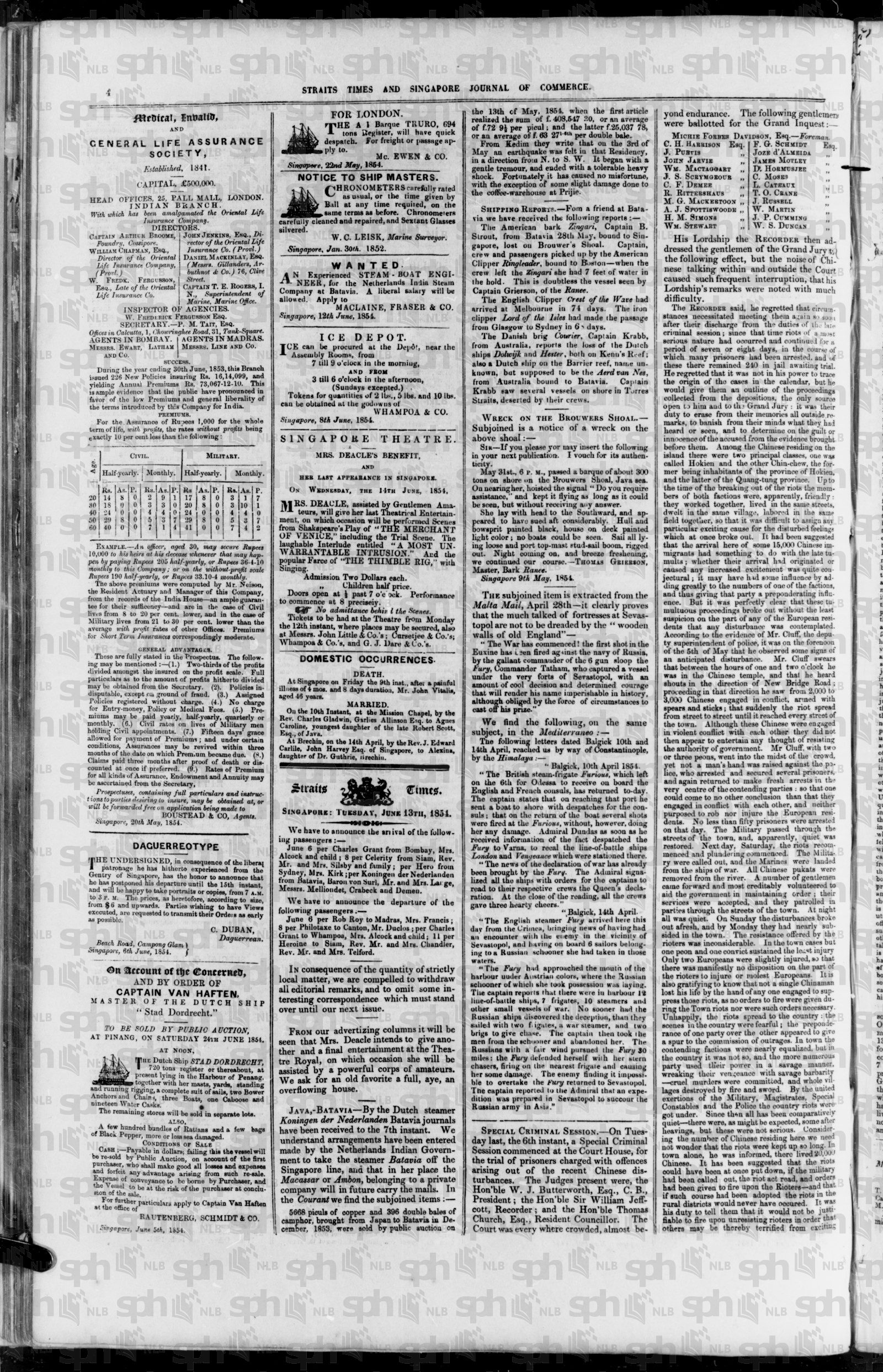 The Straits Times of the 13th of June 1854, page 4, with the report of the special criminal session held after the riots. (Singapore Press Holdings, via NewspaperSG, National Library Board Singapore, public domain)
Registering instead of banning
The colony’s first answer was to register the societies rather than ban them. The Dangerous Societies Suppression Ordinance of 1869 required them to register their names, office-bearers and members, so that the government at least knew who they were. In practice, the registers were easily faked. Rules and membership lists were made up, and the men named as office-bearers were often not the ones in charge.
In 1877 the government set up the Chinese Protectorate under William Pickering, who became Registrar of Societies too, as I described in the post on the Protectorate. Pickering preferred to watch the societies and work through their headmen, and the Protectorate gave Chinese residents a place to bring their disputes. Further laws in 1882 and 1885 tightened the rules, but the societies kept growing. In Singapore their membership rose from about 49,000 in 1885 to about 65,000 in 1888.
The ban
 Sir Cecil Clementi Smith, Governor of the Straits Settlements, in a Vanity Fair caricature published on the 23rd of January 1892. (Robert Wallace Braddell, "Kyo," public domain, via Wikimedia Commons)
In July 1887 a man put up to it by members of the Ghee Hok attacked Pickering in his office. A few months later, in October 1887, Sir Cecil Clementi Smith became Governor. He had served in Hong Kong for sixteen years, and he decided that registration had failed and the societies must be suppressed. Both Pickering and the head of the police opposed his bill. When it came before the Legislative Council in February 1889, the unofficial members, who were not government officers, voted against it, but the officials’ votes carried it.
The Societies Ordinance of 1889 came into force on the 1st of January 1890, with six months’ grace for the societies to wind up their affairs and dispose of their property. Under it, any association of ten or more people was a society, every society had to be registered to be lawful, and the government could dissolve the existing secret societies. In March 1890 the Governor reported that in Singapore the headmen of all ten dangerous societies had handed in their seals, flags and books. Most of the Ghee Hin’s papers were destroyed, but a few seals and certificates went to the Protector’s office and are now in the National Museum of Singapore.
To keep a link with the Chinese community, the government set up a Chinese Advisory Board in each settlement in December 1889, with members drawn from the main dialect groups and the Protector of Chinese sitting on it. The boards advised the government on Chinese affairs and arbitrated disputes, work that the societies’ headmen had once done.

The Chinese Protectorate in Singapore, on an early postcard. (Unknown photographer, KITLV, CC BY 4.0, via Wikimedia Commons)
After the ban
The ban did not end the societies. Some went underground, and others registered as recreational or social clubs and carried on as before. The clan and dialect associations, which ran temples, schools and burial grounds for their communities, carried on openly under the new law. M. L. Wynne, a police officer who studied the societies, summed up the dilemma: “The inherent weakness of toleration is encouragement; of registration, recognition; and of suppression, evasion.”
Gangs descended from the old societies remained a problem for decades, until tougher criminal laws and police operations in the 1950s broke up many of them. The rule that began in 1890 is still in force in another form. Under Singapore’s Societies Act, any club or association of ten or more people must be registered with the Registry of Societies, the same threshold the 1889 ordinance set.

The Ying Fo Fui Kun, a Hakka clan association, on Telok Ayer Street in October 2025. (GoAheadFan95, CC BY-SA 4.0, via Wikimedia Commons)
See more photos of old Chinese Singapore →
Where it fits in the bigger story: For most of the 19th century, colonial Singapore relied on the secret societies to manage its Chinese population, and then decided it could not live with them. The 1890 ban was a turning point in how the state dealt with the Chinese community, from working through brotherhoods it could not control to registering every association and building its own links with community leaders. The registration rule it introduced has outlasted the colony.
Sources:
- Ghee Hin Kongsi, Wikipedia
- Secret societies in Singapore, Wikipedia
- Societies Ordinance comes into force, Singapore History, National Library Board
- Heaven, Earth and Brotherhood, BiblioAsia, National Library Board
- Triads, Coolies and Pimps: Chinatown in Former Times, BiblioAsia, National Library Board
- Cheng Siok-Hwa, Government Legislation for Chinese Secret Societies in the Straits Settlements in the Late 19th Century, Asian Studies 10(2), 1972
- Charles Burton Buckley, An Anecdotal History of Old Times in Singapore (1902), Internet Archive
- Societies Act 1966, Singapore Statutes Online
- Registration of society, Registry of Societies
- “Huey Funeral Disturbances”, The Straits Times, 18 March 1846, page 2 (NewspaperSG)
- “Special Criminal Session”, The Straits Times, 13 June 1854, page 4 (NewspaperSG)
- Map data © OpenStreetMap contributors
- File:KITLV - 43317 - Lambert & Co., G.R. - Singapore - The North Bridge Road, Singapore - circa 1900.tiff
- File:Membership certificate of the Ghee Hin Kongsi from William Stirling Collection.jpg
- File:KITLV - 29169 - Chinese street in Singapore, completely decorated on the occasion of the visit of Prince Albert of Saxe-Coburg - Gotha, husband of Queen Victoria - 1860.tif
- File:Cecil Clementi Smith Vanity Fair 1892-01-23.jpg
- File:Chinese Protectorate, Singapore, KITLV 1404946.tiff
- File:Ying Fo Fui Kun, Telok Ayer Street, October 2025.jpg
- File:KITLV - 103742 - Lambert & Co. - Thian Hock Keng Temple in Singapore - circa 1890.tif
- File:Photographic Views of Singapore Plate 02 South Bridge Road.jpg
- File:KITLV - 103776 - Chinese street vendor in Singapore - circa 1890.tif
- File:KITLV - 50188 - Lambert & Co., G.R. - Singapore - Chinese cookie sellers in Singapore - circa 1900.tif
- File:KITLV - 79924 - Kleingrothe, C.J. - Medan - Cecil Street, Singapore - circa 1910.tif
- File:Bust of Sir Cecil Clementi Smith, Victoria Concert Hall, Singapore - 20141101-01.JPG
- File:Thian Hock Keng Temple, 20230630.jpg


