The Chinese Protectorate: Pickering, the Poh Leung Kuk and the Coolie Trade
On the 18th of July 1887, a Teochew carpenter named Chua Ah Siok walked into the office of the Protector of Chinese in Singapore, saying he had a petition to present. When he reached the Protector, William Pickering, he threw the iron head of an axe at him. It struck Pickering on the forehead, and he never fully recovered. The attack was blamed on a secret society, and it was aimed at the man who, for ten years, had run the colony’s first serious attempt to protect Chinese migrants from the trade that brought them to Singapore.

The Chinese Protectorate’s 1886 building at New Bridge Road and Havelock Road, on a postcard published between 1906 and 1930. Pickering was attacked here in 1887. (Anonymous, KITLV / Leiden University Library, CC BY 4.0, via Wikimedia Commons)
The coolie trade
Through the nineteenth century, most of Singapore’s growth came from Chinese migrants, and by the 1870s about 50,000 of them were arriving every year from Fujian, Guangdong and Hainan. Many came under the credit-ticket system. A broker paid the passage of a man who could not afford it, and on arrival the newcomer, known as a sinkeh, had to sign a contract and work off the debt. Until a broker or employer took the debt over, he could be kept in the ship’s hold or in a coolie depot, and the depots were often overcrowded and filthy.

The port of Singapore around 1890, where the sinkeh arrived. (G.R. Lambert & Co., public domain, via Wikimedia Commons)
The system was open to abuse, and much of the trade was in the hands of the secret societies. In 1873 three leading Chinese merchants, Hoo Ah Kay Whampoa, Tan Kim Ching and Tan Seng Poh, told the Chamber of Commerce that the head of the Ghee Hok society sent boats out to the immigrant ships, supposedly to protect the coolies but in reality to sell them. Men who thought they were going to work in nearby Johor or Riau found themselves shipped to the tobacco estates of Deli in Sumatra, where a coolie fetched a higher price, and some killed themselves when they found out. The Chinese merchants had already petitioned the government in 1871, asking for an immigration office where the coolies would be landed and told that they were free.
Pickering
William Alexander Pickering was born in Nottinghamshire in 1840 and went to sea at 16. In 1862 he joined the Chinese customs service at Fuzhou, and he went on to work in Taiwan, then called Formosa, learning to speak Chinese along the way. In March 1872 he arrived in Singapore as the colony’s Chinese interpreter, and at the time he was the only European officer in the Straits Settlements who could speak Chinese. He came to speak Mandarin, Hokkien, Teochew, Cantonese and Hakka, and he helped settle the Larut wars between rival Chinese societies in Perak in 1874.
 William Pickering, from his book Pioneering in Formosa, 1898. (British Library, no known copyright restrictions, via Wikimedia Commons)
On the 3rd of May 1877 Pickering was appointed the first Protector of Chinese, at the head of a new Chinese Protectorate, and later that year he was also made Registrar of Societies. The same year, the colony passed a Chinese Immigrants Ordinance and a Crimping Ordinance to regulate how labourers were brought in and recruited.
What the Protectorate did
The Protectorate began in a shophouse on North Canal Road, with an Assistant Protector, a boarding officer, an interpreter and clerks. Its officer boarded every ship that brought in Chinese migrants. Each sinkeh was given a handbill telling him that the Protectorate would help him and warning him against the secret societies, and each contract between a sinkeh and his employer was registered and explained to him in his own dialect. The coolie brokers and their depots had to be licensed.
With the secret societies, Pickering preferred registration and close watching to a ban. As Registrar he kept records of each society’s address, office-bearers and members, worked through their headmen, and had the ones who would not cooperate banished. Over time, Chinese residents began to bring their disputes to the Protectorate instead of to the societies, and grateful petitioners lined the walls of his office with red candles.
The Protectorate soon outgrew its first office. It moved to Upper Macao Street, which is now named Pickering Street after him, then to Boat Quay, and in 1886 to a new building at the corner of New Bridge Road and Havelock Road.
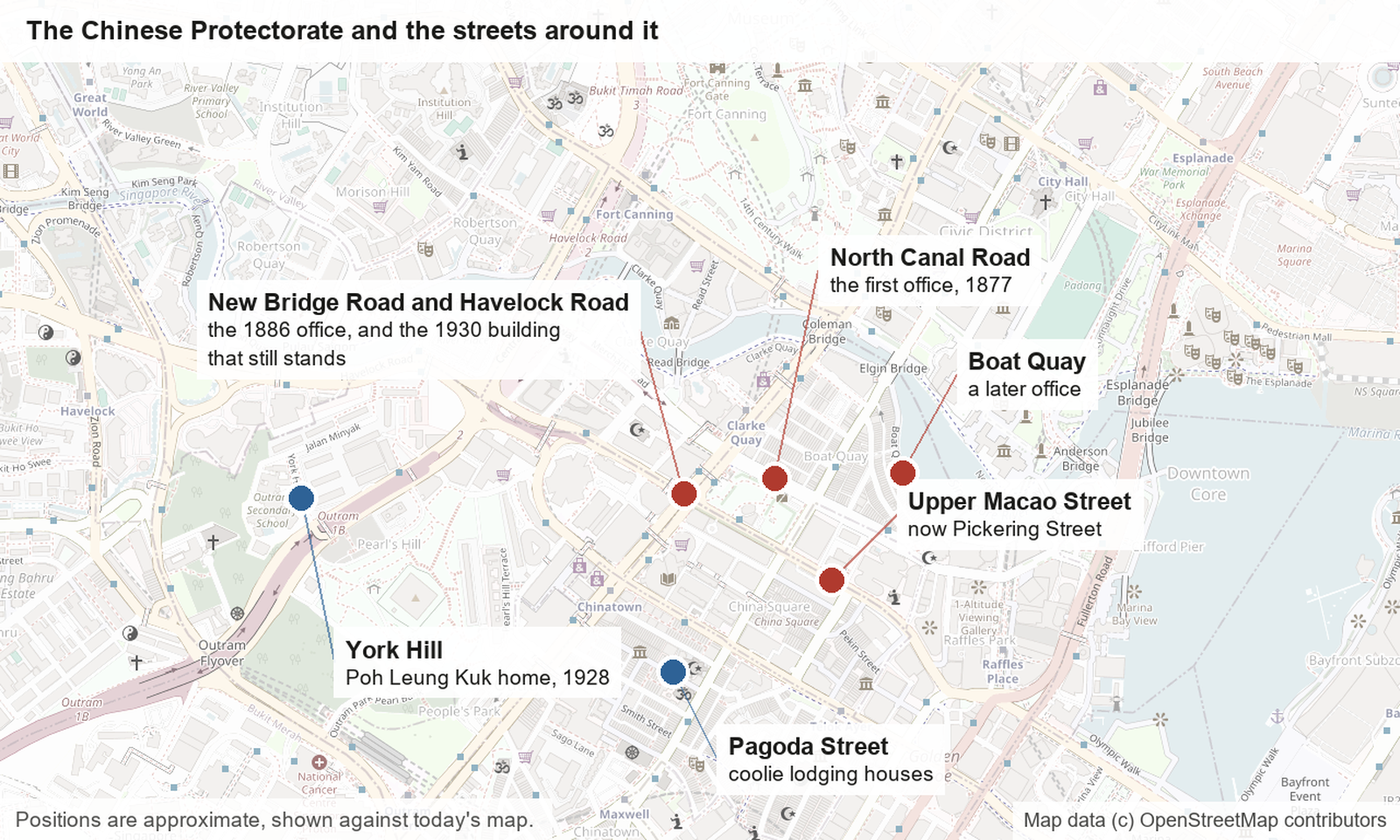
The Protectorate’s offices, the coolie houses of Pagoda Street and the Poh Leung Kuk home at York Hill, plotted on today’s map. (Map data © OpenStreetMap contributors)
Women, girls and the Poh Leung Kuk
The migrants were overwhelmingly men. In 1860 there was about one Chinese woman in Singapore for every 14 men, and by 1882 at least 2,000 women were working as prostitutes, about a third of the female population. Prostitution itself was legal, but the Protectorate registered the brothels and the women in them, and it could remove any girl under 16 who was being trained for the trade.
A similar refuge, the Po Leung Kuk, had been founded in Hong Kong in 1878. In Singapore, to give the women and girls it rescued somewhere to go, a committee of leading Chinese residents began meeting under the Protector in 1886. In 1888 the Women and Girls’ Protection Ordinance made Singapore’s Poh Leung Kuk an official place of safety. It took in rescued prostitutes, mui tsai (girls sold as domestic servants) and destitute girls, taught them to read and to keep house, and at 18 helped them into work or marriage, vetting the men who asked to marry them. It probably started in a single room at the Lock Hospital at Kandang Kerbau, and in 1928 it moved to a larger home at York Hill. A League of Nations committee that visited in 1931 called it the finest institution of its kind, though critics saw it as too much like a prison.
The attack
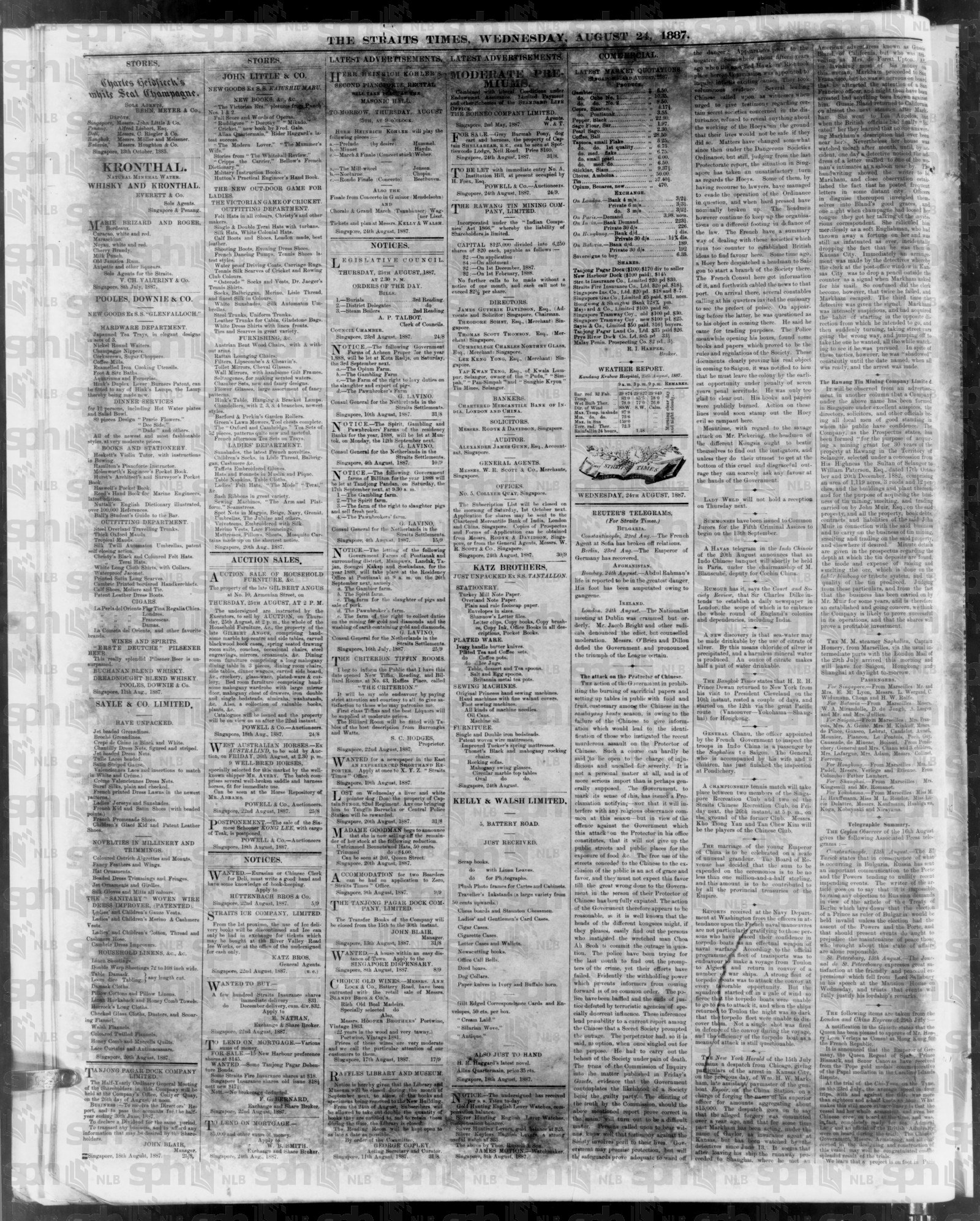 The Straits Times of 24 August 1887, page 2. Its fifth column carries a comment headed "The attack on the Protector of Chinese", on the government's response and the inquiry into who was behind it. (Singapore Press Holdings, via NewspaperSG, National Library Board Singapore, public domain)
Pickering’s regulations were resented by members of the secret societies, and in 1887 one of them struck back. According to Song Ong Siang’s history of the Chinese in Singapore, published in 1923, Chua Ah Siok had been put up to the attack by members of the Ghee Hok society. He was arrested on the spot, and said that although he had been hired to kill, he had decided not to kill a public officer. At the November 1887 assizes he pleaded guilty to voluntarily causing grievous hurt and was sentenced to seven years’ rigorous imprisonment.
Pickering never fully recovered from the wound. He went on extended leave and retired by 1890; the sources disagree on the exact year. The new governor, Sir Cecil Clementi Smith, chose a harder line, and under the Societies Ordinance of 1889, which came into force in 1890, the secret societies were banned outright. Pickering died at San Remo in Italy in January 1907.
After Pickering
The Protectorate outlived its founder by more than half a century. Its later heads included Francis Powell, George Crofton Wray and William Evans. In 1928 work began on a new building on the site of the 1886 office, and the Protectorate moved into it around 1930. It is a two-storey neoclassical building with Art Deco details, in a style close to that of the old City Hall and Supreme Court.

The 1930 Protectorate building in 2006, when it was the Family and Juvenile Court. (Chensiyuan, CC BY-SA 3.0, via Wikimedia Commons)
After the Second World War the Protectorate was renamed the Chinese Secretariat and placed under the Ministry of Labour and Welfare, which moved into the building in 1955. The Poh Leung Kuk did not survive the war in its old form: it was left out of the plans of the new Department of Social Welfare, and its committee quietly dissolved. The building later housed the Ministry of Law, and from 1990 the courts, first as the Family and Juvenile Court and later as the Family Justice Courts. On the 27th of February 1998 it was gazetted as a national monument. In November 2024 the Family Justice Courts moved to new premises nearby at Havelock Square.
The Chinese Protectorate, 1871 to today
- 1871 Chinese merchants petition for an immigration office.
- Mar 1872 Pickering arrives as the colony's Chinese interpreter.
- 3 May 1877 Pickering becomes the first Protector of Chinese.
- 1886 The Protectorate moves to New Bridge Road; the Poh Leung Kuk committee begins.
- 18 Jul 1887 Chua Ah Siok attacks Pickering with an axe head.
- 1888 The Poh Leung Kuk becomes an official place of safety.
- 1889-1890 The Societies Ordinance bans the secret societies.
- 1928 The Poh Leung Kuk moves to York Hill; a new Protectorate building is begun.
- After 1945 The Protectorate becomes the Chinese Secretariat.
- 1955 The Ministry of Labour and Welfare moves into the building.
- 27 Feb 1998 The building is gazetted a national monument.
- Mar 2015 The Prevention of Human Trafficking Act takes effect.
- Nov 2024 The Family Justice Courts move out.
Today
Some of the Protectorate’s work has present-day echoes. Singapore’s Prevention of Human Trafficking Act took effect on the 1st of March 2015, and an inter-agency taskforce on trafficking, set up in 2010, is co-chaired by the Ministry of Home Affairs and the Ministry of Manpower. Since 2018 the Ministry of Manpower has required newly arrived work permit holders in some sectors to attend a one-day Settling-In Programme, taught in their own languages, which explains their rights, Singapore’s laws and where to get help, much as Pickering’s handbills tried to do for the sinkeh of the 1870s.

The former Protectorate building, now known as the former Ministry of Labour Building, in October 2025. (GoAheadFan95, CC BY-SA 4.0, via Wikimedia Commons)
See more photos of the Protectorate and Singapore in Pickering’s time →
Where it fits in the bigger story: The Chinese Protectorate was the colonial government’s first real attempt to stand between Chinese migrants and the brokers and societies who profited from them, and it was pushed for by Chinese merchants as much as by British officials. It did not end the abuses, and its handbills and registers reached only part of the trade, but it brought migrants, women and girls under the protection of the law. The building at New Bridge Road and Havelock Road is still standing, and Pickering Street, a short lane in the middle of the city, still carries his name.
Sources:
- The attack on the Protector of Chinese, The Straits Times, 24 August 1887, page 2, NewspaperSG
- The Chinese Protectorate, Singapore Infopedia, National Library Board
- William A. Pickering, Singapore Infopedia, National Library Board
- Singapore Poh Leung Kuk, Singapore Infopedia, National Library Board
- Chinese coolies, Singapore Infopedia, National Library Board
- Former Ministry of Labour Building, Roots.gov.sg (National Heritage Board)
- Triads, coolies and pimps: Chinatown in former times, BiblioAsia, National Library Board
- Song Ong Siang, One Hundred Years’ History of the Chinese in Singapore (1923), chapters 7 and 8
- William A. Pickering, Wikipedia
- Old Ministry of Labour Building, Wikipedia
- Secret societies in Singapore, Wikipedia
- Family Justice Courts commence operations in new premises, Singapore Courts
- Prevention of Human Trafficking Act to take effect from 1 March 2015, Ministry of Home Affairs
- Launch of Singapore’s National Approach against Trafficking in Persons, Ministry of Home Affairs
- New Settling-In Programme for foreign workers, Ministry of Manpower
- Map data © OpenStreetMap contributors
- File:Chinese Protectorate, Singapore, KITLV 1404946.tiff
- File:KITLV - 150813 - Lambert & Co., G.R. - Singapore - Port at Singapore - circa 1890.tif
- File:Portrait of Pickering, William Alexander.jpg
- File:Family court singapore.jpg
- File:Former Ministry of Labour Building, October 2025.jpg
- File:British Library digitised image from page 299 of “Pioneering in Formosa, etc”.jpg
- File:Photographic Views of Singapore Plate 13 Group of Coolies.jpg
- File:Woningen van de kolensjouwers van de Tanjong Pagar Dock Co. Ltd. in Singapore Coal coolies quarters (titel op object), RP-F-F01140-AC.jpg
- File:KITLV - 402631 - Pier in Singapore - circa 1890.tif
- File:COLLECTIE TROPENMUSEUM Chinese koelies uit Shantou verlaten het schip ‘s Jacob in de haven van Belawan Sumatra om in de tabakcultuur te gaan werken TMnr 10001445.jpg
- File:KITLV - 29179 - Lambert & Co., G.R. - Singapore - Small Chinese shops in Singapore - 1897.tif
- File:Photographic Views of Singapore Plate 23 Street Scene.jpg
- File:KITLV - 43317 - Lambert & Co., G.R. - Singapore - The North Bridge Road, Singapore - circa 1900.tiff
- File:KITLV - 50189 - Lambert & Co., G.R. - Singapore - Chinese rickshaw at Singapore - circa 1900.tif
- File:Subordinate Courts, Family and Juvenile Court, Mar 06.JPG
- File:Family Justice Courts, October 2025.jpg
- File:Pickering Street, Oct 06.JPG


