Syed Mohamed Alsagoff and the Estate That Printed Its Own Money
On the 1st of May 1878, a press in Singapore printed a set of banknotes that no bank had issued. They were worth 25 cents, 50 cents, one dollar and two dollars, they were printed on one side only, and each was signed by hand. They were meant to be spent in one place, the estates of an Arab merchant named Syed Mohamed Alsagoff on the island of Kukup, off the south-western tip of Johor. The Sultan of Johor had given him the land, and with it the right to issue his own money.

Pulau Kukup, seen from the fishing village of Kukup in Johor, in 2005. Syed Mohamed Alsagoff’s estate covered the island in the late 19th century. (Sengkang, public domain, via Wikimedia Commons)
An Arab family in Kampong Glam
Syed Mohamed was born in Singapore in 1836, into one of the Arab families from the Hadhramaut, in what is now Yemen, who had settled across the ports of the Malay world. His grandfather, Syed Abdulrahman Alsagoff, had traded between Malacca and Java in his own ships before coming to Singapore in the settlement’s early years. His father, Syed Ahmed, married Raja Siti, the daughter of Hajjah Fatimah, the Malacca-born merchant whose mosque still stands on Beach Road. I wrote about her in an earlier post.

The Hadhrami Arab quarter of Surabaya, in the Dutch East Indies, around 1880. Families like the Alsagoffs traded between such quarters across the region. (Unknown photographer, public domain, via Wikimedia Commons)
Syed Ahmed founded the trading firm of Alsagoff and Company in 1848 and took over his mother-in-law’s business. When he died he was, in the words of the Singapore chronicler Charles Burton Buckley, “a very rich man,” with steamers and sailing ships of his own. The firm also carried Muslim pilgrims between Southeast Asia and Jeddah, the port for Mecca, and by 1871 the Alsagoff-owned Singapore Steamship Company was taking them there by steamer. Syed Mohamed inherited the firm, the ships and the pilgrim trade, and became its senior partner.
The Kukup concession
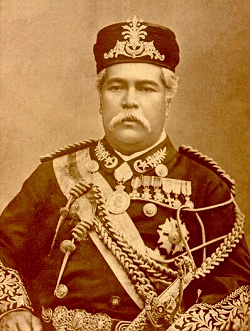 Sultan Abu Bakar of Johor, who gave Syed Mohamed the Kukup concession, photographed between 1885 and 1895. (Unknown photographer, public domain, via Wikimedia Commons)
Johor’s ruler, Abu Bakar, who took the title of Sultan in 1885, was opening his state to planters from Singapore, and he was a close patron of Syed Mohamed. In the late 1870s he granted him land on Pulau Kukup, a mangrove island at the southern end of the Strait of Malacca, and later more land on the coast nearby. The estate was named Constantinople. By 1908 it grew rubber, sago, coconuts, coffee, cocoa and pineapples, and about 200 men worked there.
The Johor government also gave him the right to issue private money for use on his estates. The notes were printed by the Al-Sa’aidi Press in Singapore and are dated the 1st of May 1878. The ones that survive are very rare. They carry hand-written signatures and stamped serial numbers, and they were never listed in the standard world catalogue of paper money. The National Museum of Singapore holds examples of the 25-cent, 50-cent and one-dollar notes.
| Value | Colour | Size (mm) |
|---|---|---|
| 25 cents | Green | 126 × 113 |
| 50 cents | Red-brown | 134 × 110 |
| 1 dollar | Black | 127 × 106 |
| 2 dollars | Brown | 134 × 106 |
Source: Standard Catalogue of Malaysia, Singapore and Brunei Coin and Paper Money, 16th edition (2003), as listed on Wikipedia.
The pilgrims who worked off their fares
The estate needed labour, and some of it came from the pilgrim trade. Many pilgrims from the Dutch East Indies ended up in Jeddah destitute and in debt, with nothing left for the voyage home. As the arrangement was described at the time, an agent of Syed Mohamed’s in Jeddah paid their debts and their passage to Singapore, and in return they signed contracts to work for him until the money was repaid.

Pilgrims from Ambon and the Kai and Banda islands at the Dutch consulate in Jeddah, around 1880. The contracts in the 1881 case were signed at the Dutch consulate in Jeddah. (Christiaan Snouck Hurgronje, Tropenmuseum, CC BY-SA 3.0, via Wikimedia Commons)
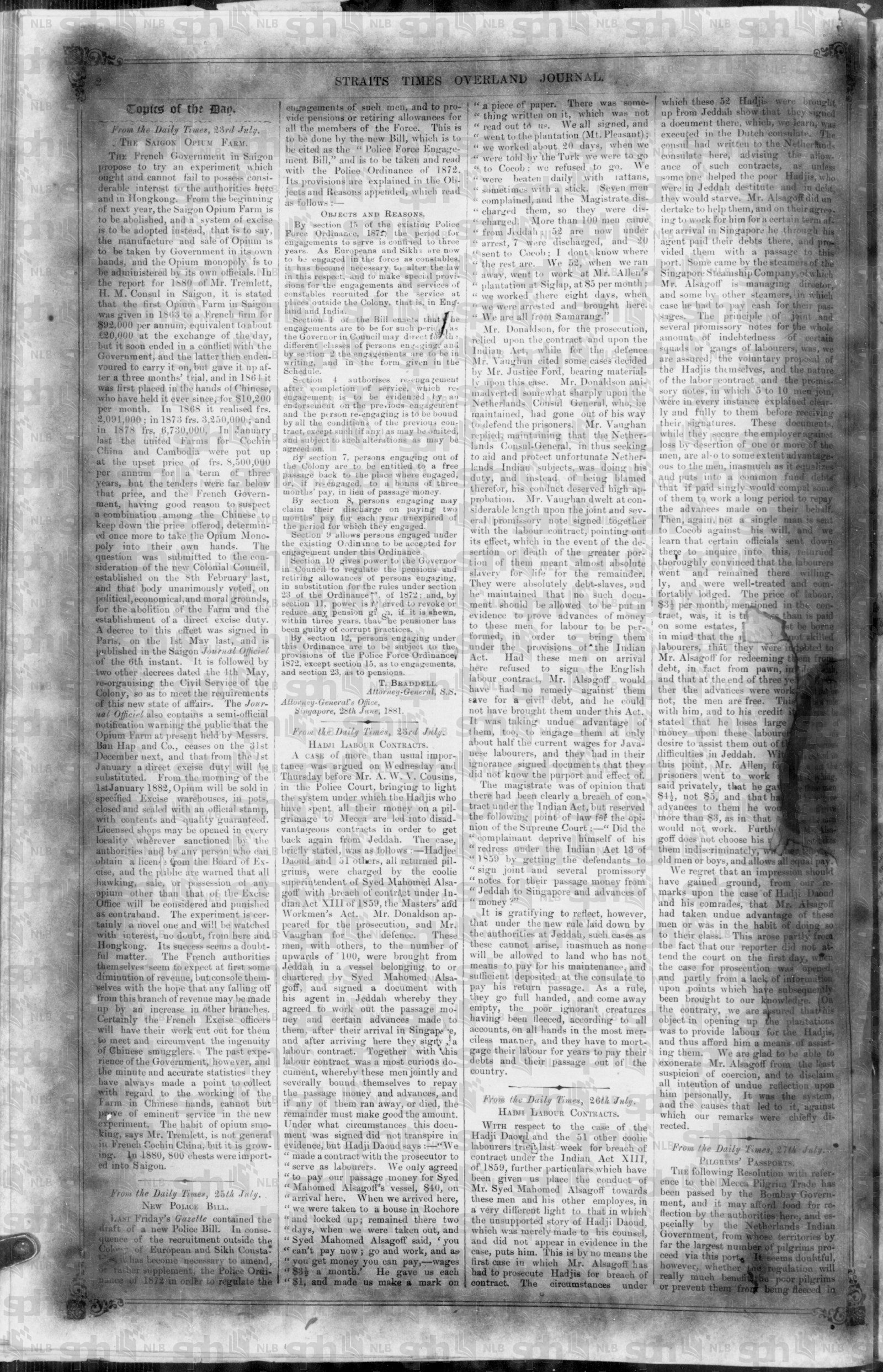 The Straits Times Overland Journal of the 28th of July 1881, page 2, which reprinted both reports on the Hadji labour case. (Singapore Press Holdings, via NewspaperSG, National Library Board Singapore, public domain)
In July 1881 the arrangement came before the Police Court in Singapore. Fifty-two returned pilgrims from Semarang, in Java, were charged by Syed Mohamed’s coolie superintendent with breaking their labour contracts. Their spokesman, Hadji Daoud, said they had agreed only to repay a fare of $40. In Singapore, he said, they were locked in a house for two days, made to put their mark on a paper that was not read to them, and set to work on a plantation at Mount Pleasant for three and a half dollars a month. When they were told to go to Kukup they refused, and they said they were beaten. They ran away to work on another estate at Siglap, where they were arrested. Their lawyer argued that the papers, which made the whole group liable for the debt of any man who ran away or died, turned them into “debt-slaves.”
The magistrate found that the contracts had been broken but referred a point of law to the Supreme Court. The paper noted that, under a new rule in Jeddah, pilgrims would only be allowed to land there if they could support themselves and had money deposited at their consulate for the journey home.
A few days later the newspaper that had reported the case printed the other side. It said the Dutch consul in Jeddah had advised such contracts, because the stranded pilgrims would otherwise starve. It said Syed Mohamed had paid off their debts, that no man was sent to Kukup against his will, and that officials who went to inspect the estate found the labourers well treated. The paper said it was glad to clear him of “the least suspicion of coercion,” and that its criticism had been aimed at “the system.” A century later, in a 1984 lecture, the historian J. M. Gullick described the pilgrim contracts on Kukup as debt bondage come again.
A merchant’s Singapore
In Singapore, Syed Mohamed’s wealth was mostly in land. The family firm owned the Raffles Hotel buildings on Beach Road, and the Perseverance Estate at Geylang, more than 1,000 acres of citronella and lemon grass, with a factory that distilled the oils. He lived in a large house at Bukit Tunggal, off Thomson Road, which the Straits Times called a “magnificent palace,” and he often travelled to Europe and to Jeddah for his health.

The Raffles Hotel on an early postcard. Its buildings belonged to Syed Mohamed and his firm. (Unknown photographer, KITLV, CC BY 4.0, via Wikimedia Commons)
He was also a public figure. The Ottoman government made him its consul in Singapore and gave him the Order of the Osmanieh, and historians of Aceh record that the Acehnese asked him to act for them in their long war with the Dutch. The Sultan of Johor gave him medals, a sword and a title. In 1890 he built the domed tomb over the grave of Habib Noh, a revered Muslim saint, on Mount Palmer, which is still a place of pilgrimage. He gave to public appeals such as the fund for the Victoria Memorial Hall.
A funeral in 1906
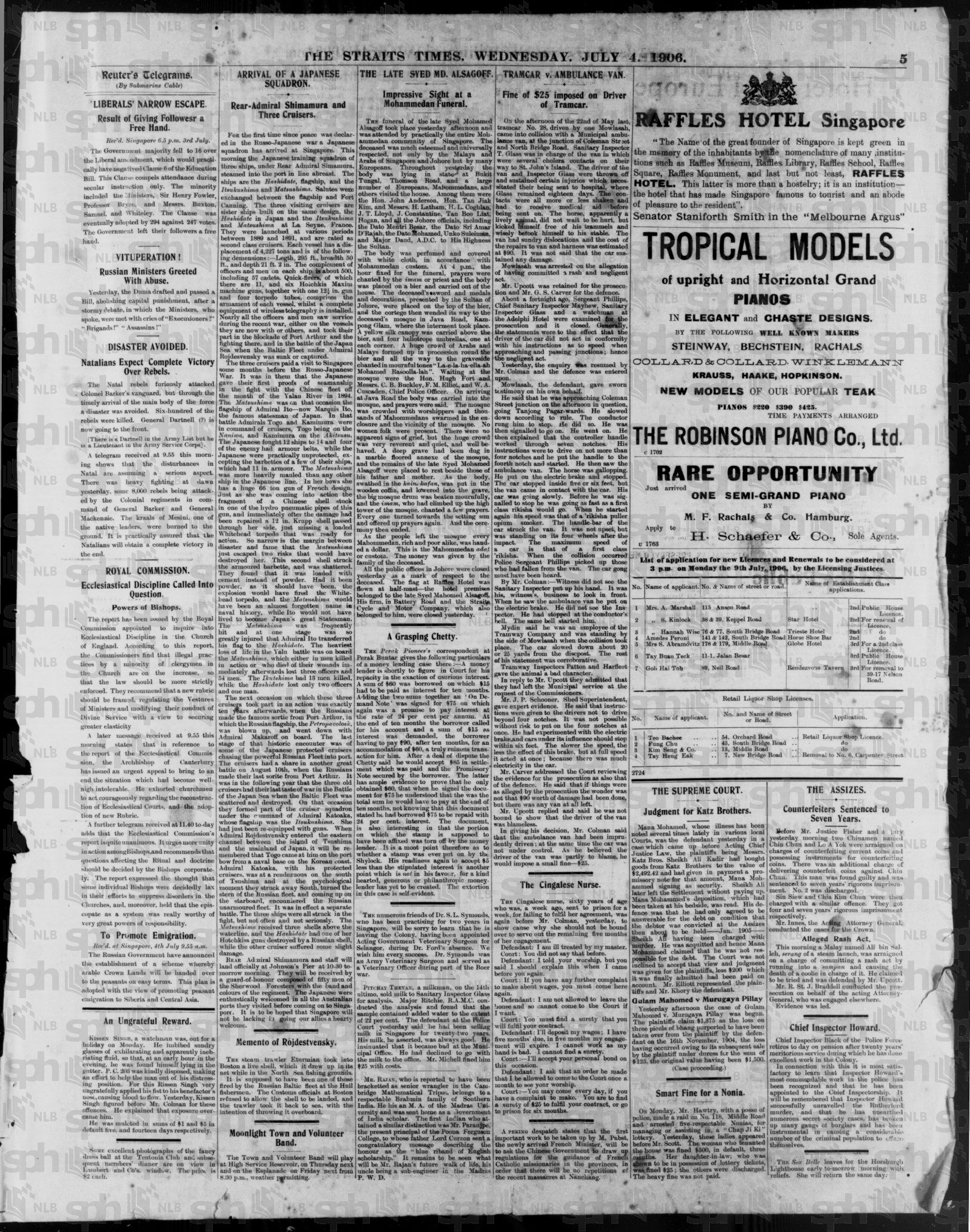 The Straits Times of the 4th of July 1906, page 5, with the report of Syed Mohamed's funeral in the third column. (Singapore Press Holdings, via NewspaperSG, National Library Board Singapore, public domain)
Syed Mohamed died at Bukit Tunggal on the morning of the 3rd of July 1906, aged 70. The Straits Times called him the head of the Arab community. His body lay in state at the house, where Europeans, Muslims and the officials of Johor came to pay their respects. That afternoon it was carried on a bier, with the sword, medals and decorations from the Sultan of Johor laid on top, under a yellow silk canopy, to his family’s mosque in Kampong Glam. A large crowd of Arabs and Malays walked with it, chanting. He was buried in the marble-floored annexe of Hajjah Fatimah’s mosque, beside his father and mother.
As the mourners left the mosque, the family gave every Muslim there a dollar, rich and poor alike. All the public offices in Johor closed for the day, the flag at the Raffles Hotel flew at half-mast, and his firm’s office in Battery Road shut its doors.
What carries the name today
The firm passed to his nephew, Syed Omar Alsagoff. According to the Malaysian writer Faisal Tehrani, part of the Kukup land was sold to a planting syndicate in the year of his death, and in 1926 the land on the island went back to the state. Pulau Kukup is now a national park, and since 2003 it has been protected as one of the world’s important wetlands under the Ramsar Convention.

The Alsagoff family burial ground at the entrance to Hajjah Fatimah’s mosque on Beach Road, in 2026. (M. Adrian Jurhami, CC BY 4.0, via Wikimedia Commons)
His will set up a charitable trust, the SMA Wakaf, a wakaf being an endowment held for religious and charitable purposes under Islamic law. In 1912 the trust opened the Alsagoff Arab School on Jalan Sultan, in the Kampong Glam he grew up in. It is the oldest madrasah still standing in Singapore, and the trust still supports it.

The Alsagoff Arab School on Jalan Sultan, in 2023. (Chainwit., CC BY 4.0, via Wikimedia Commons)
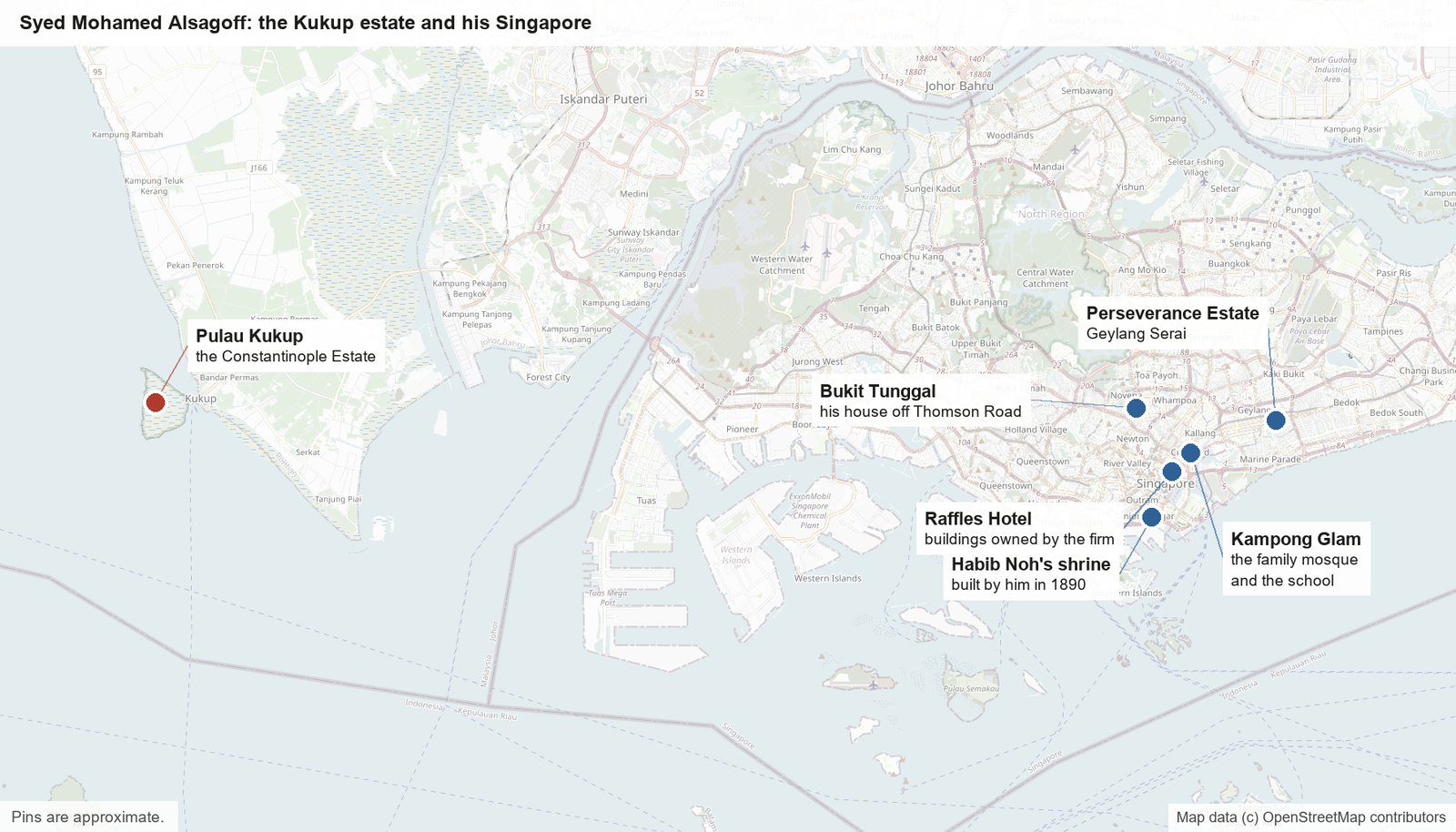
Pulau Kukup and the Alsagoff places in Singapore, plotted on today’s map. Pins are approximate. (Map data © OpenStreetMap contributors)
The Alsagoffs were one of several Hadhrami families who became great landowners in colonial Singapore. The Aljunieds and the Alkaffs were two others, and their names are still on the map, on Aljunied Road and at Alkaff Mansion on Telok Blangah Hill.
When I was courting my wife, I lived off Jalan Kayu, and seeing her home meant two buses, with a change at the corner of Serangoon Road and Aljunied Road. It never occurred to me that Aljunied was a real person, let alone the name of an immigrant family.
When I was working at Security Pacific, I dined at Alkaff Mansion. It was a slightly more expensive place, and brokers loved a chance to spend money on their clients. It was cooler up there than down in town, because it sat higher up. I have wanted to go back, but it is out of the way now that I no longer drive in Singapore.
See more photos of the Alsagoffs’ Singapore and Kukup →
Where it fits in the bigger story: Syed Mohamed Alsagoff’s life shows how much of colonial Singapore’s wealth was built by Arab merchant families whose names few people now connect with real people. His estate notes are a small, rare record of how far a planter’s power could reach in 19th-century Johor, and the 1881 case shows that the labour behind that wealth was questioned even at the time. What he left in Singapore is mostly what his money paid for, a tomb, a school and a trust that still runs.
Sources:
- Syed Mohamed bin Ahmed Alsagoff, Wikipedia
- House of al-Sagoff, Wikipedia
- Banknotes of the Constantinople Estate (Johore), Wikipedia
- One dollar Constantinople Estate banknote, National Museum of Singapore, Roots.gov.sg
- Twenty-five cent Constantinople Estate banknote, National Museum of Singapore, Roots.gov.sg
- Fifty cent Constantinople Estate banknote, National Museum of Singapore, Roots.gov.sg
- Charles Burton Buckley, An Anecdotal History of Old Times in Singapore (1902), Internet Archive
- Arnold Wright and H. A. Cartwright (eds), Twentieth Century Impressions of British Malaya (1908), Internet Archive
- Journey of Faith: Haj Pilgrimage in the Malay Archipelago before the 20th Century, BiblioAsia, National Library Board
- “Hadji Labour Contracts” (from the Daily Times, 23 and 26 July 1881), Straits Times Overland Journal, 28 July 1881, page 2 (NewspaperSG)
- “Death of Syed Mohamed Alsagoff”, The Straits Times, 3 July 1906, page 5 (NewspaperSG)
- “The late Syed Md. Alsagoff: Impressive Sight at a Mohammedan Funeral”, The Straits Times, 4 July 1906, page 5 (NewspaperSG)
- Faisal Tehrani, Menyingkap rahsia sejarah gugup di Pulau Kukup, Free Malaysia Today, 10 January 2019
- Johor’s Pulau Kukup Reopening Sheds Light On Its Shadowy Past, The Rakyat Post, 8 April 2024
- Keramat Habib Noh, Wikipedia
- Keramat Habib Noh, Roots.gov.sg
- Alsagoff Arab School, Roots.gov.sg
- Madrasah Alsagoff Al-Arabiah, Wikipedia
- About us, Madrasah Alsagoff Al-Arabiah
- Syed Abdulrahman Taha Alsagoff, Singapore Infopedia
- Syed Omar Aljunied, Wikipedia
- Alkaff Mansion, Wikipedia
- Map data © OpenStreetMap contributors
- File:Pulau Kukup.JPG
- File:Hadhrami Arab neighborhood, Surabaya 1880.jpg
- File:Johor-AbuBakar.jpg
- File:COLLECTIE TROPENMUSEUM Mekkagangers uit Ambon Key en Banda (Molukken) in het Nederlandse Consulaat in Jeddah Saoedi Arabië TMnr 10001261.jpg
- File:The Raffles Hotel, Singapore, KITLV 1404942.tiff
- File:Alsagoff burial ground, panorama.jpg
- File:Alsagoff Arabic School, Singapore (2023-06) img 01.jpg
- File:Hadhrami immigrants at Surabaya 1920s.jpg
- File:COLLECTIE TROPENMUSEUM Mekkagangers uit Mandeling Sumatra in het Nederlandse Consulaat in Jeddah Saoedi Arabië TMnr 10001258.jpg
- File:Raffles Hotel te Singapore, KITLV 156148.tiff
- File:Singapore Raffles Hotel, KITLV 1404887 (filed as “Singapore Raffels Hotel., KITLV 1404887.tiff”)
- File:COLLECTIE TROPENMUSEUM Entree van het Raffles Hotel Singapore TMnr 60018239.jpg
- File:Kukup (250511-0910).jpg
- File:Hajjah Fatimah Mosque, double grave.jpg
- File:Alsagoff Arab School, Jan 06.JPG
- File:Alsagoff Arab School - panoramio.jpg
- File:Keramat Habib Noh religious complex.jpg
- File:Alkaff Garden, Singapore., KITLV 1404907.tiff
- File:Alkaff Mansion.png


