Hajjah Fatimah: The Widow Who Ran a Fleet and Built a Mosque
In the early years of British Singapore, a widow from Malacca ran one of the trading businesses on the Kampong Glam shore, with ships of her own and houses across the town. Robbers broke into her home on Java Road twice, and the second time they set it on fire while she was away. She gave thanks for her escape by building a mosque on the site of her house, and in 1845 and 1846 it went up beside the sea. The mosque still stands on Beach Road and still bears her name, Hajjah Fatimah, but the sea has long since moved away.

Masjid Hajjah Fatimah seen from Kampong Glam Park in October 2025. (GoAheadFan95, CC BY-SA 4.0, via Wikimedia Commons)
From Malacca to Singapore
Little is written down about Fatimah’s early life. She was Fatimah binte Sulaiman, and the plaque on her mosque calls her “a Malacca Malay lady”. According to the Malay Heritage Foundation, an 1834 account by Captain Peter Begbie names her first husband as Rajah Moosa, a Bugis noble from Pulau Penyengat in the Riau islands, and she separated from him after he became insane. Her second husband was a Bugis merchant of royal descent from Gowa, in Celebes, the island now called Sulawesi, which is why she is sometimes remembered as the Sultana of Gowa. His business was based in Singapore, and she moved there with him.
 Lieutenant Jackson's plan of the town, published in 1828. Beach Road runs along the shore, past the Arab campong, the Sultan's compound and the Bugis campong. (From John Crawfurd's Journal of an Embassy, public domain, via Wikimedia Commons)
In the town plan of the 1820s, the land east of the European town was set aside for the Malay, Arab and Bugis communities. The Sultan’s compound stood at Kampong Glam, with the Arab quarter beside it and the Bugis kampong further along the shore. Beach Road was named for the obvious reason: it ran along the beach.
A widow in business
Accounts differ on what happened to her second husband. In one, he died while their daughter, Raja Siti, was young. In another, he left after Raja Siti was born and went home to Sulawesi. Either way, Fatimah took over his trading business and made it grow. The Malay Heritage Foundation says the business let her own several shipping vessels and many properties, in Kampong Glam and beyond.

The harbour and town of Singapore, in a French voyage atlas published in 1846. (Adolphe Jean-Baptiste Bayot, public domain, via Wikimedia Commons)
Trade in Singapore in the first decades after 1819 ran largely by sea, between the port, the islands of the archipelago, China and India, and a merchant needed boats to take part. A woman running such a business on her own account was rare in the colony at the time, and Fatimah built up a large fortune. She also built houses for the poor, and she made the pilgrimage to Mecca, which gave her the title Hajjah.
The fire and the mosque
Her house on Java Road, a lane in Kampong Glam close to the shore, was a target for robbers. They broke in twice, and the second time they set it on fire. The sources do not agree on when this happened: the Malay Heritage Foundation places it in the 1830s, and other accounts in the 1840s. Fatimah was away at the time and unharmed, and she put her escape down to God’s protection. In thanks, she gave the site of the house for a mosque and built herself a new house nearby.
 The minaret, built like a church steeple, in 2010. (Jacklee, CC BY-SA 3.0, via Wikimedia Commons)
The mosque was built in 1845 and 1846, mainly of wood, and for a time it was known as the Java Road Mosque, after the lane that has since disappeared. Its best-known feature is the minaret, which looks like a church steeple: an octagonal tower in stacked tiers, rising from a square base to a pointed spire. The story goes that Fatimah hired European architects, and the early buildings, the minaret among them, are often credited to John Turnbull Thomson, the Government Surveyor. No documents have been found to confirm it.
The Alsagoff connection
Raja Siti married Syed Ahmed Alsagoff, of a Hadhrami Arab merchant family that had settled in Singapore. Syed Ahmed co-founded the trading firm of Alsagoff and Company in 1848 and gradually took over his mother-in-law’s business. Their son, Syed Mohamed Alsagoff, born in 1836, became one of the best-known Arab merchants and landowners in the colony, and after Fatimah and Raja Siti died, much of her property passed to the Alsagoffs.
Fatimah’s descendants say she died in 1852, at about 98 years old. She was buried at her mosque, in a mausoleum behind the prayer hall, and her daughter was later buried beside her. Syed Ahmed is buried at the mosque too, and a small cemetery for the family lies outside the mausoleum. After Fatimah’s death the Alsagoffs looked after the mosque. Raja Siti held a feast for the poor each year on the anniversary of her mother’s death, and the mosque still marks the day.

The mausoleum of Hajjah Fatimah at the mosque, which is kept locked. (M. Adrian Jurhami, CC BY 4.0, via Wikimedia Commons)
Rebuilt and leaning
The wooden mosque was rebuilt in stages. The prayer hall was rebuilt around 1930 by the French contractor Brossard et Mopin, using Malay craftsmen, to a design by the local firm Chung and Wong. The result mixes European, Moorish, Indo-Saracenic and Chinese elements, and the ablution block is built like a traditional Malay house.

The prayer hall. (M. Adrian Jurhami, CC BY 4.0, via Wikimedia Commons)
Over the years the minaret began to tilt, as its hand-made bricks, weakened by damp and vibration, shifted on the sandy ground. It was said to have been straightened during repairs in the 1970s, but it still leans enough to be seen, and newspapers have called it the “Leaning Tower of Singapore”. When a new restoration was planned in 2016, it was decided that the lean would stay.
The mosque today
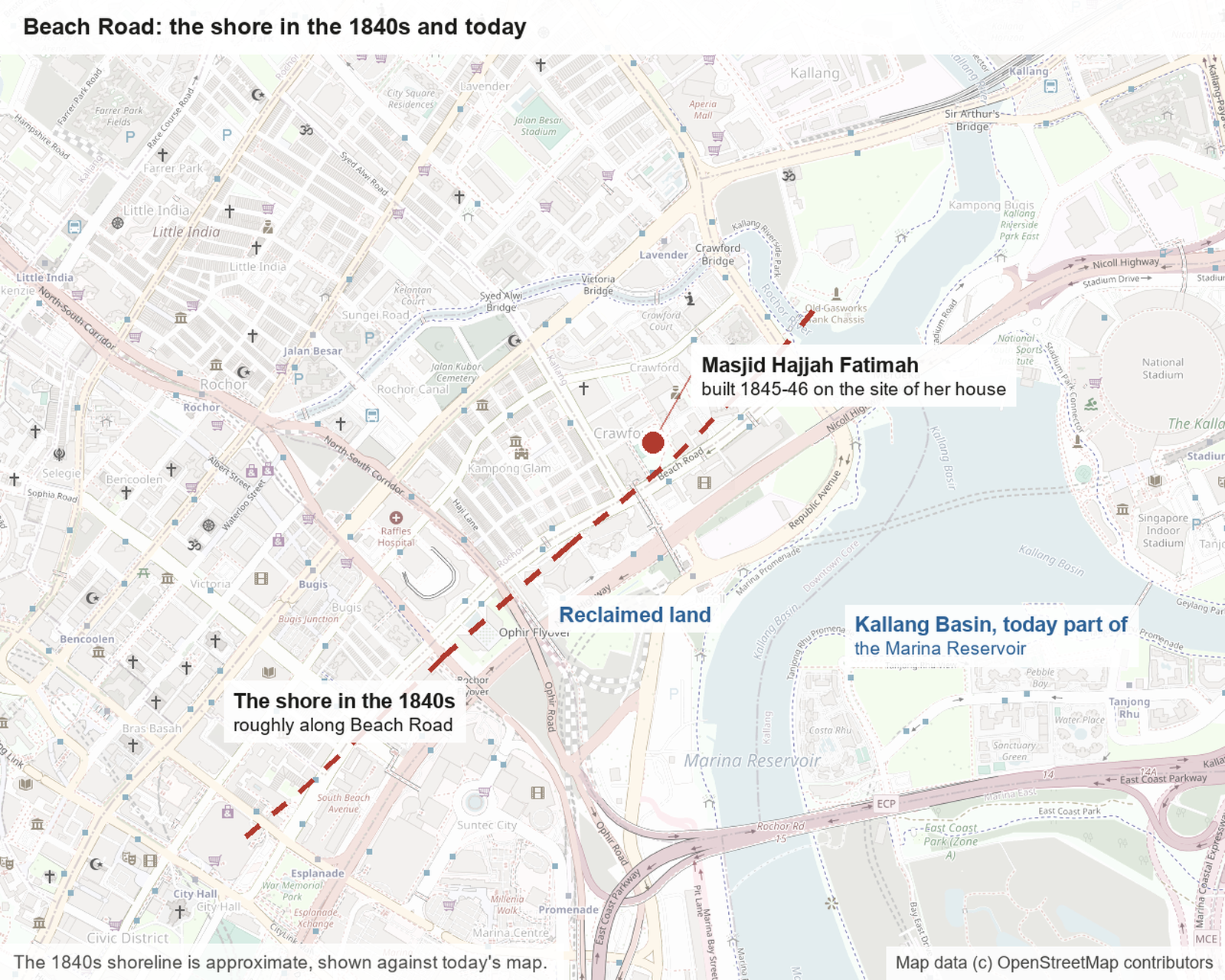
The shore in the 1840s, roughly along Beach Road, and the mosque, plotted on today’s map. (Map data © OpenStreetMap contributors)
In the early 1970s the streets around the mosque were cleared for urban renewal, and Java Road went with them. The mosque was the one building spared, and on the 28th of June 1973 it was gazetted as a national monument, in Singapore’s first group of national monuments. An appeal raised more than $240,000 to repair it, and the work was finished in 1977. In 1978 it was chosen for a set of Singapore stamps showing national monuments. It was restored again in 1998, and the soft colours chosen for that work won the mosque a Singapore Institute of Architects colour award in 2000. The mosque is now owned by the Islamic Religious Council of Singapore, MUIS, and the Alsagoff family still has a part in running it.
Hajjah Fatimah and her mosque, to today
- 1830s or 1840s Robbers break into her Java Road house twice and set it on fire.
- 1845-1846 The mosque is built on the site of her house.
- 1848 Her son-in-law, Syed Ahmed Alsagoff, co-founds Alsagoff and Company.
- 1852 Hajjah Fatimah dies, by her descendants' account, at about 98.
- c. 1930 The prayer hall is rebuilt by Brossard et Mopin with Malay craftsmen.
- 28 Jun 1973 The mosque is gazetted as a national monument.
- 1978 The mosque appears on a national monuments stamp.
- 1998 The mosque is restored and repainted.
- 2014 Hajjah Fatimah joins the Singapore Women's Hall of Fame.
- 2016 A restoration is planned that keeps the minaret's lean.
As for the sea, it is now a long way off. Land was reclaimed along the shore in stages, and Nicoll Highway, the Marina Centre and the Kallang Basin now lie between Beach Road and open water. Even the Kallang Basin is no longer sea: since the Marina Barrage closed off the bay, it has been part of the Marina Reservoir, a freshwater lake. The map above shows roughly where the shore ran when the mosque was built.
Hajjah Fatimah has been remembered in other ways too. In 2014 she was one of the women inducted into the Singapore Women’s Hall of Fame in its first year, and MUIS records her as one of three women who founded mosques in Singapore, with Khadijah binti Mohammed of Masjid Khadijah and Mak Minah Palembang of Masjid Darul Aman. The mosque on Beach Road was the first in Singapore to be named after a woman.

The Preservation of Monuments Board plaque, which records that the mosque was “built in 1845-1846 by Hajjah Fatimah, a Malacca Malay lady”. (Jacklee, CC BY-SA 3.0, via Wikimedia Commons)
See more photos of the mosque and old Singapore →
Where it fits in the bigger story: Hajjah Fatimah’s story shows that the merchant world of early Singapore was not run by men alone, and that the Malay, Bugis and Arab families of Kampong Glam built much of the town’s early wealth. No portrait of her is known to survive, and most of what we know comes from her descendants and a few short accounts. Her mosque, with its tilted church-like minaret, is the record she left, and it marks where the shore of the town once ran.
Sources:
- Masjid Hajjah Fatimah, Wikipedia
- Fatimah binte Sulaiman, Wikipedia
- Hajjah Fatimah Mosque, Roots.gov.sg (National Heritage Board)
- Malay Pioneer Series: Hajjah Fatimah, Malay Heritage Foundation
- 3 things you may not know about Hajjah Fatimah, muslim.sg
- Syed Mohamed Alsagoff, Wikipedia
- Alsagoff family, Wikipedia
- List of national monuments of Singapore, Wikipedia
- Marina Barrage, Wikipedia
- Singapore Women’s Hall of Fame, Wikipedia
- New Nation, 27 April 1973, “A relic of the past is spared by builders”, NewspaperSG
- The Straits Times, 28 January 1974, “Mosque repairs”, NewspaperSG
- Berita Harian, 16 December 1977, “$241,969 dapat dikutip utk projek baiki Masjid Hajjah Fatimah”, NewspaperSG
- Berita Harian, 8 July 1978, “Masjid Hajjah Fatimah dlm stem pos”, NewspaperSG
- Berita Harian, 17 July 1998, “Kerja pulihara hampir siap”, NewspaperSG
- Berita Harian, 25 April 2000, “Warna Hajjah Fatimah menang anugerah”, NewspaperSG
- The Straits Times, 2016, “Mosque to be restored but ‘leaning tower’ to stay” (Melody Zaccheus), as cited by Wikipedia
- The Straits Times, 3 August 2017, “A mosque named after woman merchant and philanthropist”, NewspaperSG
- Map data © OpenStreetMap contributors
- File:Masjid Hajjah Fatimah, October 2025.jpg
- File:Plan of the British settlement of Singapore published 1828.jpg
- File:Atlas pittoresque pl 134.jpg
- File:Minaret of Masjid Hajjah Fatimah, Singapore - 20101016-02.JPG
- File:Mausoleum of Hajjah Fatimah.jpg
- File:Interior of Masjid Hajjah Fatimah.jpg
- File:Preservation of Monuments Board plaque, Masjid Hajjah Fatimah, Singapore - 20101016-01.JPG
- File:Admiralty Chart No 2404 Strait of Singapore Sheet 3 (1846-54 survey)
- File:Junks of Siam at Anchor in Singapore 1841 Francois-Edmond Paris.png
- File:Atlas pittoresque pl 136.jpg
- File:Hajjah Fatimah Mosque, Dec 05.JPG
- File:Masjid Hajjah Fatimah, full exterior view.jpg
- File:Masjid Hajjah Fatimah, Singapore - 20101016-02.JPG
- File:Minaret of Masjid Hajjah Fatimah, Singapore - 20101016-01.JPG
- File:Underneath dome of Masjid Hajjah Fatimah.jpg
- File:Minbar of Masjid Hajjah Fatimah.jpg
- File:Mihrab, clock and entrance to private mausoleum in Masjid Hajjah Fatimah.jpg
- File:Alsagoff burial ground, panorama.jpg
- File:Masjid Hajjah Fatimah at night.jpg
- File:Beach Road old-style sign.jpg


