The Selarang Square Squeeze, 1942
On the 2nd of September 1942, somewhere between 15,000 and 17,000 British and Australian prisoners of war were marched into the barracks square at Selarang, in Changi, and kept there until they agreed to sign a promise not to escape. The square had been built for a single battalion. For the next four days the men lived on it and on the roofs and stairs of the barrack blocks around it, with a few taps for water and latrines dug through the parade ground, while dysentery spread. One of them, an Australian private named George Aspinall, photographed the square in secret with a small folding camera, and his pictures are the reason we can still see it.
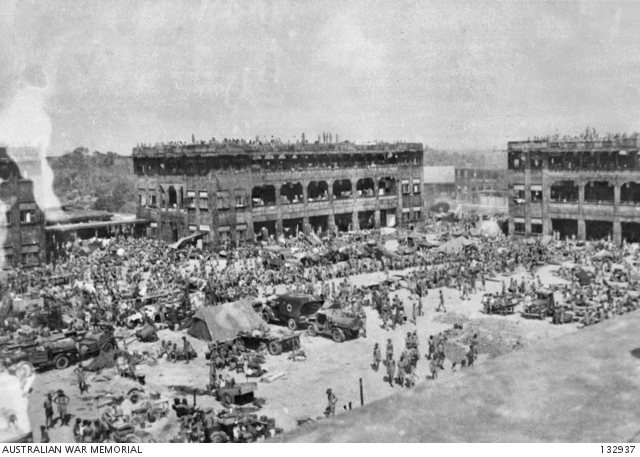
Prisoners arriving in the Selarang Barracks square on the 2nd of September 1942, in a part of the square taken by British troops. George Aspinall took the photograph in secret. (George Aspinall, Australian War Memorial 132937, public domain)
A barracks for the Changi garrison
In the 1930s the British army built a new garrison on the Changi peninsula, at the eastern tip of Singapore island, as part of the fortress that guarded the new naval base. Selarang Barracks, a set of three-storey blocks around a large parade square, was part of it. By 1937 it was home to the 2nd Battalion of the Gordon Highlanders, a Scottish regiment, and the newspapers of the time reported its boxing contests and its accidents as part of ordinary garrison life.

Barrack blocks at Changi in 1941, a year before the garrison became a prison camp. (Duncan Ian Campbell, CC BY-SA 4.0, via Wikimedia Commons)
When Singapore surrendered on the 15th of February 1942, the British and Australian troops on the island were marched out to Changi, and the garrison’s barracks became the main prisoner-of-war camp. The prisoners were left largely to organise themselves inside it, under their own officers. Many were sent out in working parties, some of them to build the Syonan Jinja shrine at MacRitchie Reservoir, which I wrote about in an earlier post.
The pledge
In August 1942 General Fukuye Shimpei arrived at Changi to take charge of the prisoner-of-war camps in Malaya. Four prisoners had escaped and been recaptured: Corporal Rodney Breavington and Private Victor Gale, both Australians, and Privates Harold Waters and Eric Fletcher, both British. Fukuye ordered every prisoner to sign a form that read, in part, “I will not, under any circumstances, attempt to escape.”
Almost all of them refused. Their officers held that a prisoner of war had a duty to try to escape, and that a promise extracted by force went against the international rules on prisoners. On the 30th of August Fukuye ordered all the British and Australian prisoners who had refused into Selarang Barracks.
Four days in the square
The men moved in on the 2nd of September, carrying whatever they could. Michael Hubert, an Australian private who kept a diary, described the column as twelve people deep. The barrack blocks filled first, and the rest of the men camped in the open square under groundsheets and blankets strung on poles. According to Hubert, each barrack block held about 1,200 men.
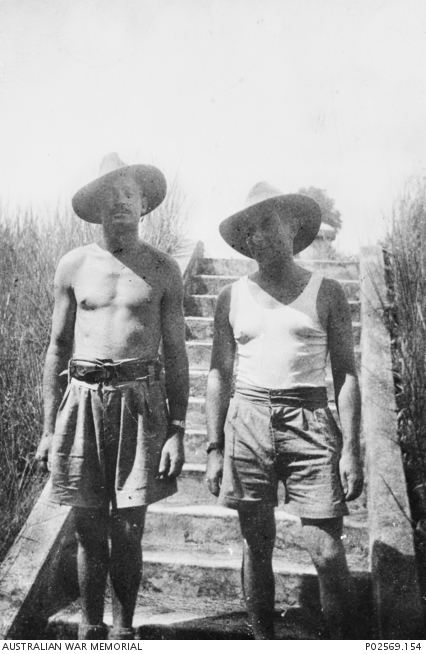 George Aspinall (left) with Harry Russell on the steps to the Selarang pump house, in a photograph from Aspinall's own collection. (Australian War Memorial P02569.154, public domain)
Water was the first problem. There were only three taps for the whole square, and each prisoner was allowed about a gallon a day, which went mostly on drinking and cooking rice. There were no latrines, so on the first night the men dug two trenches through the middle of the parade ground, each about four and a half metres deep, and over the next four days they dug 22 more. Firewood was so scarce that the barrack doors were broken up to fuel the kitchens. By the end of the first day dysentery had broken out, and requests to move the sick to hospital were refused.
Aspinall, a motor mechanic from Parramatta in New South Wales who had come to Singapore with the 2/30th Battalion, took his pictures with a folding Kodak Brownie. Photography was banned, so he kept the camera hidden in a pocket of a belt he made himself and developed the negatives in secret. Several of the Selarang pictures were taken from the upper floors of the barracks, looking down on the square.
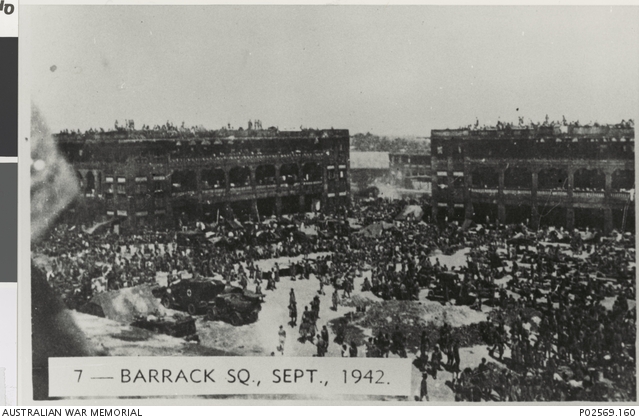
The square in September 1942, from Aspinall’s own album, where he labelled it “Barrack Sq., Sept., 1942”. (George Aspinall, Australian War Memorial P02569.160, public domain)
The executions
On the 2nd of September, the first day in the square, the four recaptured men were shot by a firing squad on the beach at Beting Kusah, near Changi. The two senior prisoner officers, Lieutenant Colonel E. B. Holmes of the British army and Lieutenant Colonel Frederick Galleghan of the Australian army, were made to watch. A witness, Lieutenant Colonel Frith, later described the shooting as very badly organised. The four men are buried today at the Kranji War Cemetery.
Signing under duress
With the sick list growing and rations cut, the prisoners’ commanders decided they could not let the standoff go on. On the 4th of September Holmes ordered every man to sign by eleven o’clock the next morning, saying that he took the decision for the sake of the men’s health. The men signed under duress, and many used false names; Ned Kelly, the Australian bushranger, was a favourite.
On the 5th of September the men marched back to their own areas of the camp. In April 1943 many of them, Aspinall among them, were sent north to work on the Burma-Thailand Railway.
The trial
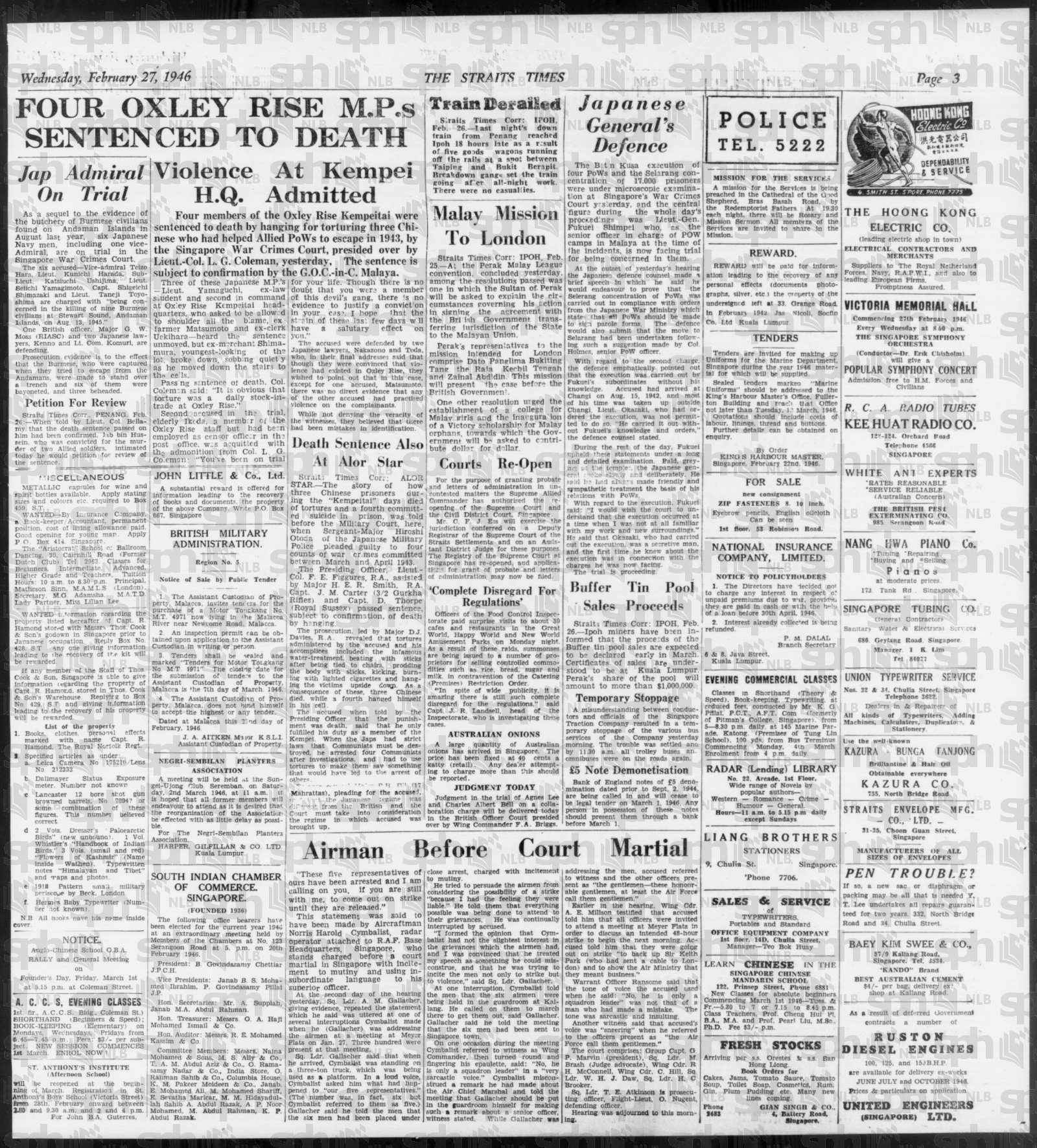 The Straits Times of 27 February 1946, page 3. "Japanese General's Defence", on Fukuye's trial, is in the fourth column. (Singapore Press Holdings, via NewspaperSG, National Library Board Singapore, public domain)
After the Japanese surrender, Fukuye was tried at the Singapore War Crimes Court in February 1946, on charges of ill-treating British and Australian prisoners and of the execution of the four men. The Straits Times reported that the hearing on the 26th of February put “the Selarang concentration of 17,000 prisoners” under close examination. His defence argued that the move to Selarang followed orders from the Japanese War Ministry that all prisoners should sign such forms, and that the shooting had been carried out by a subordinate without his knowledge.
He was found guilty on both charges and sentenced to death. On Saturday the 27th of April 1946 he was shot by a firing squad on the beach at Changi, at the spot where the four prisoners had died.
As for Aspinall’s photographs, in early 1945 his commanding officer, Galleghan, ordered him to hide the negatives, with other records, in a latrine bore-hole inside Changi Gaol, and Galleghan returned most of them to him after the war. Some negatives were also kept in an Australian army water bottle with a false bottom. The water bottle and 202 of his images are now in the Australian War Memorial in Canberra.
Selarang today
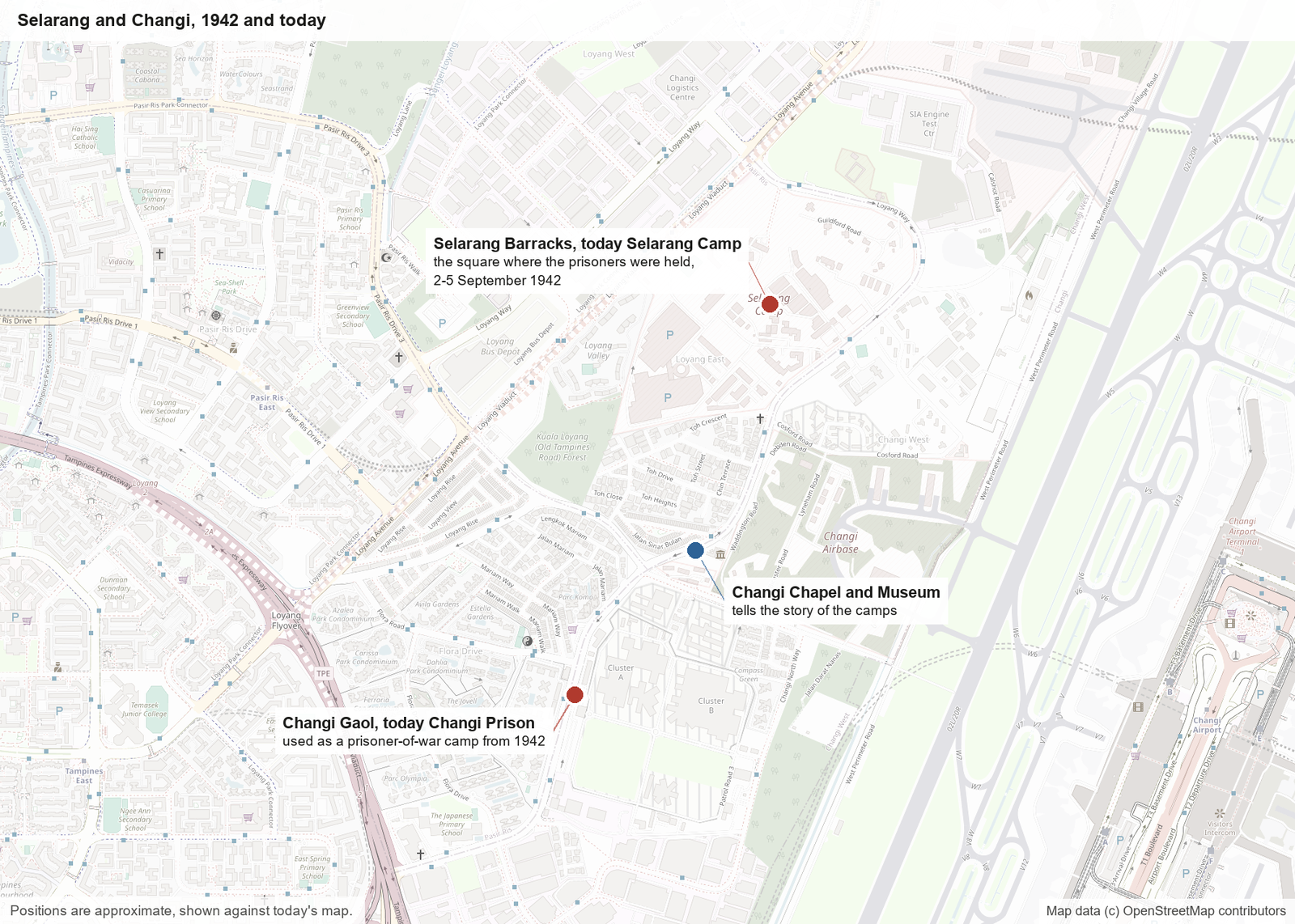
Selarang Barracks, Changi Gaol and the Changi Chapel and Museum, plotted on today’s map. (Map data © OpenStreetMap contributors)
After the war Selarang was a British and then an Australian army barracks again. In the early 1970s it was home to the Australian units of ANZUK, the joint Australian, New Zealand and British force that stayed on after Britain withdrew most of its troops, until that force was disbanded in 1974. Today it is Selarang Camp, a Singapore Armed Forces camp that is closed to the public.
Selarang, 1937 to today
- By 1937 The Gordon Highlanders are stationed at Selarang Barracks.
- 15 Feb 1942 Singapore surrenders; the British and Australian troops are held at Changi.
- Aug 1942 General Fukuye takes charge of the camps and demands a no-escape pledge.
- 30 Aug 1942 The prisoners who refused are ordered into Selarang Barracks.
- 2 Sep 1942 The men move into the square; four recaptured escapees are shot.
- 4 Sep 1942 Lt-Col Holmes orders the men to sign, under duress.
- 5 Sep 1942 The men sign and return to their camps.
- Feb 1946 Fukuye is tried and sentenced to death.
- 27 Apr 1946 Fukuye is executed on the beach at Changi.
- 1974 ANZUK is disbanded; Selarang later becomes an SAF camp.
- May 2021 The revamped Changi Chapel and Museum reopens.
The story is told today at the Changi Chapel and Museum on Upper Changi Road North, which is run by the National Museum of Singapore. It was revamped and reopened in May 2021, and among its displays is a Kodak Baby Brownie camera that a prisoner kept hidden from the guards.

The gates of the Changi Chapel and Museum in 2016, with the replica prisoners’ chapel inside. (Orderinchaos, CC BY-SA 4.0, via Wikimedia Commons)
See more photos of Selarang in 1942 and Changi after the war →
Where it fits in the bigger story: The Selarang square squeeze lasted four days and ended in signatures given under duress, yet it is one of the best-recorded episodes of the Occupation, because one prisoner risked his life to photograph it. It shows how the prisoners at Changi tried to hold on to their own rules as soldiers, what that cost them, and how the trials after the war tried to settle the account. Selarang Camp is still a working barracks, closed to visitors, so Aspinall’s pictures and the museum down the road are how most people can see the square today.
Sources:
- “Four days of unhappiness and worry”: the Selarang Barracks incident, Australian War Memorial
- Selarang Barracks incident, Wikipedia
- Changi Chapel and Museum, Wikipedia
- Changi Chapel and Museum, Roots.gov.sg
- The Sunday Tribune, 24 October 1937, “Gardayne Shield Boxing Champions at Selarang”, NewspaperSG
- Morning Tribune, 24 December 1937, “Highlander’s Fatal Fall”, NewspaperSG
- The Straits Times, 27 February 1946, “Japanese General’s Defence”, page 3, NewspaperSG
- Malaya Tribune, 27 February 1946, “Jap General Denies He Knew Of Execution”, NewspaperSG
- Malaya Tribune, 1 March 1946, “Jap General To Face Firing Squad”, page 2, NewspaperSG
- The Straits Times, 30 April 1946, report of General Fukuye’s execution, page 1, NewspaperSG
- Map data © OpenStreetMap contributors
- Australian War Memorial 132937, troops arriving in Selarang Barrack Square
- Australian War Memorial P02569.154, George Aspinall and Harry Russell
- Australian War Memorial P02569.160, Barrack Square, September 1942
- Changi 1941 ii.jpg, Wikimedia Commons
- Changi Museum gates.jpg, Wikimedia Commons
- Australian War Memorial 132933, Selarang Barracks, 3 September 1942
- Australian War Memorial 132935.JPG, Wikimedia Commons
- Australian War Memorial P02569.158
- Australian War Memorial P02569.161
- Australian War Memorial P02569.164
- Australian War Memorial P02569.166
- Australian War Memorial P02569.168
- Australian War Memorial P02569.153
- Australian War Memorial P02569.199
- Changi Prison in 1936.jpg, Wikimedia Commons
- The Release of Allied Prisoners of War From Changi Prison, 1945 CF722.jpg, Wikimedia Commons
- Kranji War Memorial - Tombs.jpg, Wikimedia Commons


