The Changi Murals: Stanley Warren's Chapel Paintings at Roberts Barracks
In September 1942, in a prisoner-of-war hospital at Changi, a British bombardier named Stanley Warren began painting Bible scenes on the walls of a small chapel. He was so ill with dysentery and kidney disease that he could only work for ten to fifteen minutes at a time, and his paints were scrounged camouflage paint and billiard chalk. Within two years his five murals had vanished under coats of distemper, and Warren went home believing they had been destroyed. They are still there today, in a building inside an air force camp that the public cannot enter.

“Orderly on His Rounds in X Ward, Changi Gaol, Singapore, With POWs Suffering from Starvation and Beri-beri”, painted in 1945 by the official war artist Leslie Cole. (Leslie Cole, Imperial War Museums, public domain, via Wikimedia Commons)
A hospital in the barracks
Singapore surrendered to the Japanese on the 15th of February 1942, and tens of thousands of British and Australian prisoners were marched to Changi, at the eastern tip of the island. They were held in and around the British Army’s own barracks there, and Roberts Barracks was turned into a hospital for the prisoners.
Stanley Warren had been a commercial designer before the war, and had reached Malaya early in 1942 with the 15th Field Regiment, Royal Artillery. On the 23rd of May 1942 he was sent to the hospital at Roberts Barracks, and by the middle of August he was in the dysentery wing, Block 151, a three-storey building that held more than a thousand patients. On its ground floor the prisoners had made a small room into a chapel, dedicated to St Luke the Physician, the patron saint of doctors.
Warren had painted before in captivity. At a camp at Bukit Batok, a chaplain had asked him to decorate the chapel there, and he drew two religious scenes in charcoal. At Roberts Barracks, two chaplains, Padres Chambers and Payne, asked him to do the same for St Luke’s Chapel. Warren, who had joined the chapel choir after hearing the hymns from his bed, agreed as a way of giving thanks for his partial recovery.

Prisoners crowded into the square of Selarang Barracks, Changi, on the 4th of September 1942, during the Selarang Barracks incident. (George Aspinall, Australian War Memorial 132935, public domain, via Wikimedia Commons)
He was still working on his sketches when the Selarang Barracks incident began on the 30th of August 1942. The Japanese ordered the prisoners to sign a pledge not to escape, and when almost all of them refused, nearly 17,000 men were crowded into and around the square of Selarang Barracks until the 5th of September. Warren began painting in early September. That month the men of his work party were listed to go north to the Thai-Burma Railway, and a colonel stepped in so that he could stay at the hospital and finish the chapel.
Five murals
Warren painted five murals, each about three metres long. In order, they showed the Nativity, the Ascension, the Crucifixion, the Last Supper, and St Luke in Prison. The Nativity was finished by Christmas 1942. Paint was almost impossible to get, so fellow prisoners found him brown camouflage paint, a little crimson, some white oil paint, and billiard chalk crushed for colour. With so little to work with, he used broad brush strokes and large areas of flat colour.
He never signed the murals, because he considered them “a gift to God”.
Hidden under distemper
In May 1944, Block 151 was turned into a store for a nearby airfield. A doorway was knocked through the wall into the next room, which almost completely destroyed the lower part of St Luke in Prison, and the chapel walls were covered over with distemper. Warren himself was moved to a camp at Kranji, where he stayed until the Japanese surrender in August 1945. He went back to England believing that the murals had been destroyed in Allied bombing, and became an art teacher in London.
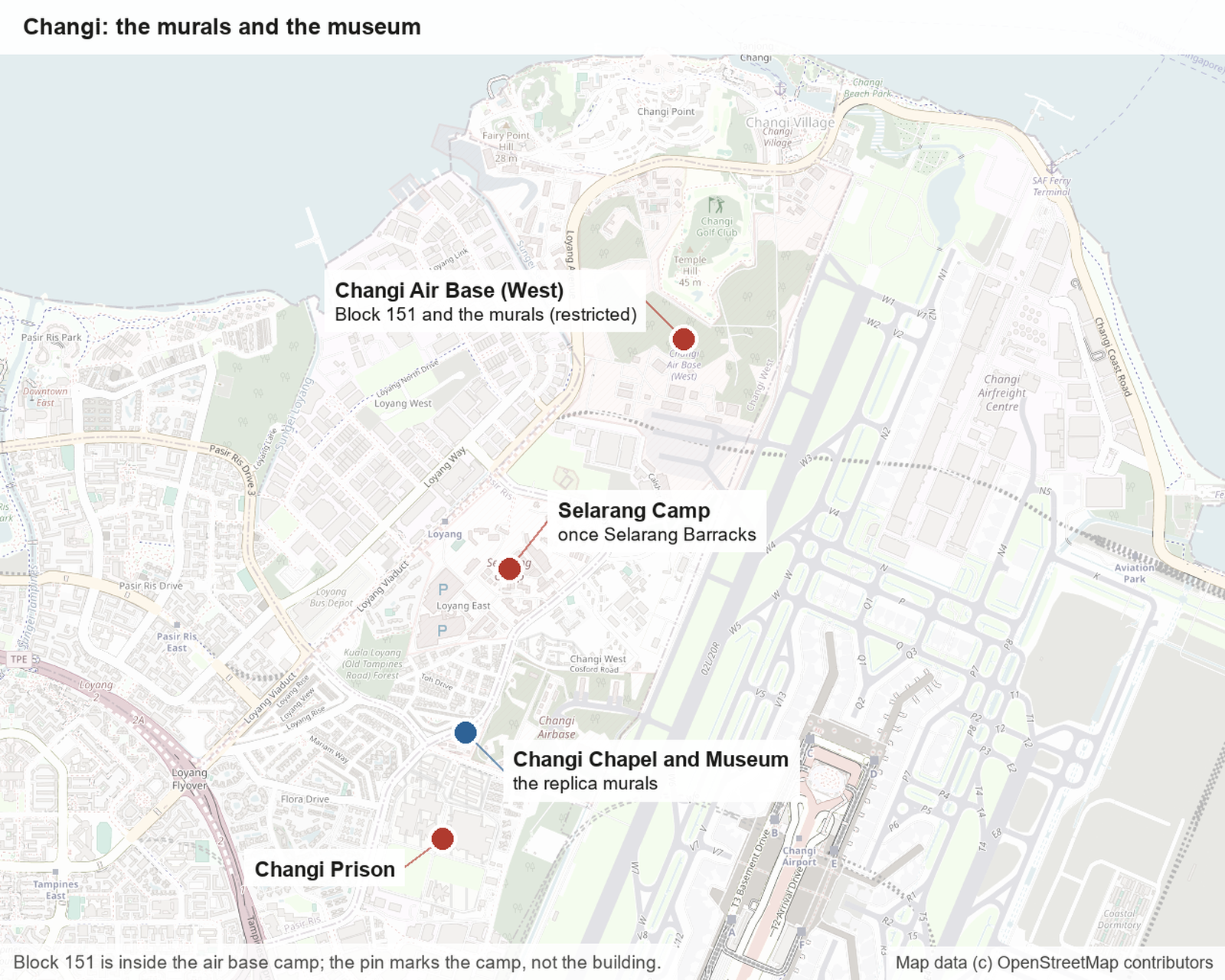
Changi today: the air base camp that holds Block 151, the old Selarang Barracks, Changi Prison, and the Changi Chapel and Museum, where the replica murals are shown. (Map data © OpenStreetMap contributors)
Found again
After the war, the barracks became part of RAF Changi. Some years later, airmen clearing out an unused storeroom in Block 151 noticed pictures under the layers of distemper. Accounts differ on when this happened. The RAF Changi Association remembers it as the early 1950s, while other accounts give 1958. The story reached the Singapore papers in January 1959, when the Sunday Times printed a photograph of one mural under the headline “Do you know who painted this PoW camp mural?”

RAF Changi in 1958. (Bob Waddell, CC BY-SA 3.0, via Wikimedia Commons)
The Sunday Times suggested that the murals might be the work of Ronald Searle, the cartoonist, who had also been a prisoner at Changi. His wife told reporters in London that he had not painted them. A reader in the RAF Changi Education Library then found Warren’s name in a book, “The Churches of the Captivity in Malaya”, and on the 1st of February 1959 the Sunday Times reported that the mystery had been solved. The Daily Mirror in London took up the search, and that month Warren was found living in London with his wife and son.
Restoring his own work
Once the distemper had been scraped away, four complete murals and the top quarter of the fifth could be seen. In 1960 the RAF asked Warren to come back and restore them. He was reluctant at first, because the work brought back painful memories, but he made three trips to Singapore to do it, in December 1963, July 1982 and May 1988. On his first visit, the Straits Times described him as “a man with a mission”. The 1982 trip was the most intensive, and officers and boys of the SAF Boys’ School helped him with much of the work.
St Luke in Prison was never fully restored, because Warren could no longer remember the missing lower part. In 1985 his original drawing for it turned up among the belongings of a fellow prisoner, Wally Hammond, and it was given to the National Archives of Singapore. By 1988 Warren was not fit enough to repaint the mural, so he made a small picture from the drawing, which was placed beneath the surviving fragment. Stanley Warren died at his home in Bridport, in Dorset, on the 20th of February 1992, at the age of 75.
The murals today
The Changi Murals, 1942 to today
- 23 May 1942 Warren is sent to the prisoners' hospital at Roberts Barracks.
- Sep 1942 He begins painting in St Luke's Chapel, Block 151.
- Dec 1942 The Nativity is finished by Christmas.
- May 1944 The block becomes a store and the murals are covered with distemper.
- Jan 1959 The rediscovered murals reach the Singapore papers.
- Feb 1959 Warren is traced to London.
- Dec 1963 His first restoration visit.
- 1969 Singapore's Ministry of Defence takes charge of the murals.
- Jul 1982 The most intensive restoration, with help from the SAF Boys' School.
- 1985 His drawing of St Luke in Prison is found and given to the National Archives.
- May 1988 His last visit.
- 20 Feb 1992 Warren dies in Bridport, aged 75.
- May 2021 The redeveloped Changi Chapel and Museum reopens, with the replica murals.
In October 1968 a British member of parliament, Charles Morris, asked the Defence Secretary, Denis Healey, to consider moving the murals to England, but nothing came of it, and in 1969 Singapore’s Ministry of Defence took responsibility for them. In the 1990s the National Heritage Board marked the site as one of Singapore’s historic sites. Most of the buildings around Block 151 were pulled down in July 2003, but the block itself still stands inside what is now the Changi Air Base camp, and access to the camp is restricted.

Inside the Changi Chapel and Museum in July 2023. (Liaw Xin Ru, CC BY-SA 4.0, via Wikimedia Commons)
Most visitors see the murals as replicas. The Changi Chapel and Museum, on Upper Changi Road North, has shown copies of them for many years, and the museum reopened in May 2021 after a redevelopment, with the replicas again among its main exhibits. A copy of one of the murals also hangs in the Garrison Church at Larkhill, in Wiltshire, England.
See more photos of wartime Changi, RAF Changi and the museum →
Where it fits in the bigger story: The Changi Murals were painted by a sick prisoner with scrounged materials, hidden for years under distemper, and traced back to their painter partly by chance and partly through a newspaper appeal. They are still on the walls where they were painted, and the man who painted them came back three times to repair them. Because the originals sit inside a working military camp, most Singaporeans know them, if at all, only through the replicas at the museum down the road.
Sources:
- Changi Murals, Wikipedia
- Changi Murals, Roots.gov.sg (National Heritage Board), historic sites
- The Changi Murals, RAF Changi Association
- Changi Chapel and Museum, Wikipedia
- Selarang Barracks incident, Wikipedia
- Vincent Ng, “Do you know who painted this PoW camp mural?”, The Straits Times, 25 January 1959; “‘Searle wasn’t the Changi murals artist’”, The Singapore Free Press, 26 January 1959; “Solved: Mystery of the Changi murals”, The Straits Times, 1 February 1959; “A man with a mission”, The Straits Times, 5 January 1964 (NewspaperSG search results)
- Map data © OpenStreetMap contributors
- File:Orderly on His Rounds in X Ward, Changi Gaol, Singapore, With Pow’s Suffering from Starvation and Beri-beri Art.IWMARTLD5618.jpg, Wikimedia Commons
- File:Australian War Memorial 132935.JPG, Wikimedia Commons
- File:Changi Air Base 1958.jpg, Wikimedia Commons
- File:Changi chapel museum.jpg, Wikimedia Commons
- File:Singapore- the cookhouse, Changi Gaol. British Pow’s prepare their main meal of rice. Art.IWMARTLD5825.jpg, Wikimedia Commons (gallery)
- File:Singapore- Limbless Officers and Men Checking Out from Changi Gaol Art.IWMARTLD5824.jpg, Wikimedia Commons (gallery)
- File:Allied prisoners of war after the liberation of Changi Prison, Singapore - c. 1945.jpg, Wikimedia Commons (gallery)
- File:Personnel of C Company, 2 29th Battalion, in their hut at the rear of Changi Gaol, 1945.jpg, Wikimedia Commons (gallery)
- File:The Release of Allied Prisoners of War From Changi Prison, 1945 CF722.jpg, Wikimedia Commons (gallery)
- File:The Release of Allied Prisoners of War From Changi Prison, 1945 CF724.jpg, Wikimedia Commons (gallery)
- File:Satellite image of RAF Changi, Singapore (Corona, KH-4, mission 9053) - 19630401.jpg, Wikimedia Commons (gallery)
- File:Changi Air Base West entrance.JPG, Wikimedia Commons (gallery)
- File:Changi Museum.jpg, Wikimedia Commons (gallery)
- File:Changi Museum Display.jpg, Wikimedia Commons (gallery)
- File:Changi Museum gates.jpg, Wikimedia Commons (gallery)
- File:POW chapel at Changi Prison.jpg, Wikimedia Commons (gallery)
- File:Changi Chapel March 2013 2.jpg, Wikimedia Commons (gallery)


