The Singapore Sweep: How the Lottery Went Legal
On the first Wednesday of every month, Singapore Pools draws the Singapore Sweep, a lottery with 3.5 million seven-digit numbers and a first prize of $2.3 million. Its rules still describe it as a “sweepstakes game”, a word that comes from the racecourse, and the game itself began at the Singapore Turf Club in 1966. At the end of 1968 it was taken over by Singapore Pools, a government-owned company set up that year to give people a legal way to bet and to take business away from the illegal lotteries. Between them the Sweep, Toto and 4-D became fixtures of Singapore life, and all three are still drawn today.

A Singapore Pools outlet in Ghim Moh in April 2007. (Fongsheng, CC BY-SA 3.0, via Wikimedia Commons)
Sweeps at the racecourse
Horse racing came to Singapore early. The Singapore Sporting Club was founded in 1842 and held its races on the course at Farrer Park, off Serangoon Road. It became the Singapore Turf Club in 1924 and moved to a new racecourse at Bukit Timah in April 1933. By the 1930s it was running sweeps alongside its races.

“Banyak jahat”: a stubborn horse at the start of a race on the Singapore racecourse, sketched by John Edmund Taylor in 1881. (John Edmund Taylor, Wellcome Collection, CC BY 4.0, via Wikimedia Commons)
A sweep worked differently from betting on a horse. A punter bought a numbered ticket without choosing anything. Before the race, ticket numbers were drawn and each one was matched to a horse that was due to run, so most tickets drew no horse at all. Whoever held the ticket matched to the winner took the first prize, and smaller prizes went to the tickets on the placed horses. Knowing about horses gave no advantage, because nobody picked a horse. It was luck twice over: first whether a ticket drew a horse, and then how that horse ran. A ticket that had drawn a favourite was worth more than one that had drawn an outsider, and in the big overseas sweeps such as the Irish Hospitals’ Sweepstake, tickets on favourite horses had a better chance of winning.
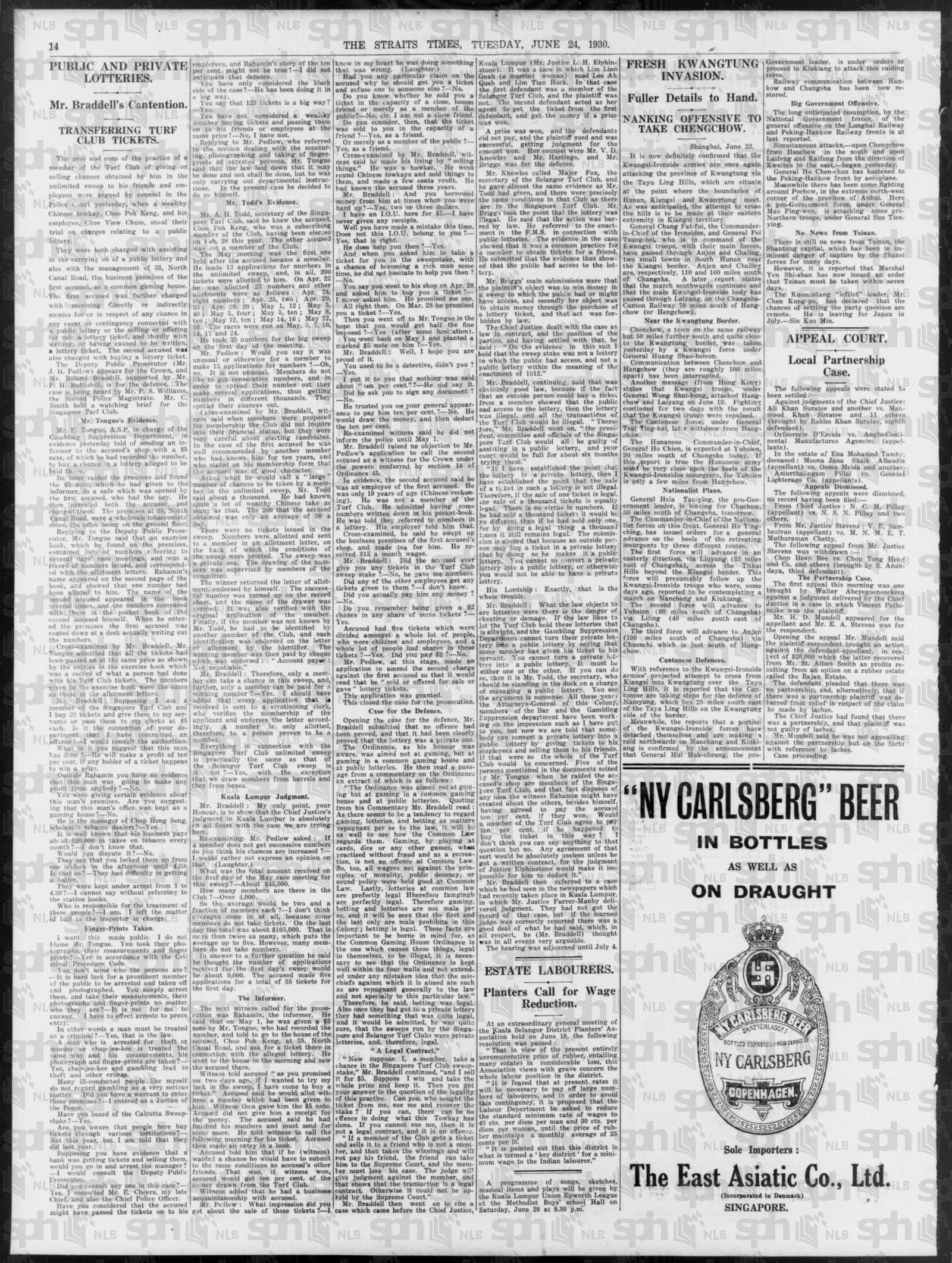 The Straits Times of 24 June 1930, page 14. The report "Public And Private Lotteries" on the Turf Club sweep ticket case is in the left-hand columns. (Singapore Press Holdings, via NewspaperSG, National Library Board Singapore, public domain)
The law treated the club’s sweeps as private lotteries for its members, while public lotteries were illegal. In June 1930 a tobacco merchant named Choo Poh Keng, a member of the Turf Club, stood trial with his employee on charges brought by the police’s Gambling Suppression Department, which accused them of running a public lottery from his premises at 35 North Canal Road. The case turned on whether a member could give or sell the chances he had bought in the club’s sweep to his friends and employees. It was treated as a test case, and in July the magistrate acquitted Choo, holding that it was not a public lottery.
The sums could be large. After the Gold Cup meeting of September 1933, The Sunday Times worked out that $298,750 had gone on the big sweeps alone. The holder of the ticket that drew the first prize in the big sweep on the last day had paid $5 for it and won $54,340. Racing also raised money for the war effort. By August 1941 the Singapore Turf Club had given $266,000 to The War Fund since June 1940, and some winners added gifts of their own. One was Peter Chong, a bookseller, whose ticket, number 114291, drew the first prize in the big sweep at the Penang races, and who sent the fund $1,000.
During the Japanese Occupation the military administration ran its own government lottery, the Syonan Syoken, which I wrote about in an earlier post.
Lotteries for good causes, and illegal ones
After the war, lotteries were also run to raise money for causes. In the early 1950s the Malayan Chinese Association ran a series of $1 million lotteries across Malaya. In March 1951 The Sunday Times printed a photograph of the $250,000 cheque that would go to the winner of the second one, to be drawn in Ipoh in April, and reported that the association’s Singapore branch, opened only the previous October, had already sold more than 120,000 tickets. In 1953 the government of the Federation of Malaya banned the association’s lottery, which the association called “a breach of faith”.
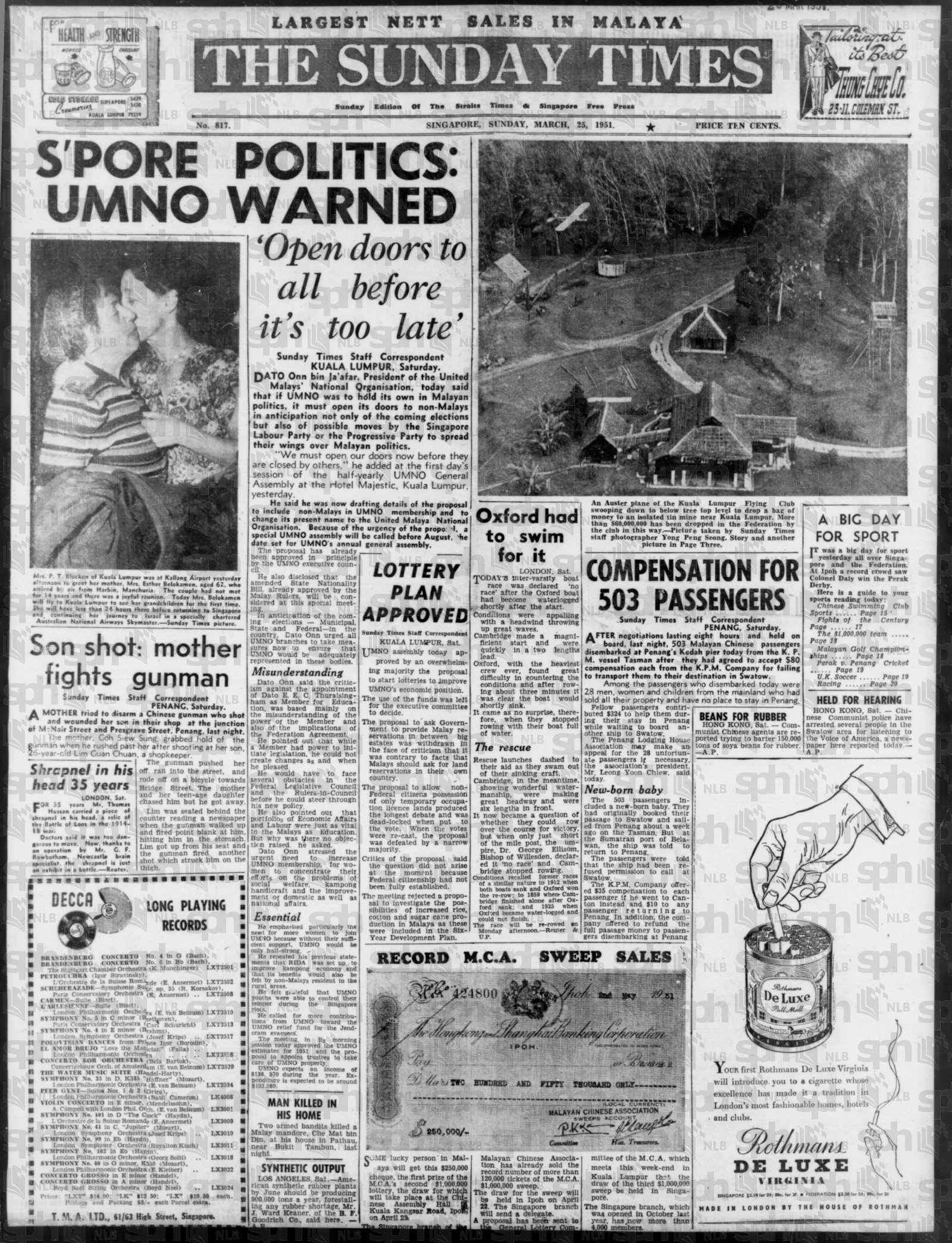 The front page of The Sunday Times, 25 March 1951, with the $250,000 first-prize cheque for the Malayan Chinese Association's second $1 million lottery at the bottom. (Singapore Press Holdings, via NewspaperSG, National Library Board Singapore, public domain)
Beside the legal games ran illegal ones. The best known was chap ji kee, Hokkien for “12 cards”, a numbers lottery run by syndicates. Punters bet on a pair of numbers from 1 to 12, and the syndicates added up the bets and declared the least-backed pair the winner. It was known as the “housewives’ opium”, because many of its players were women who staked a few cents at a time in the hope of a little extra money for the household. The courts were still fining and jailing people for running it or carrying its betting slips through the 1950s and 1960s. Lottery tickets from abroad were sold in Singapore too, and in June 1967 the government warned people against buying tickets for a Malta sweep.
1966: the Turf Club’s Singapore Sweep
In September 1966 the Turf Club announced that Singapore would have “its own social welfare lottery” by December. It would be called the Singapore Sweep and run entirely by the club. It would carry more than 2,000 prizes totalling $1 million, with a first prize of $350,000, and its profits would go to sports development and social welfare. Tickets cost $1, and the plan was to hold a draw at every Singapore race meeting. By the end of October more than two million tickets were on sale, and the first Singapore Sweep was drawn on 12 December 1966. Voluntary organisations worried that the new lottery would compete with their own fundraising, and in April 1967 the Minister for Finance, Lim Kim San, assured the Singapore Council of Social Service that it would not take away the means they already had to raise funds.
The club also ran a four-digit lottery. There had been a rush for the tickets at its office in Robinson Road, and in May 1966, when the queues had gone, the club reported that sales were still high. Its winning numbers were taken from the sweeps: the 4-D pool for 27 November 1966, for example, was based on the first, second and third prizes and the starters of the Perak Turf Club’s sweep.

Turf City in December 2006: the Turf Club raced at Bukit Timah from 1933 to 1999, and its old grandstand was later turned into shops and restaurants. (Sengkang, copyrighted free use, via Wikimedia Commons)
1968: Singapore Pools
In April 1968 the government announced that it would introduce pool betting later that year. The Eastern Sun reported two of its aims: to save foreign exchange, and to beat the illegal chap ji kee operators. The new game, called Toto, was being introduced to Singapore by the Bulgarians, and it was based on a Bulgarian numbers system. Singapore Pools (Private) Limited was incorporated on 23 May 1968 to run it.
Toto went on sale at the end of May through about 500 agents and every post office. Players crossed off six numbers out of 49 for a stake of 50 cents, and the advertisements promised a top prize of up to $500,000. The first draw was held on Sunday 9 June 1968 at the Victoria Theatre, the same hall where the Occupation lottery had been drawn in 1942. It was shown on television, and seven of Singapore’s top sportsmen and sportswomen took part in the draw. Nearly $280,000 had been staked. Nobody matched all six numbers, and two people shared the third prize of $27,840.
At the end of 1968 Singapore Pools took over the Sweep as well, with its sale, distribution and draw. The Parliamentary Secretary for Finance, Tang See Chim, told Parliament that the first prize would rise to $400,000. The first Sweep run by Singapore Pools was drawn at the National Theatre on 28 February 1969. Later draws moved around the city’s halls and amusement parks: the Gay World Stadium in May 1969, the Kreta Ayer People’s Theatre in July 1969, and the Wonderland amusement park in July 1970. Raising money to build a National Stadium was one of the driving forces behind legal betting, and proceeds from the Sweep and Toto paid a substantial part of the bill for the stadium at Kallang, which opened in 1973.

The National Theatre in 1973 or 1974. Singapore Pools held its first Sweep draw here in February 1969, and the theatre was demolished in 1986. (Rainer Halama, CC BY-SA 4.0, via Wikimedia Commons)
4-D moves to Singapore Pools
The Turf Club kept its 4-D game for another two decades. In May 1986 Singapore Pools began selling 4-D tickets through computer terminals at 97 of its outlets, and within three weeks the Turf Club reported that sales at its own outlets had fallen. That June, Singapore Pools also said it would carry out spot-checks to make sure that Toto and 4-D tickets were not sold to anyone under 18.

A 4-D betting slip, photographed in 2007. (Calvin44, public domain, via Wikimedia Commons)
In 2004 the Singapore Totalisator Board, known as the Tote Board, bought Singapore Pools from Temasek Holdings. Under the new arrangement Singapore Pools ran 4-D, Toto, the Sweep and football betting on the board’s behalf, and the Turf Club stopped running 4-D to concentrate on horse racing.
Today

The Singapore Pools headquarters on Middle Road in August 2023. (Diego Delso, CC BY-SA 4.0, via Wikimedia Commons)
Singapore Pools is still the only operator allowed to run lotteries in Singapore. It is owned by the Tote Board, and its surplus goes to the board to fund charities, sport, the arts and community projects. In 2016 the Ministry of Home Affairs allowed it to take bets online. Its games are now regulated by the Gambling Regulatory Authority, which approves their rules under the Gambling Control Act 2022.
Horse racing, where the sweeps began, has ended. The Turf Club held its last race meeting at Kranji on 5 October 2024, and the land is being returned to the government for housing and other uses.
The Sweep has carried on without the horses. Its tickets carry seven-digit numbers from 1000000 to 4499999, and each draw picks out the winning numbers for the first prize of $2.3 million and the smaller prizes down to $1,000. A separate draw of two-digit endings pays $6 each.
Legal lotteries in Singapore, 1842 to today (brown: the race clubs and associations; blue: Singapore Pools)
- 1842 The Singapore Sporting Club is founded; it becomes the Singapore Turf Club in 1924.
- 1930 A magistrate rules that passing on Turf Club sweep chances is not a public lottery.
- 1933 The Turf Club moves to Bukit Timah.
- 1951 The Malayan Chinese Association runs $1 million lotteries; they are banned in 1953.
- 1966 The Turf Club runs a four-digit lottery and launches the Singapore Sweep.
- May 1968 Singapore Pools is incorporated.
- Jun 1968 The first Toto draw is held at the Victoria Theatre.
- Feb 1969 Singapore Pools holds its first Sweep draw, at the National Theatre.
- May 1986 Singapore Pools starts computerised 4-D betting.
- 2004 The Tote Board buys Singapore Pools, which takes over 4-D from the Turf Club.
- 2016 Online betting is allowed.
- Oct 2024 The Turf Club holds its last race meeting at Kranji.
- Today The Sweep is drawn on the first Wednesday of every month.
See more historical photos related to this post →
Where it fits in the bigger story: Singapore’s legal lotteries grew out of the race clubs and charitable associations, at a time when the illegal ones ran alongside them. In 1968 the government brought the games under a single state-owned company, with the stated aims of drawing money away from illegal syndicates and keeping it in the country, and the surplus has since gone to public causes. The racecourse that gave the Sweep its name has now closed, but the word “sweepstakes” survives in the rules of a game that no longer has anything to do with horses.
Sources:
- Singapore Pools, Singapore Sweep Game Rules, approved by the Gambling Regulatory Authority of Singapore, with effect from 22 April 2026
- Ministry of Finance, “Singapore Pools Merging With The Singapore Totalisator Board”, 24 February 2004
- National Heritage Board, Toto results poster with an image of the National Stadium, Roots.gov.sg
- Singapore Pools, Wikipedia
- Singapore Turf Club, Wikipedia
- 4-Digits, Wikipedia
- National Stadium, Singapore (1973), Wikipedia
- Gay World Amusement Park, Wikipedia
- Sweepstake, Wikipedia
- Irish Hospitals’ Sweepstake, Wikipedia
- Janice Loo, “Desperate Housewives: The Lure of Chap Ji Kee”, BiblioAsia, National Library Board, October–December 2015
- Racing Post, “Racing in Singapore set to come to an end in October 2024”
- The Straits Times, 24 June 1930, “Public And Private Lotteries”, page 14, NewspaperSG
- The Singapore Free Press, 5 July 1930, “Turf Club Sweep Ticket Case”, NewspaperSG
- The Sunday Times, 24 September 1933, “Fortunes Changed Hands At Races”, page 10, NewspaperSG
- The Straits Times, 27 August 1941, “Winner Of Big Sweep Helps The War Fund”, page 10, NewspaperSG
- The Sunday Times, 25 March 1951, “Record M.C.A. Sweep Sales”, page 1, NewspaperSG
- The Straits Times, 8 August 1953, “Lottery ban was breach of faith, says MCA”, NewspaperSG
- The Straits Times, 6 May 1966, “No queues but 4-digit tickets sell big”, NewspaperSG
- The Straits Times, 10 September 1966, “$1m prizes in S’pore lottery”, NewspaperSG
- Eastern Sun, 10 September 1966, “$350,000 first prize in ‘S’pore Sweep’”, NewspaperSG
- The Straits Times, 28 October 1966, “$1m Sweep at every Singapore race meeting”, NewspaperSG
- Eastern Sun, 23 November 1966, “4-D special announcement”, NewspaperSG
- The Straits Times, 13 December 1966, “$1.5m profit from the big sweep”, NewspaperSG
- Eastern Sun, 26 April 1967, “S’pore Sweep: Kim San’s assurance”, NewspaperSG
- The Straits Times, 2 June 1967, “Govt warns against Malta Sweep tickets”, NewspaperSG
- Eastern Sun, 26 April 1968, “Pool betting for S’pore”, NewspaperSG
- The Straits Times, 3 May 1968, “$500,000 top prize in Singapore’s ‘Toto’ pools”, NewspaperSG
- The Straits Times, 18 May 1968, “Toto coupons for sale next week”, NewspaperSG
- The Straits Times, 10 June 1968, “Toto: $280,000 stake money”, NewspaperSG
- The Straits Times, 13 June 1968, “Toto: Two share $27,840 prize”, NewspaperSG
- Eastern Sun, 1 December 1968, “S’pore Pools to take over sales of Sweep tickets”, NewspaperSG
- Eastern Sun, 20 December 1968, “$400,000 top prize for S’pore Sweep”, NewspaperSG
- Eastern Sun, 1 March 1969, “Wins top prize of $400,000”, NewspaperSG
- Eastern Sun, 1 May 1969, “S’pore Sweep on Tuesday”, NewspaperSG
- The Straits Times, 1 July 1969, “Singapore Sweep draw”, NewspaperSG
- Eastern Sun, 5 July 1970, “S’pore Sweep”, NewspaperSG
- The Straits Times, 27 May 1986, “Pools’ on-line 4-D outlets look a sure winner from the start”, NewspaperSG
- The Straits Times, 9 June 1986, “Pools to carry out checks to discourage gambling by young”, NewspaperSG
- The Straits Times, 19 June 1986, “Less betting at Turf Club outlets”, NewspaperSG
- Totoghimmoh.jpg, Wikimedia Commons
- Singapore; a stubborn horse at the start of Singapore racecourse, Wellcome V0037529, Wikimedia Commons
- Turf City, Dec 06.JPG, Wikimedia Commons
- Singapore-National Theater-1973-74-WUS08168.jpg, Wikimedia Commons
- 4D Slip.jpg, Wikimedia Commons
- Sede de Singapore Pools, Middle Road, Singapur, 2023-08-16, DD 02.jpg, Wikimedia Commons
- Singapore; a police officer clearing two race-goers from the racecourse, Wellcome V0037530, Wikimedia Commons
- Happy World Amusement Park.jpg, Wikimedia Commons
- 010253 00001 Singapore, Victoria Theatre.jpg, Wikimedia Commons
- National Stadium, Singapore 2, May 07.JPG, Wikimedia Commons
- Kallang stadium zz.JPG, Wikimedia Commons
- Turf City 3, Dec 06.JPG, Wikimedia Commons
- Singapore Turf Club building, 2015.jpg, Wikimedia Commons
- Kranji Racecourse 05-12-2024.jpg, Wikimedia Commons
- Lavender Singapore Pools 12-05-2024.jpg, Wikimedia Commons
- Singapore Pools Head Office 20210503 125649.jpg, Wikimedia Commons


