The Last Race at Kranji: 182 Years of the Singapore Turf Club
On the 5th of October 2024, about 10,000 people went to Kranji for the last race meeting of the Singapore Turf Club. The last race of the day was the 100th Singapore Gold Cup, and when it was over, horse racing in Singapore ended after 182 years. In that time the club raced on three courses: an open plain off Serangoon Road that is now Farrer Park, a larger course at Bukit Timah, and finally Kranji. Each move took the horses further from the town, and each of the three sites has since been taken back for the city’s other needs.

Kranji Racecourse in December 2024, two months after the last race meeting. (LN9267, CC BY-SA 4.0, via Wikimedia Commons)
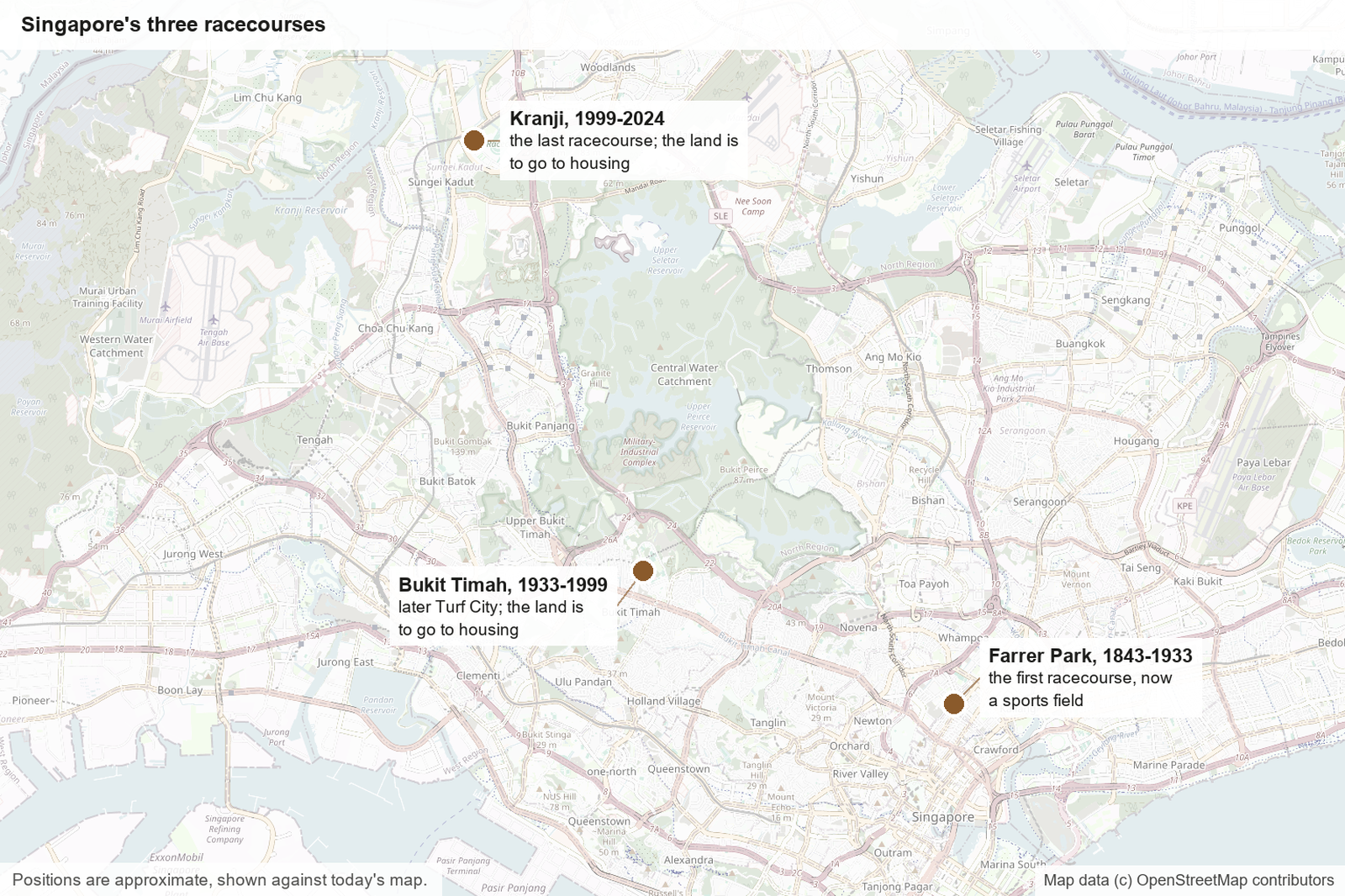
Singapore’s three racecourses: Farrer Park (1843 to 1933), Bukit Timah (1933 to 1999) and Kranji (1999 to 2024). Positions are approximate. (Map data © OpenStreetMap contributors)
Farrer Park, 1842 to 1933
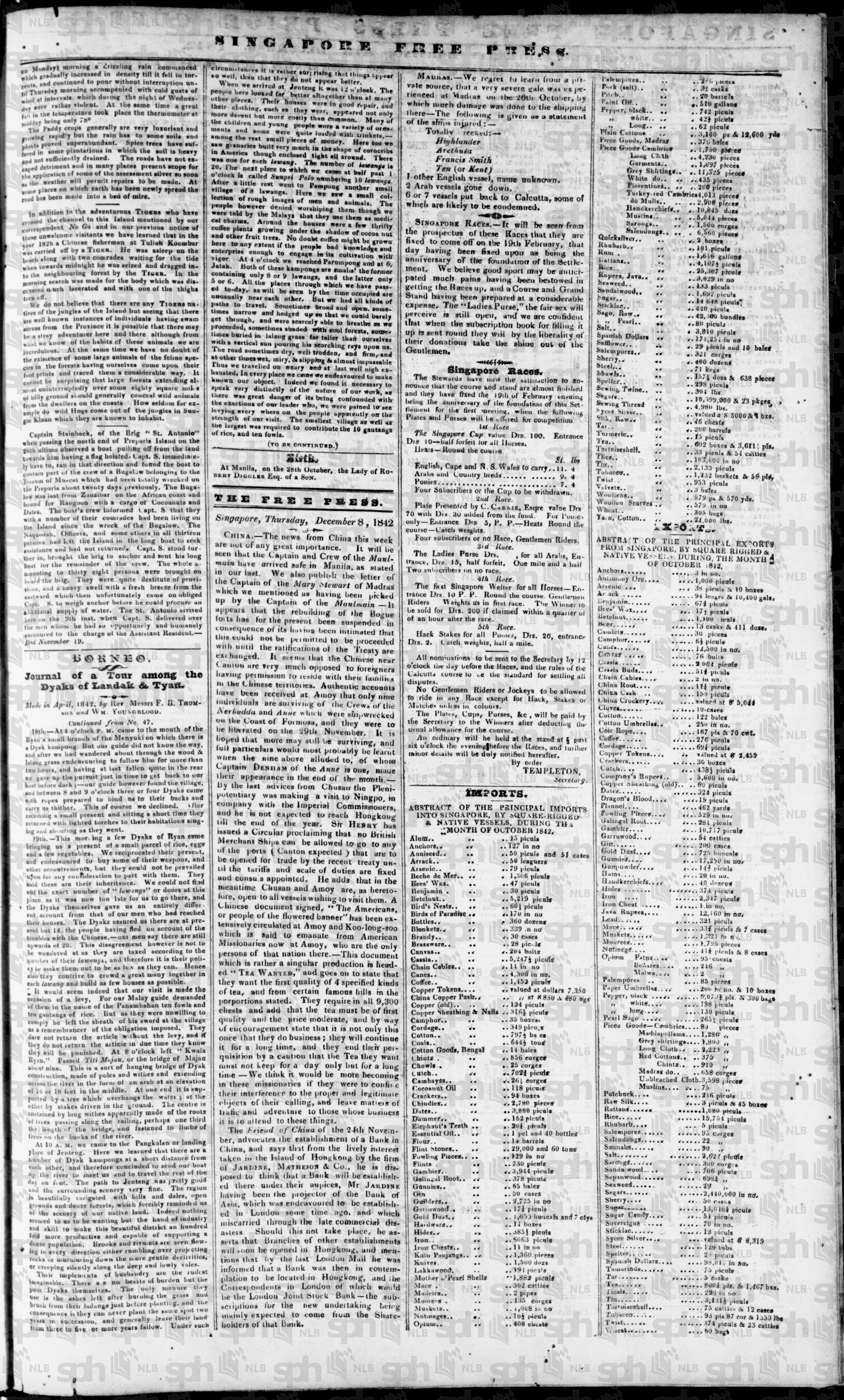 The Singapore Free Press of 8 December 1842, page 3. The notice "Singapore Races", announcing that the course and stand were almost finished, is in the middle column. (Singapore Free Press, via NewspaperSG, National Library Board Singapore, public domain)
The Singapore Sporting Club was founded on the 4th of October 1842 by William Henry Macleod Read, a Scottish merchant. Its members laid out a course and built a grandstand on swampy land off Serangoon Road, and in December the stewards announced in The Singapore Free Press that the course and stand were almost finished. The first race meeting was held on the 23rd and 25th of February 1843, timed for the anniversary of the founding of the settlement. Read himself won the first Singapore Cup, and the prize money was $150.
For the next 90 years the races were held on this plain, usually twice a year. Between meetings the open ground was used for recreation. The club was renamed the Singapore Turf Club in 1924, and that year it ran the first Singapore Gold Cup, which was worth $1,600.

The racecourse at Singapore around 1910, in a photograph by C. J. Kleingrothe. (Kleingrothe, C.J., KITLV collection, public domain, via Wikimedia Commons)
The town was growing around the course. In 1927 the club sold the land to the Singapore Improvement Trust, the colonial housing authority, and bought part of a rubber estate at Bukit Timah for a new course. The old ground was renamed Farrer Park in 1935, after Roland Farrer, who had been President of the Municipal Commissioners. Race Course Road, which ran beside it, still keeps the name.

Two race-goers talking as a horse is ridden past them, sketched at the Singapore racecourse by John Edmund Taylor in 1881. (John Edmund Taylor, Wellcome Collection, CC BY 4.0, via Wikimedia Commons)
Bukit Timah, 1933 to 1999
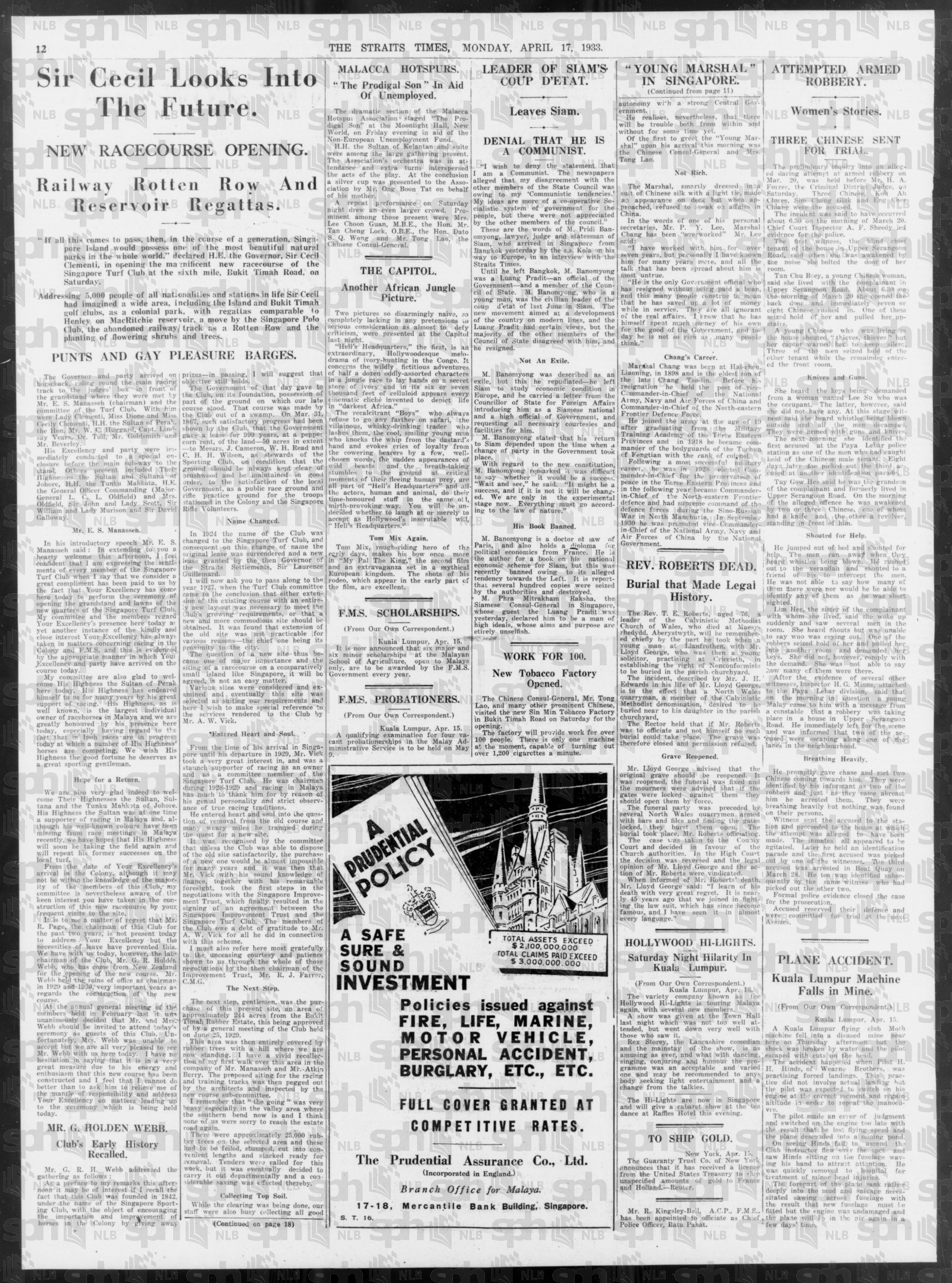 The Straits Times of 17 April 1933, page 12, with the report of the opening of the new racecourse in the left-hand columns. (Singapore Press Holdings, via NewspaperSG, National Library Board Singapore, public domain)
The new racecourse at Bukit Timah was opened on the 15th of April 1933 by the Governor, Sir Cecil Clementi. The Straits Times reported his speech under the headline “Sir Cecil Looks Into The Future”, and a crowd of about 5,000 filled the new grandstand and lawns. The course was far larger than the old one, and it was the club’s home for the next 66 years.
Singapore was one stop on a racing circuit. From 1896 the Turf Club belonged to the Malayan Racing Association, together with the clubs at Penang, Ipoh and Kuala Lumpur, and horses and jockeys from all four clubs raced at one another’s meetings.
Racing stopped during the Japanese Occupation. It came back on the 15th of November 1947, when more than 10,000 people went to Bukit Timah for the first day of the re-opening meeting. The Sunday Times called it a “record crowd in Malayan turf history”. The day before, The Straits Times reported that ticket sales for the club’s big sweep had taken the total pool for a meeting past $1 million for the first time in Malaya.
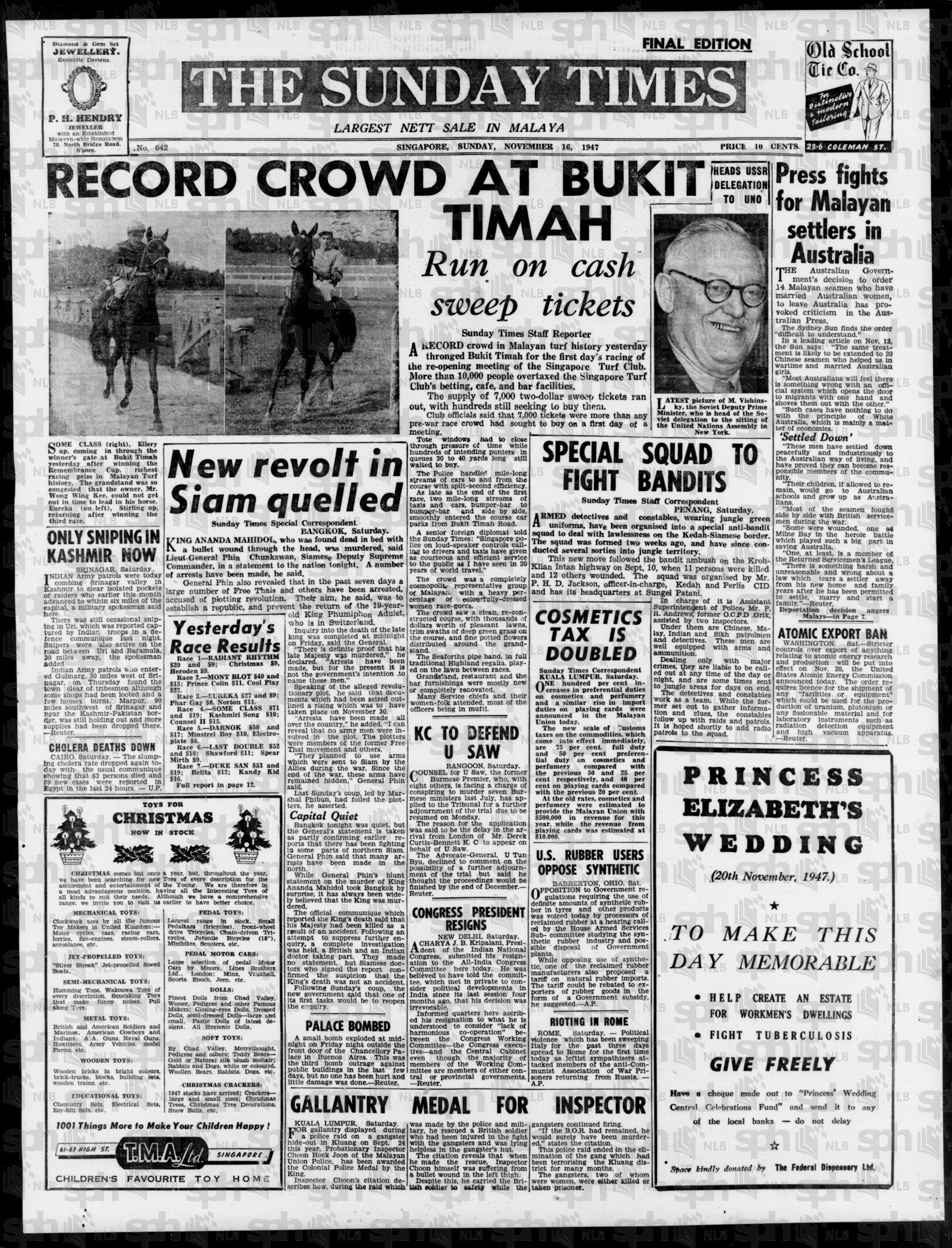 The front page of The Sunday Times of 16 November 1947, led by "Record Crowd At Bukit Timah". (Singapore Press Holdings, via NewspaperSG, National Library Board Singapore, public domain)
The club introduced Sunday racing in 1959, and in 1960 it opened its meetings to the public. The sweeps that the club ran alongside its races were a story of their own: in 1933 a single $5 sweep ticket won $54,340 at the Gold Cup meeting, and three years later the Gold Cup itself carried stakes of $5,000. How those sweeps became Singapore’s national lottery is told in The Singapore Sweep: How the Lottery Went Legal.

The old Bukit Timah racecourse buildings in December 2006, when they were in use as the Turf City shopping and leisure centre. (Sengkang, copyrighted free use, via Wikimedia Commons)
A century of Gold Cup prize money
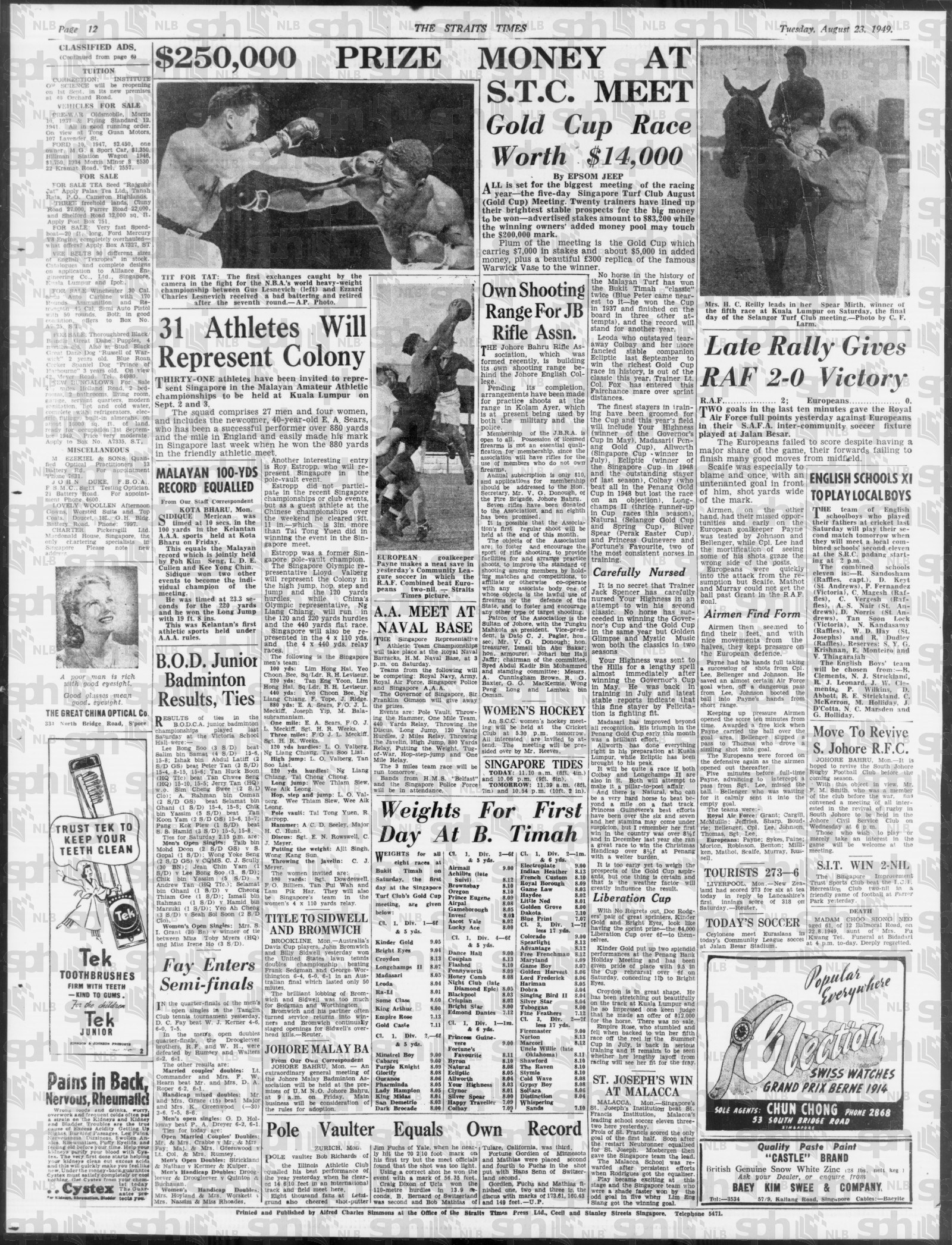 The Straits Times of 23 August 1949, page 12: "$250,000 Prize Money At S.T.C. Meet, Gold Cup Race Worth $14,000". (Singapore Press Holdings, via NewspaperSG, National Library Board Singapore, public domain)
The Gold Cup was one of the club’s richest races, and its prize money shows how racing grew. The first Gold Cup in 1924 was worth $1,600. By 1936 the stakes were $5,000, and in 1949 the race was worth $14,000. It reached $50,000 in 1961, $100,000 in 1977 and $500,000 in 1990.
When the club moved to Kranji the prize was raised to $1 million, and a one-off increase took it to $1.5 million in 2003. In later years it was set at $1.35 million, and by 2019 it was back at $1 million. For the last running in 2024 the prize was raised to $1.38 million. These figures are in the dollars of each year, so the rise is much smaller once inflation is taken into account.
Singapore Gold Cup, total prize money, 1924–2024 (logarithmic scale)
View data as a table
| Year | Gold Cup prize money |
|---|---|
| 1924 | $1,600 |
| 1936 | $5,000 |
| 1949 | $14,000 |
| 1953 | $17,054 |
| 1957 | $35,000 |
| 1961 | $50,000 |
| 1971 | $60,000 |
| 1977 | $100,000 |
| 1984 | $220,500 |
| 1985 | $300,000 |
| 1986 | $330,000 |
| 1988 | $400,000 |
| 1990 | $500,000 |
| 1996 | $650,000 |
| 1998 | $750,000 |
| 1999 | $1 million |
| 2003 | $1.5 million |
| 2005 | $1.25 million |
| 2007 | $1.35 million |
| 2017 | $1.35 million |
| 2019 | $1 million |
| 2021 | $1 million |
| 2024 | $1.38 million |
Prize money in the dollars of each year, not adjusted for inflation. Each dot is a year for which a figure was found in newspaper reports of the time (the 1924 and 1999 figures are from Wikipedia's history of the race; 1984 is worked out from the 1985 report of a $79,500 rise). There was no racing from 1942 until November 1947.
Kranji, 1999 to 2024
By the late 1980s the land at Bukit Timah was wanted for housing, and a new site was found at Kranji, in the north of the island. The last race at Bukit Timah was run on the 25th of July 1999. Six days later, on the 31st of July, Kranji opened to the racing public, and The New Paper reported that only 5,000 race-goers were allowed into the $500 million complex for its first day.

The grandstand at Kranji in June 2015. (dave ho, CC BY 2.0, via Wikimedia Commons)
The new course had a grandstand for 30,000 people and 41 floodlight masts, and on the 25th of September 1999 it held Singapore’s first night race meeting, which was interrupted when part of the lighting failed. The course was officially opened on the 4th of March 2000 with the first Singapore Airlines International Cup, a $3 million race that was won by a horse trained in Singapore, Ouzo. The International Cup brought horses from overseas to Kranji until it was discontinued in 2016.
Crowds fell in the years that followed. Average attendance on a race day dropped from about 11,000 in 2010 to about 6,000 in 2019, and after racing resumed in 2022 following the Covid-19 pandemic, it was about 2,600. The Tote Board’s chief executive linked the decline to the opening of the casinos in 2010 and to competition from other sports, such as Formula One and football.
The end of racing
On the 5th of June 2023 the Singapore Turf Club, the Ministry of Finance and the Ministry of National Development announced that racing would end. The club would hold its last race meeting in October 2024 and hand the Kranji site, of about 120 hectares, back to the government by March 2027, so that it could be planned for public housing, leisure and other uses. The Second Minister for Finance, Indranee Rajah, cited the fall in attendance and pointed to a decline in racing in other countries. About 350 staff were to be retrenched in phases, with help to find new jobs, and owners and trainers were offered support to maintain their horses or send them overseas.
The last meeting was held on the 5th of October 2024. The prize money for the day was raised, and the 100th Grand Singapore Gold Cup, over 2,000 metres, was worth $1.38 million. It was won by Smart Star, in front of a crowd of about 10,000.

The entrance plaza at Kranji in August 2025, ten months after the last race. (LN9267, CC BY-SA 4.0, via Wikimedia Commons)
The three sites today
Farrer Park is still an open sports field, and Race Course Road runs past its edge.
The old Bukit Timah course became Turf City, a shopping and leisure centre in the former racecourse buildings, until it closed at the end of 2023. In May 2024 the Urban Redevelopment Authority set out plans for a 176-hectare estate on and around the site, with about 15,000 to 20,000 public and private homes over 20 to 30 years. Some of the old racecourse buildings, including the North Grandstand, are being studied for keeping and reuse, and the estate will be served by two MRT stations, one of them on the future Cross Island Line.

The site of the future Turf City MRT station at the old Bukit Timah racecourse, October 2022. (Seloloving, CC BY-SA 4.0, via Wikimedia Commons)
At the National Day Rally in August 2025, Prime Minister Lawrence Wong said that the Kranji site would be used for about 14,000 new public and private homes, with the first expected in about ten years.
The Singapore Turf Club, 1842 to today
- Oct 1842 The Singapore Sporting Club is founded.
- Feb 1843 The first race meeting is held on the course off Serangoon Road.
- 1924 The club becomes the Singapore Turf Club and runs the first Gold Cup.
- 1927 The club sells the Serangoon Road course; it is renamed Farrer Park in 1935.
- Apr 1933 The Bukit Timah racecourse opens.
- 1942 Racing stops during the Japanese Occupation.
- Nov 1947 Racing resumes at Bukit Timah before a record crowd.
- 1960 Race meetings are opened to the public.
- Jul 1999 The last race at Bukit Timah; Kranji opens.
- Mar 2000 Kranji is officially opened with the $3 million International Cup.
- Jun 2023 The end of racing is announced.
- Dec 2023 Turf City closes at Bukit Timah.
- Oct 2024 The last race meeting and the 100th Gold Cup.
- Mar 2027 The Kranji site is due to be handed back to the government.
See more historical photos related to this post →
Where it fits in the bigger story: The Turf Club was one of Singapore’s oldest clubs, founded only 23 years after the settlement itself. Each of its moves, from the edge of town to Bukit Timah and then to Kranji, came as the city grew around the course, and each site has gone on to other uses. Farrer Park is a sports field among flats, and Bukit Timah and Kranji are being planned as housing estates, so the names Race Course Road and Turf City are among the few reminders that horses once raced there.
Sources:
- Singapore Turf Club, Wikipedia
- Singapore Gold Cup, Wikipedia
- Kranji Racecourse, Wikipedia
- National Heritage Board, Farrer Park Field, Roots.gov.sg
- Remember Singapore, “Singapore’s 182 Years of Horse Racing Reaches the Finishing Line”, 29 October 2024
- Mothership, “Horse racing average attendance fell to 2,600 in 2022, 350 Turf Club staff to be retrenched”, June 2023
- Urban Redevelopment Authority, “Heritage, nature and inclusive spaces to anchor new housing estate at Bukit Timah Turf City”, 23 May 2024
- Remember Singapore, “A Last Look at Turf City”, 14 January 2024
- MS News, “National Day Rally: New homes at Turf Club site in Kranji to be ready in 10 years”, August 2025
- The Singapore Free Press, 8 December 1842, “Singapore Races”, page 3, NewspaperSG
- The Straits Times, 17 April 1933, “Sir Cecil Looks Into The Future”, page 12, NewspaperSG
- Malaya Tribune, 17 April 1933, “Bukit Timah Race Course Opened”, NewspaperSG
- The Sunday Times, 24 September 1933, “Fortunes Changed Hands At Races”, page 10, NewspaperSG
- Pinang Gazette, 18 June 1936, “S’pore Turf Club Autumn Meeting: $5,000 Stakes For Gold Cup Race”, NewspaperSG
- The Straits Times, 15 November 1947, “Total Pool Now Exceeds One Million”, page 1, NewspaperSG
- The Sunday Times, 16 November 1947, “Record Crowd At Bukit Timah”, page 1, NewspaperSG
- The Straits Times, 23 August 1949, “$250,000 Prize Money At S.T.C. Meet”, page 12, NewspaperSG
- The Straits Times, 23 September 1953, “Gold Cup Money”, NewspaperSG
- The Singapore Standard, 18 September 1957, “$35,000 Gold Cup For Next Singapore Race Meeting”, NewspaperSG
- The Straits Times, 17 August 1961, “$50,000 Gold Cup Race At S’pore”, NewspaperSG
- New Nation, 28 August 1971, Gold Cup stakes of $60,000, NewspaperSG
- New Nation, 29 November 1977, “The $100,000 Singapore Gold Cup”, NewspaperSG
- The Straits Times, 6 September 1985, Gold Cup prize money raised to $300,000, NewspaperSG
- The Straits Times, 4 September 1986, “S’pore Gold Cup worth $330,000 this year”, NewspaperSG
- The Straits Times, 1 July 1988, the $400,000 Singapore Gold Cup, NewspaperSG
- The Straits Times, 7 October 1990, the $500,000 Singapore Gold Cup, NewspaperSG
- The Straits Times, 7 September 1996, the $650,000 Singapore Gold Cup, NewspaperSG
- The Straits Times, 9 September 1998, the $750,000 Singapore Gold Cup, NewspaperSG
- The New Paper, 1 August 1999, “Kranji Views”, NewspaperSG
- The New Paper, 22 September 1999, “‘Super Eddie’ is back”, NewspaperSG
- The New Paper, 26 September 1999, “Power failure mars big night”, NewspaperSG
- The Straits Times, 27 February 2000, “The Jewel of Kranji”, NewspaperSG
- The New Paper, 5 March 2000, Ouzo wins the first Singapore Airlines International Cup, NewspaperSG
- Today, 23 August 2003, Gold Cup prize money raised to $1.5 million, NewspaperSG
- The New Paper, 12 November 2005, the $1.25 million Singapore Gold Cup, NewspaperSG
- The Straits Times, 11 November 2007, the $1.35 million Singapore Gold Cup, NewspaperSG
- The New Paper, 28 October 2017, the $1.35 million Singapore Gold Cup, NewspaperSG
- The New Paper, 1 October 2019, the $1 million Singapore Gold Cup, NewspaperSG
- The New Paper, 15 November 2021, the $1 million Singapore Gold Cup, NewspaperSG
- The Straits Times, 6 June 2023, “Kranji racecourse to make way for housing, other developments”, NewspaperSG
- The Straits Times, 2 November 2023, “Nearly $1m boost for finale”, NewspaperSG
- Kranji Racecourse 05-12-2024.jpg, Wikimedia Commons
- Map data © OpenStreetMap contributors
- KITLV - 79903 - Kleingrothe, C.J. - Medan - Tanks and the racecourse at Singapore - circa 1910.tif, Wikimedia Commons
- Singapore; two race-going celebrities talk as a race horse i Wellcome V0037531.jpg, Wikimedia Commons
- Turf City 3, Dec 06.JPG, Wikimedia Commons
- Singapore Turf Club building, 2015.jpg, Wikimedia Commons
- Singapore Racecourse 09-08-2025(2).jpg, Wikimedia Commons
- Turf City MRT station site 081022.jpg, Wikimedia Commons
- Singapore; a stubborn horse at the start of Singapore raceco Wellcome V0037529.jpg, Wikimedia Commons
- Singapore; a police officer clearing two race-goers from the Wellcome V0037530.jpg, Wikimedia Commons
- Race Course Road, Aug 06.JPG, Wikimedia Commons
- Farrer Park Swimming Complex, Aug 06.JPG, Wikimedia Commons
- Turf City, Dec 06.JPG, Wikimedia Commons
- Turf City 7, Dec 06.JPG, Wikimedia Commons
- Turf Club Avenue.JPG, Wikimedia Commons
- Singapore Turf Club, 2015.jpg, Wikimedia Commons
- Singapore Racecourse 09-08-2025(1).jpg, Wikimedia Commons


