The Southern Special Students: Malayan Youths Sent to Japan, 1943–45
On 4 June 1943 the front page of the Syonan Shimbun reported that 33 “potential leaders” from Malaya and Sumatra were being trained at Woodsville, off Upper Serangoon Road, in Japanese language, physical culture and “the Nippon spirit”. The fifteen with the best results would go on to three years of study in Japan. Two of the 33 were from Syonan itself, “two Malai youths named Bostam and Kasmani”. Over the next two years about 200 young people from across occupied Southeast Asia went to Japan as Nanpō tokubetsu ryūgakusei, Southern Special Students. A few of them ended up at a university in Hiroshima, and two of the Malayans among them died after the atomic bomb fell on the city on 6 August 1945.

The main building of the Hiroshima University of Literature and Science in November 1945, three months after the bombing. Three of the Southern Special Students from Malaya were enrolled here. (United States Government, public domain, via Wikimedia Commons)
The scheme
The plan was announced in the Syonan Shimbun on 13 April 1943. The Gunseikanbu, the military administration, would send fifteen promising students from Malaya and Sumatra to Japan, “in order to let them get in touch with the essence of the national characteristics as well as the national constitution of Nippon”. On their return they were to work with the Japanese authorities “at the head of the local inhabitants”, towards the Greater East Asia Co-Prosperity Sphere. Only young men aged 17 to 20 could apply, and they had to be “qualified to be the leaders of their communities in future”.
The terms were generous. The administration paid for the journey, and the Greater East Asia Ministry in Tokyo, working with the education, army and navy ministries, gave each student a monthly allowance of 100 yen for school expenses. The students would spend a year learning Japanese and then study a subject such as education, industrial technique or police administration. Each state’s Chief Administrator would pick one or two candidates and recommend them to the Gunseikan by the end of April.
The aims were stated just as plainly in Tokyo. In February 1944 Kazuo Aoki, the Minister for Greater East Asia, told a budget committee of the House of Peers that the students would be guided towards “complete faith in Nippon and complete understanding of its policies”, so that they would “co-operate more fully with Nippon” when they took up positions of leadership at home. Japan was training an elite for the order it intended to build in Southeast Asia.
Who was picked
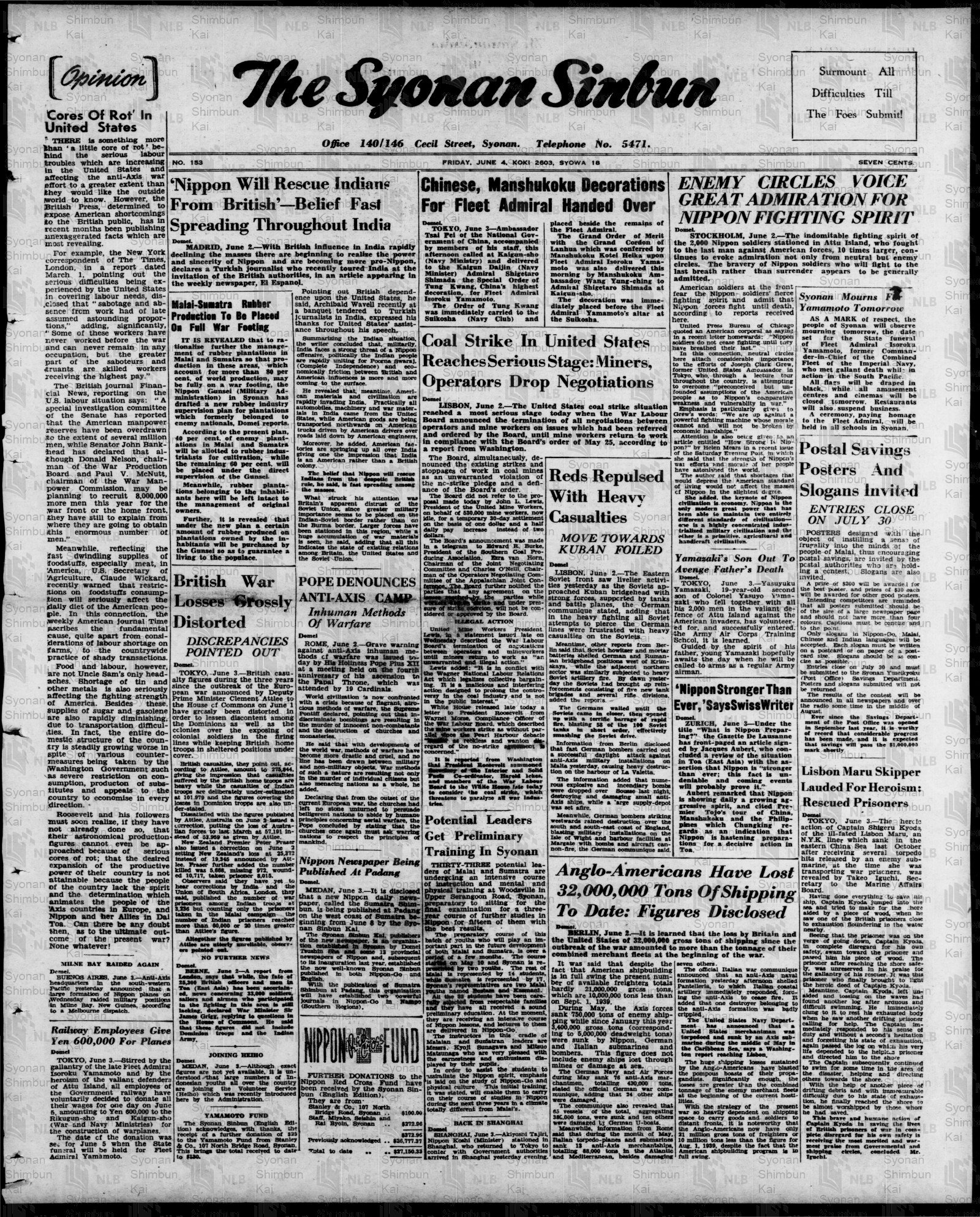 The Syonan Shimbun of 4 June 1943, page 1. The report "Potential Leaders Get Preliminary Training In Syonan", near the bottom, names the two trainees from Syonan, Bostam and Kasmani. (The Syonan Shimbun, via NewspaperSG, National Library Board Singapore, public domain)
The first course began on 10 May 1943 at the Ryugakusei Kunrenjo, the training school for overseas students, at Woodsville. Fourteen of the trainees came from Malaya, seventeen from Sumatra and two from Syonan. The newspaper said that all 33 had been “carefully selected from respectable families” and had received “a sound preliminary education”. Their instructors, Kyoji Sunagawa and Mitsuo Matsunaga, taught mainly Japanese and physical training, so that the students could “assimilate the Nippon spirit” before they left.
The fifteen who were chosen left before the course ended. On 30 June 1943 a party of students from Burma, Malaya, Sumatra and Java arrived at Tokyo Station dressed in Japan’s national civilian uniform, the kokuminfuku. They went straight to the plaza in front of the Imperial Palace to pay their respects to the Emperor, and then enrolled at the Kokusai Gakuyukai, the International Students’ Society. The 18 who stayed behind received their certificates at Woodsville in July, at a ceremony that began with a bow towards the Imperial Palace and the singing of the Japanese national anthem. The newspaper does not say whether Bostam and Kasmani were among the fifteen, and neither name appears in its pages again.
Some Malayans were in Japan already. On 1 June 1943 the paper reported that two Johor students, Ungku Aziz and Ungku Mohsen, had passed the entrance examinations for Waseda University in Tokyo, and that a third, Wan Abdul Hamid, was applying to the Tokyo University of Agriculture. Two young women from Malaya were studying there as well, and all five lived at the mansion of Marquis Tokugawa. By August 1943 the paper counted 20 students from Malaya in Japan, two of them women.
The second year’s selection was smaller and was run through the Koa Kunrensho, a training school in Malacca. In January 1944 the administration announced that ten students would be chosen on state quotas, with preference for those with a good education, everyday Japanese, and “whose absence will be no inconvenience to their families”. In April the paper named the four who had been picked “from all parts of Malai”: Ibrahim bin Mahat, 18, from Johor, to study chemistry; Hassan bin Ahmat, 17, from Malacca, for agriculture; Yusoffe bin Abdul Kadir, 20, from Penang, also for agriculture; and Abdul Razak, 18, from Selangor, for education. A second group of 89 Southern Special Students arrived in Tokyo on 10 June 1944, four of them from Malaya.
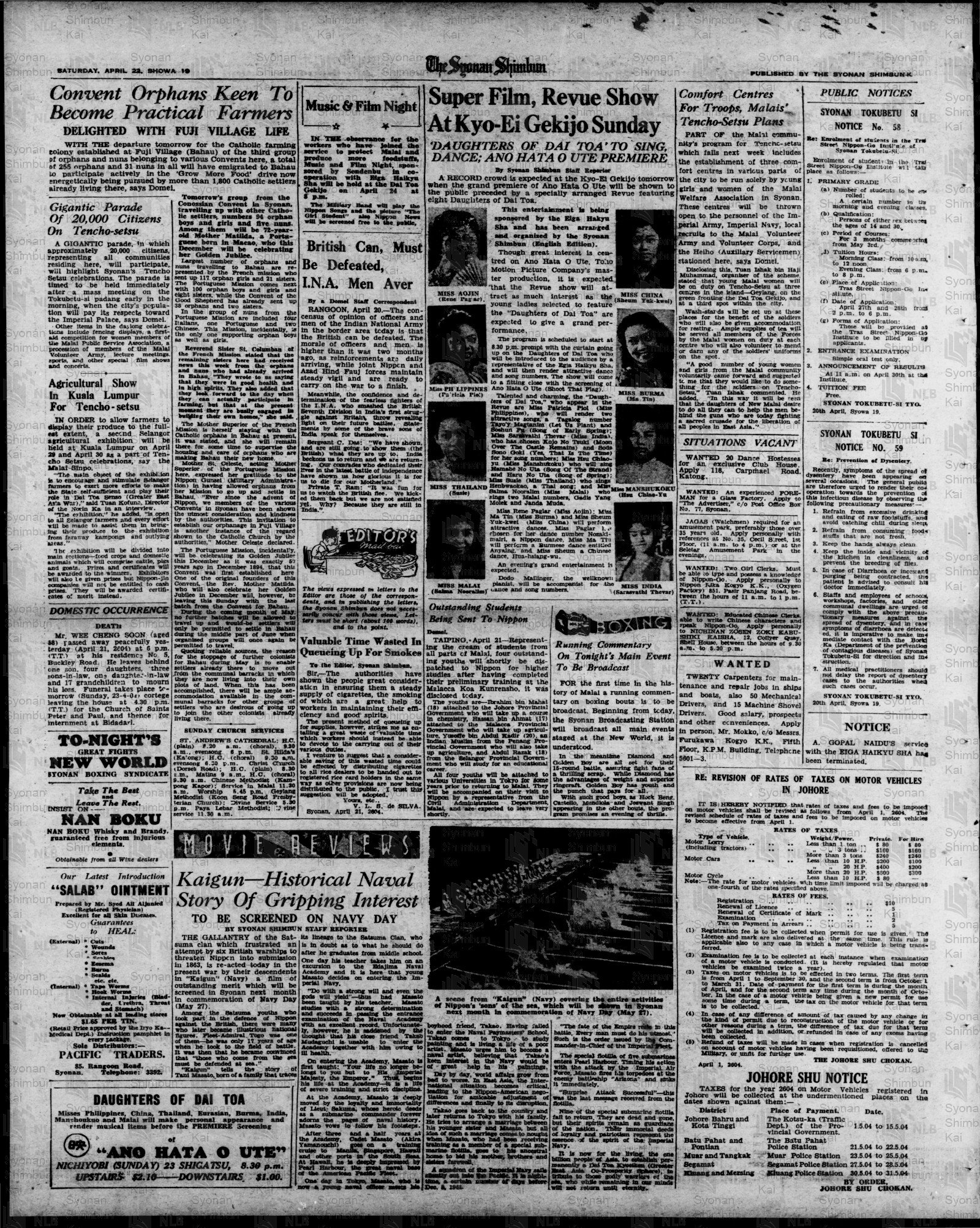 The Syonan Shimbun of 22 April 1944, page 2. The short report "Outstanding Students Being Sent To Nippon", halfway down the second column, names the four students chosen that year, among them Abdul Razak of Selangor. (The Syonan Shimbun, via NewspaperSG, National Library Board Singapore, public domain)
That Abdul Razak was almost certainly Abdul Razak Abdul Hamid, who was born in Penang in 1925 and who, Hiroshima University records, came to Japan in 1944 as a government-sponsored student. Nik Yusof Nik Ali, from Kota Bharu, and Syed Omar Syed Mohammad Alsagoff were also among the Malayans in the scheme. Altogether about 205 young people came to Japan from Southeast Asia as Southern Special Students, from Malaya, Indonesia, Burma, the Philippines, Thailand and Brunei.
Life in Japan
The students spent their first year at the International Students Institute in Tokyo, learning Japanese and Japanese history, and were then placed at universities and colleges across the country. They lived in dormitories run for them by the society, and from mid-1944 a housing society placed some of them with Japanese families as members of the household. But the war was turning against Japan. Food was short, and from November 1944 American bombers raided Tokyo.
By the spring of 1945 nine Southern Special Students were enrolled at the Hiroshima University of Literature and Science, a teacher-training university, among them Abdul Razak, Nik Yusof and Syed Omar from Malaya and Pengiran Yusuf from Brunei. Abdul Razak enrolled in April 1945. The overseas students lived at the Konan dormitory, about 900 metres from the point over which the bomb would explode.

The main gate of the Hiroshima University of Literature and Science before the war. (Unknown author, public domain, via Wikimedia Commons)
Hiroshima, 6 August 1945
At 8.15 on the morning of 6 August 1945 an American B-29 dropped an atomic bomb on Hiroshima. Eight of the nine Southern Special Students at the university were in the city. Abdul Razak was in a lecture room about 1.5 kilometres from the hypocentre. The building collapsed on top of him, and he lost consciousness and woke to a city in ruins.
Nik Yusof, who was 19, was at the Konan dormitory. He got out of the collapsed building and set off west towards Itsukaichi, on the edge of the city, but died on the way. An urn bearing his name was left in the care of Kozenji, a Buddhist temple in what is now Saeki Ward.
The surviving students slept in the open on the university grounds for days. Meiko Kurihara, a 19-year-old who had fled there after finding her home burned down, later remembered that they encouraged her, helped her search for her missing father and shared what food they had. Syed Omar, also 19, developed a fever while helping to care for the wounded, and her mother cooled his head with a wet handkerchief as he lay on the ground.
After Japan’s surrender on 15 August the students began to make their way home. Syed Omar fell ill on the journey and was admitted to a hospital in Kyoto. A doctor there, Hamajima Yoshihiro, gave him his own blood. Syed Omar is reported to have told him, “You and I are brothers because you gave me your blood to try and save my life.” He died at the beginning of September; the hospital’s death certificate is dated 3 September 1945. Abdul Razak wrote to Kurihara that his friend’s death was “undoubtedly due to the effects from the atomic bomb”, and added that he now had a cough himself and might follow the same fate.

The cloud over Hiroshima on 6 August 1945, photographed by Masami Oki from the Kure Naval Arsenal, about 20 kilometres away. (Masami Oki, public domain, via Wikimedia Commons)
After the war
The Southern Special Students went home to countries that were changing fast. The three young men from Johor who had gone before the scheme began were already back: in April 1945 the Syonan Shimbun reported that Aziz, Ungku Mohsin and Wan Abdul Hamid had returned after more than two years in Japan and joined the Johor government’s service. The paper quoted Aziz praising the Japanese family system. He was Ungku Abdul Aziz, who went on to study economics at Raffles College after the war, earned his doctorate from Waseda in 1964 and was Vice-Chancellor of the University of Malaya from 1968 to 1988.
 Pengiran Muhammad Yusuf in 1965. He survived the bombing of Hiroshima as a student and became Brunei's chief minister. (Unknown author, public domain, via Wikimedia Commons)
Pengiran Muhammad Yusuf, who had been selected in late 1943 with other students from Borneo, suffered radiation sickness after the bombing and returned to Brunei in March 1946. Writing as Yura Halim, he wrote the words of “Allah Peliharakan Sultan” in 1947, which later became Brunei’s national anthem, and from 1968 to 1973 he was the country’s menteri besar, its chief minister.
Abdul Razak Abdul Hamid became a teacher and spent his working life building ties between Malaysia and Japan. He became a professor of Japanese studies, set up the Japanese-language programme at what is now Universiti Teknologi MARA, and in 1982 was put in charge of Malaysia’s Look East Policy, which sent Malaysian students and trainees to learn from Japan. He wrote about Hiroshima in a memoir, Debu Hiroshima (The Ashes of Hiroshima), and spoke often against nuclear weapons. Hiroshima University awarded him an honorary doctorate in February 2013, and he died in Kuala Lumpur on 18 July 2013, aged 88.
The scheme set out to train young people who would lead their countries in partnership with Japan, and several of them did go on to lead. But they led independent countries, in a world that Japan’s planners had not foreseen.
Remembering them
The two who died were remembered first by Japanese people who had no connection to them. In 1961 Kenkichi Sonobe, a resident of Kyoto, built an Islamic-style grave for Syed Omar at a temple in the city, and in 1974 he formed a group to look after it. His daughter, Toshie Sonobe, has gone on visiting the grave since the group was dissolved in 2008, and a memorial service is held there each year. In Hiroshima the head priest of Kozenji raised an Islamic-style grave over Nik Yusof’s remains in 1964, the only Muslim grave at the temple, and a service is held there regularly. In 2019 a group from Kota Bharu, Nik Yusof’s home town, among them a relative of his, visited the grave for the first time.
Hiroshima University has taken part in the memorial service for Syed Omar since the 1970s, and in 2015 it gave special awards to Toshie Sonobe and to Hiroso Niimi, a former member of its staff, for keeping the students’ story alive. In 2023 the university applied to Hiroshima City to have the names of overseas students who died after the bombing, from China, Mongolia and Southeast Asia, added to the city’s register of atomic bomb victims, which is kept in the cenotaph at the Peace Memorial Park. Normally only a victim’s family can make such an application. The city accepted the request, the first time that had been done.

The cenotaph in the Hiroshima Peace Memorial Park, which holds the register of the names of the atomic bomb victims, with the A-Bomb Dome beyond. (TimMilesWright, CC0, via Wikimedia Commons)
Today
The Southern Special Students, 1943 to today
- 13 Apr 1943 Scheme to send 15 students from Malaya and Sumatra announced
- 10 May 1943 33 trainees, two from Syonan, begin at Woodsville
- 30 Jun 1943 First group arrives at Tokyo Station
- 10 Jun 1944 Second group of 89 arrives in Tokyo, four from Malaya
- Apr 1945 Abdul Razak enrols at Hiroshima
- 6 Aug 1945 Atomic bomb on Hiroshima; Nik Yusof killed
- 3 Sep 1945 Syed Omar dies in Kyoto
- 1954 Japan's government scholarships for foreign students begin
- 1961 Syed Omar's grave built in Kyoto
- 1964 Nik Yusof's grave raised at Kozenji
- 1982 Abdul Razak heads Malaysia's Look East Policy
- 2013 Abdul Razak's honorary doctorate; he dies in July
- 2023 Overseas students' names added to Hiroshima's register
Japan still pays for students from Southeast Asia to study in its universities, but on very different terms. The Japanese Government (Monbukagakusho) Scholarship began in 1954 and has since brought tens of thousands of students from around the world, Singaporeans among them, to study in Japan. Students apply for it themselves and choose what they study.
At the start of 1986, straight after graduating from NUS, I went to Japan for 18 months on a scholarship from AOTS, an organisation set up in 1959 with the support of Japan’s trade ministry to train engineers and managers from developing countries. I began with Nihongo lessons at the Yokohama Kenshu Center and then trained at TOPACS, a Tokyo company that wrote real-time software for chemical plants. It was more than forty years after Bostam and Kasmani were chosen at Woodsville, and by then Japan came to Singapore as an investor and trading partner rather than as an occupier.
See more historical photos related to this post →
Where it fits in the bigger story: the Southern Special Students are a small part of the Occupation’s history, but the newspapers of 1943 and 1944 show clearly what the scheme was meant to do: to take promising young people from Singapore and Malaya and shape them into leaders loyal to Japan’s order in Asia. The war ended before that order could take hold, and two of the young men died in Hiroshima far from home. The survivors went on to teach, write and govern in their own independent countries, and the two who died are remembered today by a Kyoto family, a Hiroshima temple and the university where they studied.
Sources
- The Syonan Shimbun, 13 April 1943, “Malai, Sumatra Students To Be Sent To Nippon”, NewspaperSG
- The Syonan Shimbun, 16 April 1943, “A Unique Opportunity”, NewspaperSG
- The Syonan Shimbun, 1 June 1943, “Malai Boy, Girl Students Happy To Be In Nippon”, NewspaperSG
- The Syonan Shimbun, 4 June 1943, “Potential Leaders Get Preliminary Training In Syonan”, NewspaperSG
- The Syonan Shimbun, 2 July 1943, “Nampo Students Arrive In Tokyo”, NewspaperSG
- The Syonan Shimbun, 26 July 1943, “Ryugakusei Kunrenjo Students Graduate”, NewspaperSG
- The Syonan Shimbun, 7 August 1943, “1,500 Toa Students Now Studying In Nippon”, NewspaperSG
- The Syonan Shimbun, 31 January 1944, “Malai To Send 10 Students To Nippon”, NewspaperSG
- The Syonan Shimbun, 3 February 1944, “Daijin Outlines Guidance For Nampo Students”, NewspaperSG
- The Syonan Shimbun, 20 April 1944, “Two Malai Young Ladies Return From Nippon”, NewspaperSG
- The Syonan Shimbun, 22 April 1944, “Outstanding Students Being Sent To Nippon”, NewspaperSG
- The Syonan Shimbun, 29 April 1944, “Four Students To Be Trained As Future Leaders Of New Malai”, NewspaperSG
- The Syonan Shimbun, 12 June 1944, “Nampo Students”, NewspaperSG
- The Syonan Shimbun, 4 July 1944, “Nippon Families Taking In Nampo Students”, NewspaperSG
- The Syonan Shimbun, 20 April 1945, “Malai Students Praise Spirit Of Nippon Youths”, NewspaperSG
- Minami Yamashita, “Documenting Hiroshima of 1945: In early September, death notice for Southern Special Student delivered”, Hiroshima Peace Media Center, 7 September 2024 (archived copy)
- Yuji Yamamoto, “Malaysian group offers prayers at Southeast Asian student’s grave at Kozenji Temple in Hiroshima”, Hiroshima Peace Media Center, 4 November 2019 (archived copy)
- Kyoko Shinmoto, “Efforts to remember A-bombed international students from Southeast Asia are recognized by Hiroshima University”, Hiroshima Peace Media Center, 14 November 2015 (archived copy)
- “Hiroshima University applies for first time to have names of overseas students added to register of A-bomb victims”, Hiroshima Peace Media Center
- Peace Memorial Ceremony, 6 August 2023, Hiroshima University
- Honorary doctorate for Abdul Razak, Hiroshima University, 4 March 2013
- Dineskumar Ragu, “Forgotten Malaysian victims of Hiroshima atomic bombing”, Free Malaysia Today, 14 August 2022
- Abdul Razak Abdul Hamid, Wikipedia
- Ungku Abdul Aziz, Wikipedia
- Jomo Kwame Sundaram, “Ungku Aziz’s lasting footprints in the nation’s sands of time”, 3 January 2024
- Yusuf Abdul Rahim (Pengiran Muhammad Yusuf), Wikipedia
- Association for Overseas Technical Scholarship, Wikipedia
- Japanese Government (MEXT) Scholarship, Embassy of Japan in Singapore
- Ruins of Hiroshima University of Literature and Science, Wikimedia Commons
- Hiroshima Bunrika University, main gate, Wikimedia Commons
- Atomic cloud over Hiroshima from the Kure Naval Arsenal, Wikimedia Commons
- Pengiran Muhammad Yusuf bin Abdul Rahim, 1965, Wikimedia Commons
- Upper Serangoon Road before the Woodsville Flyover, 2006, Wikimedia Commons
- Fire- and blast-damaged remains of Hiroshima University of Literature and Science, Wikimedia Commons
- Fire-damaged chemical lab, Hiroshima University of Literature and Science, Wikimedia Commons
- Fire-damaged interior with books reduced to ashes, Hiroshima University of Literature and Science, Wikimedia Commons
- Blast-damaged ruins of Hiroshima University Museum, Wikimedia Commons
- Atomic cloud over Hiroshima (George R. Caron), Wikimedia Commons
- Devastated Tokyo Station building from the platform, 1945, Wikimedia Commons
- Hiroshima University, 1955, Wikimedia Commons
- Hiroshima Bunrika Daigaku former building, 2010, Wikimedia Commons
- Hiroshima University Higashi-Hiroshima Campus, Wikimedia Commons


