Labuan: The Borneo Island That Was Part of Singapore
For almost forty years, a small island off the coast of Borneo, about 1,100 kilometres from Singapore across the South China Sea, was governed from Singapore. From 1 January 1907 Labuan was part of the Settlement of Singapore, and from 1912 it was a settlement of its own within the Straits Settlements, run by a Resident who answered to the Governor in Singapore. Today it is a Malaysian federal territory and an offshore financial centre, and few people in Singapore know that it was once on the same map.

The East India Company steamer Phlegethon at Labuan in August 1848, the year the island became a colony. (Unknown artist, public domain, via Wikimedia Commons)
A coaling station for the China route, 1846 to 1890
In the 1840s British steamers sailing between Singapore and the new colony of Hong Kong needed coal on the way, and Labuan had both coal seams and a deep, sheltered harbour at the mouth of Brunei Bay. Its name comes from the Malay word labuhan, meaning a harbour or anchorage. James Brooke, by then the Rajah of Sarawak, pressed the British government to take it. On 18 December 1846 the Sultan of Brunei, Omar Ali Saifuddin the Second, signed a treaty ceding the island, and on 24 December the British flag was hoisted there in the presence of Captain Rodney Mundy of the Royal Navy.

The ceremony of hoisting the British flag on Labuan, 24 December 1846. (Leopold Heath, public domain, via Wikimedia Commons)
 Sir James Brooke in the late 1850s, about ten years after he became Labuan's first Governor. (Herbert Watkins, public domain, via Wikimedia Commons)
Labuan became a Crown Colony and a free port in 1848, with Brooke as its first Governor. His Lieutenant-Governor was William Napier, a Singapore lawyer who had helped found the Singapore Free Press in 1835 and edited it until 1846. Napier’s secretary on the island was Hugh Low, later known as the British Resident of Perak, who married Napier’s daughter Catherine in 1848. That same year Napier, as Lieutenant-Governor of Labuan, invested Brooke with his knighthood at a ceremony in the Singapore Assembly Rooms.
Some people in Singapore worried that the new colony would draw trade away from their port, and Singapore’s centenary history, written in 1921, remembered the gloomy predictions made when Labuan was ceded. They came to nothing. Several British companies, starting with the Eastern Archipelago Company in 1849, tried to mine coal at Tanjung Kubong, at the northern tip of the island, but the coal never paid. Malaria, accidents and poor management all took their toll, and the ships went on calling at Singapore. Brooke himself had to answer a commission of inquiry, held in Singapore in 1854, into his campaigns against the pirates of the Borneo coast, and it cleared him of the most serious charges.
 The Chimney at Tanjung Kubong, the best-known relic of Labuan's coal-mining years. (CEphoto, Uwe Aranas, CC BY-SA 3.0, via Wikimedia Commons)
The best-known relic of the mining years is the Chimney, a brick tower about 32 metres tall at Tanjung Kubong, although nobody is quite sure what it was built for. Singapore and Labuan also shared a church for a time. From the late 1860s they were in the same Anglican diocese, the Diocese of Singapore, Labuan and Sarawak, and in 1870 St Andrew’s Church in Singapore was made its cathedral. The diocese was only divided in 1909, when Singapore got a bishop of its own and Labuan and Sarawak another.
Company years, 1890 to 1906
By the 1880s the colony was deep in debt, and from 1 January 1890 the British government handed its administration to the British North Borneo Company, which governed it alongside North Borneo. In 1894 a submarine telegraph cable linked Labuan with North Borneo, Singapore and Hong Kong. One of the governors the company sent there, from 1900 to 1901, was Hugh Clifford, a young colonial officer from Malaya. Company rule did not solve the island’s problems, and in 1906 Britain took it back and looked for a better arrangement.
Part of Singapore, 1907 to 1946
 A Labuan two-cent stamp overprinted "Straits Settlements" in 1906, as the island passed to the colony. (Royal Mail, public domain, via Wikimedia Commons)
Letters Patent of 30 October 1906 made Labuan part of the Colony of the Straits Settlements from a date the Governor would proclaim, and he chose 1 January 1907. From that day the island was part of the Settlement of Singapore. The next afternoon the Legislative Council in Singapore passed the Labuan Bill, which provided for the island’s administration, through all its stages in a single sitting, and the Straits Times reported it the same day in a one-line note.
On 1 December 1912 Labuan was made a separate settlement, the fourth in the colony alongside Singapore, Penang and Malacca. It stayed part of the same colony, and the Governor in Singapore was also Governor of Labuan. Between 1907 and the war that meant Sir John Anderson, Sir Arthur Young, Sir Laurence Guillemard, Sir Hugh Clifford, Sir Cecil Clementi and Sir Shenton Thomas. On the island itself the government was run by a Resident, who, unlike the Resident Councillor of Penang, had no seat on the Legislative Council.
 Sir Hugh Clifford, Governor of the Straits Settlements, and so of Labuan, from 1927 to 1930. (The Straits Times, 15 October 1929, public domain, via Wikimedia Commons)
Hugh Clifford came back to Labuan’s affairs from the other end. Nearly thirty years after he had governed the island for the North Borneo Company, he was Governor of the Straits Settlements in Singapore from 1927 to 1930, and Labuan was one of the four settlements in his charge.
Labuan was a quiet posting. The coal mines closed for good in 1911, after years of losses, and the island made the news in Singapore only now and then. In May 1916 the Resident, E. B. Maundrell, was shot dead by Sikh policemen, as the chronology in Singapore’s 1921 centenary history records. On 17 May 1922 the Prince of Wales landed on Labuan from the battlecruiser HMS Renown, seven weeks after he had laid the foundation stone of the Cenotaph in Singapore, and went on from there to Jesselton and Brunei.
 A map of Labuan drawn by the Survey Department in Singapore in 1930. (Singapore Survey Department, public domain, via Wikimedia Commons)
Its maps were made in Singapore too, and the map of the island shown here was produced by the Survey Department there in 1930. By the last pre-war count, in 1941, about 9,000 people lived on the island, whose one town, Victoria, stood on the harbour.
War, 1942 to 1945
Japanese forces landed on Labuan in the first days of January 1942, a few weeks before Singapore fell. Its airfield mattered to them. Lieutenant-General Toshinari Maeda, who commanded the Japanese forces in Borneo, was killed in an air crash at Bintulu on 5 September 1942 while on his way to open it, and on 9 December 1942 the Japanese renamed Labuan Maeda Island in his memory.
On 10 June 1945 Australian troops of the 24th Brigade, 9th Australian Division, landed on the island in Operation Oboe Six, the first step in retaking Borneo. The fighting went on until 21 June. Thirty-four Australians and 389 Japanese were killed, and the Allied bombing and shelling left Victoria in ruins and about 3,000 civilians homeless.

The ruins of Victoria, Labuan’s town, on 26 June 1945, after the Allied bombardment. (Jack Band, Australian War Memorial, public domain, via Wikimedia Commons)
On 10 September 1945 Lieutenant-General Masao Baba, commander of the Japanese 37th Army, surrendered all the Japanese forces in Borneo to Major-General George Wootten of the 9th Division at Layang-Layangan, on Labuan’s west coast. The place is now called Surrender Point. Two days later, on 12 September, the Japanese commanders in Southeast Asia surrendered in Singapore, at the Municipal Building.

Lieutenant-General Masao Baba signs the surrender of the Japanese forces in Borneo on Labuan, 10 September 1945. (Australian War Memorial, public domain, via Wikimedia Commons)
Labuan also holds a large Commonwealth war cemetery. The Labuan War Cemetery has 3,908 graves, and most of the men buried there died as prisoners of war in the Japanese camps at Sandakan and Kuching. Many had been sent there from Singapore. After the fall of Singapore, the Japanese shipped two groups of Australian prisoners from Changi to Sandakan, about 1,500 in “B” Force in 1942 and about 500 in “E” Force in 1943, to build an airfield, and very few of them survived. Their graves were moved to Labuan after the war because the Sandakan site flooded, and because the camp records had been destroyed, more than half of the Sandakan graves are unnamed. Baba was later tried for the Sandakan death marches and was hanged at Rabaul on 7 August 1947.

The Labuan War Cemetery in April 2025. (Calistemon, CC BY-SA 4.0, via Wikimedia Commons)
After the war
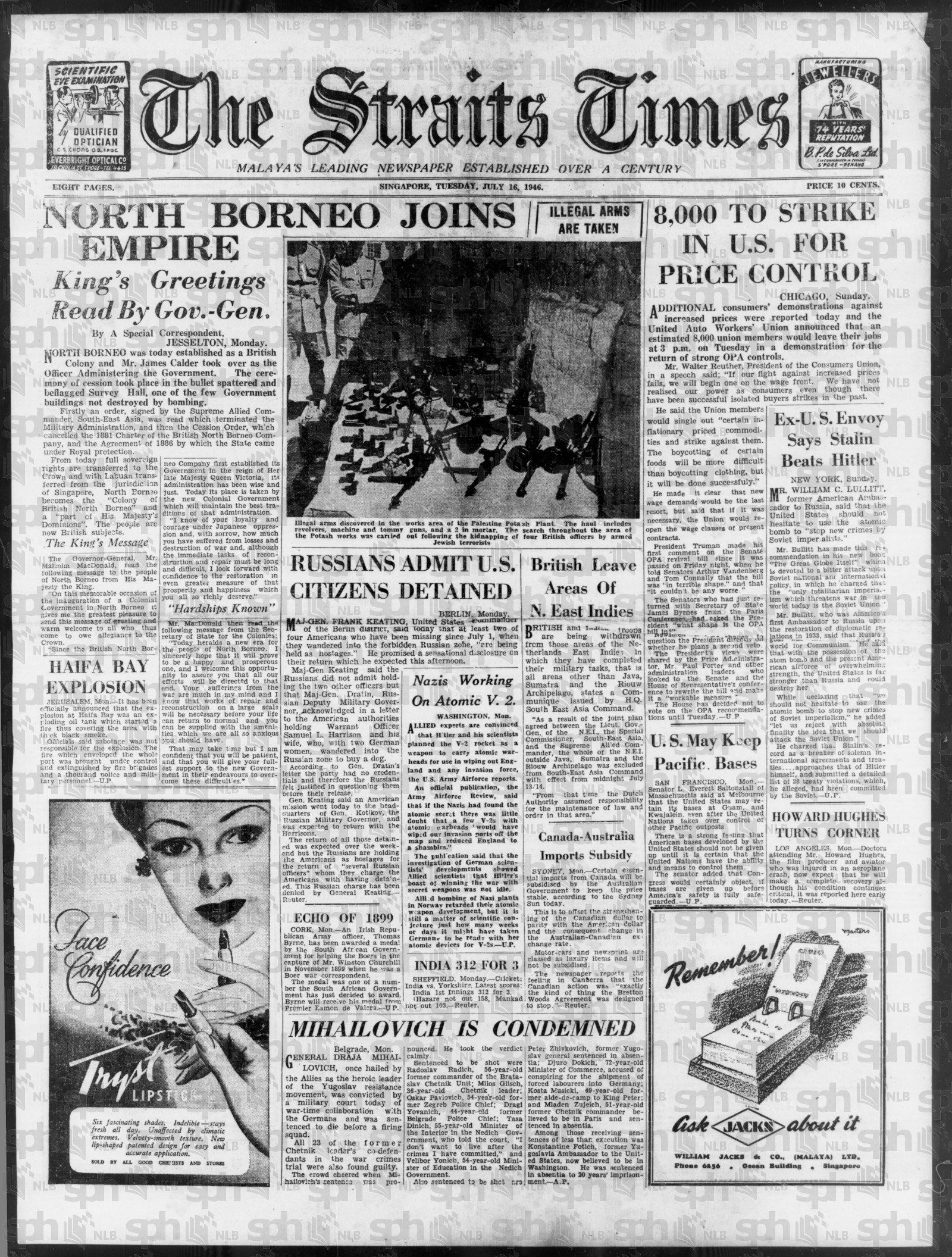 The Straits Times of 16 July 1946, page 1: "North Borneo Joins Empire," reporting Labuan's transfer from Singapore. (Singapore Press Holdings, via NewspaperSG, National Library Board Singapore, public domain)
The Straits Settlements were dissolved on 1 April 1946, and Singapore became a Crown Colony on its own, with Labuan still under its jurisdiction for a few more months. On 15 July 1946 the island was joined to the new Crown Colony of North Borneo, which took over from the North Borneo Company. The next morning’s Straits Times reported on its front page that, “with Labuan transferred from the jurisdiction of Singapore,” North Borneo had become a British colony at a ceremony in the bullet-scarred Survey Hall in Jesselton, one of the few government buildings there that the bombing had spared. In 1963 North Borneo, renamed Sabah, became part of Malaysia, and Labuan went with it. On 16 April 1984 Sabah handed the island to the federal government, and it became a federal territory.
Today
On 1 October 1990 Malaysia declared Labuan an international offshore financial centre, now known as the Labuan International Business and Financial Centre. At the end of 2024 it had 838 licensed financial institutions, 627 new Labuan companies had been set up that year, and its licensed financial sector employed about 5,000 people. The island is still a free port, and ferries run to it from Kota Kinabalu and from Brunei.

Labuan Financial Park, in the town once called Victoria, in 2009. (JKT-c, CC BY 3.0, via Wikimedia Commons)
Labuan’s land area is about 92 square kilometres, roughly an eighth of Singapore’s. Its history is kept in a handful of places: the Chimney, now a small museum, the war cemetery, the memorial at Surrender Point, and a row of old memorial stones outside the Labuan Museum that mark the cession of 1846, the Prince of Wales’s visit of 1922 and General Maeda’s death. In Singapore the link has left almost no trace. St Andrew’s Cathedral was once the seat of a bishop whose diocese reached Labuan, and the island is listed in old atlases and directories as one of the Straits Settlements, alongside Penang and Malacca.
Labuan, 1846-1990
From British colony to part of Singapore to Malaysian federal territory
Sources: Makepeace et al., One Hundred Years of Singapore (1921); Wikipedia; Australian War Memorial; Labuan FSA.
View as table
| Date | Event |
|---|---|
| 1846 | The Sultan of Brunei cedes Labuan to Britain by treaty on 18 December 1846, and the British flag is hoisted on 24 December. |
| 1848 | Labuan becomes a Crown Colony and free port, with James Brooke as Governor and the Singapore lawyer William Napier as Lieutenant-Governor. |
| 1890 | From 1 January 1890 the British North Borneo Company runs Labuan, until Britain takes it back in 1906. |
| 1907 | From 1 January 1907 Labuan is part of the Settlement of Singapore, under Letters Patent of 30 October 1906. |
| 1912 | From 1 December 1912 Labuan is the fourth settlement of the Straits Settlements, run by a Resident under the Governor in Singapore. |
| 1945 | Australian troops land on 10 June 1945. On 10 September Lieutenant-General Masao Baba surrenders the Japanese forces in Borneo on Labuan. |
| 1946 | The Straits Settlements are dissolved on 1 April 1946, and on 15 July Labuan joins the new Crown Colony of North Borneo. |
| 1963 | On 16 September 1963 North Borneo, renamed Sabah and including Labuan, becomes part of Malaysia. |
| 1984 | On 16 April 1984 Sabah cedes Labuan to the federal government, and it becomes a federal territory. |
| 1990 | On 1 October 1990 Labuan is declared an international offshore financial centre, now Labuan IBFC. |
See 10 more historical and present-day pictures of Labuan →
Where it fits in the bigger story: Singapore’s borders were not always the ones it has now. Like Christmas Island and the Cocos Islands, which are told in the Christmas Island post, Labuan was for a time run from Singapore as part of one scattered colony, from 1907 until the colony was broken up in 1946. The island never became the rival port that some people in Singapore feared in the 1840s, but for almost forty years it shared Singapore’s governors and laws, for about forty years until 1909 it shared its bishop, and its war cemetery still holds many of the men who left Changi for Borneo and never came back.
Sources
- Labuan, Wikipedia
- Crown Colony of Labuan, Wikipedia
- Governor of Labuan, Wikipedia
- Straits Settlements, Wikipedia
- Battle of Labuan, Wikipedia
- Labuan War Cemetery, Wikipedia
- Masao Baba, Wikipedia
- Labuan, Britannica
- Labuan, British Empire map room
- Walter Makepeace, Gilbert E. Brooke and Roland St J. Braddell (eds), One Hundred Years of Singapore, vol. 1 (1921), Internet Archive
- Walter Makepeace, Gilbert E. Brooke and Roland St J. Braddell (eds), One Hundred Years of Singapore, vol. 2 (1921), Internet Archive
- The Straits Times, 2 January 1907, page 6, NewspaperSG
- The Straits Times, 11 September 1945, NewspaperSG
- “North Borneo Joins Empire”, The Straits Times, 16 July 1946, page 1, NewspaperSG
- Labuan War Cemetery, Commonwealth War Graves Commission
- CWGC Memorial to the Missing, Labuan War Cemetery, Australian Department of Veterans’ Affairs
- Surrender to Major-General Wootten at Labuan, Australian War Memorial
- History of Labuan, Labuan Tourism
- Press release: Labuan IBFC Driving Forward with Resilience and Sustained Growth, Labuan FSA, 30 April 2025
- Wikimedia Commons: H.C. steamer Phlegethon at Labuan, August 1848.jpg
- Wikimedia Commons: Ceremony of Hoisting the British Flag on the island of Labuan, N. W. Coast of Borneo.jpg
- Wikimedia Commons: Sir-James-Brooke.jpg
- Wikimedia Commons: Labuan Malaysia Chimney-01.jpg
- Wikimedia Commons: 1906straitssettlements2c.jpg
- Wikimedia Commons: Hugh Charles Clifford (The Straits Times, 15 October 1929).jpg
- Wikimedia Commons: Labuan 1930 img0035 AccNo128 1.jpg
- Wikimedia Commons: Victoria Town (AWM 018703).JPG
- Wikimedia Commons: Japanese Surrender, Labuan (AWM 115989).JPG
- Wikimedia Commons: Labuan War Cemetery, April 2025 09.jpg
- Wikimedia Commons: Treaty of Labuan1846.jpg
- Wikimedia Commons: Map of Labuan (1888).jpg
- Wikimedia Commons: Admiralty Chart No 947 Victoria Harbour, Published 1913.jpg
- Wikimedia Commons: Labuan Government Offices.jpg
- Wikimedia Commons: Labuan Malaysia Memorial-Stone-Visit-Prince-of-Wales-01.jpg
- Wikimedia Commons: Japanese landing off the west coast of British North Borneo, Labuan.jpg
- Wikimedia Commons: Labuan Malaysia Memorial-Stone-GENERAL-MAIDA-01.jpg
- Wikimedia Commons: MasaoBaba Labuan01.jpg
- Wikimedia Commons: Labuan Malaysia Surrender-Point-Memorial-01.jpg


