Singapore 'Sold' Christmas Island in 1958 — Except It Never Owned It
Ask most Singaporeans about Christmas Island and you’ll get some version of the same story: Singapore used to own it, and sold it off to Australia in 1958 for far less than it was worth. It’s a tidy story — a small colonial outpost cashing in an island, a year before Singapore even got a real vote in its own affairs. It’s also wrong. Singapore never owned Christmas Island, so there was nothing for it to sell.

Flying Fish Cove, Christmas Island’s capital and main settlement. (Photo: David Stanley / Wikimedia Commons, CC BY 2.0)
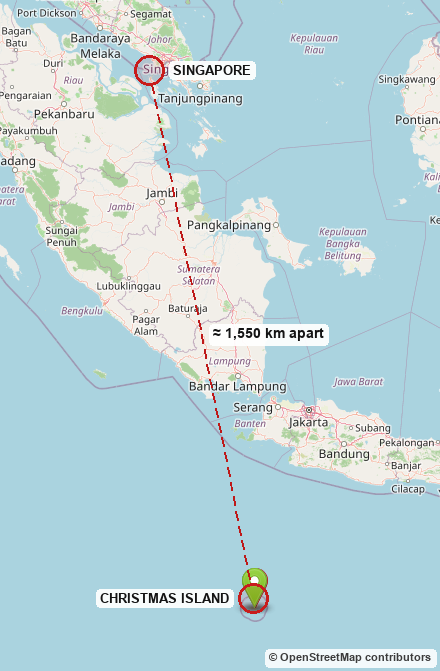 Christmas Island lies about 1,550 km south of Singapore, out in the Indian Ocean south of Java — nothing like the neighbouring island the "sold it off" story implies. (Map data: © OpenStreetMap contributors)
Sovereignty over Christmas Island belonged to the British Crown from the moment Britain annexed it in 1888. When it was folded into the Straits Settlements in 1900, Singapore was named the administering authority purely as a matter of convenience — it was the nearest seat of British government in the region, nothing more. Singapore’s own leaders said as much at the time. When the 1958 transfer to Australia came up for debate, the colony’s Acting Chief Minister, Abdul Hamid Jumat, told the Legislative Assembly plainly that Christmas Island had never belonged to Singapore: “The Colony was asked to administer it and nothing more.” No Singaporean government, colonial or postcolonial, ever had title to give away.
What Singapore did have was a share of the island’s phosphate income, and that’s what was actually on the table in 1958. Phosphate mining began in 1897, and by 1900 the island was shipping ore to Japan and Germany, worked largely by indentured Chinese, Malay, and Sikh labourers under British and Australian mine operators. The revenue — royalties and tax on the mining company’s operations — flowed to whoever administered the island, which for over half a century meant Singapore’s colonial government.
That arrangement survived a wartime disaster. In March 1942, a mutiny among the island’s Indian garrison troops, swayed by Japanese propaganda about liberating India from British rule, left several British soldiers dead and the remaining Europeans imprisoned. When Japanese forces arrived on 31 March, they took the island without firing a shot. The episode exposed just how vulnerable a British-administered phosphate rock in the middle of the Indian Ocean actually was — and it sharpened Australia’s postwar interest in controlling the supply directly rather than relying on someone else’s colony to guarantee it.
 Lim Yew Hock, Singapore's Chief Minister when the Christmas Island transfer was finalised in 1958 — a year before Singapore had full internal self-government. (Photo: Central Office of Information, London, 1956 / Wikimedia Commons, public domain)
In 1948, the Australian and New Zealand governments, acting through the British Phosphate Commissioners, bought out the Christmas Island Phosphate Company’s operations outright. From there it was only a matter of time before ownership followed the money: in June 1957, Britain and Australia announced sovereignty would transfer to Canberra, and the Christmas Island Bill cleared the UK Parliament the following spring. On 1 October 1958, the island formally became Australian territory — a date it still marks every year as Territory Day.
Singapore’s government, led by Chief Minister Lim Yew Hock, received a lump-sum ex-gratia payment reported at roughly M$20 million (UK parliamentary records cite a broadly similar sum in sterling), pitched explicitly as compensation for lost phosphate royalty and tax income — not as a purchase price for land it never held title to in the first place. At the time, Singapore was collecting around M$1.5 million a year from the island’s phosphate operations, with about 32 years left on the mining lease. Run that forward and the income being signed away was worth in the neighbourhood of M$48 million — more than double the lump sum Singapore actually got.
M$20 million in, roughly M$48 million left on the table
What Singapore received for Christmas Island's phosphate income vs. what the remaining lease was worth
Singapore's compensation was pitched as covering lost phosphate income, not as a sale price — it still landed at under half of what that income stream was projected to be worth.
View data as table
| Figure | Amount |
|---|---|
| Lump-sum payment received (1958) | ~M$20 million |
| Projected value of remaining 32-year lease (at ~M$1.5M/yr) | ~M$48 million |
The timing makes the deal stranger still. It was finalised entirely by outgoing colonial administrators in London and Canberra — Singapore’s own Legislative Assembly could object, as Abdul Hamid Jumat’s remarks show it did, but it had no power to stop it. Singapore wouldn’t win full internal self-government for another year, in 1959, with its own elected Legislative Assembly and Lee Kuan Yew’s PAP taking office that May. The last chapter of Singapore’s administrative link to Christmas Island was written by people who, within twelve months, would no longer be the ones running the place.
Christmas Island today has nothing to do with phosphate, and even less to do with Singapore. Since 2008, its North West Point facility has been Australia’s flashpoint immigration detention centre, built to process asylum seekers who arrived by boat — one of the most politically fraught pieces of infrastructure in Australian public life. The island is also famous for something far less grim: every wet season, tens of millions of native red crabs migrate from the rainforest to the sea in a single synchronised wave, drawing naturalists from around the world. Almost nobody making that connection — to detention policy or to crabs — has any idea the rock they’re picturing was once run out of an office in Singapore. See five more historical photos related to this post →

The North West Point Immigration Detention Centre on Christmas Island, opened in 2008 — the island’s best-known feature today, on territory once administered from Singapore. (Photo: DIAC Images / Wikimedia Commons, CC BY 2.0)
Why it matters today: Singapore didn’t lose an island in 1958 — it lost the chance to correct a story about one, and nobody in power since has bothered to. The myth survives not because it was ever true, but because it was more interesting than the actual, more bureaucratic answer: Singapore was never anything more than the landlord’s agent, and got paid out accordingly.
Sources:
- Christmas Island never belonged to S’pore — Mothership.SG
- Was Christmas Island Part of Singapore? — ExplorerSG
- CHRISTMAS ISLAND BILL — UK Parliament, House of Commons Hansard, 12 May 1958
- CHRISTMAS ISLAND BILL [H.L.] — UK Parliament, House of Lords Hansard, 24 April 1958
- Christmas Island — National Archives of Australia fact sheet
- Christmas Island — Wikipedia
- Battle of Christmas Island — Wikipedia
- Self-governance of Singapore — Wikipedia
- North West Point Immigration Detention Centre — Wikipedia
- Lim Yew Hock — Wikipedia
- Singapore and Christmas Island on the map — OpenStreetMap
- File:Flying Fish Cove (25341355156).jpg — Wikimedia Commons
- File:Lim Yew Hock, 1956 (cropped).png — Wikimedia Commons
- File:Christmas Island Immigration Detention Centre and the Lilac compound (5774458263).jpg — Wikimedia Commons
- File:0-8-0 tender locomotive for the Christmas Island Phosphate Co.’s Railway by Peckett & Sons Ltd. of Bristol, No. 1824 of March 1931.jpg — Wikimedia Commons
- File:Japanese Marines in Christmas Island 1942.jpg — Wikimedia Commons
- File:Abdul Hamid bin Haji Jumat.jpg — Wikimedia Commons
- File:Stamp Christmas Island 1958 2c.jpg — Wikimedia Commons
- File:ST31May1959.jpg — Wikimedia Commons


