From Borneo to Singapore: The Sabah and Sarawak People in Singapore's Story
Elizabeth Choy, the wartime heroine who survived 200 days in the hands of the Kempeitai, was born in Kudat, in British North Borneo. Hugh Zehnder, the lawyer after whom Zehnder Road is named, was born in Sarawak. So was Wee Kheng Chiang, who founded the bank that became UOB. They were not exceptions. For more than a century and a half, people, money and ships have moved between Singapore and the two Borneo territories that are now the Malaysian states of Sabah and Sarawak, and some of the people who came from there left a lasting mark here.

The steamer Rajah Brooke leaving Kuching for Singapore on 22 July 1896. Nine days later she ran onto a rock and was lost. (Ho Ah Chon, public domain, via Wikimedia Commons)
A port for Borneo
The story begins with a voyage from Singapore. In 1839 a young Englishman, James Brooke, sailed from Singapore to Sarawak in his schooner, the Royalist. By 1841 he had become the Rajah of Sarawak, and for the next hundred years his family ruled it. Kuching was a small river port, and most of Sarawak’s trade with the outside world went through Singapore. Its sago, pepper and gambier were shipped there, and the goods its people bought came back the same way.
 Ong Ewe Hai, the Singapore-born trader who became Kuching's leading merchant. (From Song Ong Siang's One Hundred Years' History of the Chinese in Singapore, CC BY-SA 4.0, via Wikimedia Commons)
Some of the first people to make the crossing went from Singapore to Borneo, not the other way. Ong Ewe Hai was born in Singapore around 1830. His father died when he was about seven, and as the eldest child he had little schooling and went to work young. In 1846, aged 16, he went to Sarawak with his mentor, Lim Eng Moh, to trade with the local people, using credit from Singapore firms. Within about ten years he had a firm in Singapore and another in Kuching, which he merged in 1872 as Ewe Hai and Company, trading in sago, gambier and pepper. Brooke appointed him Kapitan Cina, the head of Kuching’s Chinese community. He built a house in Singapore, called Bonnie Grass, where he meant to retire, but it was still unfinished when he died in Kuching in 1888.
British capital followed the same route. The Borneo Company was formed in London in 1856 to trade in Sarawak, and on 31 July 1857 it opened its Singapore branch, taking over the business of its agent there, MacEwen and Company, with its wharves at Telok Blangah. In its first years most of its profit came from antimony, a metal mined in Sarawak and shipped to Europe through Singapore. It later mined gold at Bau, near Kuching, and grew into a trading house with offices across the region.

The Borneo Company’s building in Kuching, from the collection of the Sarawak administrator Charles Hose. (Wellcome Collection, CC BY 4.0, via Wikimedia Commons)
Further north, the British North Borneo Company received a royal charter in 1881 to govern North Borneo, today’s Sabah. Its officials, too, dealt constantly with Singapore, the nearest large British port. Labuan, a small island off the coast, was even governed from Singapore for a time: from 1 January 1907 it was part of the Settlement of Singapore, and in 1912 it became a separate settlement within the Straits Settlements, until it was transferred to North Borneo in 1946.

Officers of the British North Borneo Company with commissioners from Singapore, at Sandakan, between about 1900 and 1920. (Colonial Office, The National Archives UK, Open Government Licence, via Wikimedia Commons)
Coming to Singapore: school, law and banks
The traffic in people soon ran the other way. Ong Ewe Hai’s son, Ong Tiang Swee, was born in Kuching in 1864, went to school there, and then spent two years in Singapore to finish his education. In 1882 he joined his father’s firm, and in 1887 he became a director of the Sarawak and Singapore Steamship Company, whose ships were Sarawak’s main link with the outside world. He succeeded his father as Kapitan Cina in 1889 and led Kuching’s Chinese community for most of the next 60 years.
 Hugh Zehnder in 1936, the year he joined the Legislative Council. (Unknown author, public domain, via Wikimedia Commons)
Hugh Ransome Stanley Zehnder was born in Sarawak on 27 August 1879, the son of a Swiss Anglican missionary, and was of Eurasian descent. He came to Singapore in August 1909 and was called to the bar on 23 May 1910, and with his brother he founded the law firm of Zehnder Brothers. He was a founding member of the Eurasian Association in 1919 and its president from 1936. In 1918 he helped form the Eurasian company of the Singapore Volunteer Corps, which he later commanded, and he was made an OBE for his volunteer work in 1930. From 1936 to 1939 he was the Eurasian member of the Legislative Council of the Straits Settlements. After the war he sat on the Singapore Advisory Council and served as a civil district judge, before he retired to England in 1948. He had owned land off Pasir Panjang Road and lived on Pasir Panjang Hill, and Zehnder Road there, which runs beside Haw Par Villa, is named after him. He died in 1963.
 Chee Swee Cheng, whose fortune was made partly in North Borneo. (Unknown author, public domain, via Wikimedia Commons)
Money moved both ways too. Chee Swee Cheng was born in Malacca in 1866 and came to Singapore at 16 to work as a cashier. In 1900 he became a partner in the General Spirit and Opium Farm in North Borneo, the licence to sell alcohol and opium there, and later its manager. The North Borneo government granted him 5,000 acres of land, on which he planted tapioca and then rubber and set up a sawmill, and he also built brickfields and shophouses and founded two scholarships there. Back in Singapore, he co-founded Ho Hong Bank in 1917, and when it merged with two other Chinese banks in 1932 to form the Oversea-Chinese Banking Corporation, OCBC, he became its first chairman. He died in Singapore on 22 August 1938.
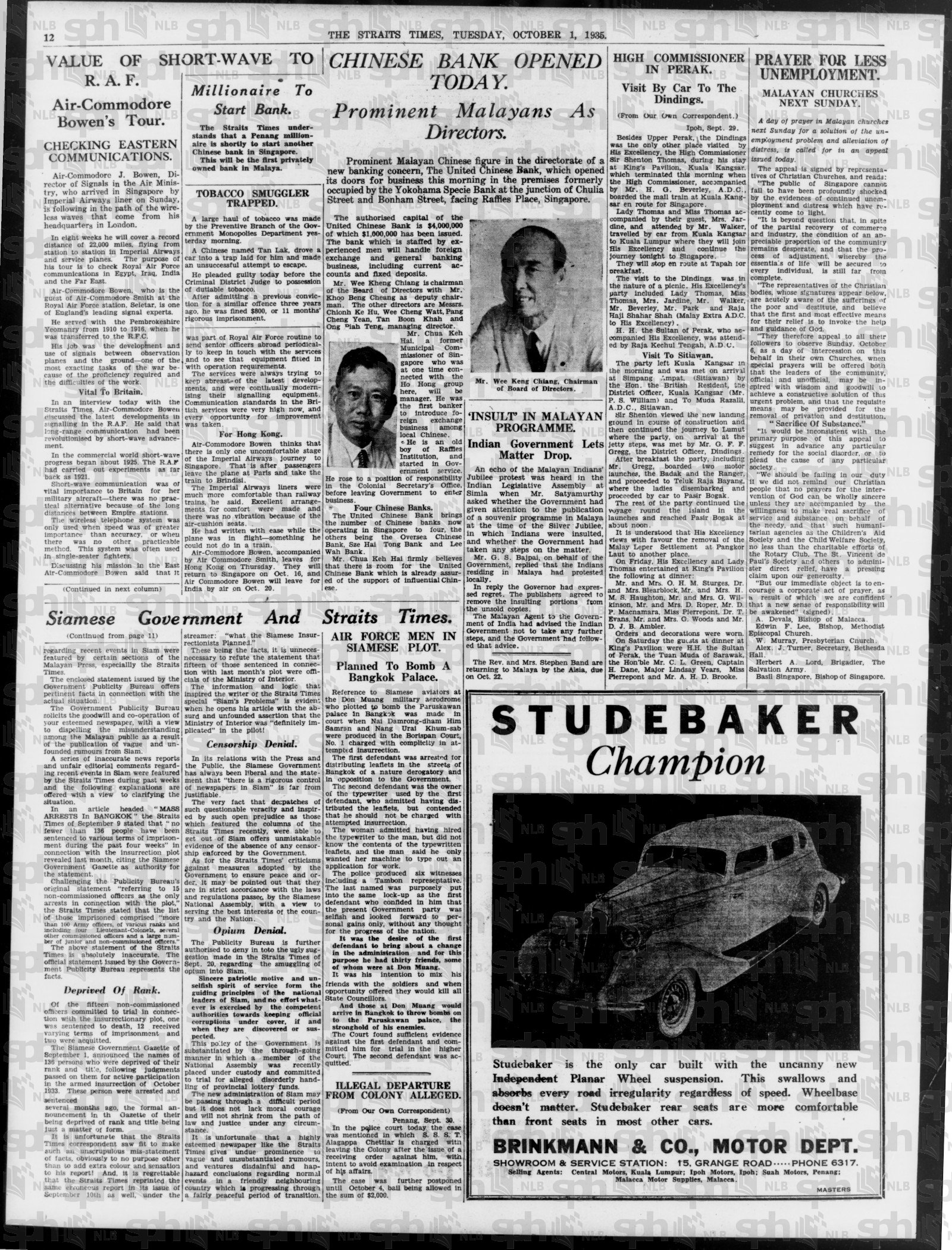 The Straits Times of 1 October 1935, page 12: "Chinese Bank Opened Today," with photographs of the chairman, Wee Kheng Chiang, and the manager, Chua Keh Hai. (Singapore Press Holdings, via NewspaperSG, National Library Board Singapore, public domain)
The two family stories met in Wee Kheng Chiang. He was born in Kuching on 22 July 1890, married Ong Tiang Swee’s eldest daughter, Ong Siew Eng, and managed a bank owned by his father-in-law before founding his own, the Bian Chiang Bank, in Kuching in 1924. In 1935 he led a group of seven businessmen in founding the United Chinese Bank in Singapore. It was incorporated on 6 August and opened on 1 October 1935, with Wee as its chairman and largest shareholder. Wee kept his home in Kuching, where he died in 1978, but the bank stayed in Singapore and was renamed United Overseas Bank in 1965. His son, Wee Cho Yaw, led it for decades, as the UOB post tells.
The war
 Elizabeth Choy on her wedding day, 16 August 1941. (Family of Elizabeth Choy, public domain, via Wikimedia Commons)
Elizabeth Choy was born Yong Su-Moi in Kudat on 29 November 1910. She went to school in Kudat and at St Monica’s, an Anglican boarding school in Sandakan, and in December 1929 she came to Singapore to study at the Convent of the Holy Infant Jesus. She stayed on to teach, and in 1941 she married Choy Khun Heng, a bookkeeper at the Borneo Company. During the Japanese Occupation the couple ran a canteen at the Mental Hospital and used it to smuggle food, medicine, money and letters to the internees in Changi. In 1943, after the Double Tenth arrests, both were detained by the Kempeitai, and she was held and tortured for about 200 days without giving them a single name.
After the war she was made an OBE, and the Rajah of Sarawak gave her the Order of the Star of Sarawak. From 1951 to 1955 she was the only woman on Singapore’s Legislative Council, and she went on to be the first principal of the Singapore School for the Blind. Her full story is in the Elizabeth Choy post.
On the screen
After the war, Singapore was the centre of the Malay film industry, with studios run by Shaw Brothers’ Malay Film Productions and by Cathay-Keris. One of its best-known actresses came from Kuching. Ramlah binti Mohamad, known as Siput Sarawak, was born there in 1921, and by the age of about 11 she was acting in bangsawan, Malay opera, with her father, the performer Dollah Sarawak. After the war she sang in cabarets in Singapore, and in 1947 she made her first film, Singapura di Waktu Malam. She went on to act in about 50 films for Malay Film Productions, Cathay-Keris and Merdeka Studio, often as the villain, and in 1952 the Straits Times Annual called her one of Malaya’s best-known film actresses. Her daughters, the actress Murni Sarawak and the singer Anita Sarawak, both became entertainers too. Siput Sarawak died in Singapore on 3 June 1999 and is buried at Pusara Abadi in Lim Chu Kang.
One country, 1963 to 1965
For two years Singapore, Sabah and Sarawak were part of the same country. In 1962 a commission led by Lord Cobbold went to North Borneo and Sarawak to find out whether their people supported joining a new federation with Malaya and Singapore. Its report, signed in June and published on 1 August 1962, found that about a third of the people in each territory strongly favoured the plan and another third favoured it with safeguards, while the remaining third were divided between those who wanted independence first and those who preferred British rule to continue. The Malaysia Agreement was signed in London on 9 July 1963, and on 16 September 1963 Malaya, Singapore, North Borneo, renamed Sabah, and Sarawak became Malaysia.

The members of the Cobbold Commission signing their report at Knebworth House, England, on 21 June 1962. (British Government, public domain, via Wikimedia Commons)
The union was short. On 9 August 1965 Singapore separated from Malaysia and became an independent country, while Sabah and Sarawak remained Malaysian states. A border now ran between them and Singapore, but the old ties went on.
Today
Sabahans and Sarawakians still come to Singapore to study and work, and they are among the many Malaysians in Singapore’s workforce, although no official figures count them separately by state. Their food has come with them. Kolo mee, Kuching’s springy egg noodles tossed in lard and shallot oil, and Sarawak laksa, a spiced coconut soup with prawns and omelette strips, are sold at a handful of hawker stalls across the island, several of them run by families from Sarawak. One stall owner from Sarikei told a food writer that she had opened in Bedok because the Sarawakian community in Singapore was small and missed the taste of home.
 A bowl of Sarawak laksa. (Oiloon, CC BY-SA 4.0, via Wikimedia Commons)
Singaporeans travel the other way, too. Mount Kinabalu, in Sabah, is a popular climb for visitors from Singapore, and some schools take groups of pupils there. On the morning of 5 June 2015 an earthquake of magnitude 6.0 struck the mountain and killed 18 people on its slopes. Ten of them were Singaporeans: seven pupils and two teachers from Tanjong Katong Primary School, and an adventure guide travelling with their group. Four were Sabahan mountain guides, Robbi Sapinggi, Valerian Joannes, Ricky Masirin and Joseph Solungin, who died while protecting the climbers in their care, and other local guides were the first rescuers on the scene. Singapore held a day of national remembrance on 8 June, with flags at half-mast, and in 2016 a plaque bearing the names of all 18 victims was put up near the foot of the mountain.

Mount Kinabalu in the morning. (Anton Zelenov, CC BY-SA 4.0, via Wikimedia Commons)
Other traces are easy to walk past. UOB’s headquarters at Raffles Place stands on the site of the building where Wee Kheng Chiang’s bank rented its first office. Zehnder Road still carries the name of a Sarawak-born lawyer, and the Heeren, at the corner of Orchard Road and Cairnhill Road, keeps the name of the building Chee Swee Cheng put up there in 1931, which was pulled down in 1990.
Borneo and Singapore, 1839-2015
People and links between Sarawak, North Borneo and Singapore
Sources: Wikipedia; NLB Infopedia; UOB; Straits Times (1935); Malay Wikipedia (Siput Sarawak).
View as table
| Date | Event |
|---|---|
| 1839 | James Brooke sails from Singapore to Sarawak in his schooner, the Royalist. By 1841 he is Rajah of Sarawak, and its trade runs through Singapore. |
| 1846 | Ong Ewe Hai, born in Singapore around 1830, goes to Sarawak at 16 as a trader, on credit from Singapore firms. He becomes Kuching's leading merchant and Kapitan Cina. |
| 1857 | The Borneo Company, formed in London in 1856 to trade in Sarawak, opens its Singapore branch on 31 July 1857. Sarawak's antimony reaches Europe through Singapore. |
| 1881 | The British North Borneo Company receives its royal charter to govern North Borneo, now Sabah. |
| 1896 | The Kuching-Singapore steamer Rajah Brooke leaves Kuching on 22 July 1896 and is wrecked on a rock on the night of 31 July. |
| 1907 | From 1 January 1907 the island of Labuan, off Borneo, is part of the Settlement of Singapore. It becomes a separate settlement of the Straits Settlements in 1912. |
| 1910 | Hugh Zehnder, born in Sarawak in 1879, is called to the Singapore bar on 23 May 1910. He goes on to lead the Eurasian Association and sit on the Legislative Council. |
| 1929 | Elizabeth Choy, born in Kudat in North Borneo in 1910, comes to Singapore in December 1929 to study at the Convent of the Holy Infant Jesus. |
| 1935 | The United Chinese Bank, founded by a group led by the Kuching-born Wee Kheng Chiang, opens in Singapore on 1 October 1935. It is now UOB. |
| 1947 | The Kuching-born actress Siput Sarawak makes her first film, Singapura di Waktu Malam, and goes on to act in about 50 Malay films made in Singapore. |
| 1963 | On 16 September 1963 Malaya, Singapore, North Borneo (renamed Sabah) and Sarawak form Malaysia. |
| 1965 | On 9 August 1965 Singapore separates from Malaysia and becomes independent. Sabah and Sarawak remain in Malaysia. |
| 2015 | An earthquake on 5 June 2015 kills 18 people on Mount Kinabalu, among them ten Singaporeans, mostly pupils and teachers of Tanjong Katong Primary School, and four Sabahan mountain guides. |
Where it fits in the bigger story: Singapore’s history is usually told through the people who came from China, India, the Malay world and Europe, and the Borneo territories rarely get a mention. Yet for more than 150 years Sarawak and North Borneo were part of Singapore’s hinterland: their trade passed through its port, their children came to its schools, and their money helped build two of its three big local banks. Some of the people who made that crossing, like Elizabeth Choy, Hugh Zehnder and Wee Kheng Chiang, became part of Singapore’s own story. Many others, the traders, students and workers who came and went, left no record at all, and they still come today.
Sources
- Ong Ewe Hai, Wikipedia
- Ong Tiang Swee, Wikipedia
- Borneo Company Limited, Wikipedia
- Crown Colony of Labuan, Wikipedia
- Straits Settlements, Wikipedia
- Hugh Ransome Stanley Zehnder, Wikipedia
- Hugh Zehnder: a Eurasian Pioneer in Pasir Panjang, Pasir Panjang Heritage (PPPEA)
- Chee Swee Cheng, Wikipedia
- Chee Swee Cheng: The Man with the Midas Touch, The Peranakan Association Singapore
- Passing of an influential Baba Chinese philanthropist, Daily Express
- Wee Kheng Chiang, Wikipedia
- From Humble Beginnings, UOB
- “Chinese Bank Opened Today”, Straits Times, 1 October 1935, page 12, NewspaperSG
- Elizabeth Choy, Lesser Known Singapore
- Siput Sarawak, Wikipedia Bahasa Melayu
- Siput Sarawak, Roots.gov.sg (National Heritage Board)
- Cobbold Commission, Wikipedia
- Malaysia Agreement, Wikipedia
- The Heeren, Roots.gov.sg (National Heritage Board)
- 2015 Sabah earthquake, Wikipedia
- Sarawak Delicacy Laksa & Kolo Mee, Miss Tam Chiak
- Wikimedia Commons: SS Rajah Brooke leaving Kuching for Singapore on 22 July 1896.jpg
- Wikimedia Commons: Ong Ewe Hai.png
- Wikimedia Commons: Kuching, Sarawak; the Borneo Company’s building. Photograph. Wellcome V0037398.jpg
- Wikimedia Commons: Officers of the British North Borneo Company and the commisioners from Singapore, Sandakan, c. 1900–1920.jpg
- Wikimedia Commons: H.R.S. Zehnder.png
- Wikimedia Commons: Chee Swee Cheng.png
- Wikimedia Commons: Elizabeth Choy, 1941.jpg
- Wikimedia Commons: Signing-of-the-Cobbold-Report-of-the-Commission-of-Enquiry-North-Borneo-and-Sarawak.jpg
- Wikimedia Commons: Sarawak Laksa 01.jpg
- Wikimedia Commons: Morning view of Mount Kinabalu in Malaysia, with its peak clearly visible.jpg
- Wikimedia Commons: Kuching 1844.jpg
- Wikimedia Commons: Sir James Brooke (1847) by Francis Grant.jpg
- Wikimedia Commons: Marianne North (1830-1890) - View of Kuching and River, Sarawak, Borneo - MN543 - Marianne North Gallery.jpg
- Wikimedia Commons: Kuching, Sarawak; the Public Offices. Photograph. Wellcome V0037395.jpg
- Wikimedia Commons: The Borneo Company Limited building between 1950-1959.jpg
- Wikimedia Commons: Sandakan-Sabah-Sandakan-about1895.PNG
- Wikimedia Commons: OldKudat-1.gif
- Wikimedia Commons: Jesselton, circa 1911.JPG
- Wikimedia Commons: Zehnder Road, Haw Par Villa (14790728261).jpg
- Wikimedia Commons: Sarawak Kolo Mee.jpg


