Tanjong Katong by the Sea: From Dunman's Bungalows to the Seaside Resort
For more than a century, Tanjong Katong was where Singapore went to the seaside. Meyer Road and Marine Parade Road ran along the beach, and many of the houses on their seaward side had gardens that ended at the sand. The sea is now several hundred metres away, beyond East Coast Park and the East Coast Parkway, and a station on the Thomson–East Coast Line opened on Meyer Road in 2024. How a coconut coast became a resort, then a suburb of seaside houses, and finally an inland neighbourhood is also a story about property: what people paid to live by the sea, and what happened to their land when the sea moved away.

The beach at Tanjong Katong at sunset, looking towards the town, painted in 1879. (John Edmund Taylor, Wellcome Collection, CC BY 4.0, via Wikimedia Commons)
A coconut coast
Tanjong Katong takes its name from the Malay for “turtle point”. In the first decades of British Singapore its sandy shore east of the town was planted with cotton and then with coconuts, which grew better. By the 1830s there were about 660 acres of coconut palms on the island, mostly at Tanjong Katong and on Blakang Mati.

Bungalows under the coconut palms at Tanjong Katong, painted in 1879. (John Edmund Taylor, Wellcome Collection, CC BY 4.0, via Wikimedia Commons)
The largest estate belonged to Thomas Dunman, who ran Singapore’s police force from 1843 to 1871 (his story is told here). His coconut plantation of about 400 acres, later known as Grove Estate, stretched from the old Tanjong Katong Road to the sea along what is now Mountbatten Road. He built his own house there, and three bungalows on the shore. The historian Charles Burton Buckley, writing in 1902, called them “the first of the Tanjong Katong waterside houses for honeymoons and holidays”.
The first seaside houses
Dunman’s bungalows were not alone for long. The 1868 street directory listed 14 holiday houses, or “sanitaria”, around the island, and six of them were cottages at “Dunman Ville” in Tanjong Katong. A Tanjong Katong Hotel opened in 1883, and wealthy Straits Chinese, European and Jewish families began to build their own weekend houses along the beach.
 Sea Breeze Lodge on Marine Parade Road in 2024. When it was built in 1898 it stood about five metres from the sea. (S5A-0043, CC BY 4.0, via Wikimedia Commons)
One of those houses still stands. Sea Breeze Lodge, at 37 Marine Parade Road, was completed in 1898 for Choa Kim Keat, a businessman with the Straits Trading Company. It was a single-storey bungalow raised above the ground, with a staircase up to a front verandah, and it stood about five metres from the sea. The Choa family used it as a weekend retreat.
By the turn of the century the beach had filled up. Buckley noted that Dunman’s three bungalows “were not added to for many years”, but by 1902 “the whole beach is overrun with them, and the land divided and sub-divided to such an extent and built over that the enjoyment is gone”. It is one of the earliest descriptions of a Singapore seafront being parcelled out for property.

The beach at Tanjong Katong, in an undated photograph from the early 20th century. (Unknown photographer, KITLV, CC BY 4.0, via Wikimedia Commons)
The resort years
The best known address on the beach was the Sea View Hotel. It opened on Saturday, 2 June 1906, in a converted bungalow owned by Manasseh Meyer, a Jewish merchant and property owner whose name the road in front of it took in 1921. The Straits Times reported on the opening day that guests began arriving “by sea and road” soon after two o’clock. The hotel had 40 rooms and stood near the terminus of the tram line, which made it easy to reach from town.

The Sea View Hotel at Tanjong Katong, in an undated photograph. (Unknown photographer, KITLV, CC BY 4.0, via Wikimedia Commons)
The Sarkies brothers, who ran Raffles Hotel, took over its management in 1923 and added a new wing and a bathing house with a shark-proof sea pool. In the 1930s it was counted among Singapore’s three leading hotels, with Raffles and the Adelphi. By the 1950s it had 69 rooms, and dances were held in its ballroom most nights of the week. During the Japanese Occupation it was renamed and used by the occupiers, and it reopened to civilian guests in July 1946.
The beach also had its swimming clubs. The Chinese Swimming Club began in 1905 as a group of Straits Chinese men who called themselves the Tanjong Katong Swimming Party and swam off Marine Parade every Sunday. It renamed itself in 1910, and around 1921 it moved to Amber Road, renting a seaside bungalow from the philanthropist Lee Choon Guan. It was the Chinese answer to the European-only Singapore Swimming Club, which had been set up in 1894. In 1939 the club built a three-storey clubhouse and a concrete pool that was filled with seawater at high tide.
From estates to house lots
As the town grew crowded in the early 20th century, more people moved east, and the old plantations were broken up into building lots. Seafront land became some of the most desirable in Singapore. In 1909 Manasseh Meyer built Crescent Flats on the beach, a curved block thought to be among the earliest luxury beachfront apartments in Singapore, and Meyer Flats followed in 1928. Along Meyer Road, families built large houses facing the sea.

Crescent Flats at Tanjong Katong, built by Manasseh Meyer in 1909, in an undated postcard. (Unknown photographer, KITLV, CC BY 4.0, via Wikimedia Commons)
After the Second World War, the public beach along Marine Parade was popular with swimmers and picnickers, and hawkers sold food on the promenade. In 1952 the seawall had decayed so badly that a nearby road was in danger of falling into the sea, and after a dispute between the colonial government and the city council over who should pay, the council was given $318,000 to repair it and lay out a seaside promenade with changing rooms and lifeguard posts.

Bathers at Marine Parade in the 1950s, before the reclamation moved the shore. (malakins, CC BY 2.0, via Wikimedia Commons)
The resort era ended in the 1960s. The Sea View Hotel closed in early 1964, after its operating company went into liquidation, and in August that year its 359,600-square-foot property was put up for sale. The hotel was demolished soon afterwards. A new Sea View Hotel, an 18-storey tower, opened nearby in 1969, and it was in turn demolished in 2003 to make way for a condominium.
Losing the sea
In 1966 the government began the East Coast reclamation, the largest land reclamation project in Singapore at the time. Hills at Siglap, Bedok and Tampines were cut down, and their earth was carried by conveyor belt to a jetty off Bedok and taken out by barge, around the clock. The first two phases, from Bedok to the tip of Tanjong Rhu, added 458 hectares between 1966 and 1971 and created a sandy beach about nine kilometres long. The project used artificial headland breakwaters, one of the first large-scale uses of the method anywhere, to shape the new beaches.
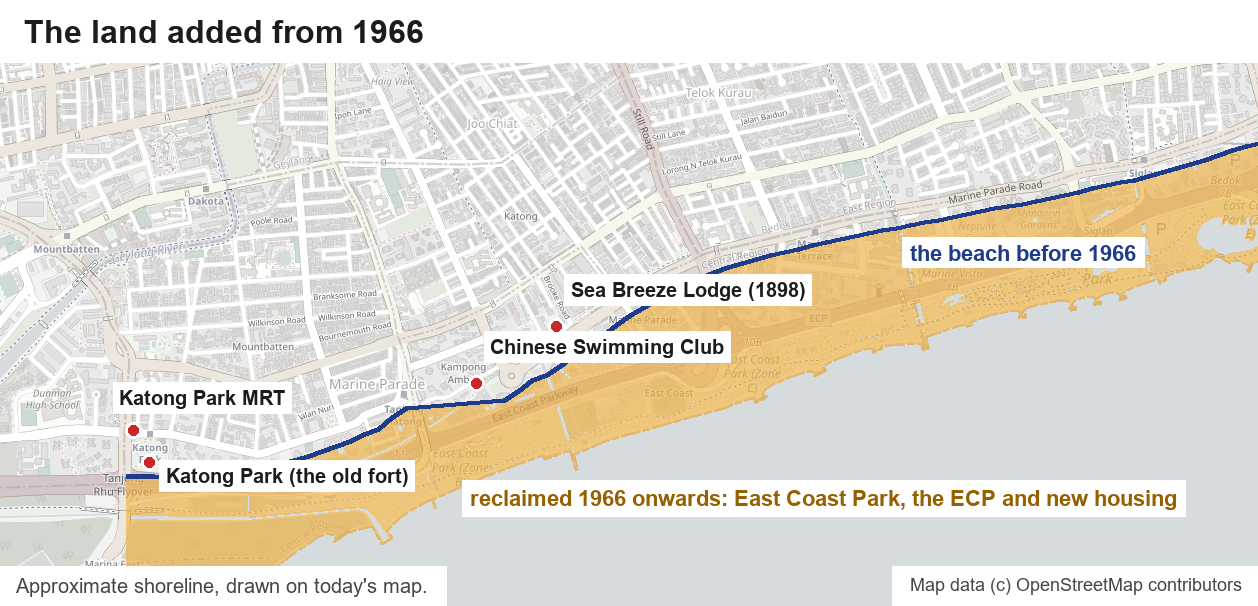
Where the beach used to be, shown on today’s map. Use the buttons to step through each stage. The old shoreline is approximate, drawn along the seaward side of the old seafront roads and checked against a 1942 map. (Map by Lesser Known Singapore; map data © OpenStreetMap contributors)
By 1985 the reclamation had added 1,525 hectares of land along the East Coast, at a cost of about $613 million. Katong Park, which had been laid out on the seafront in the 1930s over the remains of Fort Tanjong Katong, lost its sea frontage as soon as the work began, and the Chinese Swimming Club, whose pool had once jutted out into the sea, found itself inland. Sea Breeze Lodge was left facing a road instead of a beach.
The new land was used for East Coast Park, the East Coast Parkway and new housing. Marine Parade became the first housing estate in Singapore built entirely on reclaimed land. Its first flats were put to ballot in 1974, when a three-room flat cost $13,500, a four-room flat $20,500 and a five-room flat $35,500. By the late 1980s, with the beach, the park and the shops close by, it was one of the most sought-after estates, and a three-room flat that had cost $13,500 resold for about $50,000 in 1988 and more than $165,000 in 1996.
Tanjong Katong by the sea, 1840s-2024
From coconut estate to seaside resort to an inland suburb
Sources: C. B. Buckley (1902); W. Makepeace (1921); NLB Infopedia; BiblioAsia; press reports.
View as table
| Date | Event |
|---|---|
| 1840s | Thomas Dunman plants a coconut estate of some 400 acres at Tanjong Katong and builds three bungalows on the shore, the first seaside houses there for holidays and honeymoons. |
| 1868 | Six of the 14 holiday houses listed in the 1868 Directory are cottages at Dunman Ville, Tanjong Katong. |
| 1879 | Fort Tanjong Katong is completed on the beach to guard the eastern approach; it is abandoned by 1901. |
| 1898 | Choa Kim Keat's bungalow, Sea Breeze Lodge, is built about 5 m from the sea. |
| 1906 | The Sea View Hotel opens on 2 June 1906, in a converted bungalow owned by Manasseh Meyer. |
| 1921 | Around 1921 the Chinese Swimming Club moves to Amber Road, renting a seaside bungalow from Lee Choon Guan; Meyer Road and Amber Road are named the same year. |
| 1930s | Katong Park is laid out on the seafront over the buried fort in the 1930s. |
| 1964 | The Sea View Hotel closes; its 359,600 sq ft property is put up for sale in August 1964. |
| 1966 | The East Coast reclamation begins; earth from the hills of Siglap, Bedok and Tampines is carried to the sea. |
| 1974 | The first HDB flats in Marine Parade, an estate built entirely on reclaimed land, are put to ballot. |
| 1985 | By 1985 the reclamation has added 1,525 hectares along the East Coast, at a cost of about $613 million. |
| 2011 | The 47,400 sq ft site of Sea Breeze Lodge is sold for $103.8 million. |
| 2024 | Katong Park MRT station on the Thomson-East Coast Line opens on Meyer Road on 23 June 2024. |
Tanjong Katong today
 Exit 1 of Katong Park MRT station on Meyer Road, on its opening day in June 2024. (S5A-0043, CC BY 4.0, via Wikimedia Commons)
Meyer Road is now a street of condominiums, many of them built on the plots of the old seaside houses. The seafront is still part of their value: Meyer Park, built in 1984, was described as offering sea views from every unit, and in 2023 it was sold en bloc for $392.18 million. Crescent Flats and Meyer Flats were demolished in the early 1990s. Katong Park MRT station opened on 23 June 2024, with two exits on Meyer Road.
Sea Breeze Lodge is the last bungalow on Marine Parade Road that was built before the reclamation. Eric Choa, Choa Kim Keat’s grandson, turned down several offers to redevelop it so that he could live out his life there. After his death in 2009, the 47,400-square-foot site was put up for tender, and in June 2011 it was sold to a subsidiary of Far East Organization for $103.8 million, a price reported at the time as a new benchmark for land in the area. The bungalow itself, with a floor area of about 3,100 square feet, has been conserved by the Urban Redevelopment Authority as part of the Joo Chiat Secondary Settlement.

Sea Breeze Lodge in 2025, now beside a road and well inland. (Chainwit., CC BY 4.0, via Wikimedia Commons)
The East Coast may yet change again. The Urban Redevelopment Authority is studying “Long Island”, a plan to reclaim more than 800 hectares off East Coast Park to protect the low-lying coast from rising sea levels, create a new reservoir and provide land for future use. As of its update in March 2026 the design was still being worked out through technical studies, as described in the post on Singapore’s first land reclamations. Buyers of seafront homes in the 1950s had no way of knowing that their beach would be moved within a generation; buyers along the East Coast today can read about the plans in URA’s published updates and master plans before they decide.
See 11 more historical and present-day pictures of Tanjong Katong →
Why it matters today: Tanjong Katong shows how much of a property’s value can come from its setting, and how that setting can change. Dunman’s three bungalows, the Sea View Hotel and the swimming clubs were all built for the beach, and the land under them was divided and sold again and again because it faced the sea. The sea has moved several hundred metres away, but the old seafront roads are still lined with private homes and condominiums, and one 1898 bungalow on Marine Parade Road still marks where the beach used to be.
Sources
- Charles Burton Buckley, An Anecdotal History of Old Times in Singapore, vol. 1 (1902), via Internet Archive
- Walter Makepeace, Gilbert E. Brooke and Roland St. J. Braddell (eds.), One Hundred Years of Singapore, vol. 2 (1921), via Internet Archive
- Meyer Road, Singapore Infopedia (National Library Board)
- Marine Parade, Singapore Infopedia (National Library Board)
- Chinese Swimming Club, Singapore Infopedia (National Library Board)
- Tanjong Katong, Singapore Infopedia (National Library Board)
- Fort Road, Singapore Infopedia (National Library Board)
- Lim Tin Seng, Land From Sand: Singapore’s Reclamation Story, BiblioAsia (National Library Board), 2017
- “Sea View Hotel. Opening Day”, Straits Times, 5 June 1906, page 5, NewspaperSG
- The Sea View Hotel, Roots.gov.sg (National Heritage Board)
- Sea View Hotel (Singapore), Wikipedia
- Meyer Road, Wikipedia
- Sea Breeze Lodge, Wikipedia
- Katong, Wikipedia
- Update on the ‘Long Island’ project, Urban Redevelopment Authority, 30 March 2026
- Singapore map 1942, Wikimedia Commons
- OpenStreetMap (map data © OpenStreetMap contributors, ODbL)
- Wikimedia Commons: John Edmund Taylor, Singapore. From Tanjong Katong. (1879, Wellcome V0037488).jpg
- Wikimedia Commons: John Edmund Taylor, Under the Cocoa Nut Trees. The Bungalows. Tanjong Katong, Singapore. (1879, Wellcome V0037492).jpg
- Wikimedia Commons: (SGP-Singapore) Sea Breeze Lodge 2024-08-17.jpg
- Wikimedia Commons: Strand van Tanjong Katong te Singapore, KITLV 104808.tiff
- Wikimedia Commons: Sea View Hotel te Singapore, KITLV 104797.tiff
- Wikimedia Commons: Crescent flats Tanjong Katon, Singapore, KITLV 1404949.tiff
- Wikimedia Commons: Indians-MarineParade-Singapore-1950s.jpg
- Wikimedia Commons: (SGP-Singapore) Katong Park MRT Station Exit 1 2024-06-23.jpg
- Wikimedia Commons: Sea Breeze Lodge (Choa Family Bungalow) Marine Parade, Singapore (2025) - img 01.jpg
- Wikimedia Commons: John Edmund Taylor, The Point. Tanjong Katong. (1879, Wellcome V0037485).jpg
- Wikimedia Commons: John Edmund Taylor, Tanjong Katong, Looking towards Singapore (1879, Wellcome V0037481).jpg
- Wikimedia Commons: John Edmund Taylor, A Fort at Tanjong Katong, Singapore (1880, Wellcome V0037520).jpg
- Wikimedia Commons: Cocoanut plantation Tanjong Katong. Singapore., KITLV 1404873.tiff
- Wikimedia Commons: Photographic Views of Singapore Plate 20 Scenery at Tanjong Katong.jpg
- Wikimedia Commons: Tandjong Katong, Singapore, KITLV 1407451.tiff
- Wikimedia Commons: Tanjong Katong, Singapore, KITLV 1404753 (filed as “Tanjong W ton”)
- Wikimedia Commons: Tanjong Katong, Singapore, KITLV 1404950 (filed as “Tanjong Katon”)
- Wikimedia Commons: Sea View Hotel, Singapore, KITLV 1407450.tiff
- Wikimedia Commons: Remains of Fort Tanjong Katong, Katong Park, Singapore - 20060826.jpg
- Wikimedia Commons: Singapore - Marine Parade - east coast park IMG 9176.jpg


