Sir Manasseh Meyer: Singapore's Jewish Landlord and the Synagogues He Built
Sir Manasseh Meyer arrived in Singapore from Calcutta as a boy of 15 in 1861 and died at his house on Oxley Rise in 1930, reputed to be a millionaire in sterling several times over. In between he built a trading firm, became one of the largest property owners in the colony, and paid for both of the synagogues that Singapore’s Jewish community still uses today. His hotels, flats and shophouses have almost all gone, but the synagogues, a college building and a school still carry his name.

Chesed-El Synagogue on Oxley Rise, which Manasseh Meyer built in the grounds of his home in 1905. (Terence Ong, CC BY 2.5, via Wikimedia Commons)
From Baghdad to Singapore
 Manasseh Meyer, from a history of Singapore published in 1921. (Unknown photographer, public domain, via Wikimedia Commons)
Manasseh Meyer was born in Baghdad in 1846 and went to school in Calcutta, where many Baghdadi Jewish families had settled to trade. In 1861 he came to Singapore, where his uncle, Joshua Raphael Joshua, ran a firm called Joshua Brothers. He continued his education at St Joseph’s Institution, which at the time had a single class of 25 pupils. Three years later he went back to Calcutta to learn book-keeping and Hebrew in his maternal uncle’s business.
In 1867, at 21, he set up on his own in Rangoon, and he stayed there for six years. In 1873 he returned to Singapore and founded an import and export firm, Meyer Brothers. It grew into the largest local firm in the trade with India and, according to his obituary, one of the most profitable in the colony. It also dealt in opium, which was then a legal trade: the Straits Times recorded that before the import of opium became a government monopoly, his firm “handled large quantities of that commodity”.
A landlord in the making
Meyer began buying property in 1885, and his largest purchases came between 1890 and 1892. In 1890 he bought Killiney House on Oxley Rise, built in 1842 for the colonial surgeon Thomas Oxley, rebuilt it and renamed it Belle Vue. It became his family home for the rest of his life.

Raffles Place around 1890, when Meyer was buying property in the town centre. (Unknown photographer, KITLV, public domain, via Wikimedia Commons)
His holdings were spread across the town and beyond it. He owned much of the property around Raffles Place and Collyer Quay, and when he died a new Meyer Building was going up in Raffles Place. He built the Adelphi Hotel on Coleman Street and Meyer Mansions opposite St Andrew’s Cathedral. At Tanjong Katong he built the Sea View Hotel and, in 1909, Crescent Flats, which the Straits Times called the first block of flats in Singapore. Meyer Road in Katong was named after him in 1921, and the story of that seafront is told in the Tanjong Katong post.
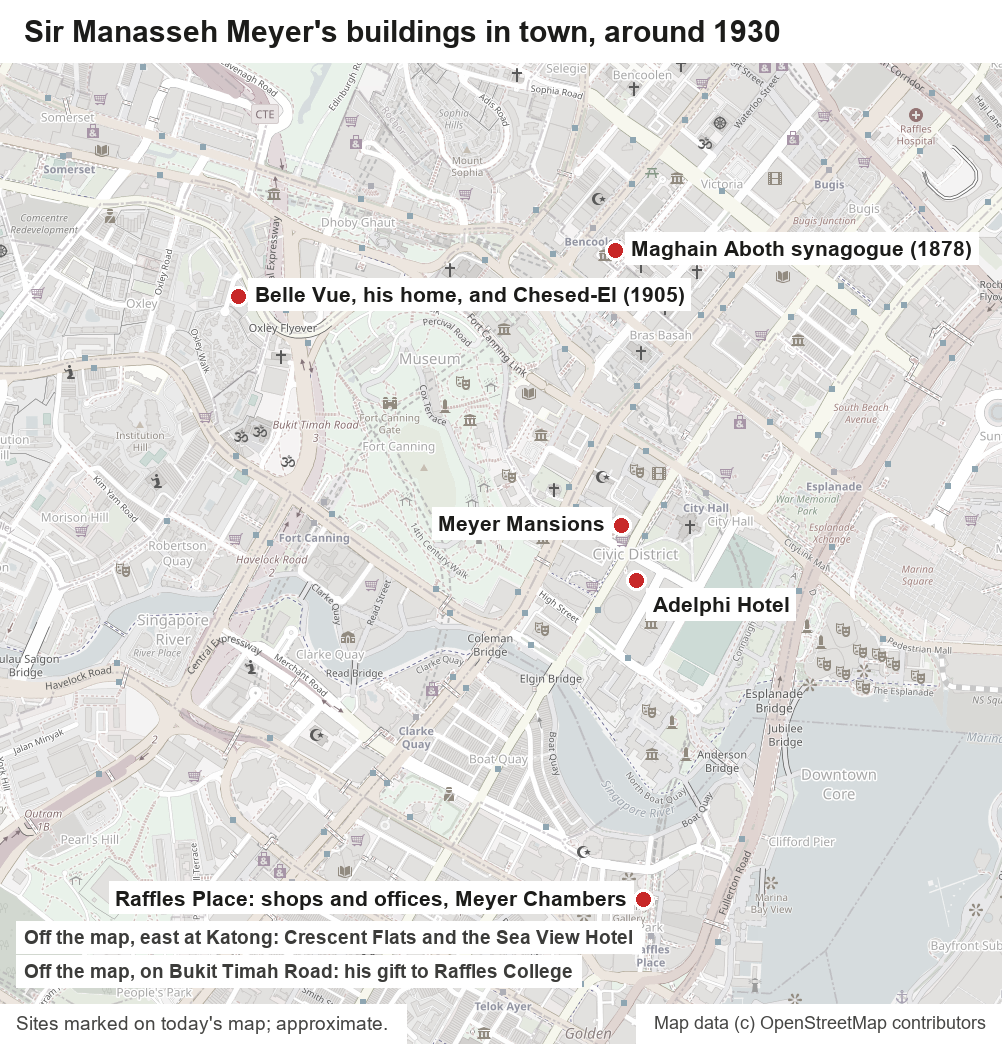
Where his main town properties stood around 1930, and what is on those sites today. Use the buttons to switch views. The markers are placed on today’s map and are approximate. (Map by Lesser Known Singapore; map data © OpenStreetMap contributors)
From 1893 to 1900 he sat on the Municipal Commission, the body that ran the town’s roads, water and sanitation, where his knowledge of property and local conditions was described as especially useful. In 1911 he led a successful protest against a Bill that would have abolished the Municipal Commissioners. He also served on the Straits Committee on Currency.

The Adelphi Hotel on Coleman Street, built by Meyer, in a photograph dated 1928. (Unknown photographer, KITLV, CC BY 4.0, via Wikimedia Commons)
Two synagogues
Singapore’s first synagogue was a small building on Synagogue Street, put up in the 1840s with room for 30 or 40 people. When Meyer came back in 1873 he found it run-down and the street around it overcrowded, so he asked the Attorney-General, Thomas Braddell, to let the community sell it and build elsewhere. The government agreed, and a new synagogue, Maghain Aboth (“Shield of Our Fathers”), opened on Waterloo Street on 4 April 1878. Meyer later paid for galleries so that women could attend the services.

Maghain Aboth Synagogue on Waterloo Street, opened in 1878, in 2023. (Chainwit., CC BY 4.0, via Wikimedia Commons)
By the early 1900s the community had more than doubled, to about 500 people, and Maghain Aboth was becoming crowded. Meyer was also troubled by frequent disagreements among members of different backgrounds over the order of services. In 1902 he decided to build a private synagogue of his own in the grounds of Belle Vue, and held services in a hired house in the meantime. Chesed-El, meaning “bountiful mercy and goodness of God”, was designed by R. A. J. Bidwell of the architects Swan & Maclaren and dedicated on 14 April 1905, with Meyer leading the service himself.
The building carries his initial: an “M” for Meyer appears in the mouldings and on the railings of the upper gallery, which is unusual for a synagogue. A chair with a small plaque bearing his name marks where he sat with his family. He paid poor men from the community to make up the minyan, the ten men needed for daily prayers, so that services could be held every day. He also kept his own Hebrew school on Bencoolen Street.

Inside Chesed-El Synagogue, with its gold-banded columns, in 2010. (Smuconlaw, CC BY-SA 3.0, via Wikimedia Commons)
Gifts and a knighthood
Meyer gave to causes inside and outside his community. His largest gift was $150,000 for a science block at the new Raffles College, which opened in 1928, and during the First World War he gave $20,000 for an aeroplane. On 2 November 1922 about 300 guests gathered at Belle Vue to hear Albert Einstein, who was on his way to Japan and had been asked to raise money for the new Hebrew University in Jerusalem; Meyer gave £500. He also promised an organ for a concert hall that the Philharmonic Society hoped to build, but the First World War intervened and the hall had still not been begun in 1921.
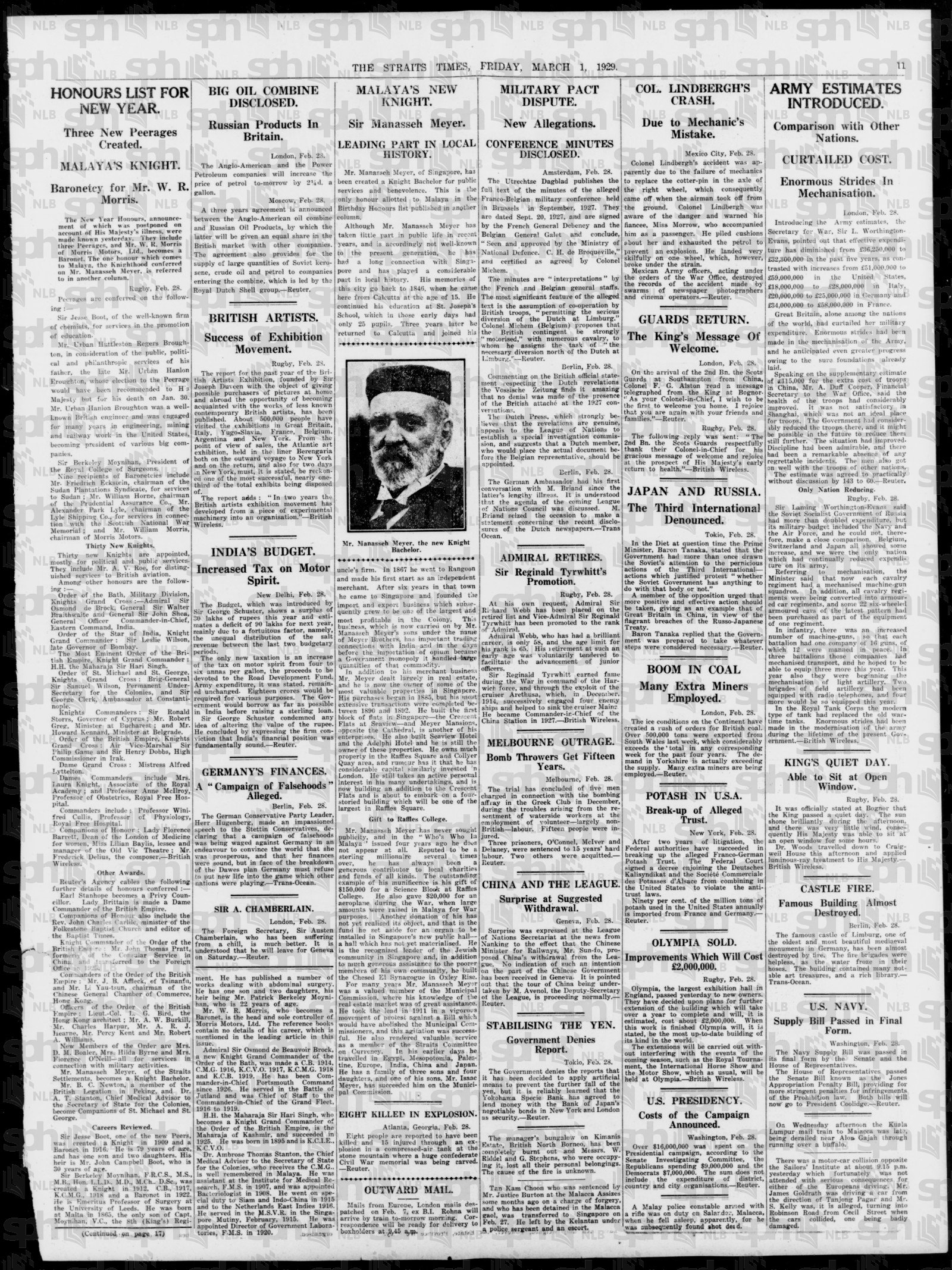 The Straits Times of 1 March 1929, page 11, with "Malaya's New Knight" in the third column. (Singapore Press Holdings, via NewspaperSG, National Library Board Singapore, public domain)
He avoided publicity, and he did not appear at all in the “Who’s Who in Malaya” of the mid-1920s. In March 1929 he was made a Knight Bachelor “for public services and benevolence”, the only honour given to Malaya in that year’s New Year list. By then, the Straits Times noted, he had taken little part in public life for some years and was not well known to the younger generation.
After Sir Manasseh
Sir Manasseh Meyer died at Belle Vue on 1 July 1930, aged 84, after an illness of ten days. After a short service at Chesed-El he was buried that morning at the Jewish cemetery on Thomson Road. He left three sons and four daughters. His will made his three sons, Isaac, Jacob and Reuben, his executors and trustees. It kept Chesed-El and the Hebrew school going with the rents of six houses in front of the school, and set aside houses in Cecil Street, Telok Ayer Street and Japan Street to fund charities in Jerusalem and for Jewish people in need.
During the Japanese Occupation no services were held at Chesed-El. The Japanese military used the building to store heavy goods and ammunition, and took out its wooden benches. Singapore’s Jewish community had grown to nearly 2,000 before the war, but about half left as the Japanese approached, and on 5 April 1943 more than 100 Jewish men were interned. Fewer than 700 Jewish people remained when the war ended.
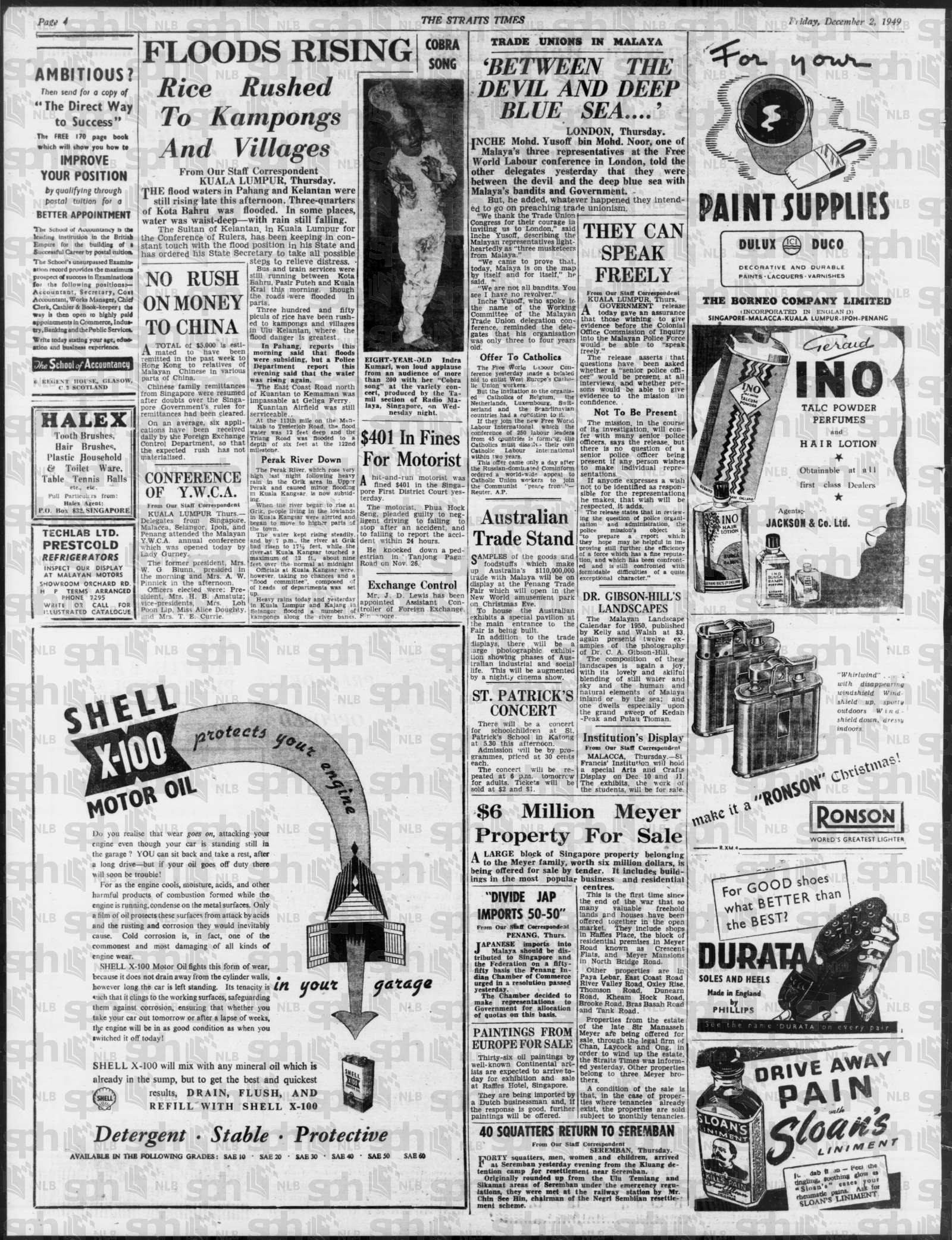
The Straits Times of 2 December 1949, page 4, which reported that the Meyer family’s property was being offered for sale. (Singapore Press Holdings, via NewspaperSG, National Library Board Singapore, public domain)
After the war the estate was wound up. In December 1947 the Straits Times reported that it would sell shops at Nos. 4 and 5 Raffles Place, Meyer Mansions on North Bridge Road and large plots of freehold land at Paya Lebar, East Coast Road, Thomson Road, Dunearn Road and Kheam Hock Road. In December 1949 a block of Meyer family property worth about six million dollars was offered for sale by tender, the first time since the war that so many valuable freehold lands and houses had been offered together. At an auction reported on 1 December 1950, land and houses worth more than $2 million, including Crescent Flats and Meyer Flats on Meyer Road, were withdrawn because the bids did not reach their reserve prices.
Belle Vue itself became the subject of a dispute. In 1956 the house was classified as an “ancient monument” under the colony’s draft Master Plan. The estate’s trustees objected that the label would cut its resale value, while a senior government architect argued that it was one of the few surviving examples of an 1840s planter’s home and should be kept. The house no longer stands. Meyer Mansions was demolished in 1970 to make way for Peninsula Plaza, the Adelphi Hotel closed in 1973 and was pulled down in 1980, and Crescent Flats and Meyer Flats were demolished in the early 1990s.
What lasted
The synagogues survived. Maghain Aboth was gazetted as a national monument on 27 February 1998 and Chesed-El on 18 December 1998, and both are still used for services. Beside Maghain Aboth, the Jacob Ballas Centre opened in 2007, and the Jews of Singapore Museum opened there in 2021.

The Manasseh Meyer Building at the former Raffles College, now the Bukit Timah campus of the National University of Singapore, in 2025. (GoAheadFan95, CC BY-SA 4.0, via Wikimedia Commons)
His gift to Raffles College is still visible on Bukit Timah Road. The Manasseh Meyer Building was one of six former Raffles College buildings gazetted together as a national monument on 11 November 2009, and it is now part of the National University of Singapore’s Bukit Timah campus. The trust he set up, now the Sir Manasseh Meyer Trust, still supports education and charity. In 1996 a small Jewish nursery opened at Oxley Rise; it grew into a school named after him and in 2016 moved to a campus in Sembawang as the Sir Manasseh Meyer International School. Singapore’s Jewish community, which was down to a few hundred people by the late 1960s, now numbers about 2,500, according to the Jewish Welfare Board.
Sir Manasseh Meyer and what he left, 1861-2016
A trader turned landlord, two synagogues, and the institutions that still carry his name
Sources: W. Makepeace (1921); Straits Times (1929, 1930, 1949); NLB Infopedia; Einstein Papers; Roots.gov.sg.
View as table
| Date | Event |
|---|---|
| 1861 | Manasseh Meyer, born in Baghdad in 1846 and schooled in Calcutta, first comes to Singapore in 1861 and studies at St Joseph's Institution. |
| 1873 | After six years trading in Rangoon, he returns and founds the import and export firm Meyer Brothers, which grows into the largest local firm in the India trade. |
| 1878 | The Maghain Aboth synagogue on Waterloo Street opens on 4 April 1878, after Meyer persuades the government to let the community sell its old Synagogue Street building. |
| 1890 | Five years after his first property purchase, he buys Killiney House at Oxley Rise, built in 1842 for the surgeon Thomas Oxley, and makes it his family home, Belle Vue. His largest purchases come in 1890-92. |
| 1905 | His private synagogue, Chesed-El, built at his own cost in the grounds of Belle Vue, is dedicated on 14 April 1905. |
| 1922 | On 2 November 1922 about 300 guests hear Albert Einstein speak at Belle Vue, at a reception for the Hebrew University in Jerusalem. |
| 1929 | He is made a Knight Bachelor for public services and benevolence, the only honour given to Malaya in that year's New Year list. |
| 1930 | He dies at his house in Oxley Rise on 1 July 1930. His will endows the synagogue and his Hebrew school with rents from six houses. |
| 1949 | The Meyer estate's properties, worth about six million dollars, are offered for sale to wind up the estate; auctions follow in 1950. |
| 1998 | Maghain Aboth (27 February) and Chesed-El (18 December) are gazetted as national monuments. |
| 2009 | The Manasseh Meyer Building, paid for by his $150,000 gift to Raffles College, is gazetted with five other former Raffles College buildings. |
| 2016 | The Jewish nursery started in 1996 becomes the Sir Manasseh Meyer International School and moves to a campus in Sembawang. |
See 12 more historical and present-day pictures related to Manasseh Meyer →
Why it matters today: Manasseh Meyer’s story shows how a trading fortune could be turned into land, and how land could be turned into things that last longer than any building. Almost everything he owned in town was sold or demolished within a few decades of his death, but the synagogues, the college building and the school he paid for or inspired are still in use, and the community he led is larger today than it was in his lifetime.
Sources
- Manasseh Meyer, Singapore Infopedia (National Library Board)
- Chesed-El Synagogue, Singapore Infopedia (National Library Board)
- Walter Makepeace, Gilbert E. Brooke and Roland St. J. Braddell (eds.), One Hundred Years of Singapore, vol. 2 (1921), via Internet Archive
- “Malaya’s New Knight”, Straits Times, 1 March 1929, page 11, NewspaperSG
- “Sir M. Meyer Dies at Age of 84”, Straits Times, 1 July 1930, page 13, NewspaperSG
- “Sir Manasseh Meyer: Will of Singapore Millionaire”, Straits Times, 23 September 1930, page 13, NewspaperSG
- “S’pore Millionaire’s Land to Be Sold”, Straits Times, 21 December 1947, page 3, NewspaperSG
- “$6 Million Meyer Property For Sale”, Straits Times, 2 December 1949, page 4, NewspaperSG
- “$2 Million Property Withdrawn”, Straits Times, 1 December 1950, page 7, NewspaperSG
- “This house with a past has an uncertain future”, Straits Times, 21 June 1956, page 9, NewspaperSG
- Sir Manasseh Meyer, Chesed-El Synagogue
- The Collected Papers of Albert Einstein, vol. 13, document 660 (Princeton University Press)
- Oriental, Utai, Mexican: The Story of the Singapore Jewish Community, BiblioAsia (National Library Board), 2013
- Jewish Community, Singapore Infopedia (National Library Board)
- Chesed-El Synagogue, Roots.gov.sg (National Heritage Board)
- Maghain Aboth Synagogue, Roots.gov.sg (National Heritage Board)
- Former Raffles College, Roots.gov.sg (National Heritage Board)
- Peninsula Plaza, Roots.gov.sg (National Heritage Board)
- Adelphi Hotel, Singapore, National Archives of Singapore
- Community in Singapore, World Jewish Congress
- Sir Manasseh Meyer International School, Wikipedia
- OpenStreetMap (map data © OpenStreetMap contributors, ODbL)
- Wikimedia Commons: Chesed-El Synagogue, Singapore - 20060529.jpg
- Wikimedia Commons: Manasseh Meyer.jpg
- Wikimedia Commons: KITLV - 103753 - Raffles Place, Singapore - circa 1890.tif
- Wikimedia Commons: Adelphi Hotel Singapore, KITLV 1404749.tiff
- Wikimedia Commons: Maghain Aboth Synagogue - Singapore (2023) img 01.jpg
- Wikimedia Commons: Interior of Chesed-El Synagogue, Singapore - 20100815-01.jpg
- Wikimedia Commons: Manasseh Meyer Building, National University of Singapore Bukit Timah Campus, October 2025.jpg
- Wikimedia Commons: Manasseh Meyer’s chair, Chesed-El Synagogue, Singapore - 20100815.jpg
- Wikimedia Commons: Memorial plaque to Menasseh Meyer, Chesed-El Synagogue, Singapore - 20100815.jpg
- Wikimedia Commons: Interior of Maghain Aboth Synagogue.jpg
- Wikimedia Commons: KITLV - 103746 - Lambert & Co. - Raffles Place in Singapore - circa 1885.tif
- Wikimedia Commons: Raffles Place c. 1920.jpg
- Wikimedia Commons: KITLV - 103744 - Collyer Quay in Singapore - circa 1890.tif
- Wikimedia Commons: Adelphi Hotel te Singapore, KITLV 34127.tiff
- Wikimedia Commons: Crescent flats Tanjong Katon, Singapore, KITLV 1404949.tiff
- Wikimedia Commons: Sea View Hotel te Singapore, KITLV 104797.tiff
- Wikimedia Commons: Albert Einstein photo 1921.jpg
- Wikimedia Commons: SMMIS outside.jpg


