Tani Yutaka, the “Tiger of Malaya”: The Man and the Wartime Legend
On 17 March 1942, a month after the fall of Singapore, a 30-year-old Japanese man died of malaria in a Singapore hospital. He had grown up in Kuala Terengganu, spoke Malay, had led a gang of robbers in the north of the peninsula, and had been recruited by Japanese military intelligence the year before the invasion. His name was Tani Yutaka. Within a year, newspapers in Japan had made him a hero, and a feature film called him Harimau Malai, the Tiger of Malaya. Much of what is told about him comes from those wartime accounts and from books written decades later, and the few records from his own time tell a plainer story.
 Tani Yutaka, seated, in a songkok, baju and sarong, in a photograph taken some time before 1942. (Unknown photographer, public domain, via Wikimedia Commons)
A barber’s son in Kuala Terengganu
According to Japanese accounts of his life, Tani Yutaka was born on 6 November 1911 near Fukuoka, the eldest son of a barber, Tani Urakichi. When he was about two, the family moved to Kuala Terengganu on the east coast of Malaya, where his father opened a barbershop. His father wanted him educated in Japan, so he was sent back to his grandparents for primary school, and in 1927, at 15, he returned to Terengganu. He grew up among Malay friends, and around 1930, by these accounts, he became a Muslim and took the name Mohammad Ali bin Abdullah. The photograph of him seated in a songkok, baju and sarong is the best known picture of him.
In 1931 he went back to Japan for his conscription examination. He was below the army’s minimum height and was not taken for active service, and he stayed on in Fukuoka working briefly for a footwear company and then at an ironworks. His father died in Malaya at the end of that year.
6 November 1933

Shophouses in Kampung Cina, the old Chinatown of Kuala Terengganu, in 2014. The Tani family’s barbershop was in the town. (Fikku fiq, CC BY-SA 4.0, via Wikimedia Commons)
On the morning of 6 November 1933, a killing in Kuala Terengganu changed the course of his life. The Malaya Tribune reported it three days later under the headline “Little Girl’s Head Chopped Off”. At about 7 o’clock that morning, it said, a Chinese man “armed with a large parang” entered the house of a Japanese man named Yamada and struck him on the head, “badly wounding the man”. He then went into another Japanese house and, finding no one there, into the next one, “occupied by a Japanese barber named Tani and his family”. There he killed an eight-year-old girl. A crowd had gathered at the first victim’s cries, and after a chase the man was “overpowered and taken into custody”. The paper reported that he was believed to be sane, but that no motive “has as yet been disclosed”. The crime took place near the Customs Office.
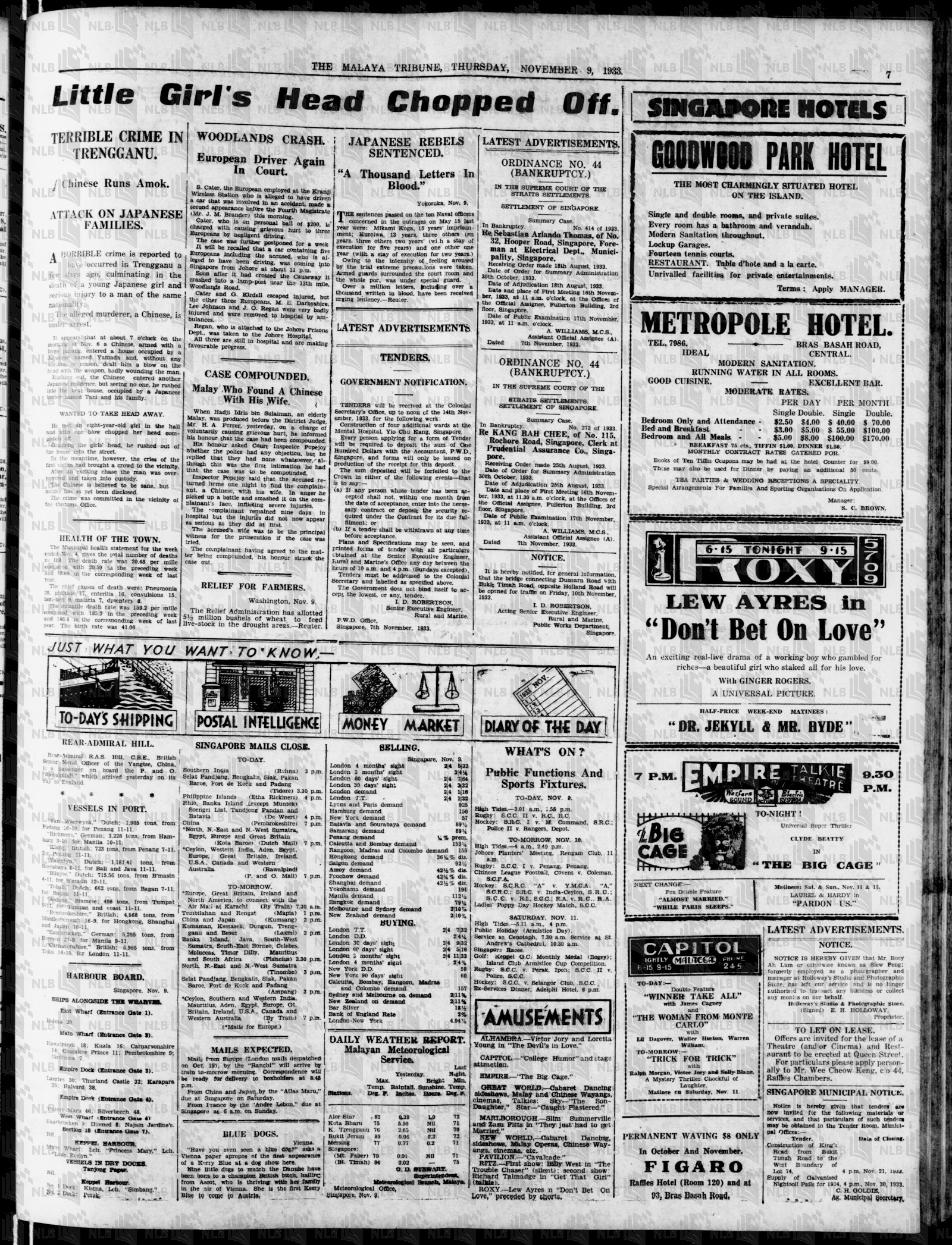 Page 7 of the Malaya Tribune, 9 November 1933. The report of the killing in the Tani house runs down the first column under the headline "Little Girl's Head Chopped Off". (Singapore Press Holdings, via NewspaperSG, National Library Board Singapore, public domain)
Japanese accounts name the girl as Shizuko, Tani’s youngest half-sister, who was in bed with a fever upstairs when the attacker came in. They describe the attack as anger over Japan’s seizure of Manchuria two years earlier, and the common version holds that the killer was never caught, though the Malaya Tribune reported his arrest on the day. Tani himself was in Japan at the time. In June 1934 the rest of the family left Terengganu for Japan, and later that year, according to these accounts, he went back to Malaya alone.
Harimau
What he did over the next six years is known almost entirely from Japanese books and from the recollections of the men who later worked with him. By these accounts, he gathered a band of Malay friends who robbed mainly Chinese merchants and moved about the peninsula and southern Thailand, and he spoke Malay and Thai so well that people took him for a Malay. He was eventually arrested in Hat Yai, in southern Thailand, and was in prison there when Japanese military intelligence came looking for him.
 Kamoto Toshio in F Kikan uniform, photographed in March 1942, just after the fall of Singapore. (Unknown author, public domain, via Wikimedia Commons)
Japan’s army was preparing for a war in Southeast Asia and wanted agents who knew Malaya. According to Japanese accounts, in early 1941 an agent named Kamoto Toshio, a former police officer in Manchukuo working for the army under cover of a trading company, paid Tani’s bail and persuaded him to work for the Japanese army. Tani brought his old gang back together. The same accounts credit them with surveying the British defensive line being built at Jitra, in northern Kedah, and with damaging materials and equipment at the site. Japanese troops broke through the Jitra line on 12 December 1941, four days after the invasion began.

Royal Engineers prepare to blow up a bridge in Malaya during the British retreat, December 1941. (Fred Palmer, Imperial War Museum, public domain, via Wikimedia Commons)
During the campaign he worked with the F Kikan, the intelligence unit led by Major Fujiwara Iwaichi. One of his tasks, according to these accounts, was to remove the demolition charges that retreating British troops had placed on bridges, and the bridges were often blown before he could reach them.
Death in Singapore
Somewhere on the way south he caught malaria. Japanese accounts say he refused the quinine the army had captured from the British, saying a true Malay would not take a white man’s medicine, and that he grew so ill he had to be carried on a stretcher. On 1 February he was admitted to a field hospital in Johor Bahru. After Singapore fell on 15 February, Fujiwara ordered him moved to a hospital in Singapore, where he died on 17 March 1942, at the age of 30.
His men are said to have taken his body and buried it with Muslim rites, and where he was buried is not known. Because he had been working for the army, he was recorded as having died in the war, and he was enshrined at the Yasukuni Shrine in Tokyo despite being a Muslim. A memorial stone bearing his name and dates stands in the Japanese Cemetery Park in Hougang.
The Tiger of Malaya
After his death, the Japanese press at home made him a hero. Newspapers and the weekly Shukan Asahi described him as a man who gave money, food and other necessities to poor local people. In June 1943 the film studio Daiei released Marai no Tora (The Tiger of Malaya), with Nakata Koji in the lead. The film was set in Kota Bharu, and a Singapore blog that tracks old film locations has identified scenes shot in Singapore and Malacca, including the old Orchard Road Police Station standing in for the police station of Kota Bharu.
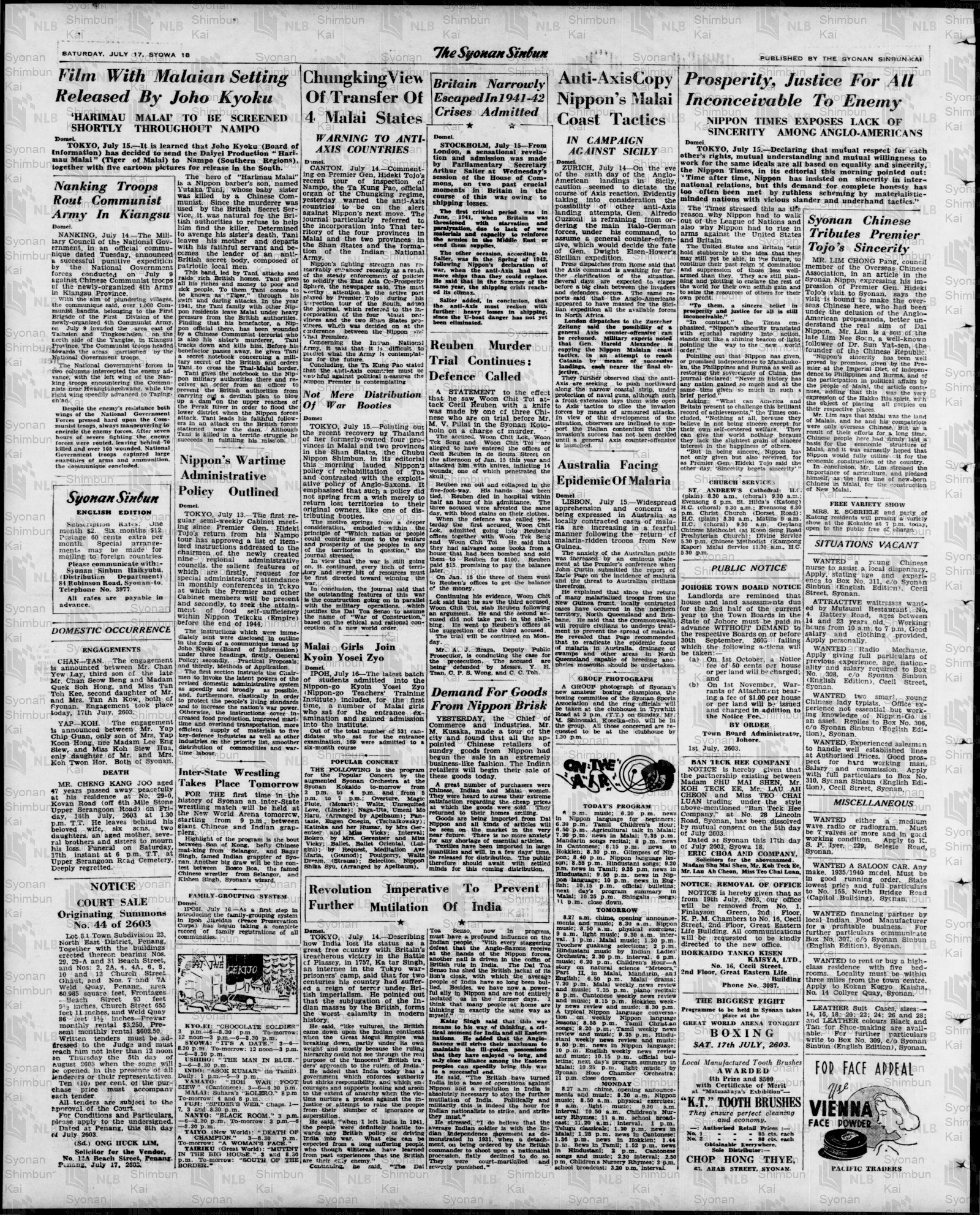 Page 2 of the Syonan Shimbun, 17 July 1943. The report at top left, "Film With Malaian Setting Released By Joho Kyoku", summarises the plot of Marai no Tora. (Singapore Press Holdings, via NewspaperSG, National Library Board Singapore, public domain)
On 17 July 1943 the Syonan Shimbun reported that the Board of Information in Tokyo had decided to send “Harimau Malai” to the occupied south, and it printed a summary of the plot. In the film’s story, Tani’s “baby sister was killed by a Chinese Communist”, and “since the murderer was used by the British Secret Service, it was natural for the British authorities to refuse to help him find the killer”. Tani becomes “the leader of an anti-British secret body”, raids “rich British homes” and gives “all his riches and money to poor and sick people”, who come to call him “Tiger”. He tracks down and kills his sister’s murderer, and he dies “in a terrific struggle” stopping the British from blowing up a dam on the Perak River. Set beside the 1933 newspaper report, in which the attacker was arrested on the spot and no motive was disclosed, and beside his death from malaria in hospital, the film’s version shows how far the story had been reshaped in ten years.
The nickname has caused its own confusion. General Yamashita Tomoyuki, who commanded the Japanese invasion of Malaya, was also called the Tiger of Malaya, and the name is better known today as his.
After the war the legend took new forms in Japan. Kaiketsu Harimao, a television drama loosely modelled on Tani, ran on Nippon Television in 1960 and 1961 and was the first Japanese drama filmed in colour, with a hero who fought Western colonial rulers in Southeast Asia. In 1989 the director Wada Ben made the film Harimao, which portrayed him as a tragic young man used by army intelligence. In Singapore, Teater Ekamatra staged Tiger of Malaya at the Drama Centre Black Box in September 2018, in English, Malay, Japanese and Mandarin. In it, a group of actors re-enact scenes from the 1943 film and try to place themselves among its heroes, villains and victims.
Tani Yutaka and the Harimau legend
From the killing in Kuala Terengganu to the wartime film
Sources: Malaya Tribune, 9 Nov 1933; Syonan Shimbun, 17 Jul 1943 (NewspaperSG); Japanese accounts of his life.
View as table
| Date | Event |
|---|---|
| Nov 1933 | On 6 November a man with a parang kills an eight-year-old girl in the house of a Japanese barber named Tani in Kuala Terengganu, and is arrested after a chase. |
| 1934 | According to Japanese accounts, the family leaves for Japan in June 1934 and Tani goes back to Malaya alone later that year. |
| Early 1941 | According to Japanese accounts, the agent Kamoto Toshio pays his bail in Thailand and persuades him to work for the Japanese army. |
| Dec 1941 | Japanese forces land in northern Malaya and southern Thailand on 8 December 1941. |
| Mar 1942 | He dies in a Singapore hospital on 17 March 1942, aged 30, a month after the fall of Singapore. |
| Jun 1943 | Daiei releases Marai no Tora (The Tiger of Malaya) in Japan on 24 June; in July the Syonan Shimbun reports that it will be shown across the occupied south. |
See 13 more photographs related to this post →

Graves in the Japanese Cemetery Park off Chuan Hoe Avenue, where a memorial stone to Tani Yutaka stands. (ProjectManhattan, CC BY-SA 3.0, via Wikimedia Commons)
Why it matters today: Tani Yutaka is remembered in Singapore mainly through a memorial stone in the Japanese Cemetery Park, but his story shows how quickly a life can be turned into propaganda. The few records from his own time, a 1933 newspaper report and the date of his death, sit uneasily beside the hero that wartime newspapers and a feature film made of him, and many of the details told about him today still come from accounts written long after the fact. Reading the story against the newspapers of the day is one way to separate what can be checked from what was added later.
Sources
- Malaya Tribune, 9 November 1933, “Little Girl’s Head Chopped Off: Terrible Crime in Trengganu”, page 7, NewspaperSG
- The Syonan Shimbun, 17 July 1943, “Film With Malaian Setting Released By Joho Kyoku”, page 2, NewspaperSG
- Ryoko Nakano, “Nostalgic Asianism in Postwar Japan: The TV Drama Kaiketsu Harimau”, electronic journal of contemporary japanese studies, vol. 14, issue 1 (2014)
- Wikipedia (Japanese): 谷豊 (Tani Yutaka)
- Wikipedia: Tani Yutaka
- Wikipedia: Marai no Tora
- sgfilmhunter: posts tagged Tani Yutaka (Marai no Tora filming locations)
- Bakchormeeboy: Preview, Tiger of Malaya by Teater Ekamatra (2018)
- Wikipedia: Japanese Cemetery Park
- Wikimedia Commons: Tani Yutaka seated, in Malay dress.webp
- Wikimedia Commons: KT Chinatown 3.jpg
- Wikimedia Commons: Toshio Kamoto.jpg
- Wikimedia Commons: Royal Engineers prepare to blow up a bridge in Malaya.jpg
- Wikimedia Commons: Japanese Cemetery Park 1.jpg
- Wikimedia Commons: Fujiwara Iwaichi.jpg
- Wikimedia Commons: Tomoyuki yamashita malaya.png
- Wikimedia Commons: Japanese bicycle troops crossing a river., Malayan campaign, 1942.jpg
- Wikimedia Commons: Destroyed bridge and temporary bridge in Labis, January 22 1942.jpg
- Wikimedia Commons: Japanese soldiers crossing a river on a temporary bridge., Malayan campaign, 1942.jpg
- Wikimedia Commons: Kota Bahru - Kelantan 1941.jpg
- Wikimedia Commons: Japanese troops at Johore.jpg
- Wikimedia Commons: Pacific War - Malaya 1941-42 - Map.jpg
- Wikimedia Commons: Japanese nationals arriving at custom barriers while leaving Singapore, 1942 (23918242273).jpg
- Wikimedia Commons: KT Chinatown 1.jpg
- Wikimedia Commons: Kampung Cina Kuala Terengganu.jpg
- Wikimedia Commons: Japanese Cemetery Park.jpg
- Wikimedia Commons: Prayer hall, Japanese Cemetery Park, Singapore - 20070526.jpg


