1903: The Straits Dollar, Singapore's First Money of Its Own
On the afternoon of 29 January 1906, the Legislative Council of the Straits Settlements fixed the value of the dollar at two shillings and fourpence in British money. The next morning’s Straits Times led its fifth page with the news, under the headline “Government tries to buy £100,000 at Saturday’s Rate and then lowers the Dollar”, and a reader wrote in that “a most painful sensation has been caused in Singapore”. What the day settled lasted far longer than the row. For the first time, Singapore had a dollar of its own whose value did not rise and fall with the price of silver, backed by reserves under a currency board, and that idea of a fully backed currency still underpins the Singapore dollar today.

A Straits Settlements dollar of 1903, the first year of the new coin. (Windrain, CC0, via Wikimedia Commons)
A silver dollar in a gold world
For most of the nineteenth century Singapore had no money of its own. Trade ran on silver dollars from elsewhere, first Spanish and then Mexican, as told in the posts on the Spanish dollar and on the 1867 transfer to Crown rule. After 1867 the Straits recognised several foreign silver dollars as legal tender, and from 1895 Britain struck a trade dollar of its own for the region. Banks issued their own notes, which had to be redeemed in silver.
A silver dollar was worth whatever its silver would fetch. Britain, Singapore’s main trading partner, was on the gold standard, and through the late nineteenth century the price of silver against gold fell steeply. According to One Hundred Years of Singapore (1921), the dollar was worth about four shillings and sixpence around 1870. By 1893 it averaged about two shillings and sevenpence, having dropped nearly tenpence in three years, and in 1902 it sank to about one shilling and sixpence. For anyone in Singapore paid in dollars but owing money in sterling, such as a European clerk sending money home, or a company paying for goods from Britain, the value of the dollar was a constant uncertainty.
What a dollar was worth in British money
Value of one silver dollar in Singapore, in British pence (12 pence to the shilling)
Source: W. Makepeace et al., One Hundred Years of Singapore (1921), vol. 2. Figures rounded; the scanned text garbles fractions.
View as table
| Row | Value | Detail |
|---|---|---|
| About 1870 | about 54d (4s 6d) | Around 1870 a dollar was worth about four shillings and sixpence |
| About 1890 | about 41d | Around 1890, nearly 10 pence more than the 1893 average |
| 1893 | about 31d (2s 7d) | The 1893 average, the year the first calls for a fixed value were made |
| 1896 | about 26d (2s 2d) | The 1896 average |
| 1902, at its lowest | about 18d (1s 6d) | In 1902 the dollar fell to about one shilling and sixpence |
| Fixed, 29 Jan 1906 | 28d (2s 4d) | Fixed at two shillings and fourpence on 29 January 1906 |
Two sides of the argument
The Singapore Chamber of Commerce, led mainly by European firms, pressed for a dollar with a fixed value in gold. In 1897 one of its committees recommended fixing it at two shillings. The proposal stalled, and nothing was done until 1902, when the dollar fell again and the Chamber asked the government to look at the question afresh.
Not everyone agreed. According to Song Ong Siang’s One Hundred Years’ History of the Chinese in Singapore (1923), when a committee of experts sat in London at the end of 1902 to consider the Straits currency, Chinese and other Asian merchants sent it a counter-petition. They argued that “on the whole cheap dollars have contributed largely to stimulate the development of the resources of these Settlements”, and would go on doing so as long as China, the region’s great trading partner, used silver. The merchant Tan Keong Saik had made the case against a fixed rate in an article in 1897. Many traders who had signed the petition for a gold currency had since changed their minds and asked to join the counter-petition.
 Sir Frank Swettenham, Governor of the Straits Settlements when the new dollar arrived, painted by John Singer Sargent in 1904. (John Singer Sargent, public domain, via Wikimedia Commons)
A currency of its own
The groundwork had already been laid. In 1897 the Straits Settlements set up a Board of Commissioners of Currency with the sole right to issue notes, and from 1899 it began issuing government currency notes, while the banks’ right to issue their own notes was wound down. The London committee, known after its chairman, Sir David Barbour, reported in 1903. It recommended a new Straits dollar of the same weight and fineness as the British trade dollar, the withdrawal of the Mexican and British dollars once enough new coins were in circulation, and, later, a fixed value against the pound.
On 29 May 1903 the Colonial Secretary moved the adoption of the committee’s recommendations in the Legislative Council. Tan Jiak Kim, who sat on the Council, said that since the Chinese counter-petition had been considered in London, the Chinese would now accept its conclusions and do all they could to support the scheme. In October 1903 the new Straits dollars, minted in India, began to arrive. Within a month, according to Song, counterfeits were already circulating. By November 1904 the recoinage was complete, and some 35 million new dollars had reached the colony. The British, Hong Kong and Mexican dollars had stopped being legal tender two months earlier.

A British trade dollar of 1895. The new Straits dollar was struck to the same weight and fineness. (As6022014, public domain, via Wikimedia Commons)
The fixed rate
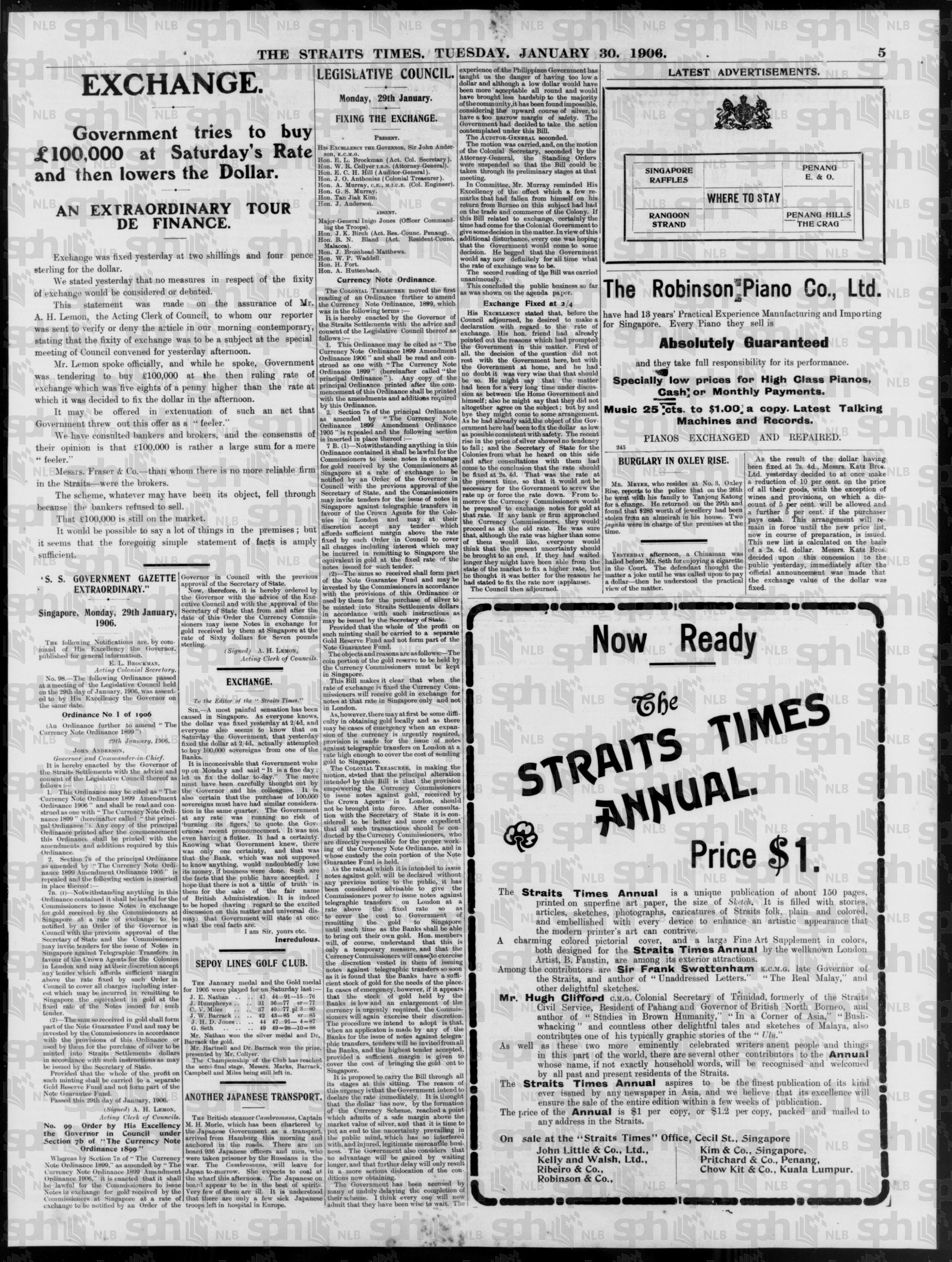 Page 5 of The Straits Times, 30 January 1906. The report at top left describes the fixing of the dollar the day before. (Singapore Press Holdings, via NewspaperSG, National Library Board Singapore, public domain)
With the new coin in place, the government waited for the right moment to fix its value. That came on 29 January 1906, under Governor Sir John Anderson, when the dollar was fixed at two shillings and fourpence. The Straits Times reported the next day that, on the very afternoon the rate was being decided, the government had tried to buy £100,000 in sterling at the market rate, which was five-eighths of a penny higher than the rate it then fixed. The banks refused to sell, and the paper called the episode “an extraordinary tour de finance”.
The system worked through the Currency Commissioners. From 1906 they issued dollar notes in Singapore in exchange for gold at a rate of $60 for £7, and later in the year they were also allowed to pay out gold in exchange for notes, so that the dollar could be turned into sterling, and back, at the fixed rate. The notes were backed by reserves of silver, gold and investments held largely in London. By 1921, according to One Hundred Years of Singapore, the law required the reserve behind the notes to be held one-sixth in silver, one-third in gold and half in securities.
 Sir John Anderson, Governor of the Straits Settlements from 1904 to 1911, under whom the dollar was fixed. (G. R. Lambert, public domain, via Wikimedia Commons)
The troubles were not quite over. In 1906 the price of silver rose so high that the silver in a Straits dollar was worth more than its fixed value, and the coins risked being melted down. The government responded by striking a smaller dollar, with the same fineness but less silver, from 1907. At the end of 1907 there was a run on the Currency Commissioners, and their gold reserve in Singapore was quickly used up. The rate itself was also debated for years. Some argued that two shillings and fourpence was too high and hurt exporters of Straits produce, while others credited the fixed rate with bringing in capital and, because the dollar was worth more, attracting the labour the region needed.

The smaller Straits dollar of 1907, struck with less silver after the price of silver rose. (Windrain, CC0, via Wikimedia Commons)
From the Straits dollar to the Singapore dollar
 A Straits Settlements one-dollar note of 1935, issued by the Board of Commissioners of Currency. (Bradbury, Wilkinson and Co., public domain, via Wikimedia Commons)
The Straits dollar lasted until the first Malayan dollar coins appeared in 1939, issued by a currency board that now covered the Malay states as well. After separation from Malaysia, Singapore set up its own Board of Commissioners of Currency on 12 June 1967, chaired by the Minister for Finance, Lim Kim San, as told in his post. The new board kept the old principle. According to the Ministry of Finance, the currency in circulation was fully backed by gold and foreign assets, and when convertibility on demand was ended in 1982, that full backing was kept as a requirement of the Currency Act.
What lasted
On 1 October 2002 the Board of Commissioners of Currency merged into the Monetary Authority of Singapore, which became the issuer of the country’s notes and coins. The Currency Act was retained, and with it the rule that the currency in circulation must be fully backed by gold and foreign assets at all times. Since 1967, Singapore’s notes have also been exchangeable at par with those of Brunei, an arrangement that continues today.
The details have changed many times since 1906, and the dollar no longer has a fixed value against the pound or any other single currency. But the basic promise of the currency board, that every dollar issued is matched by reserves held behind it, is the one Singapore still keeps.
See 11 more historical photos related to this post →
Why it matters today: The Straits dollar is remembered mostly by coin collectors, yet the arguments of 1897 to 1906 over silver, gold and what backs a currency produced the system whose central rule, full backing, still stands behind the money in every Singaporean’s pocket.
Sources
- Walter Makepeace, Gilbert E. Brooke and Roland St J. Braddell (eds), One Hundred Years of Singapore, vol. 2 (1921), Internet Archive
- Song Ong Siang, One Hundred Years’ History of the Chinese in Singapore (1923; annotated edition 2020)
- History of Singapore currency, Singapore Infopedia, National Library Board
- Merger of the Board of Commissioners of Currency, Singapore (BCCS) with the Monetary Authority of Singapore (MAS), Ministry of Finance
- Straits dollar, Wikipedia
- The Straits Times, 30 January 1906, page 5, NewspaperSG
- File:1dollar_of_Straits_Settlements,_Edward_VII-_1903_B.png, Wikimedia Commons
- File:Sir_Frank_Swettenham_by_John_Singer_Sargent_1904.jpg, Wikimedia Commons
- File:Great_Britain_Trade_Dollar_1895.jpg, Wikimedia Commons
- File:Sir_John_Anderson_(cropped).gif, Wikimedia Commons
- File:1dollar_of_Straits_Settlements-_Edward_VII_1907.png, Wikimedia Commons
- File:Straits_Settlements_-1935-$1_banknote(obverse).jpg, Wikimedia Commons
- File:Straits_settlements-1Dollar-1903.jpg, Wikimedia Commons (gallery)
- File:Straits_Settlements,One_Dollar,_Edward_VII,_1904,-_reverse.jpg, Wikimedia Commons (gallery)
- File:Edward_VII_sovereign_MET_DP100405.jpg, Wikimedia Commons (gallery)
- File:1888_México_8_Reals_Trade_Coin_Silver.jpg, Wikimedia Commons (gallery)
- File:Straits_Setlements_-1911-_$50_banknote.jpg, Wikimedia Commons (gallery)
- File:Straits_Settlements_-1927-_$10_banknote.jpg, Wikimedia Commons (gallery)
- File:Collyer_Quay,_Singapore_1900s.jpg, Wikimedia Commons (gallery)
- File:KITLV_-50198-Lambert&Co.,_G.R.-Singapore-Building_of_the_Hong_Kong_and_Shanghai_Bank_in_Singapore-_circa_1900.tif, Wikimedia Commons (gallery)
- File:KITLV_-1404900-Johnston’s_Pier_and_H._M._Bank._Singapore-_1895-1906.tif, Wikimedia Commons (gallery)
- File:Photographic_Views_of_Singapore_Plate_03_Raffles’_Square.jpg, Wikimedia Commons (gallery)
- File:Sir_john_anderson.gif, Wikimedia Commons (gallery)


