More Historical Photos: The Straits Dollar
← Back to “1903: The Straits Dollar, Singapore's First Money of Its Own”
More images of the coins and notes of the Straits dollar, the money it replaced, and the waterfront of banks where the business of exchange was done.
The 1903 dollar, another example

Another Straits Settlements dollar of 1903. (As6022014, public domain, via Wikimedia Commons)
The design in close-up

The reverse of a Straits dollar of 1904, with its value in English, Chinese and Jawi. (5snake5, CC0, via Wikimedia Commons)
The gold sovereign

A gold sovereign of Edward VII, 1902. From 1906, $60 in Straits notes could be exchanged for seven of these. (George William de Saulles and Benedetto Pistrucci, Metropolitan Museum of Art, CC0, via Wikimedia Commons)
The Mexican dollar it replaced

A Mexican silver dollar of 1888, stamped with Chinese merchants’ chop marks. Mexican dollars stopped being legal tender in the Straits in 1904. (Centpacrr, CC BY-SA 3.0, via Wikimedia Commons)
A fifty-dollar note

A fifty-dollar note of the Government of the Straits Settlements, printed by De La Rue. (De La Rue, public domain, via Wikimedia Commons)
A ten-dollar note, 1927
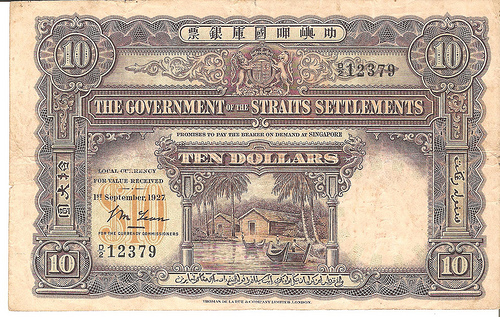
A Straits Settlements ten-dollar note of 1927. (De La Rue, public domain, via Wikimedia Commons)
Governor Anderson

Sir John Anderson, Governor of the Straits Settlements from 1904 to 1911, under whom the dollar was fixed in 1906. (G. R. Lambert, public domain, via Wikimedia Commons)
Commercial Square, 1904

Commercial Square and Collyer Quay on a postcard of about 1904, with the banks and merchant houses where exchange was traded. (Unknown photographer, public domain, via Wikimedia Commons)
The Hongkong and Shanghai Bank

The Hongkong and Shanghai Bank in Singapore around 1900, one of the banks whose own notes gave way to government currency notes. (G. R. Lambert and Co., KITLV, public domain, via Wikimedia Commons)
Johnston’s Pier and the bank

Johnston’s Pier and, behind it, the bank the postcard calls the “H. M. Bank”, between 1895 and 1906. (G. R. Lambert and Co., KITLV, public domain, via Wikimedia Commons)
Raffles Square

Raffles Square, the commercial heart of the town, in a G. R. Lambert view from before 1900. (G. R. Lambert and Co., public domain, via Wikimedia Commons)
← Back to “1903: The Straits Dollar, Singapore's First Money of Its Own”