The Progressive Party: The Colonial-Era Party That Won Singapore's First Elections, Then Vanished
When the results of Singapore’s 1955 election were announced, the Progressive Party had won 4 of the 25 seats. It had won the two elections before that, in 1948 and 1951, and it went into 1955 as the colony’s leading party. Its president, C. C. Tan, lost his own contest, in Cairnhill, to David Marshall, whose Labour Front formed the new government. Ten months later the Progressives voted to dissolve their party, and at the 1959 election the party they had merged into won no seats at all. Their story is as much about who was allowed to vote, and how the votes were divided, as about the party itself.

Victoria Memorial Hall, where the results of the 1951 election were declared, photographed in 1971. (Wilford Peloquin, CC BY 2.0, via Wikimedia Commons)
A party of lawyers, 1947
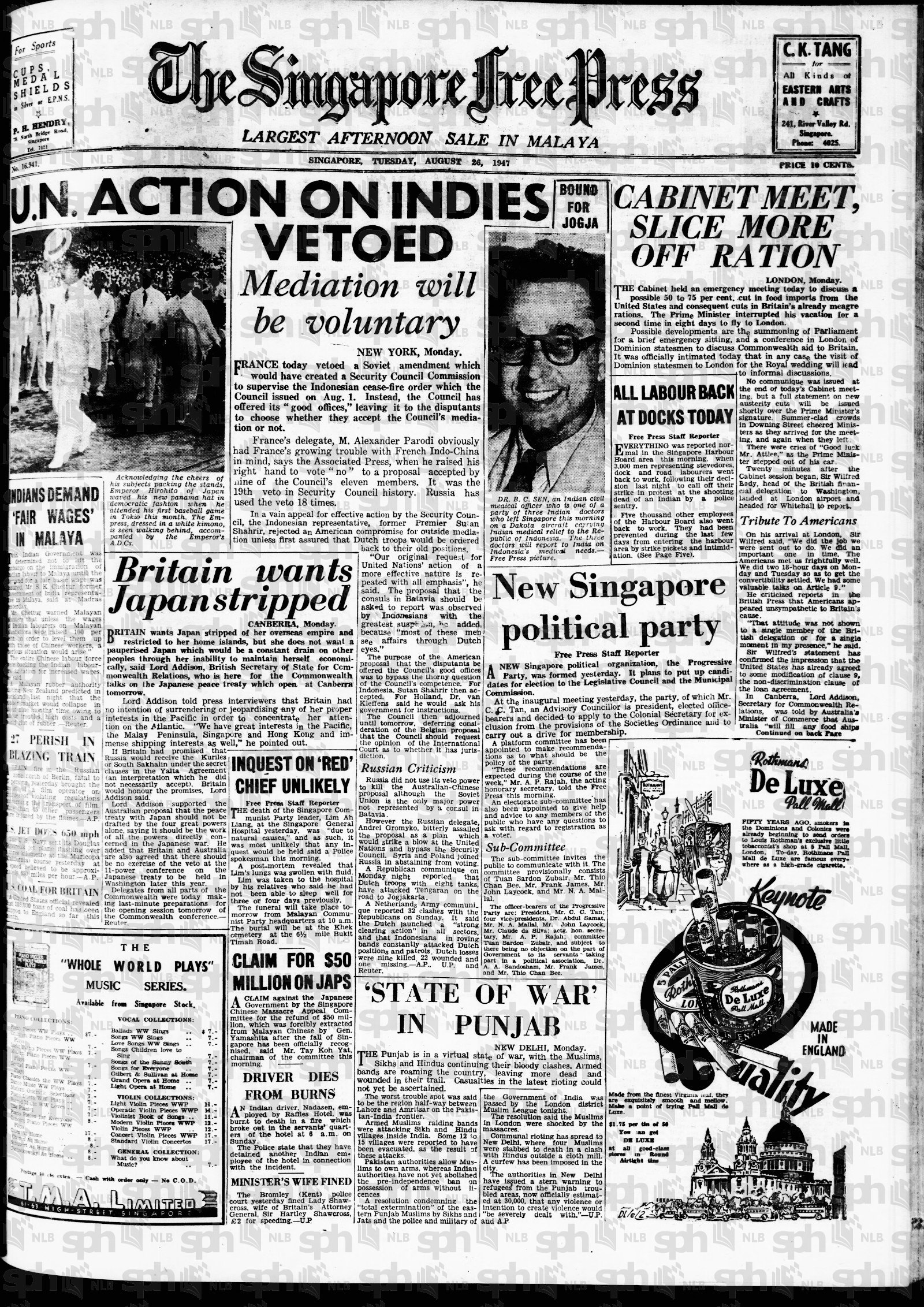 Front page of The Singapore Free Press, 26 August 1947, reporting the new party under "New Singapore political party." (Singapore Press Holdings, via NewspaperSG, National Library Board Singapore, public domain)
The Singapore Progressive Party was formed on 25 August 1947 by three lawyers, C. C. Tan, John Laycock and N. A. Mallal. The Singapore Free Press reported the next morning that the new party intended to put up candidates for the Legislative Council and the Municipal Commission. Tan, a member of the governor’s Advisory Council, was elected president, with Dr Abdul Samat, Mallal, Laycock and Claude da Silva as vice-presidents and A. P. Rajah as acting secretary. The party also set up an electorate sub-committee to help members of the public who wanted to register as voters.
Its programme was gradual. The Progressives were willing to work with the British administration towards steady constitutional reform, enlarging the number of elected members over time and eventually forming a cabinet of ministers. Their leaders and much of their support came from English-educated professionals, and the party was backed by groups such as the Straits Chinese British Association.
Winning a small electorate, 1948 and 1951
 C. C. Tan, the party's president, speaking on the night the 1951 results were declared. (Ministry of Information and the Arts Collection, courtesy of National Archives of Singapore, public domain, via Wikimedia Commons)
The electorate the Progressives first faced was very small. In the 1948 election, six of the Legislative Council’s 22 seats were elected, voting was open only to British subjects who had chosen to register, and 22,334 people were on the roll in a city of more than 940,000. The Progressive Party won three of the six seats and C. C. Tan topped the poll. The other three went to independents.
At the next election, on 10 April 1951, nine of the council’s 25 seats were elected. The Straits Times reported that about 51 per cent of the 48,155 registered voters went to the polls. Six Progressives were elected: C. C. Tan for Tanglin, John Laycock for Katong, Thio Chan Bee for Balestier, C. J. Paglar for Changi, N. A. Mallal for City and H. J. C. Kulasingha for Bukit Timah. The Labour Party won two seats, one of them Keppel, where Lim Yew Hock defeated the Progressive vice-president A. P. Rajah, and Vilasini Menon won Seletar as an independent to become the first woman elected to the council.
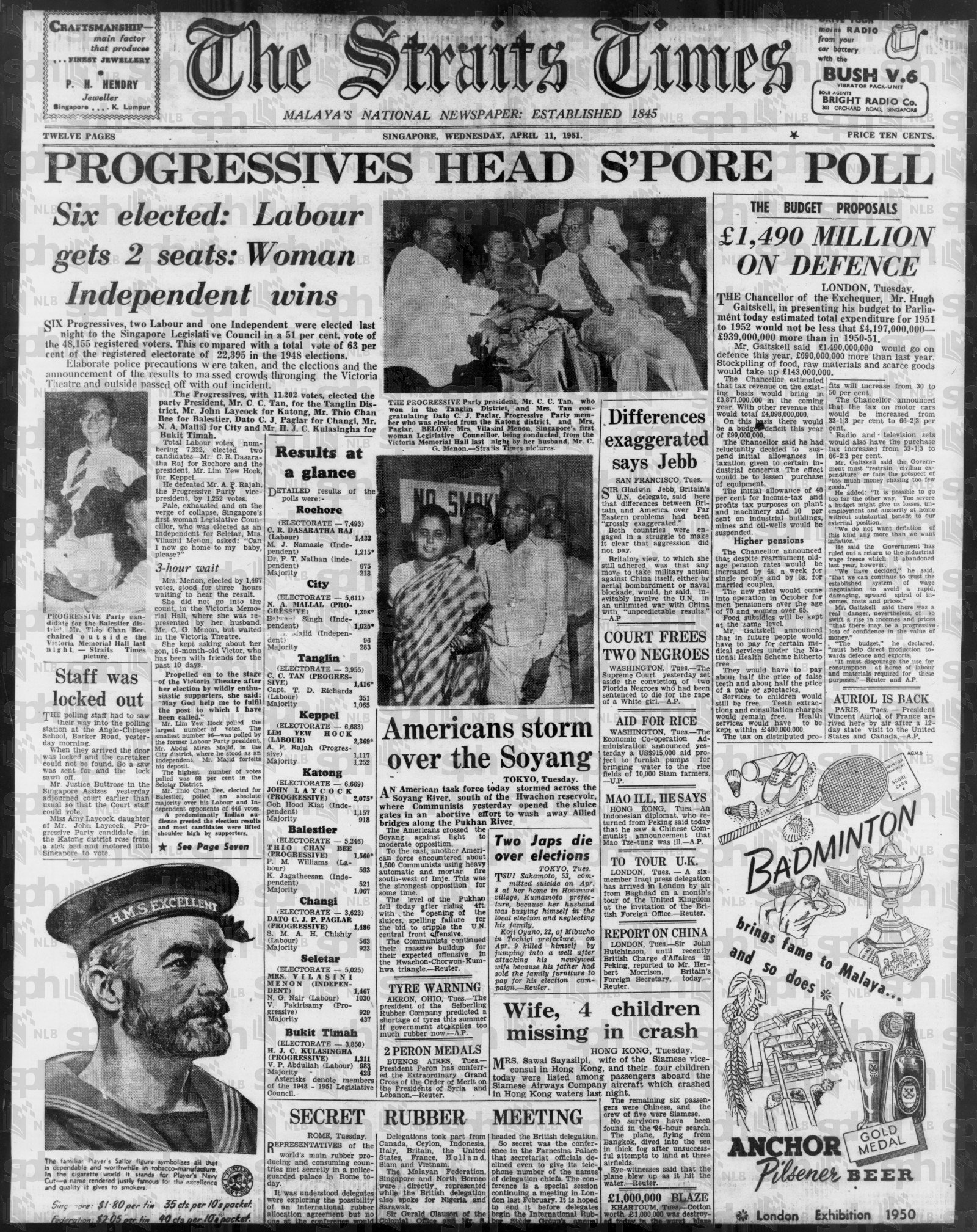 Front page of The Straits Times, 11 April 1951: "Progressives head S'pore poll." (Singapore Press Holdings, via NewspaperSG, National Library Board Singapore, public domain)
The Progressives now held most of the council’s elected seats. The National Library Board credits the party with a role in initiating the bill that set up the Central Provident Fund, which began operating in 1955. The party’s limits were the limits of the system it worked within. Most of the council’s members were still officials or appointed by the governor, and the electorate that had chosen the Progressives was a small fraction of the population.
1955: a bigger electorate and a split vote
The Rendel constitution changed both of those things. For the 1955 election, 25 of the 32 seats in a new Legislative Assembly were elected, and voters were registered automatically instead of having to apply. The roll grew to about 300,000, roughly six times the 1951 figure. Before then, only British subjects who applied could vote, and in 1948 Thio Chan Bee had warned that about 100,000 Straits-born Chinese who were entitled to register had not done so. Automatic registration put people like them on the roll. Several new parties formed to contest the election, including the Labour Front, the People’s Action Party and the Democratic Party.
 John Laycock, one of the party's three founders, on the night of the 1951 results. (Ministry of Information and the Arts, courtesy of National Archives of Singapore, public domain, via Wikimedia Commons)
The Progressive Party’s vote did not shrink in number, even as its share fell. Its 22 candidates won 38,695 votes, more than its candidates had won in 1948 and 1951 combined. The Labour Front, with 42,300 votes, won 10 seats. The Progressives, with 24.8 per cent of the vote, won 4. The Democratic Party won 2, the People’s Action Party 3, the alliance of UMNO, the MCA and the Malay Union 3, and independents 3. In Cairnhill, C. C. Tan polled 2,530 votes against David Marshall’s 3,305.
The Straits Times examined the result the next morning in an editorial headed “Looking For A Party.” It noted that on the afternoon of polling day both the Labour Front and the People’s Action Party had appeared reconciled to a Progressive-Democratic victory, and it pointed out that the combined vote of the Labour Front, the People’s Action Party and the Alliance was some two thousand fewer than the combined Progressive and Democratic vote, yet those three had won sixteen seats against the Progressives’ and Democrats’ six. In fifteen of the twenty-one contests with three or more candidates, the winner had polled less than half the votes. In four of them, Cairnhill, Katong, Whampoa and Rochore, the paper judged that the Progressives and Democrats had divided votes that would have won the seat for one of them.
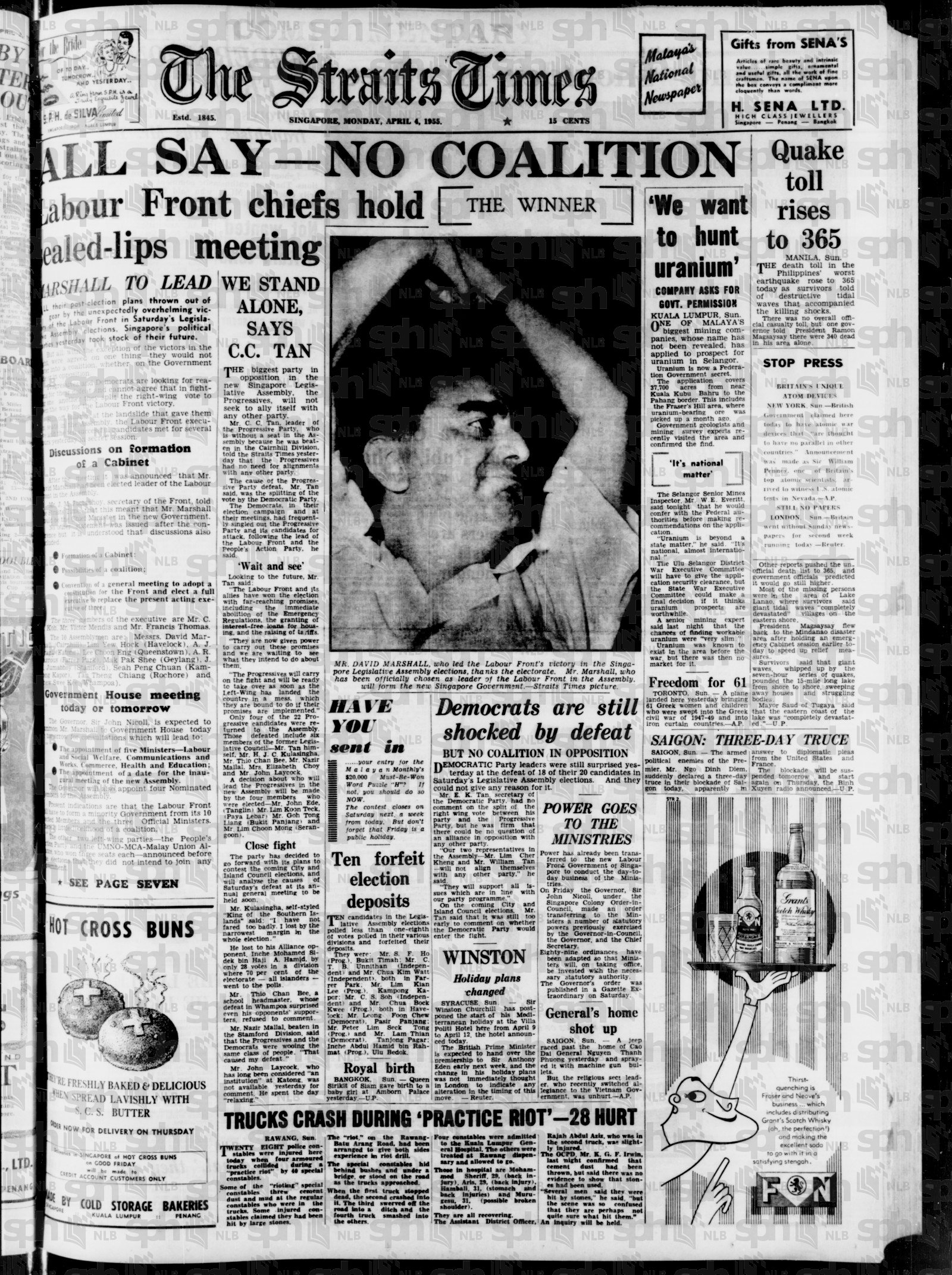 Front page of The Straits Times, 4 April 1955. Its lead story carries C. C. Tan's response as leader of the largest opposition party: "We stand alone." (Singapore Press Holdings, via NewspaperSG, National Library Board Singapore, public domain)
The arithmetic was only part of it. Most of the newly registered voters had never been asked to choose between the parties before, and the Labour Front and the People’s Action Party campaigned for faster progress towards self-government than the Progressives’ gradual programme offered. The National Library Board’s account puts it as the Progressives being displaced by parties able to appeal to a wider spectrum of people. As the largest party in opposition, the Progressives said they would not enter any coalition.
Merging, then fading, 1956 to 1959
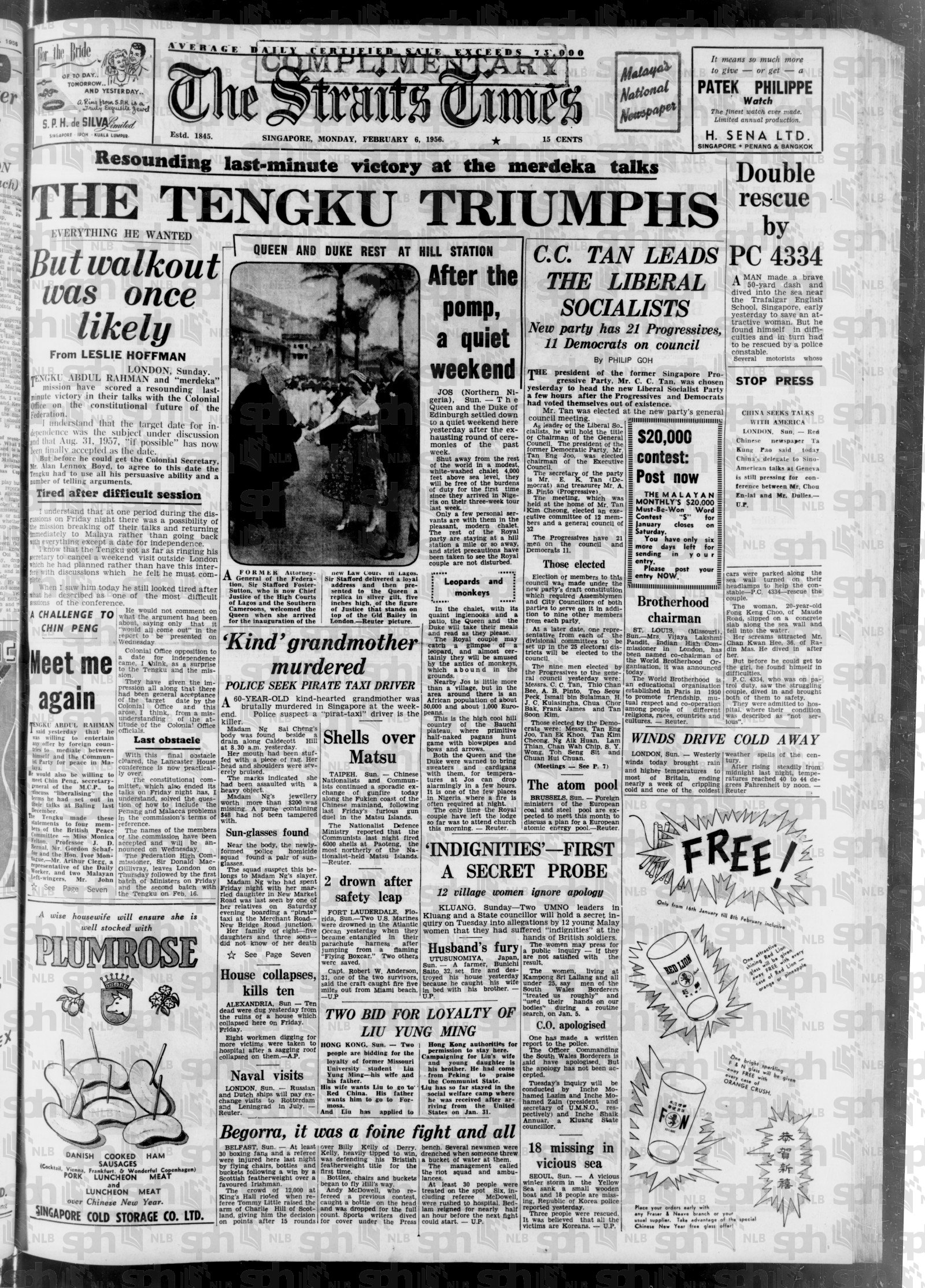 Front page of The Straits Times, 6 February 1956: "C. C. Tan leads the Liberal Socialists." (Singapore Press Holdings, via NewspaperSG, National Library Board Singapore, public domain)
The two parties that had divided the vote in 1955 joined together. On 5 February 1956 the Progressive Party and the Democratic Party voted themselves out of existence, and a few hours later the members chose C. C. Tan to lead the new Liberal Socialist Party. Tan Eng Joo, the former Democratic president, became chairman of its executive council, and its general council of 32 had 21 former Progressives and 11 former Democrats.
The electorate changed again before the next test. For the general election of 30 May 1959, all 51 seats were elected, the roll had almost doubled again to more than 580,000, and voting was compulsory for the first time. The Liberal Socialist Party put up 32 candidates and received about 8 per cent of the vote. It won no seats, and twenty of its candidates lost their deposits. The People’s Action Party won 43 of the 51 seats and formed the first government of a self-governing Singapore.
The vote and the seats
The chart sets the party’s share of the vote against its share of the elected seats at each of the four elections. In 1948 and 1951 its seats ran level with or ahead of its votes. From 1955 the seats fell faster than the votes.
The Progressive Party's share of the vote and of the elected seats
Each election, 1948–1959; the 1959 figures are for the Liberal Socialist Party it merged into
Sources: The Straits Times, 11 April 1951 (1951); Elections Department Singapore constituency results (1955, 1959); the election records cited below the post (1948).
View as table
| Election | Votes | Share of vote | Seats won | Share of elected seats |
|---|---|---|---|---|
| 1948 | 11,754 | 49.5% | 3 of 6 | 50% |
| 1951 | 11,202 | 45.4% | 6 of 9 | 67% |
| 1955 | 38,695 | 24.8% | 4 of 25 | 16% |
| 1959 (Liberal Socialist Party) | 42,805 | 8.2% | 0 of 51 | 0% |
What changed
Part of what shaped the Progressives’ story has changed for good. Voters have been registered automatically since 1955, and voting has been compulsory since 1959, so the kind of small, self-selected electorate that returned the Progressives in 1948 and 1951 no longer exists. Another part is still in place: single-member constituencies are decided by whoever polls the most votes, whether or not that is a majority. Under that rule, as the Straits Times worked out in 1955, two parties drawing on the same voters can each do well and still lose to a third.
See more photos related to this post →
Where it fits in the bigger story: Singapore’s political history is usually told from 1959. The Progressive Party is easy to leave out because it did not last, but it was the party that won Singapore’s first two elections, and its rise and fall track the widening of the vote from a few tens of thousands of registered British subjects to more than half a million citizens obliged to vote.
Sources
- “Singapore Progressive Party is formed,” National Library Board Singapore
- Progressive Party (Singapore), Wikipedia
- 1948 Singaporean general election, Wikipedia
- 1951 Singaporean general election, Wikipedia
- 1955 Singaporean general election, Wikipedia
- 1959 Singaporean general election, Wikipedia
- 1955 Legislative Assembly General Election Results, Elections Department Singapore
- 1959 Legislative Assembly General Election Results, Elections Department Singapore
- “New Singapore political party,” The Singapore Free Press, 26 August 1947, page 1, NewspaperSG
- “Progressives head S’pore poll,” The Straits Times, 11 April 1951, page 1, NewspaperSG
- “All say: no coalition,” The Straits Times, 4 April 1955, page 1, NewspaperSG
- “Looking for a party” (editorial), The Straits Times, 4 April 1955, page 6, NewspaperSG
- “Parties to merge on Sunday,” The Straits Times, 1 February 1956, page 5, NewspaperSG
- “C. C. Tan leads the Liberal Socialists,” The Straits Times, 6 February 1956, page 1, NewspaperSG
- File:172a Victoria Hall Singapore (51253058494).jpg, Wikimedia Commons
- File:Tan Chye Cheng.png, Wikimedia Commons
- File:John Laycock at the Legislative Election, 1951.jpg, Wikimedia Commons
- “63 per cent voters go to poll: Boycotters defeated,” The Sunday Times, 21 March 1948, page 1, NewspaperSG (gallery)
- “Labour wins,” The Sunday Times, 3 April 1955, page 1, NewspaperSG (gallery)
- File:John Laycock.png, Wikimedia Commons (gallery)
- File:John Laycock, 1951.jpg, Wikimedia Commons (gallery)
- File:Thio Chan Bee.jpg, Wikimedia Commons (gallery)
- File:Lim Yew Hock, 1951.jpg, Wikimedia Commons (gallery)
- File:Vilasini Menon.jpg, Wikimedia Commons (gallery)
- File:Singaporean election 1951 map.png, Wikimedia Commons (gallery)
- File:Map of the results of the 1955 Singaporean general election.svg, Wikimedia Commons (gallery)
- File:PP Logo.svg, Wikimedia Commons (gallery)
- File:LSP Logo.svg, Wikimedia Commons (gallery)
- File:Collectie Familie Khouw, KITLV D14089.tiff, Wikimedia Commons (gallery)


