Singapore's First Election, 1948: 22,000 Voters in a City of 940,000
On 20 March 1948 Singapore held its first election. Six seats on a Legislative Council of twenty-two were open to the vote, and 22,334 people were registered to cast one, in a colony of about 940,000. The Sunday Times the next morning reported that 63 per cent of them had gone to the polls. Eleven years later, at the 1959 election, 586,098 people were registered and voting was compulsory.

The Victoria Theatre and Memorial Hall, where the votes of Singapore’s first election were counted on the night of 20 March 1948. (Photo: Kelly & Walsh Ltd., KITLV/Leiden University Library, CC BY 4.0, via Wikimedia Commons)
The council they were electing
After the Japanese occupation the Straits Settlements were broken up, and in 1946 Singapore became a Crown colony of its own. Its new Legislative Council had 22 members. Thirteen were officials, three were nominated by the chambers of commerce, and six were to be elected, two each from two municipal constituencies and one each from two rural ones. On the morning of the vote the Straits Times described it as “the Colony’s first election of representatives to the Government and the first step in the promised progress towards ultimate self-government.”
Who could vote
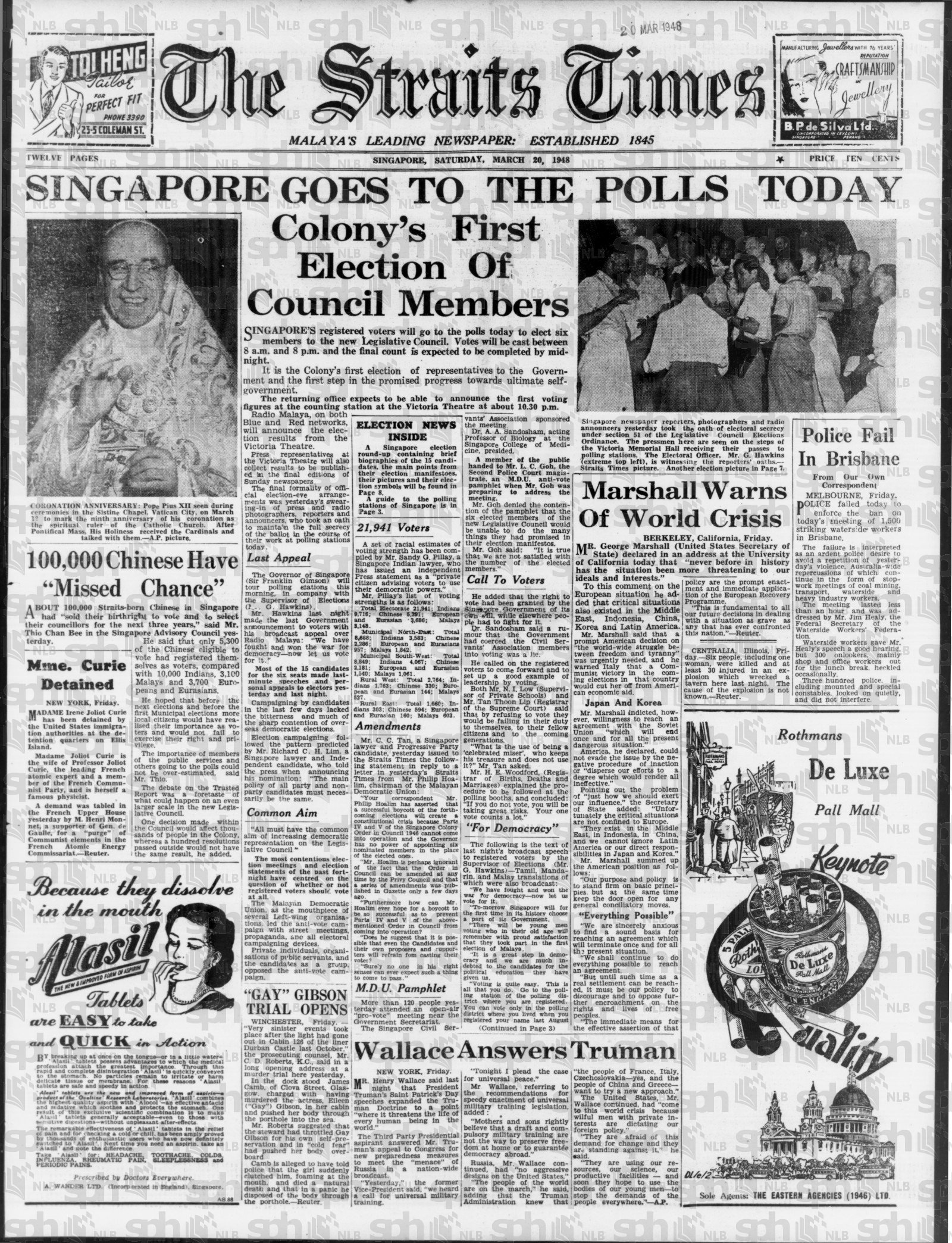 Front page of The Straits Times, 20 March 1948, the morning of the election. (Singapore Press Holdings, via NewspaperSG, National Library Board Singapore, public domain)
The vote was open to British subjects aged 21 or over who had lived in Singapore for at least a year and who had registered. Registration was voluntary, and many people who were eligible did not register. The same front page carried a warning from Thio Chan Bee, a member of the Singapore Advisory Council, that about 100,000 Straits-born Chinese, who as British subjects were entitled to vote, had “missed chance.” He said that only about 5,300 of the Chinese eligible had registered, compared with about 10,000 Indians, 3,100 Malays and 3,700 Europeans and Eurasians. Many other residents, including most of those born in China, were not British subjects and could not vote at all.
The Malayan Democratic Union and several other left-wing organisations campaigned against the election, arguing that six elected seats on a council of 22 fell far short of representative government. Candidates for the Progressive Party replied that the election was a step towards more. On the eve of the vote, the Supervisor of Elections, G. Hawkins, broadcast an appeal to registered voters in English, Tamil, Mandarin and Malay.
The result
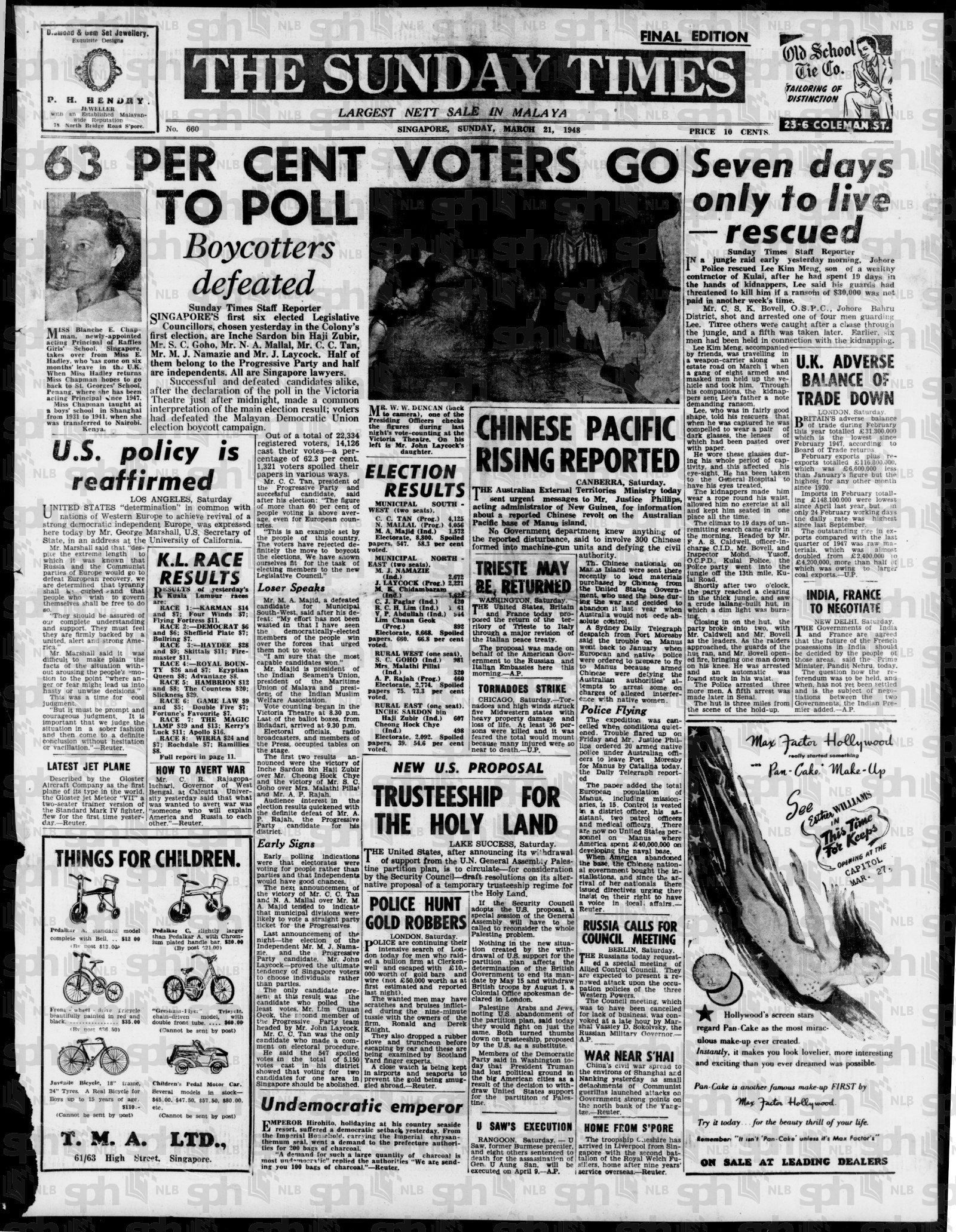 Front page of The Sunday Times, 21 March 1948, with the results by constituency. (Singapore Press Holdings, via NewspaperSG, National Library Board Singapore, public domain)
Fifteen candidates stood. The Sunday Times of 21 March reported that of the 22,334 registered voters, 14,126 had cast their votes, 62.3 per cent, and 1,321 papers had been spoiled. The six elected members were Sardon bin Haji Zubir, S. C. Goho, N. A. Mallal, C. C. Tan, M. J. Namazie and J. Laycock. Three belonged to the Progressive Party and three were independents, and all six were lawyers. C. C. Tan, the Progressive Party’s president, topped the poll with 4,125 votes in Municipal South-West, and the paper headlined its report “Boycotters defeated.”
How the vote grew
The electorate stayed small for several years. At the next election, on 10 April 1951, nine of the council’s 25 seats were elected and 48,155 people were registered. The large change came in 1955, under the Rendel constitution, when 25 of the 32 seats in a new Legislative Assembly were elected and the number of registered voters rose above 300,000, more than six times the 1951 figure. That election made David Marshall Singapore’s first Chief Minister. At the 1959 election, the first under full internal self-government, all 51 seats were elected, 586,098 people were registered, and voting was compulsory for the first time.
Registered voters at Singapore’s first four elections
Linear scale; the label beside each bar gives how many seats were elected
Sources: The Sunday Times, 21 March 1948 (1948); the election records cited below the post (1951–1959).
View as table
| Election | Registered voters | Seats |
|---|---|---|
| 1948 | 22,334 | 6 of 22 seats elected |
| 1951 | 48,155 | 9 of 25 seats elected |
| 1955 | 300,199 | 25 of 32 seats elected |
| 1959 | 586,098 | all 51 seats elected |
See more photos related to this post →
Where it fits in the bigger story: Singapore’s political history is usually told from 1959, when the whole Assembly was elected. The first election, eleven years earlier, was held for a handful of seats by a few thousand British subjects who had chosen to register, while most of the colony’s residents could not vote or did not. The growth from 22,334 voters in 1948 to 586,098 in 1959 is the part of the story that is easy to miss, and it happened in little more than a decade.
Sources
- 1948 Singaporean general election, Wikipedia
- 1951 Singaporean general election, Wikipedia
- 1955 Singaporean general election, Wikipedia
- 1959 Singaporean general election, Wikipedia
- “Singapore goes to the polls today,” “100,000 Chinese have ‘missed chance’” and “21,941 voters,” The Straits Times, 20 March 1948, page 1, NewspaperSG
- “63 per cent voters go to poll: Boycotters defeated” and “Election results,” The Sunday Times, 21 March 1948, page 1, NewspaperSG
- File:KITLV A887 - Victoria Theatre en Memorial Hall te Singapore, KITLV 107516.tiff, Wikimedia Commons
- File:Victoria Theatre and Victoria Memorial Hall - c 1930.jpg, Wikimedia Commons (gallery)
- File:Tan Chye Cheng.png, Wikimedia Commons (gallery)
- File:David Marshall, 1956 (cropped).png, Wikimedia Commons (gallery)
- File:Sir Franklin Gimson in 1951.png, Wikimedia Commons (gallery)
- File:1948 Singapore General Elections Result Map.svg, Wikimedia Commons (gallery)
- File:Gravestone of John Laycock, Bidadari Garden, Singapore - 20121008.jpg, Wikimedia Commons (gallery)


