The Run on the Banks, 1914: When War in Europe Emptied a Singapore Bank
On Tuesday 4 August 1914, the day before news of war in Europe was published in Singapore, depositors began to rush the Chinese Commercial Bank on Kling Street. By the next evening they had taken out more than $300,000, and the bank closed its doors. It would stay shut for eight weeks, and the story of how it reopened says a good deal about how a bank could be saved before deposit insurance existed.

“Chinese Quarters”, from a souvenir album of Singapore published in 1914. (Photo: unknown photographer, from Souvenir of Singapore (1914), public domain, via Wikimedia Commons)
A warning the Chinese bank did not get
The Chinese Commercial Bank was the first Hokkien bank in Singapore. It had opened in December 1912, and by 1914 it had $1 million in paid-up capital. It also opened only a year before Singapore’s first Chinese bank, the Kwong Yik Bank, failed after a run in November 1913, a collapse described in our post on the Chinese banks that became OCBC. The Straits Times later wrote that the Kwong Yik affair had shaken confidence in Chinese banking more than anything else, so that when the war alarm came, the Chinese rushed to draw out their money.
According to the same editorial, it was “generally understood” that a day or two before the declaration of war, “certain communications were made to the leading European banks here, so that they could prepare for a possible panic.” The Chinese Commercial Bank, the paper added, “did not share in that warning.”
The run
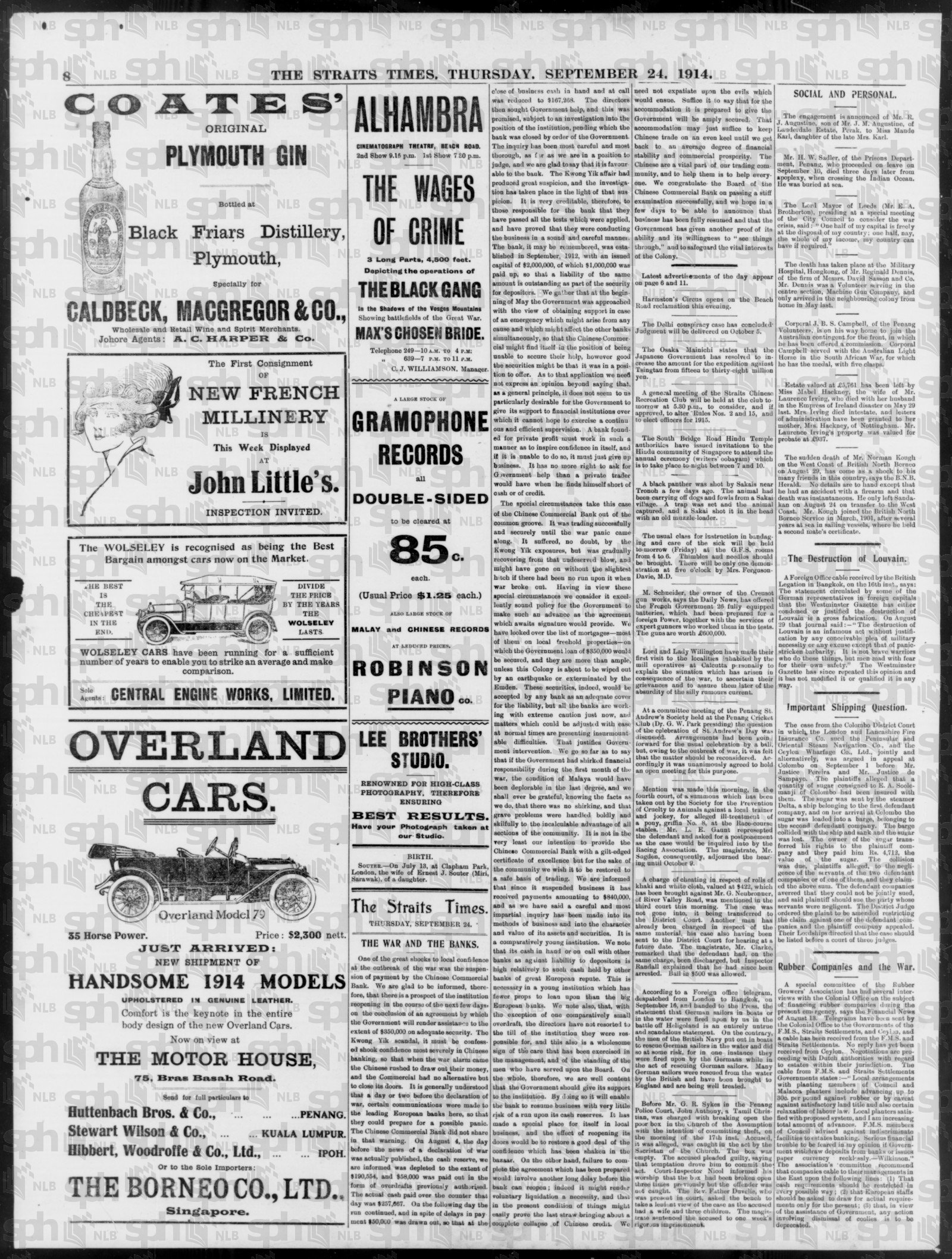 Page 8 of the Straits Times, 24 September 1914, with the editorial “The War and the Banks”, which gave the figures of the run. (Singapore Press Holdings, via NewspaperSG, National Library Board Singapore, public domain)
The editorial set out what happened, day by day. On 4 August, the day before the news of war was published, $257,667 was paid over the counter. The next day the run continued, and despite delays in paying, another $50,000 was drawn out, so that by the close of business the bank had only $167,268 in cash. Its secretary, Seow Poh Leng, wrote to the Malaya Tribune that the directors “have had to request the assistance of Government”, and that the government had promised help pending an examination of the bank’s accounts. The bank was closed while the inspection went on.
The Chinese Commercial Bank’s cash, August–October 1914
Straits dollars; linear scale. Hover or tap a bar for details.
Sources: “The War and the Banks”, Straits Times, 24 September 1914; “Chinese Commercial Bank”, Straits Echo, 5 October 1914.
View as table
| When | What | Amount |
|---|---|---|
| Tue 4 Aug | paid over the counter | $257,667 |
| Wed 5 Aug | paid out, despite delays | $50,000 |
| Close, 5 Aug | cash left in hand | $167,268 |
| Thu 1 Oct, noon | taken in more than paid out | +$27,552 |
“Help the enemy”
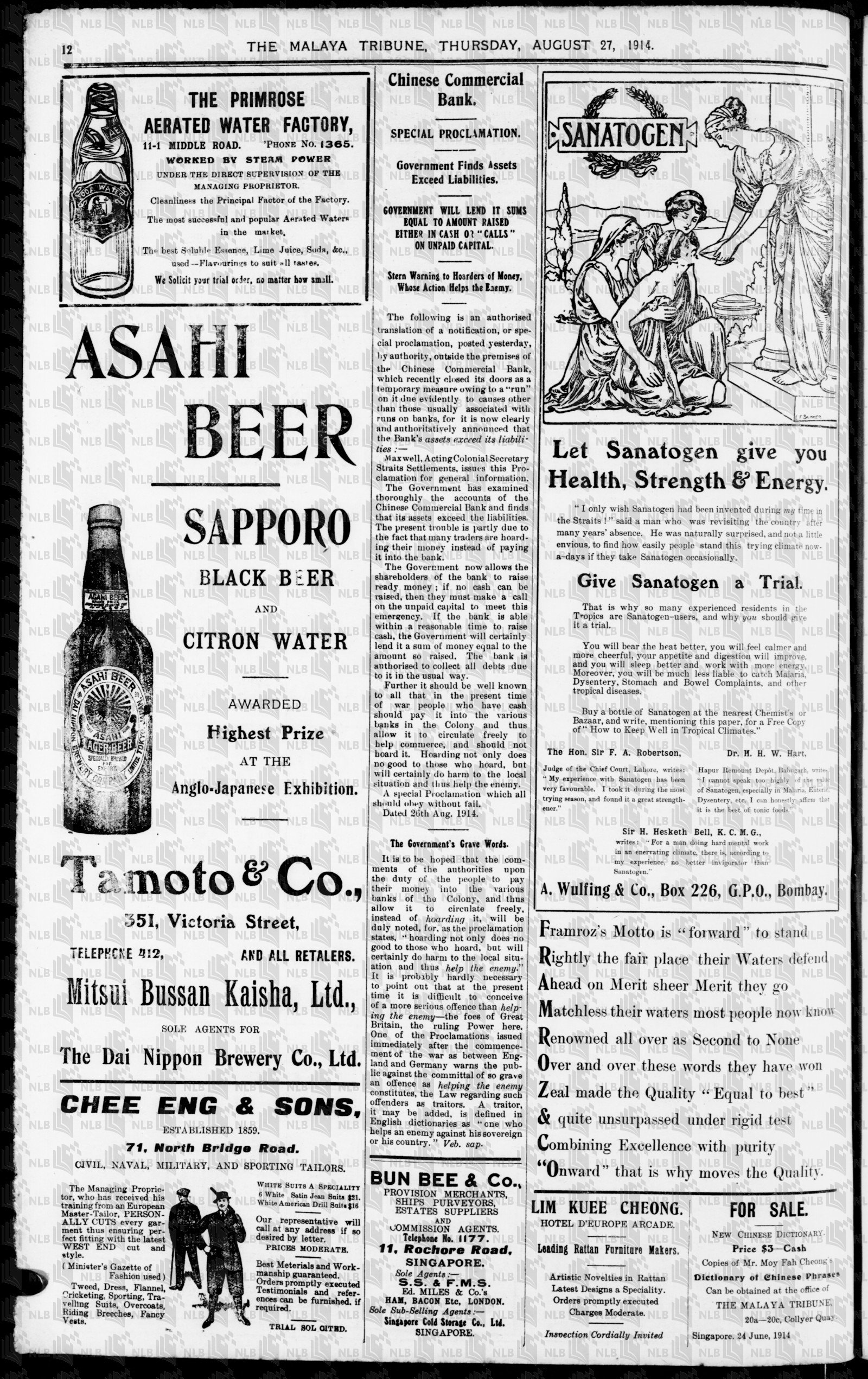 Page 12 of the Malaya Tribune, 27 August 1914, which printed the government's proclamation about the bank. (Malaya Tribune, via NewspaperSG, National Library Board Singapore, public domain)
On 26 August the government posted a proclamation in Chinese outside the bank, signed by the acting Colonial Secretary, Maxwell. It said the government had “examined thoroughly the accounts of the Chinese Commercial Bank and finds that its assets exceed the liabilities”, and that the trouble was “partly due to the fact that many traders are hoarding their money instead of paying it into the bank.” If the shareholders could raise money, either in cash or by a call on their unpaid capital, the government would lend the bank an equal amount.
It ended with a warning to everyone in the colony: people who had cash should pay it into the banks so that it could circulate and help commerce, because hoarding “not only does no good to those who hoard, but will certainly do harm to the local situation and thus help the enemy.” The Malaya Tribune headlined it “Stern Warning to Hoarders of Money, Whose Action Helps the Enemy.”
The bank that held
The Teochew community’s bank, Sze Hai Tong, came through the same panic without closing. According to the National Library Board’s account, it met its customers’ withdrawals from strong cash reserves, the Teochew business community stood by it, and its largest shareholder, Low Peng Yam, put $500,000 into the bank to restore confidence.

Raffles Place around 1910, a few streets from Kling Street, where the European banks and trading firms had their offices. (Photo: Carl Josef Kleingrothe, KITLV/Leiden University Library, public domain, via Wikimedia Commons)
Reopening day
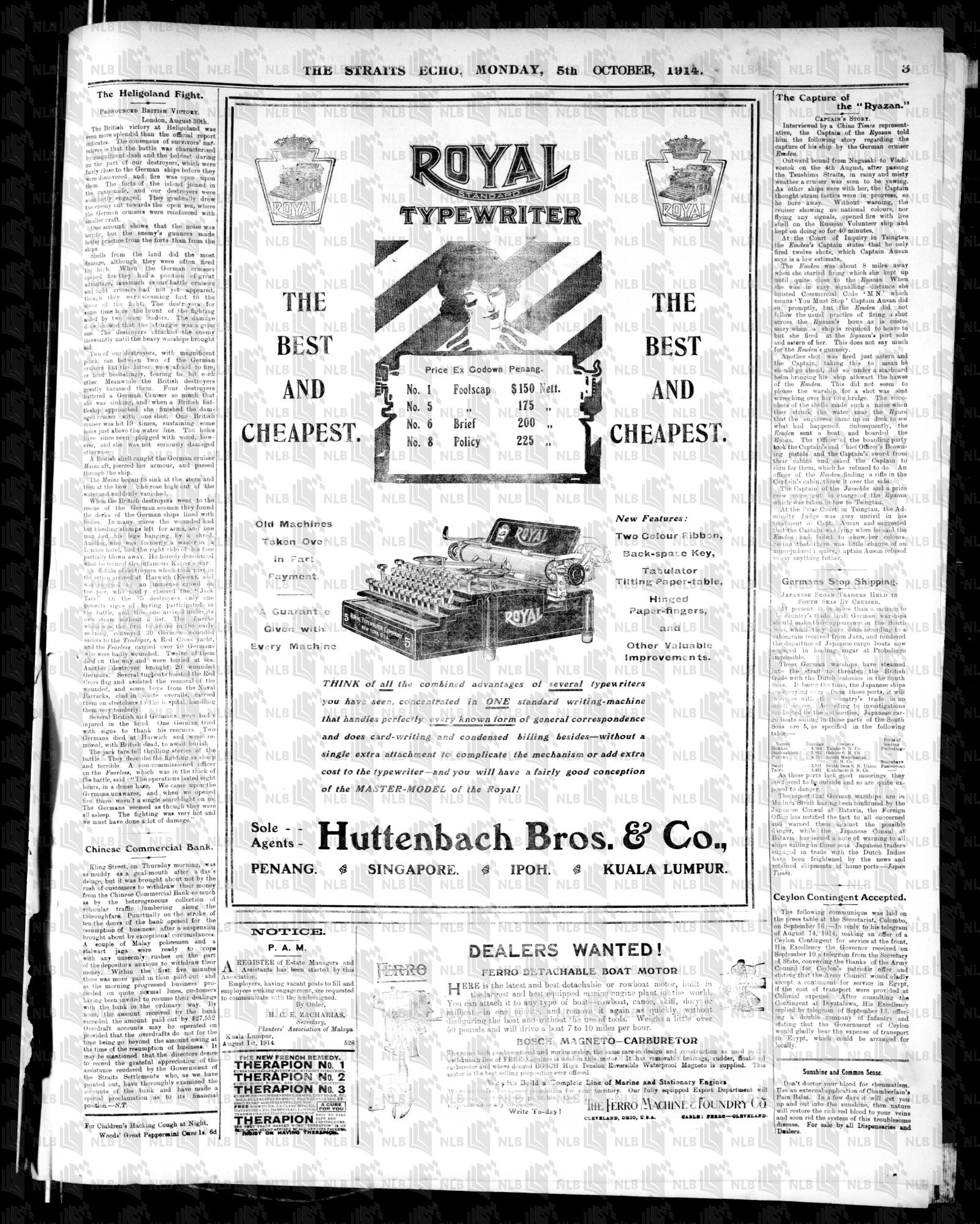 Page 3 of the Straits Echo, 5 October 1914, which reported the bank's reopening. (Straits Echo, via NewspaperSG, National Library Board Singapore, public domain)
On 24 September the Straits Times reported that the bank was expected to reopen within days, once an agreement was signed under which the government would lend it up to $350,000 on adequate security. It reopened at ten o’clock on Thursday 1 October. According to the Straits Echo, Kling Street that morning “was as muddy as a goal-mouth after a day’s deluge”, but from traffic rather than from depositors. A couple of Malay policemen and a watchman stood ready at the doors “to cope with any unseemly rushes”, but within five minutes more money had been paid in than taken out, and by noon the bank had received $27,552 more than it paid out. Afterwards the bank kept a much larger share of its money in cash, choosing safety over profit.

Kling Street, home of the Chinese Commercial Bank and the Sze Hai Tong bank, in a postcard of 1907. (Image: New York Public Library, public domain, via Wikimedia Commons)
How bank runs end today
In 1914, a bank in trouble depended on its community standing behind it, and on the government deciding to step in. Today the safety net is set out in advance. Singapore has had a deposit insurance scheme since 2006, run by the Singapore Deposit Insurance Corporation. Since April 2024 it covers Singapore dollar deposits of up to $100,000 per depositor at each member bank, enough, according to the corporation, to cover 91 per cent of depositors in full. In October 2008, during the global financial crisis, the government went further and guaranteed all bank deposits until the end of 2010, backed by $150 billion of reserves. No claims were made under the guarantee.
Could it happen again? Several of the conditions behind the 1914 run are now dealt with directly. Banks in Singapore are supervised by the Monetary Authority of Singapore, which requires them to hold minimum levels of capital and of liquid assets that can be turned into cash quickly, so that a sudden wave of withdrawals is less likely to empty the till as it did on Kling Street. Most ordinary depositors are fully insured, which removes much of the reason to queue at all. But runs have not disappeared, and they have become much faster. On 9 March 2023, customers of Silicon Valley Bank in the United States withdrew about US$42 billion, almost a quarter of its deposits, in a single day, much of it above the insured limit, and requests for about US$100 billion more were waiting the next morning. Regulators closed the bank on 10 March. In 1914 the run on the Chinese Commercial Bank took two days; phone banking and messages spreading online meant this one took little more than one. The lesson that carries over from Kling Street is that confidence is what holds a bank together, and that the safeguards built since then are meant to protect it before a panic starts.
See more historical photos related to this post →
Where it fits in the bigger story: The Chinese Commercial Bank survived the panic of August 1914 because the government examined its books, said publicly that it was sound and lent it money. A century later, deposit insurance, the 2008 guarantee and the rules on capital and liquidity were built to make that kind of rescue unnecessary, by giving ordinary depositors no reason to run, though a run can now move far faster than one on Kling Street.
Sources
- “The War and the Banks”, The Straits Times, 24 September 1914, page 8, NewspaperSG
- “Chinese Commercial Bank: Special Proclamation”, Malaya Tribune, 27 August 1914, page 12, NewspaperSG
- “The Chinese Commercial Bank, Ltd.”, Malaya Tribune, 7 August 1914, page 10, NewspaperSG
- “Chinese Commercial Bank”, Straits Echo, 5 October 1914, page 3, NewspaperSG
- Chinese Commercial Bank, Infopedia (National Library Board)
- Sze Hai Tong Banking & Insurance Company Limited, Infopedia (National Library Board)
- Deposit Insurance Scheme, Singapore Deposit Insurance Corporation
- Deposit insurance limit goes up to $100,000 from today, Singapore Deposit Insurance Corporation, 1 April 2024
- Ministerial statement on the Government Guarantee on Deposits, Monetary Authority of Singapore, 2008
- Material Loss Review of Silicon Valley Bank, Office of Inspector General, Federal Reserve Board, September 2023
- MAS Notice 649: Minimum Liquid Assets and Liquidity Coverage Ratio, Monetary Authority of Singapore
- MAS Notice 637: Risk Based Capital Adequacy Requirements for Banks Incorporated in Singapore, Monetary Authority of Singapore
- File:Souvenir of Singapore, 1914 - Plate 11 - Chinese Quarters.jpg, Wikimedia Commons
- File:KITLV - 79891 - Kleingrothe, C.J. - Medan - Raffles Place, Singapore - circa 1910.tif, Wikimedia Commons
- File:Kling Street, Singapore (NYPL Hades-2359713-4044478).jpg, Wikimedia Commons
- File:Souvenir of Singapore, 1914 - Plate 05 - Market Scene.jpg, Wikimedia Commons (gallery)
- File:Souvenir of Singapore, 1914 - Plate 06 - Harbour View.jpg, Wikimedia Commons (gallery)
- File:Souvenir of Singapore, 1914 - Plate 01 - Anderson Bridge.jpg, Wikimedia Commons (gallery)
- File:Souvenir of Singapore, 1914 - Plate 10 - Rubber Tapping.jpg, Wikimedia Commons (gallery)
- File:KITLV - 79892 - Kleingrothe, C.J. - Medan - Raffles Place, Singapore - circa 1910.tif, Wikimedia Commons (gallery)
- File:KITLV - 79923 - Kleingrothe, C.J. - Medan - South Bridge Road, Singapore - circa 1910.tif, Wikimedia Commons (gallery)
- File:Singapore. Linksboven Raffles Place. Rechtsboven Raffles Place. Linksonder Ra, Bestanddeelnr 844 07.jpg, Wikimedia Commons (gallery)
- File:Skyline of the Central Business District of Singapore with Esplanade Bridge in the evening.jpg, Wikimedia Commons (video)
- File:MASBuilding-Singapore-20090914.jpg, Wikimedia Commons (video)
- File:3003 Tasman Drive.jpg, Wikimedia Commons (video)


