The Indian Convicts Who Built Colonial Singapore, 1825–1873
On 18 April 1825 the brig Horatio reached Singapore with 80 convicts from Madras, transferred from the British penal station at Bencoolen in Sumatra. A week later 122 more arrived from Bengal. For the next 48 years Singapore took in convicts sentenced to transportation in British India, and much of the early town, from its roads to its cathedral and the Governor’s house, was built by their labour.

St Andrew’s Church around 1860. Indian convicts built it, and it was consecrated in 1862. (Photo: unknown photographer, KITLV/Leiden University Library, public domain, via Wikimedia Commons)
Why convicts came to Singapore
Britain had been sending Indian convicts to its settlements in the region since before Singapore was founded: to Bencoolen from 1787, Penang from 1796 and Malacca from 1805. Singapore was short of labour and grew faster than the other Straits Settlements, and by the 1830s it had become the main convict station, holding more than 2,000 convicts, over half of those in the Straits. In 1857 the jail held 2,139 convicts from India, Burma and Ceylon. According to J. F. A. McNair, who ran it from 1857 until the end, about 1,900 were under its control at any one time.
Who the convicts were
Most were ordinary criminals, sentenced by Indian courts to transportation, often for life. McNair’s count of the convicts still in the Straits Settlements in 1873 lists 581 transported for dacoity, or armed gang robbery, 269 for robbery with murder, 256 for thuggee, the robbery and murder of travellers by organised gangs, and 21 for professional poisoning. Most of the rest had been convicted of murder or robbery with violence.
A smaller number were political prisoners. After the uprising of 1857 in India, rebels were shipped to Singapore. The first group, 17 men and 2 women who arrived on the Earl Grey in October 1857, included five described as mutineers, and McNair recorded the arrival of a large number of mutineers in 1858 and 1859. The Sikh leader Bhai Maharaj Singh, sent to Singapore in 1850, was a State prisoner, held apart in a cell at Outram Road rather than put to work with the convicts.
What the last convicts had been transported for, 1873
Convicts in the Straits Settlements when the system ended, for the four offences McNair counted separately (1,127 in all); linear scale
Source: J. F. A. McNair and W. D. Bayliss, Prisoners Their Own Warders (1899), page 146. Most of the remaining convicts had been convicted of murder or robbery with violence.
View as table
| Offence | Convicts |
|---|---|
| Dacoity | 581 |
| Robbery with murder | 269 |
| Thuggee | 256 |
| Professional poisoning | 21 |
| Total in these four offences | 1,127 |
Prisoners as their own warders
 Duffadar Ram Singh, senior petty officer of the Singapore jail and himself a convict. (Photo: J. F. A. McNair and W. D. Bayliss, Prisoners Their Own Warders, 1899, public domain, via Wikimedia Commons)
When the first convicts landed, four free watchmen from Chittagong were put in charge of them. The Resident, George Bonham, found that the convicts worked willingly, so he dismissed the paid watchmen and chose five Madrasis and five Bengalis from among the convicts to supervise the rest. McNair thought this was possibly the first time any penal establishment had tried such a system. As more convicts arrived, one convict warder was appointed for every twenty men and paid $3 a month on top of his rations and clothing.
Under rules formalised by Governor William Butterworth in 1845, the convicts were divided into six classes. New arrivals worked in light irons in the fourth class, and those thought likely to escape wore heavy irons in the fifth. After a probation, a convict moved into the third class to work on roads and public works, and good conduct could lift him into the second class as a petty officer, hospital orderly or office worker. At the top was the first class, trustworthy convicts on a ticket-of-leave, who lived and worked outside the jail and reported to a monthly muster. A man serving a life sentence could reach it after sixteen years.

The general monthly muster of the convicts at the Singapore jail, before 1873. (Photo: J. F. A. McNair and W. D. Bayliss, Prisoners Their Own Warders, 1899, public domain, via Wikimedia Commons)
The convicts also built their own jail. It took about twenty years, was finished in 1860, and on completion was the largest building complex in the settlement, stretching along Bras Basah Road from Victoria Street to Bencoolen Street.
The convicts were not the first Indians in that part of town. Indian washermen, or dhobies, had come in 1819 with the sepoy garrison at the foot of Government Hill, now Fort Canning, as part of the service workers who looked after the soldiers. They were free workers, mostly from what is now Uttar Pradesh and Bihar, along with Tamil dhobies from the Madras region, and they washed clothes in the stream that fed the Bras Basah canal and dried them on the green nearby, which gave Dhoby Ghaut its name. Singapore’s early Indian population grew from both groups, free workers and convicts, living a few streets apart.
What they built
 Plate XVII of McNair's book: a mortar mill at Government House, and convicts laying out its garden while the house was being built, 1867 to 1869. (Photo: J. F. A. McNair and W. D. Bayliss, Prisoners Their Own Warders, 1899, public domain, via Wikimedia Commons)
The convicts’ first big task was filling in the mud flat that became Commercial Square, now Raffles Place, with earth carried from Pearl’s Hill. From 1833, when the architect G. D. Coleman became superintendent of convicts, they built roads: Beach Road along the shore, Bukit Timah Road to carry goods in from the interior, and Thomson, Serangoon and Bedok roads through the forest and along the east coast.
From 1845 the superintendent Henry Man turned the jail into a training ground for trades. Convicts learned carpentry, bricklaying, blacksmithing, stonecutting and lime-burning, and the bricks from their kilns off Serangoon Road won a silver medal at the Agra Exhibition in 1867.
Their best-known work is St Andrew’s Church, now St Andrew’s Cathedral. Its designer, Ronald MacPherson, chose a simple Gothic style that convict builders could manage, and they finished it in 1862. They plastered its walls and columns with Madras chunam, a mix of shell lime, egg white and coarse sugar that was polished to a glossy finish, and boy convicts climbed the spire to fix its slates.
Government House, now the Istana, followed. When the Straits Settlements passed from Indian to Crown rule on 1 April 1867, the new Governor, Sir Harry Ord, had no official residence, and McNair designed one. According to McNair, convicts did all the brickwork, the exterior plastering and most of the flooring and interior work, and made all the bricks. The house was ready for the visit of the Duke of Edinburgh in October 1869.

Government House, now the Istana, nearing completion in 1869, with the tower still in scaffolding. (Photo: J. F. A. McNair and W. D. Bayliss, Prisoners Their Own Warders, 1899, public domain, via Wikimedia Commons)

The same building as the Istana in 2022, seen across the lawn during a public open house. (Photo: LesserKnownSingapore, CC BY-SA 4.0, via Wikimedia Commons)
A cheap workforce
For the colony, the convicts were a cheap source of labour. In the early years each convict received rations, clothing, a blanket a year and 50 cents a month for salt and condiments, and convict warders cost less than free ones. In 1849 the Resident Councillor, Thomas Church, told the Governor that “the labour of the convicts is equivalent to all expenses incurred in their maintenance at this station”, and argued that giving repairs and minor works to the convict department would be “vastly more economical” than the existing arrangements. According to BiblioAsia, the large public buildings put up with convict labour also strengthened the colony’s case for separation from India in 1867.
Two convicts who stayed
Some convicts made careers after their release. Hammapah, a convict land surveyor, set up a land brokerage in the east of the island, and his son Somapah carried on the business. According to BiblioAsia, Somapah Village off Upper Serangoon Road took its name from him. Bawajee Rajaram, a convict from Bombay, became Singapore’s first local draughtsman and headed the team that drew plans for St Andrew’s Church, the General Hospital and Government House. After his release he worked on municipal drawings, and in 1890 he designed a bungalow on Devonshire Road.
The end of transportation
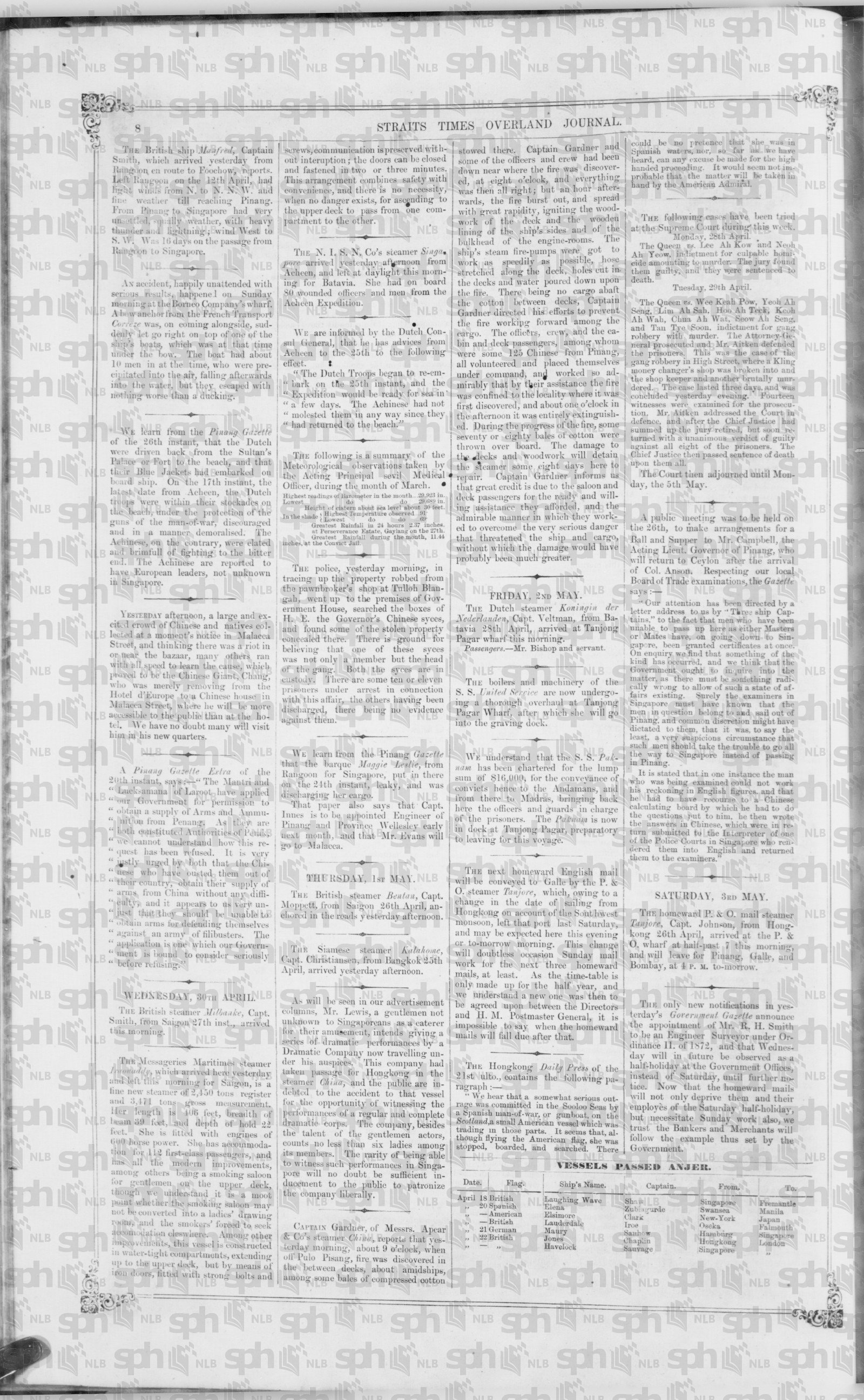 Page 8 of the Straits Times Overland Journal, 3 May 1873, which reported that the Paknam had been chartered to take the convicts to the Andamans. (Singapore Press Holdings, via NewspaperSG, National Library Board Singapore, public domain)
Transportation to Singapore officially ended with the transfer to Crown rule in 1867, but the convict establishment carried on until 1873. On 3 May 1873 the Straits Times Overland Journal reported that the steamer Paknam had been chartered “for the lump sum of $16,000” to take the convicts to the Andaman Islands, where India had opened a new penal settlement after 1857. The last convicts left on the Paknam on 8 May 1873.
Those on a ticket-of-leave were allowed to stay. McNair wrote that they merged into the population, “continuing to earn their livelihood as artizans, cow keepers, cart drivers, and the like”. The old and infirm were kept in Singapore at the Indian government’s expense.
See more historical photos related to this post →
Where it fits in the bigger story: Singapore’s early public buildings are usually credited to the architects and governors who commissioned them. Much of the labour came from Indian convicts, most of them transported for serious crimes, who worked their way up through a system run largely by prisoners themselves. Many stayed on after 1873, and along with the free migrants who came before and after them, they were part of how Singapore’s Indian community began.
Sources
- Convict Labour in Colonial Singapore, BiblioAsia (National Library Board)
- Indian convicts’ contributions to early Singapore (1825–1873), Infopedia (National Library Board)
- J. F. A. McNair and W. D. Bayliss, Prisoners Their Own Warders (1899), Project Gutenberg
- Colonising the penal body: transit of the convicts from Bengal to the Malay Peninsula, Southeast Asia: A Multidisciplinary Journal
- Untitled report on the charter of the Paknam, Straits Times Overland Journal, 3 May 1873, page 8, NewspaperSG
- Dhoby Ghaut, Roots.gov.sg (National Heritage Board)
- File:KITLV - 29163 - St. Andrew’s Cathedral, belonging to the Anglican Church, Singapore - 1860.tif, Wikimedia Commons
- File:California Digital Library (IA prisonerstheirow00mcnarich).pdf, page 127, Wikimedia Commons
- File:California Digital Library (IA prisonerstheirow00mcnarich).pdf, page 156, Wikimedia Commons
- File:General monthly muster of the convicts, Singapore Jail (McNair 1899, frontispiece).jpg, Wikimedia Commons
- File:Government House, Singapore, approaching completion, 1869 (McNair 1899, Plate XVIII).jpg, Wikimedia Commons
- File:Istana Singapore, main building from the lawn during an open house, 2022.jpg, Wikimedia Commons
- File:KITLV - 89910 - Cavanagh Bridge in Singapore - before 1880.tif, Wikimedia Commons (gallery)
- File:Main gate of Singapore Jail, Bras Basah (McNair 1899, Plate XI).jpg, Wikimedia Commons (gallery)
- File:Convicts stone-quarrying at Pulau Ubin, Singapore (McNair 1899, Plate XX).jpg, Wikimedia Commons (gallery)
- File:Istana Singapore main gate, Orchard Road, during an open house, 2022.jpg, Wikimedia Commons (gallery)
- File:Photographic Views of Singapore Plate 06 St Andrew’s Cathedral and Raffles Monument.jpg, Wikimedia Commons (gallery)
- File:KITLV - 89904 - Hotel de l’Europe against the backdrop of St Andrews Cathedral in Singapore - before 1880.tif, Wikimedia Commons (gallery)
- File:Malaysia; view across the harbour to Fort Canning and the ca Wellcome V0037489.jpg, Wikimedia Commons (gallery)
- File:KITLV - 53172 - Lambert & Co., G.R. - Singapore - Government House in Singapore - circa 1890.tif, Wikimedia Commons (gallery)
- File:KITLV - 103751 - Government House in Singapore - circa 1890.tif, Wikimedia Commons (gallery)
- File:KITLV - 155825 - Cavanagh Bridge at Singapore - circa 1870.tif, Wikimedia Commons (gallery)
- File:California Digital Library (IA prisonerstheirow00mcnarich).pdf, pages 12, 135 and 143, Wikimedia Commons (gallery)
- File:J F A McNair, architectural drawing of a proposed prison at Outram, Singapore (1880s).jpg, Wikimedia Commons (gallery)


