The Sikh Prisoner of Outram Road and the Shrine That Moved Twice
In June 1850 the Straits Times reported, in a few lines, that a ship from Calcutta had brought two State prisoners to Singapore. One of them was Bhai Maharaj Singh, a Sikh religious leader who had opposed British rule in Punjab, and he died in the jail on Outram Road six years later. The place where he was cremated became a shrine that people of several faiths visited for decades, and it has since moved twice to reach the Silat Road gurdwara, where it stands today.

The prison at Outram Road, also known as the Pearl’s Hill prison, in the 1850s. (Photo: unknown photographer, public domain, via Wikimedia Commons)
Who he was
 Maharaja Duleep Singh, the last ruler of the Sikh kingdom, and the Governor-General, Lord Dalhousie, in a painting from Lahore of about 1849–50, inscribed in Persian with both their names. (Image: unknown artist, Toor Collection, public domain, via Wikimedia Commons)
Bhai Maharaj Singh was the head of a Sikh religious order at Naurangabad, in Punjab. After the death of Maharaja Ranjit Singh in 1839, the Sikh kingdom was weakened by disputes over the succession, and in the 1840s it fought two wars against the British East India Company. Sikh accounts describe Maharaj Singh as a leader of the resistance to British rule; the British treated him as an outlaw and put a reward of 10,000 rupees on him. He was arrested near Adampur on 28 December 1849, soon after Punjab was annexed. The Governor-General, Lord Dalhousie, decided that he should be held far from Punjab, and he was sent to Singapore.
Six years at Outram Road
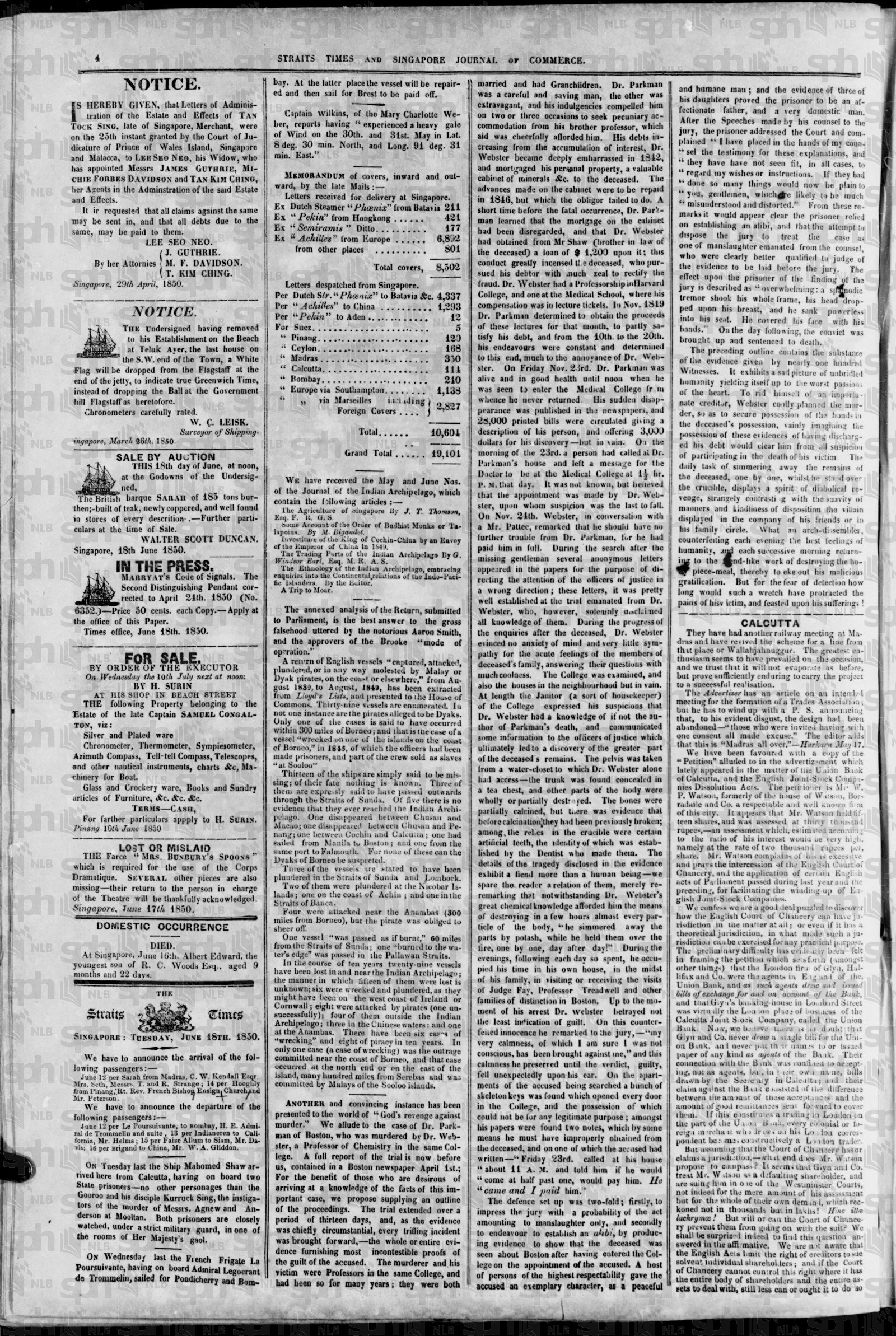 Page 4 of The Straits Times, 18 June 1850, which carried the short report of the prisoners' arrival. (Singapore Press Holdings, via NewspaperSG, National Library Board Singapore, public domain)
The Straits Times of 18 June 1850 reported that the ship Mahomed Shaw had arrived from Calcutta “having on board two State prisoners,” Maharaj Singh, whom it called the Gooroo, and his companion Khurruck Singh. The paper described them as the instigators of the killing of two British officers at Multan in 1848, a charge that reflected the British view of the events, and added that both were “closely watched, under a strict military guard, in one of the rooms of Her Majesty’s gaol.”
According to the Central Sikh Gurdwara Board’s history, Dalhousie had instructed the authorities in Singapore that the prisoner should not be treated with unnecessary harshness and should be held somewhere clean but secure. He was nevertheless kept in a cell on the upper floor of the new jail, about 14 by 15 feet, whose windows had been walled up. His health failed. He was almost blind within three years, suffered from rheumatic pain in his feet and ankles, and developed a swelling of the tongue and neck that left him unable to eat properly.
 Bhai Maharaj Singh and Khurruck Singh in a prison cell, a drawing by Colesworthy Grant dated 1850. (Image: Colesworthy Grant, public domain, via Wikimedia Commons)
He died in the jail on 5 July 1856. The Straits Times of 8 July reported that “the State prisoner at Singapore, better known as ‘The Gooroo’” had died “at one o’clock on Saturday last,” and suggested that his companion might now be allowed to return to India. Khurruck Singh was later moved to Penang, where he also died. According to the gurdwara board, it was Khurruck Singh who performed the cremation, near the prison.
The shrine
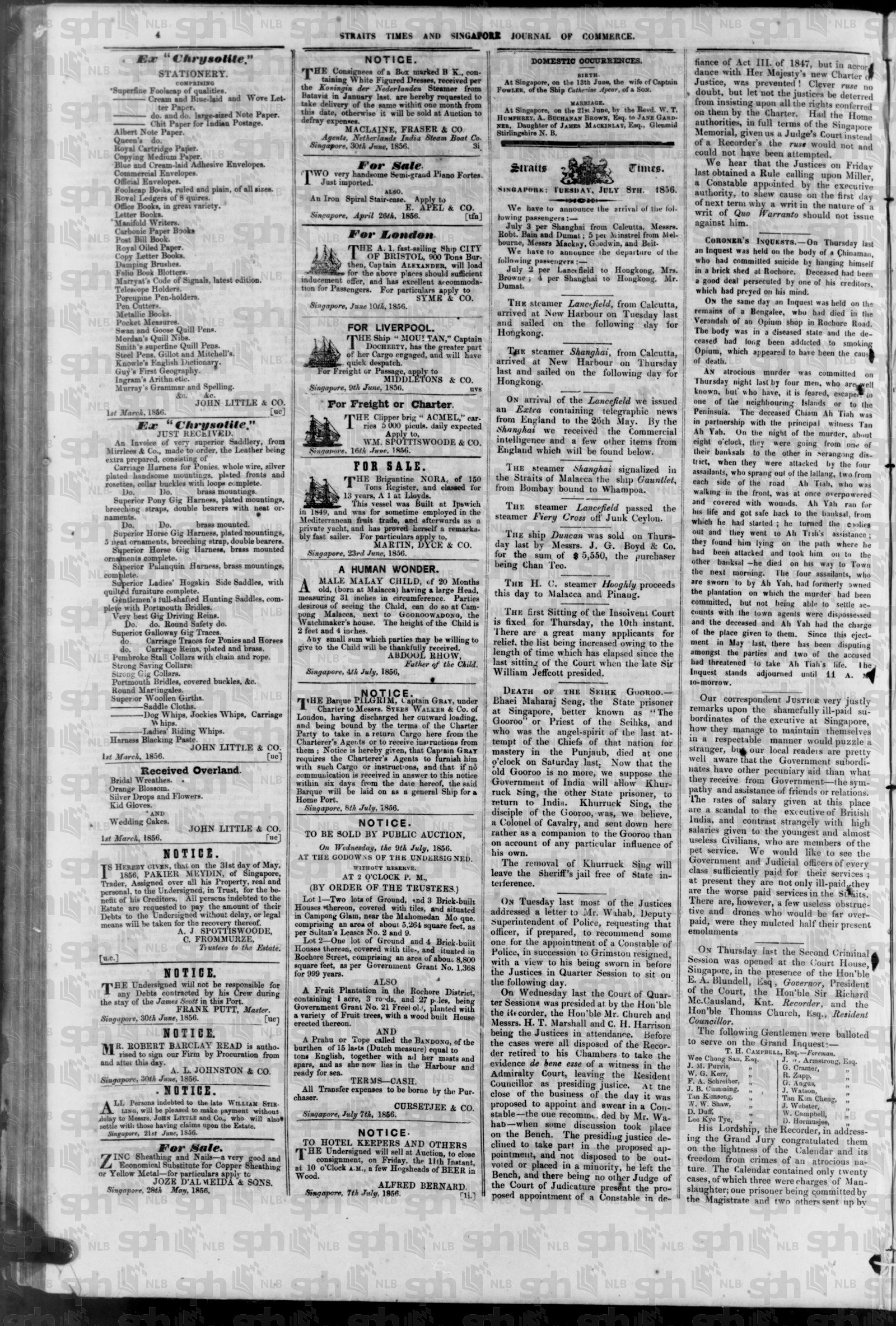 Page 4 of The Straits Times, 8 July 1856, which reported the death of the Sikh prisoner. (Singapore Press Holdings, via NewspaperSG, National Library Board Singapore, public domain)
The cremation site did not stay anonymous. According to accounts collected by the Sikh community, Tamils were the first to mark it with stones and leave flowers there. Muslims later put up green flags around it and treated it as a keramat, a holy grave, and Sikhs came as well. Many people in Singapore came to know the man buried there not as Maharaj Singh but as “Baba Karam Singh,” a name that may have come from an epithet meaning a worker of wonders.
Moving twice
In the 1940s the shrine was moved from the prison area to a small field on the grounds of Singapore General Hospital. In 1961 a Sikh police officer installed a copy of the Guru Granth Sahib there, and the number of visitors grew until the crowds were getting in the way of the hospital’s ambulances. The Sikh community and the government agreed to move the shrine again, and from 12 October 1966 it was transferred to the grounds of the Silat Road gurdwara, the temple that the Sikh Police Contingent had helped to build in 1924.
A memorial building dedicated to Bhai Maharaj Singh was opened there on 23 October 1995, and on 14 November 1999 the National Heritage Board declared the site a historic site.

The Silat Road gurdwara, where the memorial has stood since 1966. (Photo: ProjectManhattan, CC BY-SA 4.0, via Wikimedia Commons)
From prisoner to memorial, 1849–1999
Linear scale, 1845–2005
Dates from the sources cited below the post.
View as table
| Date | Event |
|---|---|
| Dec 1849 | Bhai Maharaj Singh was arrested near Adampur, in Punjab, on 28 December 1849. |
| Jun 1850 | The Straits Times of 18 June 1850 reported the arrival of the two State prisoners from Calcutta on the ship Mahomed Shaw. |
| Jul 1856 | He died in the jail on 5 July 1856, as the Straits Times reported on 8 July. |
| 1940s | The shrine was moved from the prison area to the grounds of Singapore General Hospital in the 1940s. |
| Oct 1966 | From 12 October 1966 the shrine was moved to the grounds of the Silat Road gurdwara. |
| Oct 1995 | The Bhai Maharaj Singh Memorial building was opened on 23 October 1995. |
| Nov 1999 | The National Heritage Board declared the site a historic site on 14 November 1999. |
See more photos related to this post →
Where it fits in the bigger story: The Outram Road prison is gone, and the few lines the Straits Times gave to its State prisoners in 1850 and 1856 are easy to miss. What kept this story alive in Singapore was not the official record but the people who marked a cremation site with stones, flags and flowers without always knowing whose it was, and a community that carried the shrine with it twice as the city was rebuilt around it.
Sources
- Bhai Maharaj Singh: A Saint-Soldier’s Life in Punjab and Singapore, Central Sikh Gurdwara Board
- Bhai Maharaj Singh, Wikipedia
- Bhai Maharaj Singh: Freedom Fighter for Panjab, Asia Samachar
- Gurdwara Sahib Silat Road, Central Sikh Gurdwara Board
- Untitled report of the arrival of two State prisoners, The Straits Times, 18 June 1850, page 4, NewspaperSG
- “Death of the Seikh Gooroo,” The Straits Times, 8 July 1856, page 4, NewspaperSG
- File:Photograph of Outram Prison (Pearl’s Hill Prison) in the 1850’s.jpg, Wikimedia Commons
- File:Maharaja Duleep Singh and Governor-General Lord Dalhousie, Lahore, Punjab, ca.1849–50.jpg, Wikimedia Commons
- File:Bhai Maharaj Singh and Companion (Khurruck Singh) in a Prison Cell.jpg, Wikimedia Commons
- File:Silat Road Sikh Temple, Singapore.jpg, Wikimedia Commons
- File:Painting of the Sikh warrior, Bhai Maharaj Singh, holding court in his darbar.jpg, Wikimedia Commons (gallery)
- File:Photograph of the Samadhi of Bhai Maharaj Singh (then referred to as ‘Baba Karam Singh’) on the grounds of Singapore General Hospital.jpg, Wikimedia Commons (gallery)
- File:Gurdwara Sahib Silat Road in Singapore after construction was just completed in 1924.jpg, Wikimedia Commons (gallery)
- File:Photograph of members of the Sikh Police Contingent in-front of Gurdwara Sahib Silat Road in 1931.jpg, Wikimedia Commons (gallery)


