Singapore's First Chief Minister: What David Marshall Could and Couldn't Do, 1955–56
At 5 p.m. on 7 June 1956, David Marshall resigned as Singapore’s first Chief Minister, fourteen months after taking office and three weeks after constitutional talks in London had ended without agreement. He had said he would resign if he could not bring home full internal self-government, and he kept to that. The Straits Times of the following morning put the news across the top of its front page under the headline “Lim told: take the helm,” and turned at once to the man who would succeed him. The story of those fourteen months is as much about what the office could not do as about what Marshall did with it.

The Singapore delegation at the constitutional talks in London in 1956. From left: Lim Yew Hock, David Marshall, Abdul Hamid Jumat, J. M. Jumabhoy, Seah Peng Chuan, Wong Foo Nam, Lee Kuan Yew and Lim Chin Siong. (Photo: Central Office of Information, London, public domain, via Wikimedia Commons)
A lawyer, a prisoner of war and a new party
 David Marshall as a prisoner of war under the Japanese, 1944. (Photo: unknown photographer, David Marshall Collection, ISEAS Library, public domain, via Wikimedia Commons)
David Marshall was born in Singapore on 12 March 1908 into a Baghdadi Jewish family and was called to the bar in London in 1938. He joined the Singapore Volunteer Corps that year and was mobilised in December 1941. After the fall of Singapore he was marched to Changi on 17 February 1942 as a prisoner of war and was later sent to Japan, where he worked in the coal mines of Hokkaido. He returned to Singapore in February 1946 weighing 107 pounds.
After the war he became one of Singapore’s best-known criminal lawyers, earning an average of S$11,300 a month in the early 1950s. In August 1954 he founded the Labour Front with Lim Yew Hock and Francis Thomas. In March 1955, a month before the election, he left his law firm after disagreements over his political involvement.
The office he won
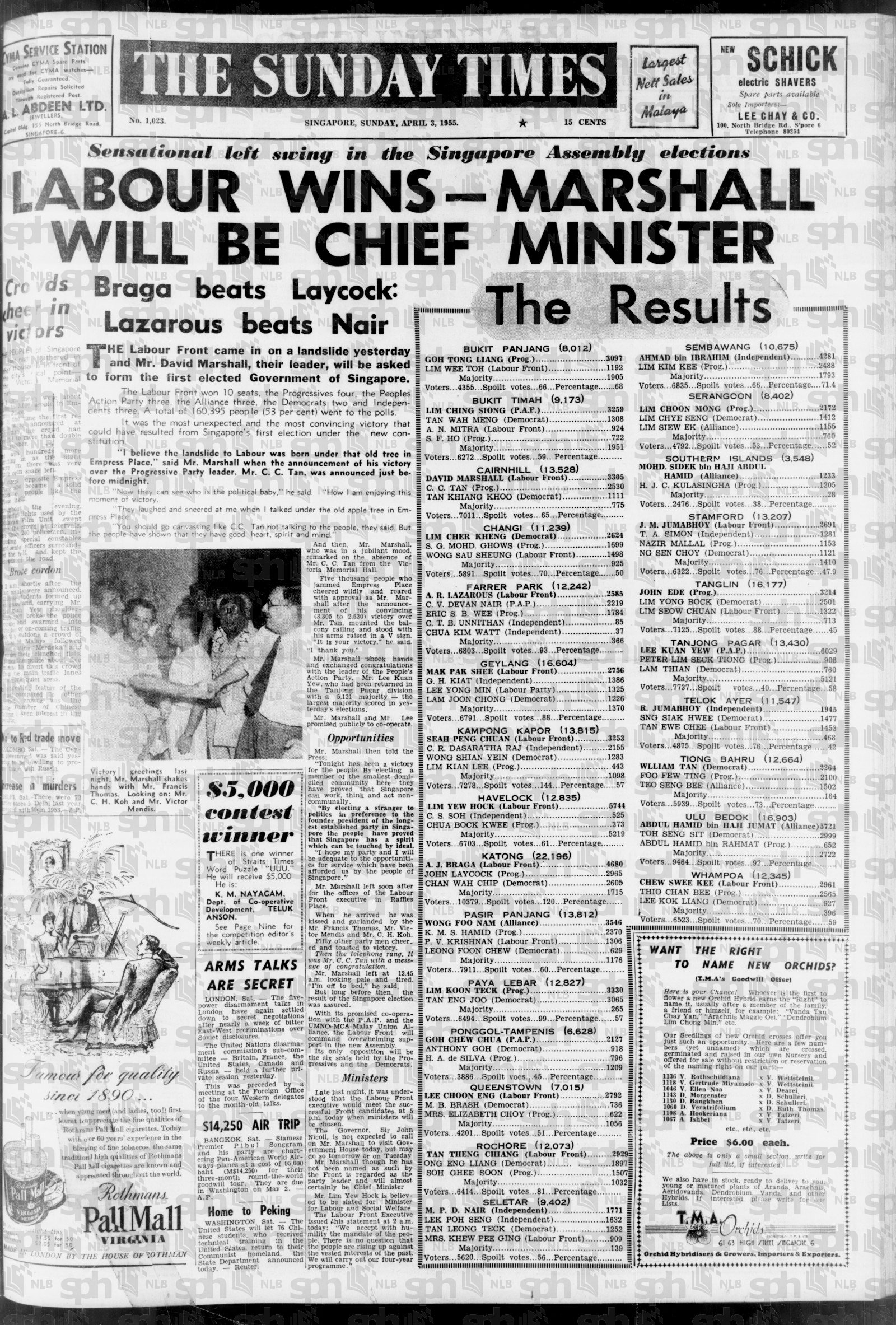 Front page of The Sunday Times, 3 April 1955, the day after the election. (Singapore Press Holdings, via NewspaperSG, National Library Board Singapore, public domain)
The election of 2 April 1955 was the first held under the Rendel constitution, which enlarged the Legislative Assembly to 32 members, 25 of them elected. The rest were officials and nominated members. The British kept defence, external affairs and internal security in their own hands, and the Governor held reserve powers. There were more than 300,000 registered voters, and the Straits Times reported that 160,395 of them, 53 per cent, went to the polls.
The Sunday Times of 3 April ran the headline “Labour wins, Marshall will be Chief Minister” over a report of a “sensational left swing.” The Labour Front had won ten seats, the most of any party but well short of a majority. The Straits Times of the next day headed its front page “All say, no coalition” while the Labour Front’s leaders met behind closed doors. Marshall nevertheless formed a minority government with the Alliance and nominated members. Three colonial officials, the Chief Secretary, the Financial Secretary and the Attorney-General, also sat in the cabinet. Marshall held the Commerce and Industry portfolio himself, and Lim Yew Hock became Minister for Labour and Welfare.
Seats won, 2 April 1955
The 25 elected seats of the 32-member Legislative Assembly
Source: The Sunday Times (Singapore), 3 April 1955, front page. The Alliance is counted as one group.
View as table
| Party | Seats |
|---|---|
| Labour Front | 10 |
| Progressive Party | 4 |
| People's Action Party | 3 |
| Alliance (UMNO, MCA, Malay Union) | 3 |
| Independents | 3 |
| Democratic Party | 2 |
The first tests
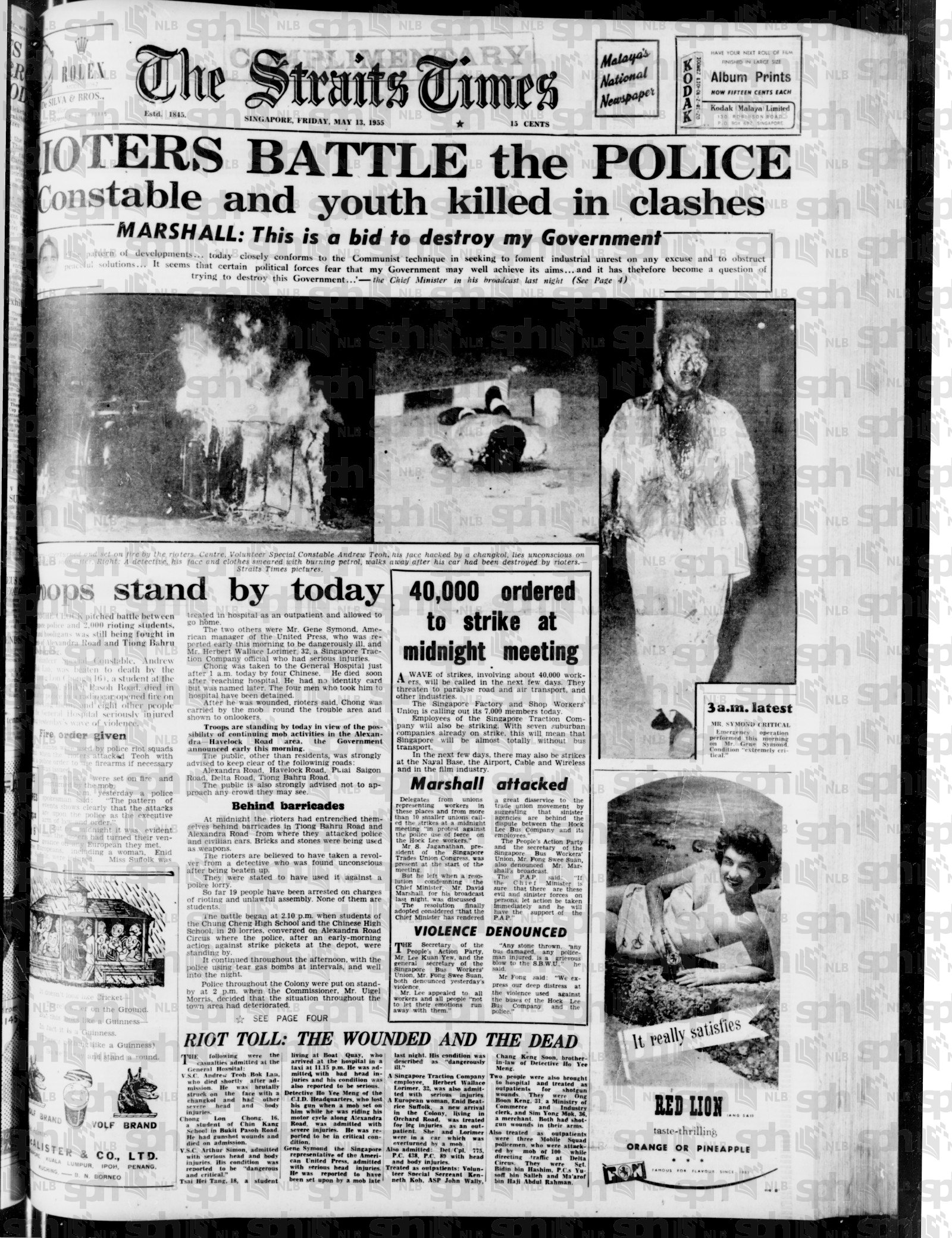 Front page of The Straits Times, 13 May 1955, the day after the Hock Lee bus riots. (Singapore Press Holdings, via NewspaperSG, National Library Board Singapore, public domain)
His government was barely a month old when the Hock Lee bus strike turned violent. The dispute began when the bus company dismissed workers for belonging to a union, and students from Chinese middle schools joined the strikers. On 12 May 1955 riots broke out along Alexandra Road. Four people died, among them two police officers, an American journalist and a 16-year-old student, and 31 were injured. The Straits Times of 13 May carried Marshall’s statement that the trouble was “a bid to destroy my Government.” An agreement to end the strike was reached on 14 May after Marshall met union leaders and advisers, including Lee Kuan Yew, Fong Swee Suan and Lim Chin Siong. After students staged sit-ins at several Chinese schools, he reopened the closed schools once an all-party committee on Chinese education had been appointed. Critics described his handling of the strike as an “unconditional surrender.”
The second test was over the limits of the office itself. In July 1955 Marshall asked for four junior ministers, and the Governor approved two. He threatened to resign, and the dispute was resolved in August after the Secretary of State for the Colonies, Alan Lennox-Boyd, visited Singapore. The outcome enlarged the Chief Minister’s powers.
What the government did
Marshall’s government passed a good deal in its fourteen months. The Emergency Regulations were replaced by seven bills, including the Preservation of Public Security Bill, and formally lifted on 29 October 1955. The all-party committee on education produced a white paper that set out a policy of teaching in English, Chinese, Malay and Tamil. A Malayanisation Commission, set up in August 1955, issued an interim report in February 1956, and Marshall began weekly Meet-the-People sessions in June 1955. The Central Provident Fund was amended in May 1955. In February 1956 the Assembly voted unanimously to allow members to speak in languages other than English, and a select committee on multilingualism tabled its report on the practical arrangements on 7 June 1956, the day he resigned. A Free Legal Aid Bill was still under discussion when he resigned, with the Singapore Bar Committee having sent a memorandum on it to the Attorney-General.
The London talks
 David Marshall at the constitutional talks in London, 1956. (Photo: Central Office of Information, London, public domain, via Wikimedia Commons)
The all-party delegation, thirteen strong, left for London on 14 April 1956, and the talks opened on 23 April. Marshall asked for full self-government by April 1957, and the British offered a more limited measure of internal self-government. The sticking point was the council that would control internal security. The British proposed equal numbers from Britain and Singapore, with the British High Commissioner in the chair and holding the casting vote. Marshall proposed a chairman born in Singapore or the Federation of Malaya and appointed by the Federation government, and no casting vote. The British rejected both proposals, citing concern about communist influence and unrest in the colony, and the talks reached a deadlock on 15 May.
The Straits Times of 16 May, in a special 8 a.m. edition, ran the headline “The talks fail” with the words “Marshall (‘I’ll resign’) returns on Sunday.” Marshall made a last attempt to restart the negotiations on 16 and 17 May, which the rest of the delegation opposed.
7 June 1956
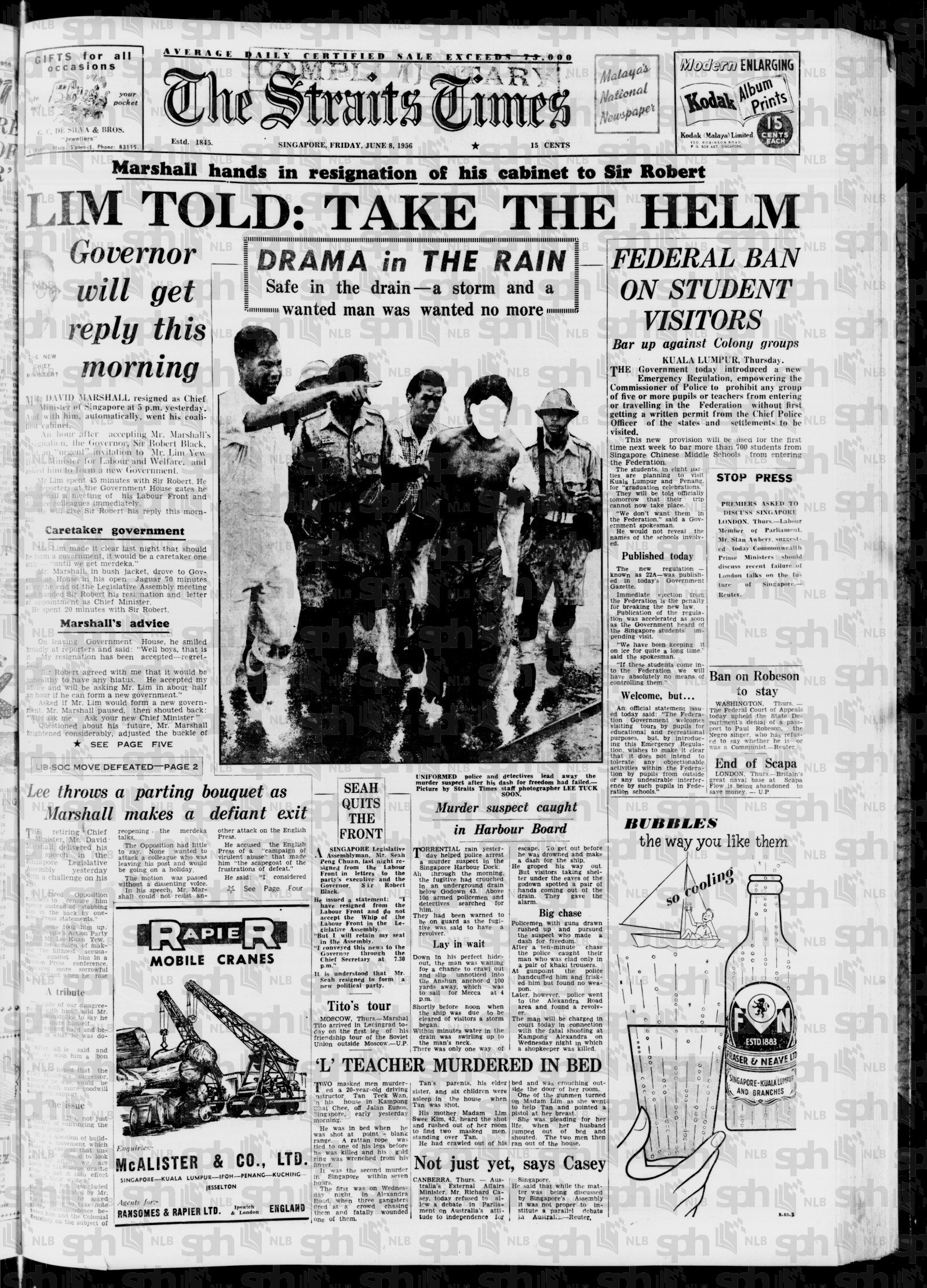 Front page of The Straits Times, 8 June 1956. (Singapore Press Holdings, via NewspaperSG, National Library Board Singapore, public domain)
On 7 June Marshall moved a motion in the Legislative Assembly asking members to endorse the delegation’s rejection of Britain’s terms. The Liberal Socialist Party proposed an amendment declaring that the British offer should have been accepted as an interim measure, because it was a considerable constitutional advance. The amendment found a single supporter outside the party’s own ranks and was defeated by 18 votes to 6, and the Assembly then backed Marshall’s motion. Two hours after the Assembly rose, he submitted his resignation to the Governor.
The Straits Times editorial the next day said that his resignation “comes as close to anti-climax as resignation could ever be,” and reported that the Governor had invited Lim Yew Hock to take over. On the same front page, the paper reported that a member of the Assembly, Seah Peng Chuan, had resigned from the Labour Front. Lim Yew Hock became Chief Minister on 8 June.
What followed
Lim Yew Hock led a delegation to London in March and April 1957, and the talks of 11 March to 11 April produced an agreement giving almost complete self-government, with the British keeping external security and internal security shared through a council of three members from Britain, three from Singapore and one from the Federation of Malaya. The State of Singapore Act received royal assent on 1 August 1958, and the People’s Action Party won 43 of the 51 seats in May 1959.
Marshall stayed in the Assembly as a backbencher and founded the Workers’ Party on 7 November 1957. He lost his Cairnhill seat in 1959, won the Anson by-election in 1961 and left the Workers’ Party in January 1963, losing his seat as an independent later that year. From 1978 to 1993 he served as Singapore’s ambassador to France, Portugal, Spain and Switzerland. He died on 12 December 1995.
See more historical photos related to this post →
Where it fits in the bigger story: Singapore’s road to self-government is usually told through the years after 1959. The fourteen months before them show a first elected government working out what an elected government inside a colony could actually decide, and how far the Governor, London and the Assembly’s own parties would let it go. The internal security council that failed in 1956 was settled on different terms the year after, with a seat for the Federation of Malaya, and the disagreement over that council was what ended Marshall’s time in office.
Sources
- Chief ministership of David Marshall, Wikipedia
- David Marshall (Singaporean politician), Wikipedia
- 1955 Singaporean general election, Wikipedia
- Hock Lee bus riots, Wikipedia
- 1956 in Singapore, Wikipedia
- Self-governance of Singapore, Wikipedia
- “Labour wins, Marshall will be Chief Minister,” The Sunday Times, 3 April 1955, page 1, NewspaperSG
- “All say, no coalition,” The Straits Times, 4 April 1955, page 1, NewspaperSG (gallery)
- “Voters battle the police,” The Straits Times, 13 May 1955, page 1, NewspaperSG
- “The talks fail,” The Straits Times, 16 May 1956, page 1, NewspaperSG (gallery)
- “Lim told: take the helm,” “Censure move by Lib-Socs is defeated” (page 2), “Lawyers’ memo on free aid Bill” (page 5), “3-booth plan in Assembly” (page 6) and “Mr. Marshall Passes On” (page 8), The Straits Times, 8 June 1956, NewspaperSG
- File:Singaporean delegation at the 1956 constitutional talks.png, Wikimedia Commons
- File:David Marshall as a prisoner-of-war, 1944.png, Wikimedia Commons
- File:David Marshall, 1956 (cropped).png, Wikimedia Commons
- File:Lim Yew Hock and David Marshall, 1956 (cropped).png, Wikimedia Commons (gallery)
- File:Lim Yew Hock, 1956 (cropped).png, Wikimedia Commons (gallery)
- File:David Saul Marshall, 1930s (cropped).jpg, Wikimedia Commons (gallery)
- File:David Marshall with “B” Company during WWII.jpg, Wikimedia Commons (gallery)
- File:David Marshall, 1952.jpg, Wikimedia Commons (gallery)
- File:David Marshall, 1920s.png, Wikimedia Commons (gallery)


