Song Ong Siang: The Chronicler Who Became Singapore's First Chinese Knight
If you have read much history of the Singapore Chinese, you have almost certainly relied on a 602-page book published in London in 1923, at £12 a copy. Its author, Song Ong Siang, was a lawyer, a magazine editor, a volunteer captain and eventually a knight, and yet few people today know his name.
 Song Ong Siang in academic dress with his wife, Helen Yeo, from the frontispiece of his 1923 book. (Song Ong Siang, One Hundred Years' History of the Chinese in Singapore, public domain, via Wikimedia Commons)
He was born in Singapore on 14 June 1871 into a Straits Chinese family, the locally born, English-educated Chinese community also called the Peranakans. His father, Song Hoot Kiam, was a Presbyterian who founded the Chinese Christian Association in 1889. Song went to Raffles Institution from 1878, won the Guthrie Scholarship five times, and was head prefect at fifteen.
The schoolboy who was too young
The great prize for a bright colonial schoolboy was the Queen’s Scholarship, which paid for study in Britain. Song came first in the examination in both 1886 and 1887 and was passed over each time because he was under the age limit. Lim Boon Keng, later his collaborator, won in 1887 and became the first Chinese Queen’s Scholar. Song finally took the scholarship in 1888, and he was the only Chinese Queen’s Scholar to read law in England.
Cambridge and the Bar
He entered the Middle Temple in 1888 and went up to Downing College, Cambridge, in 1890, taking a second-class law degree. He was called to the English Bar in June 1893, and on 20 March 1894 he was admitted to the Singapore Bar, the first Chinese barrister there. With his Cambridge classmate James Aitken he founded the firm Aitken & Ong Siang, and after Aitken’s death in 1928 he became the doyen of the local Bar. A tribute in the Straits Times in 1936 described him as a lawyer who preferred quiet chamber work to the courtroom, whose desk was “usually piled high with papers.”
A magazine, an association and a school
Song’s public life ran alongside his practice. In 1894 he started a short-lived newspaper in Romanised Malay, Bintang Timor. In 1897 he and Lim Boon Keng launched the Straits Chinese Magazine, an English-language quarterly that ran until 1907 and folded for lack of funds. In 1899 the two men helped found the Singapore Chinese Girls’ School, and in 1900 Song was secretary when the Straits Chinese British Association was formed with Lim, Tan Jiak Kim and Seah Liang Seah.
 Lim Boon Keng, Song's co-editor at the Straits Chinese Magazine, in the 1930s. (Lee Brothers Studio, public domain, via Wikimedia Commons)
He was also a soldier of sorts. When the Chinese company of the Singapore Volunteer Infantry was formed in 1901, he was among its original members, and in 1902 he was one of seven men chosen to represent it in the Straits contingent at King Edward VII’s coronation. He was promoted captain in 1915. He served on the Legislative Council as an unofficial member from 1921, with a break, until 1927, and he sat on a 1926 committee on Chinese marriage that backed monogamy, a reform that led eventually to the Civil Marriage Ordinance of 1941.
Three years of incessant toil
The book began small. Singapore’s 1919 centenary called for a commemorative volume, One Hundred Years of Singapore, and Song was asked to write two or three chapters on the Chinese, after Lim Boon Keng declined and recommended him. The chapters grew into a full chronological history. Working with two assistants and members of the Straits Chinese Reading Club, he spent about three years going through old newspapers and asking prominent families for sketches of their forebears.
 Song Hoot Kiam, the author's father, in a plate from the book. (Song Ong Siang, One Hundred Years' History, 1923, CC BY-SA 4.0, via Wikimedia Commons)
It was finished in 1922, but the cost of printing was daunting. Song arranged for John Murray to publish it in London, and it appeared in November 1923 at £12 a copy, more than a month’s wages for most Chinese workers. Subscriptions were poor until an open letter from the Reverend William Murray in the Straits Times helped rescue it. The dedication, which the paper later quoted, thanked his late father and his wife, whose “encouragement and help” had sustained him through “three years of incessant toil.” The Times Literary Supplement reviewed it enthusiastically.
What made it valuable was its portraits and biographies of the merchants, planters and community leaders who built the colony, many of whom appear nowhere else. This blog has leaned on it for its portrait of pineapple magnate Lim Nee Soon in the pineapple kings post, among other things.
The knight
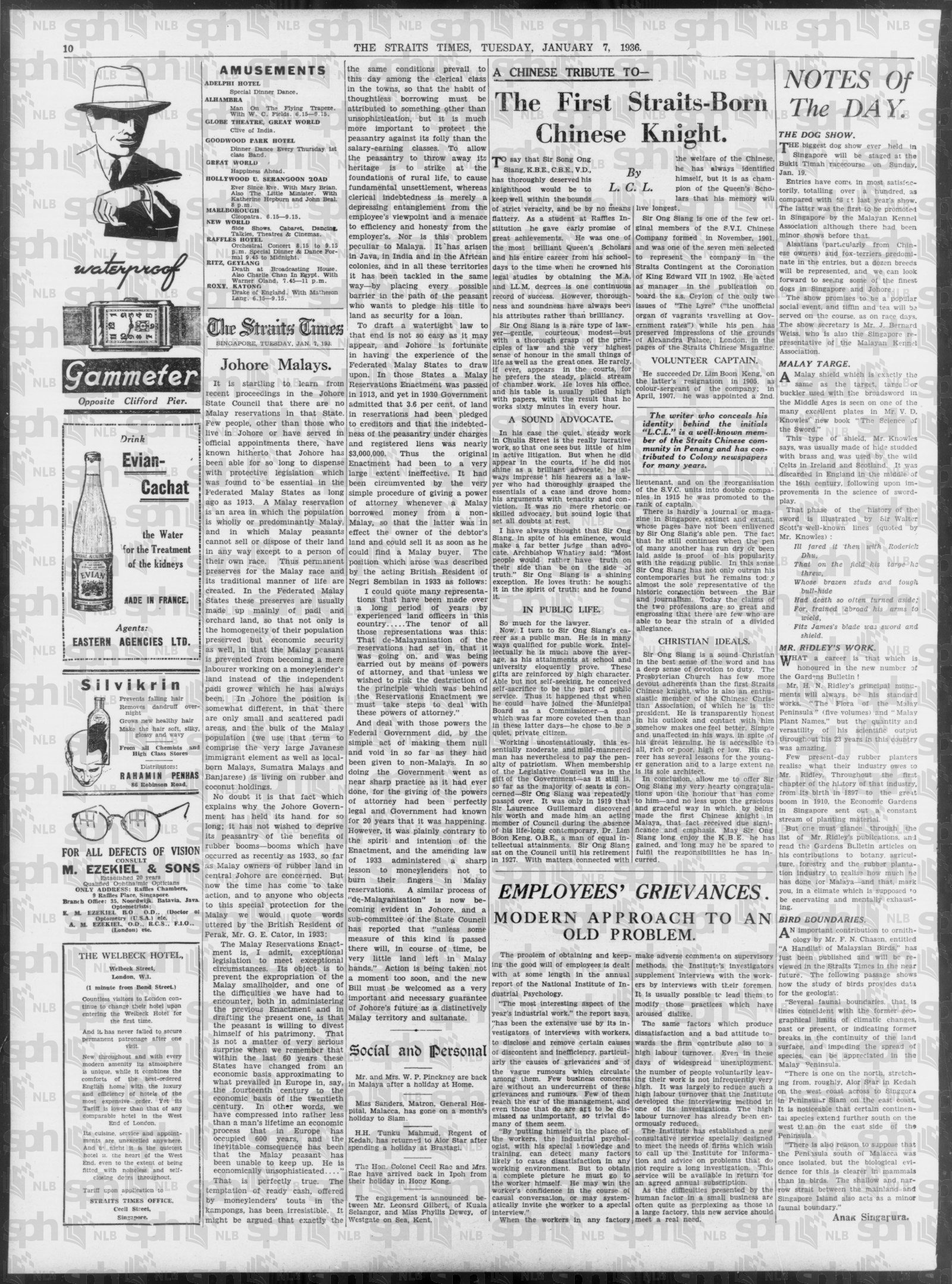 Page 10 of The Straits Times, 7 January 1936, carrying "A Chinese Tribute to the First Straits-Born Chinese Knight." (Singapore Press Holdings, via NewspaperSG, National Library Board Singapore, public domain)
He was knighted in the New Year Honours of 1936, and the Straits Times reported it under the sub-head “First Chinese Knighthood In Malaya.” A week later the paper ran a tribute by a Penang Straits Chinese writer signing himself “L.C.L.”, who called him “The First Straits-Born Chinese Knight” and praised his gentleness, modesty and “very highest sense of honour in the small things of life.”
Song was proud of a description of his community as “the King’s Chinese,” and the paper later quoted a tribute to his “simultaneous loyalty” to his own community and to the Throne.
The end
Ill health withdrew him from public life in his last years. He died on 29 September 1941, and the next day the Straits Times published an editorial headed “A Great Gentleman,” declaring that no citizen, Asian or European, was more worthy of honour. His funeral was held with military honours, and his coffin, under a Union Jack, was drawn on a gun carriage to Bidadari. His firm was dissolved at the end of 1941, when the Japanese invasion of Malaya was already under way.
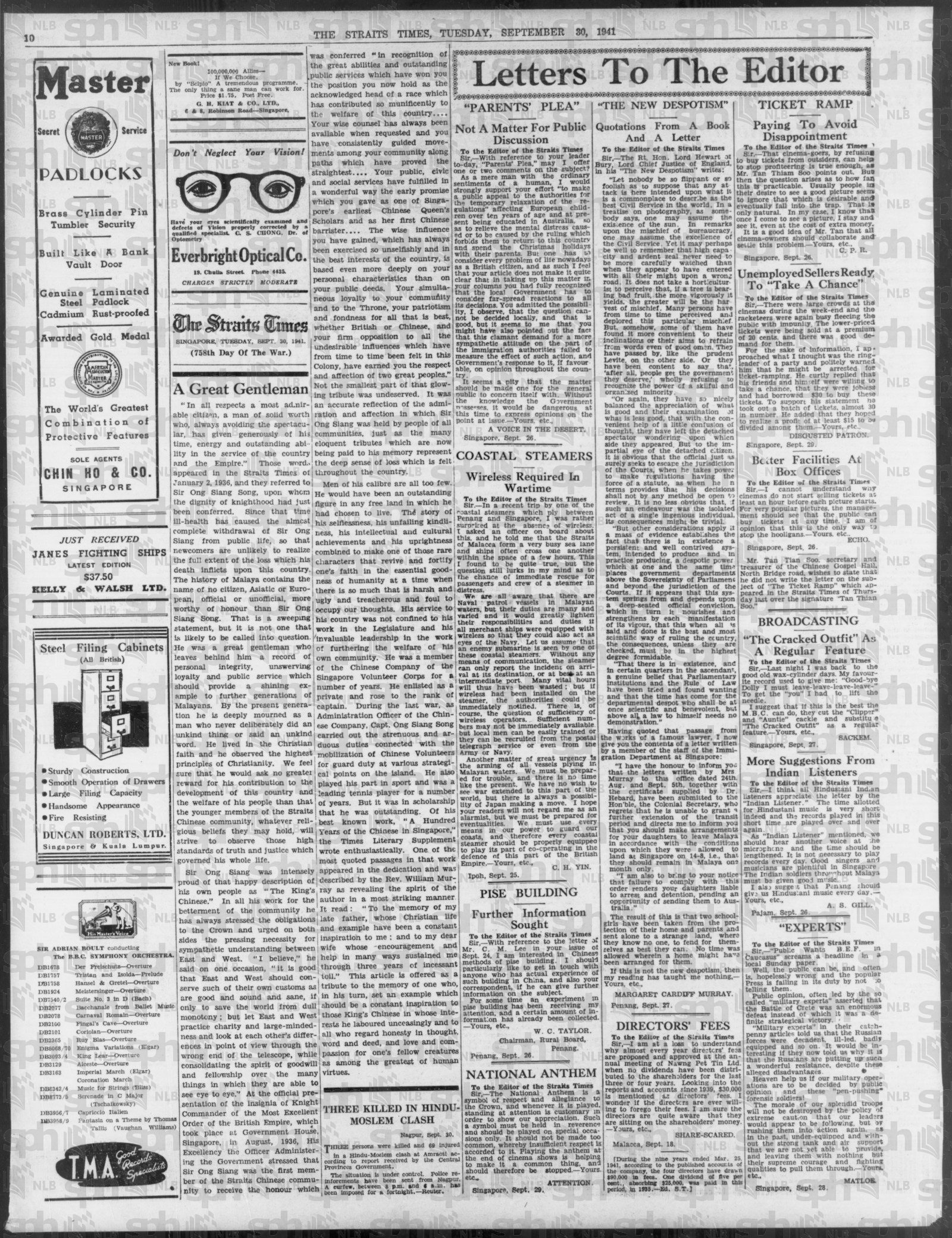 Page 10 of The Straits Times, 30 September 1941, with the editorial "A Great Gentleman" at left. (Singapore Press Holdings, via NewspaperSG, National Library Board Singapore, public domain)
A chronicler with blind spots
Scholars have judged the book differently. Paul Wheatley, writing in 1969, thought it concentrated on the English-educated Straits Chinese elite and said almost nothing about the labourers who made up most of the community. James Warren, who wrote on the lives of poorer Chinese, argued that it records more about ordinary Chinese than most earlier works. Both views describe the same sprawling book, and historians of the period still turn to it.
I found no single explanation for why its author is remembered so much less than his book. What the record does show is a man who spent a lifetime building institutions for his own community, wrote its history when nobody else had, and was mourned by people of every community when he died.
See more historical photos related to this post →
Why it matters today: Much of what Singapore knows about its nineteenth-century Chinese pioneers comes from one book written by a man most Singaporeans could not name. Song Ong Siang is a reminder that the history we inherit was compiled by particular people, with particular loyalties and blind spots, and that they deserve to be read as carefully as the events they recorded.
Sources:
- “The First Straits-Born Chinese Knight,” The Straits Times, 7 January 1936, page 10, NewspaperSG
- “A Great Gentleman,” The Straits Times, 30 September 1941, page 10, NewspaperSG
- “Malayan & Home New Year Honours Lists in Full” (“First Chinese Knighthood In Malaya”), The Straits Times, 2 January 1936, page 13, NewspaperSG issue index
- The King’s Chinese: The Life of Sir Song Ong Siang, BiblioAsia, National Library Board, 2020
- One Hundred Years’ History of the Chinese in Singapore, BiblioAsia, National Library Board, 2016
- Song Ong Siang, Wikipedia
- Sir Song Ong Siang, British Empire
- Lim Boon Keng, Edinburgh Global, University of Edinburgh
- File:Mr and Mrs Song Ong Siang, 1923.png, Wikimedia Commons
- File:Lim Boon Keng, 1930s.jpg, Wikimedia Commons
- File:Song Hoot Kiam.jpg, Wikimedia Commons
- File:Tan Kim Ching.jpg, Wikimedia Commons
- File:Sir Song Ong Siang, 1923 (cropped).png, Wikimedia Commons
- File:Seah Eu Chin.jpg, Wikimedia Commons
- File:Wee Boon Teck.jpg, Wikimedia Commons


