When Singapore Led the World in Canned Pineapple
In 1912, ships leaving Singapore carried more than half a million cases of canned pineapple, and for the first decades of the twentieth century the island was the largest producer and exporter of canned pineapple in the world. The fruit is almost absent from the way Singapore tells its own economic story now, which tends to start with rubber, tin and the port. Yet pineapple came first. It filled some of the island’s earliest factories, and it seeded at least three of the largest Chinese business fortunes in the region — fortunes whose names are still attached to a town, a run of schools and universities, and a charitable foundation that is still giving money away today.

Tan Kah Kee, Lee Kong Chian and Tan Lark Sye in 1946. Two of the three built their first fortunes on canned pineapple. (Tan Kah Kee Memorial Museum, via the National Archives of Singapore / Wikimedia Commons, public domain)
A crop that paid for rubber

A pineapple plantation on Buona Vista Road, Singapore, around 1910 — rows of pineapple on land also being cleared for rubber. Photographed by C. J. Kleingrothe. (KITLV / Leiden University Library, via Wikimedia Commons, public domain)
Pineapple reached commercial scale in Malaya in the 1880s, and it took hold for a practical reason. A rubber tree yields nothing for its first five to seven years, which is a long time to carry an estate with no income. Pineapple fruits in about eighteen months, needs little capital, and grows in the same poor lateritic soil. Planters took to setting the two out together, with rows of pineapple between the young rubber, the fruit covering the estate’s costs until the trees were ready to tap. Historians of the industry call it catch-cropping, and it made pineapple less a crop in its own right than the thing that made rubber affordable to plant.
The canneries followed the plantations. Pineapple canning became one of Singapore’s first manufacturing industries, clustered along the Singapore River around Clarke Quay and later spreading to Sembawang, Rochor and Serangoon. Some were large operations. One cannery run by a Corsican-Italian named J. P. Bastiani was turning out five thousand cans a day at its peak. Most were Chinese-owned, and a handful of the owners became very rich. Local lore later grouped four of them together as the “pineapple kings”: Tan Tye, the earliest, who arrived in 1860 and ran canneries at Clarke Quay; and the three whose names outlasted the fruit.


“Chinese Pine-apple Factory (inside), Singapore” — baskets of peeled fruit, stacked cans, workers at their stations. (Agricultural Bulletin of the Straits and Federated Malay States, 1904; Biodiversity Heritage Library / Harvard University Botany Libraries, via Wikimedia Commons, public domain)
 Lim Nee Soon (1879–1936), from Song Ong Siang's "One Hundred Years' History of the Chinese in Singapore" (1923). (National Library Board / World Scientific, CC BY-SA 4.0; the portrait itself is long out of copyright)
Lim Nee Soon
The name a Singaporean is most likely to half-recognise, without knowing why, is Lim Nee Soon. He was born in Singapore in 1879 to a Teochew family with roots in Shantou, founded his own firm in 1911, and built up large estates in the north of the island — Sembawang, Chong Pang, Bah Soon Pah, and the district that came to carry his name. He planted rubber and pineapple across them, advised other estate owners, ran a transport business, and served two terms as president of the Singapore Chinese Chamber of Commerce. The newspapers called him the “Pineapple King.” He died in Shanghai in 1936 and was buried in Nanjing, near Sun Yat-sen’s mausoleum, a measure of how deep his ties to the Chinese nationalist movement ran.
His estates became Yishun New Town. “Nee Soon” and “Yishun” are the same two Chinese characters: the first is the Teochew reading of his given name, the second the Mandarin. Nee Soon Road was gazetted in 1950, and the district kept the older form for decades. When Singapore standardised place names to their Mandarin readings in the 1980s, in the years after the Speak Mandarin Campaign began, Nee Soon on the map became Yishun. The change drew public complaints at the time, and the older name never fully went away. It survives on Nee Soon Road, at Nee Soon Camp, and in the Nee Soon electoral division.
I spent most of my national service at Khatib Camp, a few minutes from there, and on weekends we would go into Nee Soon for a meal. It never once occurred to me that the place was named after a person.
 Tan Kah Kee (1874–1961) as a young man, photographed by the Lee Brothers Studio, around the 1910s–1920s. (National Archives of Singapore / Wikimedia Commons, public domain)
Tan Kah Kee
The largest of the pineapple fortunes belonged to Tan Kah Kee, and pineapple is where it began. He came from Fujian in 1890 and joined his father’s rice business, which failed around 1904. With a few thousand Straits dollars he opened a small pineapple cannery in Sembawang, then a second, then a third by the Rochor River, and used the proceeds to move into rubber — first plantations, then the manufacturing that made him one of the wealthiest men in Southeast Asia. By the mid-1920s his companies ran some fifteen thousand acres of rubber, dozens of factories, and a workforce in the tens of thousands.
Then it came apart. The Depression pushed rubber and pineapple prices down together, his businesses could not carry their debts, and in 1934 the group was wound up. He is remembered instead for what he did with the money while he had it. He founded The Chinese High School in Singapore in 1919 and Xiamen University in China in 1921, and he funded schools across Fujian and the diaspora, by one count more than a hundred institutions. During the war he led the overseas Chinese fundraising drive against Japan, which put him high on the Kempeitai’s wanted list and forced him out of Singapore in 1942. He left for China for good in 1950, took a role in the government there, and died in Beijing in 1961.
 Lee Kong Chian (1893–1967), around 1946. (Tan Kah Kee Memorial Museum, via the National Archives of Singapore / Wikimedia Commons, public domain)
Lee Kong Chian
The third fortune grew straight out of the second. Lee Kong Chian arrived in Singapore from Fujian as a boy in 1903, went to work for Tan Kah Kee, and in 1920 married his eldest daughter. He then built his own group: Lee Rubber, founded in the late 1920s, which became one of the largest rubber businesses in the region, and Lee Pineapple, which he and his brother assembled from existing canneries around 1930. He later chaired OCBC and served as the first pro-chancellor of the University of Malaya.
Lee Pineapple is the reason any of this is more than history. As the plantations and canneries left Singapore for Johor after the war, the company went with them and kept canning pineapple at a factory in Skudai, just across the Causeway. It ran there for ninety-two years. Only at the end of 2023 did it stop canning pineapple and turn the land over to oil palm, which is, fittingly, the crop that displaced pineapple almost everywhere else. Lee also set up the Lee Foundation in 1952, and it remains one of Singapore’s largest private funders of education and welfare. His name is on the National Library’s reference library, on a medical school, on a natural history museum, and on a business school.
Why it vanished from Singapore
Singapore’s part of the industry did not so much collapse as get priced out. Pineapple is a land-hungry crop with thin margins, and on an island where land was about to become some of the most valuable in the world, an acre of pineapple could not compete with an acre of anything else. The plantations were subdivided and built over from the 1950s onward, the canneries followed the fruit north to Johor, and by the 1960s there was no pineapple industry left in Singapore to speak of. Malaya’s own canning industry peaked in the late 1960s, when the country was the world’s third-largest exporter of canned pineapple, and then fell away in turn as rubber and oil palm drew off the land and the capital, and as Thailand, the Philippines and Indonesia took over the world market.
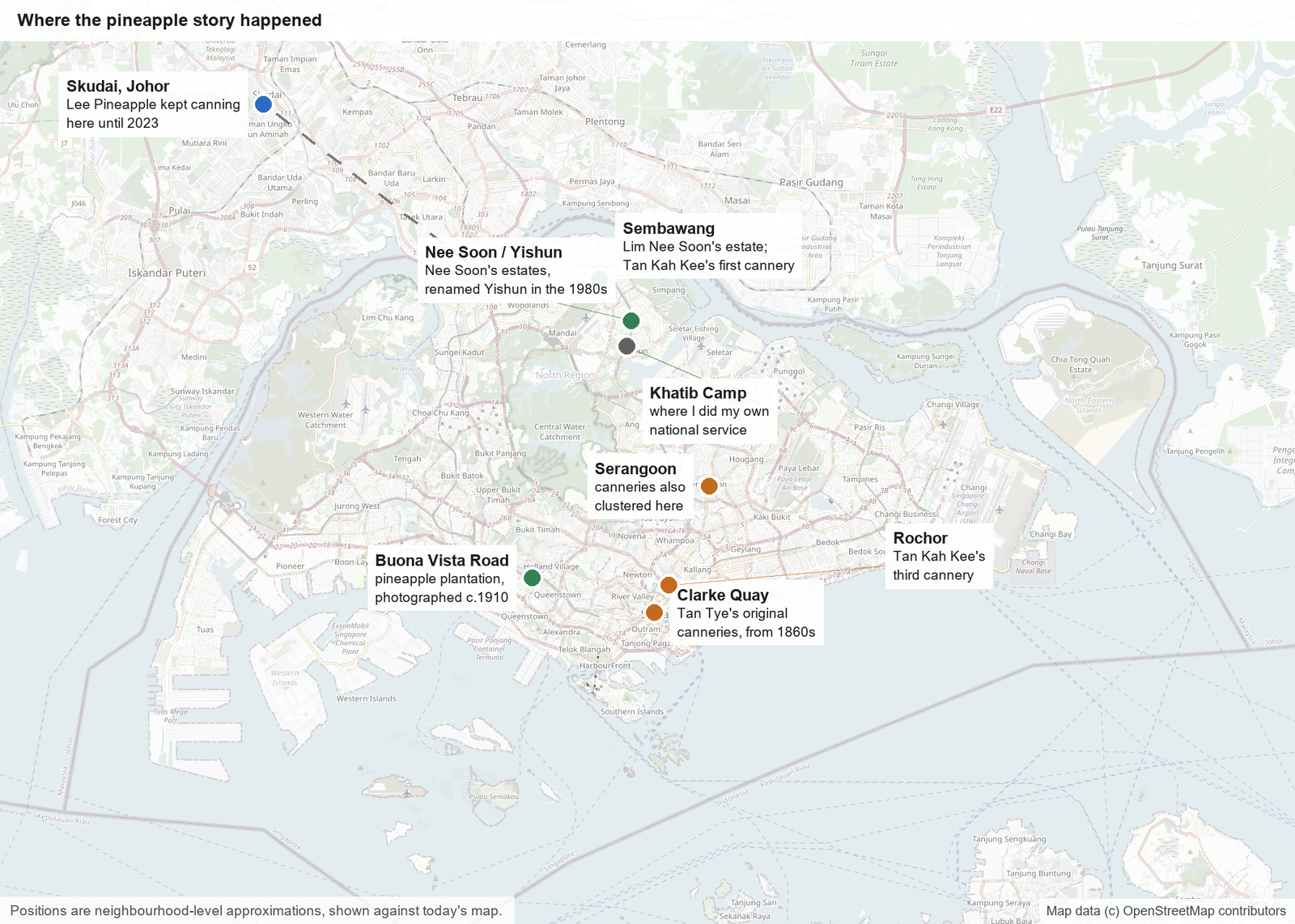
How spread out the story was: canneries clustered around the Singapore River, Lim Nee Soon’s and Tan Kah Kee’s estates in the north of the island, and — the one place this is not purely history — Lee Pineapple’s factory just across the Causeway in Skudai, Johor, which kept canning until 2023. (Map data © OpenStreetMap contributors)
Timeline as a table
| Year | Event |
|---|---|
| 1888 | Pineapple planted at commercial scale in Malaya |
| c.1904 | Tan Kah Kee opens his first Sembawang cannery |
| 1912 | Singapore ships about 580,000 cases; world's largest exporter of canned pineapple |
| 1920s | Industry begins shifting north to Johor |
| 1934 | Tan Kah Kee's empire wound up in the Depression |
| 1936 | Lim Nee Soon dies |
| 1960s | No pineapple industry left in Singapore |
| late 1960s | Malaysia is the world's third-largest exporter of canned pineapple |
| 1980s | Nee Soon renamed Yishun |
| 2023 | Lee Pineapple stops canning pineapple at Skudai after 92 years |
See more archival photographs of the pineapple kings and their institutions →
Where it fits in the bigger story: The pineapple industry is a rare case of something genuinely large being written almost entirely out of the national memory. There is no monument to it, no museum on this side of the Causeway, nothing on the map that reads as “pineapple.” What is left instead is indirect: the name of a town that most people no longer connect to a man, a foundation still signing cheques seventy years on, and a tin of pineapple tarts that comes out once a year without anyone thinking about where the fruit in it used to come from.
Sources:
- Lim Nee Soon — Singapore Infopedia, National Library Board
- Lim Nee Soon — Wikipedia
- Lee Kong Chian — Singapore Infopedia, National Library Board
- Tan Kah Kee — Roots.gov.sg
- Biography — Tan Kah Kee Foundation
- Pineapple — Singapore Infopedia, National Library Board
- The History of the Pineapple Industry in Singapore, 1900s–1930s — Singapore Chinese Chamber of Commerce & Industry
- The French Can: Pineapples, Sardines and the Gallic Connection — BiblioAsia, National Library Board
- Singapore Cannery Pioneers — the Four Heavenly Kings of Pineapple — Johor Kaki
- End of an era: Singapore’s Lee Pineapple to shutter Johor factory after 92 years — AsiaOne
- Who We Are — Lee Pineapple
- Rejuvenating the Malaysian Pineapple Industry — International Society for Horticultural Science
- Yishun — Wikipedia
- Yishun — SG101
- File:Tan Kah Kee, Lee Kong Chian, and Tan Lark Sye, 1946.png — Wikimedia Commons
- File:Lim Nee Soon.png — Wikimedia Commons
- File:年轻的陈嘉庚.jpg — Wikimedia Commons
- File:Lee Kong Chian, 1946.png — Wikimedia Commons
- File:KITLV - 79906 - Kleingrothe, C.J. - Medan - Pineapple plantation in the Buona Vista Road, Singapore - circa 1910.tif — Wikimedia Commons
- File:Agricultural bulletin of the Straits and Federated Malay States. New series (1902) (17944867551).jpg — Wikimedia Commons
- File:Agricultural bulletin of the Straits and Federated Malay States. New series (1902) (17756609000).jpg — Wikimedia Commons
- File:Agricultural bulletin of the Straits and Federated Malay States. New series BHL43583042.jpg — Wikimedia Commons
- Map data © OpenStreetMap contributors


