Linggiu Reservoir: The Dam Singapore Built Inside Another Country to Secure Its Own Water
In 1962 Singapore signed a treaty guaranteeing it up to 250 million gallons of water a day from the Johor River, a legal right that runs until 2061. That guarantee turned out not to be enough on its own. In November 1990 Singapore agreed to pay the entire cost of building a dam and reservoir inside Johor — land it didn’t own and had no authority over — for no reason other than to make sure the treaty it already held would actually keep working.

The Johor River at Kota Tinggi — the stretch of river the 1962 agreement, and the dam built decades later to protect it, both exist to serve. (Chongkian, CC BY-SA 4.0, via Wikimedia Commons)
This blog told part of this story already, in a post about Marina Barrage — the dam Singapore eventually built at home to end its water dependency for good. Linggiu Reservoir is an earlier, quieter chapter of that same anxiety, and the fix this time wasn’t built in Singapore at all.
A promise with a weak point
The 1962 Johor River Agreement, signed alongside the 1961 Tebrau and Scudai Rivers Agreement, gave Singapore the legal right to draw up to 250 million gallons of raw water a day from the Johor River, at three Malaysian cents per thousand gallons — a price fixed for the life of the deal. But a treaty right is not the same thing as water that’s actually there to draw. Singapore’s extraction point sits at Kota Tinggi, close enough to the sea that in a dry spell, when the river’s flow drops, seawater pushes back upstream past the intake and the water arriving at the pumps turns too saline to treat. No agreement, however watertight on paper, could stop a river from running low.
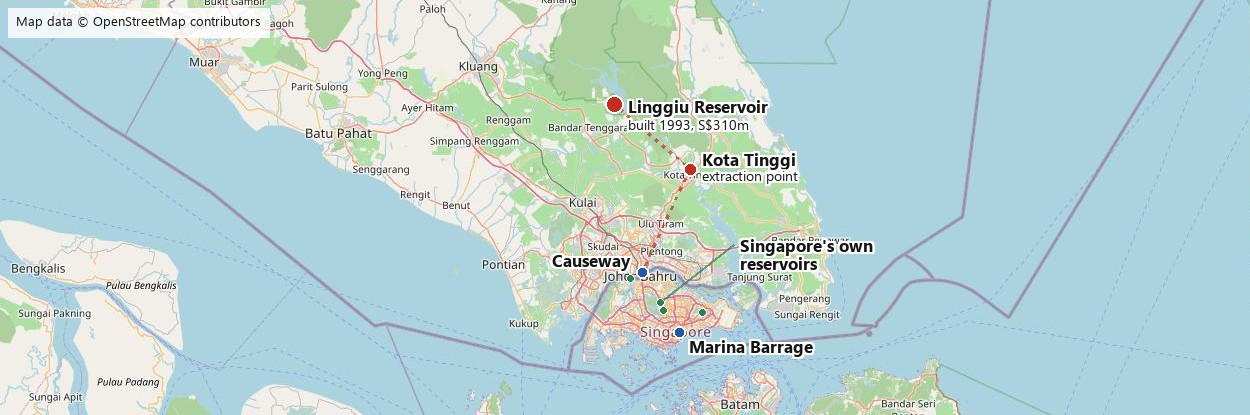
Linggiu Reservoir sits roughly 120 km north of the Causeway, well upstream of the Kota Tinggi extraction point it exists to protect — a long way to reach for a single intake, compared with how tightly clustered Singapore’s own reservoirs are. (Map data © OpenStreetMap contributors)
Paying to protect a promise already owed
Singapore’s answer was to control the river itself. From 1989, its Public Utilities Board began work on a dam across Sungai Linggiu, a tributary that feeds the Johor River upstream of the Kota Tinggi intake — holding back wet-season flow and releasing it during dry spells to keep the river fresh enough, that far downstream, to draw at all. An environmental impact assessment, contested for a time between the two governments over who had actually commissioned it, concluded in September 1990 that the project’s benefits outweighed its costs. The supplementary Water Agreement covering it was signed on 24 November 1990, between Singapore’s PUB and the Johor state government. Johor’s Mentri Besar at the time, Muhyiddin Yassin — later Malaysia’s prime minister — said publicly that the new deal would ease some of the friction the original 1962 agreement had caused.
Singapore bore the full cost, construction and maintenance both, of infrastructure sitting entirely inside another country. Prime Minister Goh Chok Tong made a short working visit to Johor in February 1991 specifically to see the work in progress, and Johor’s Department of Environment assured the public that the valley’s flora and fauna would not be destroyed when the site was flooded. The dam, its reservoir and the surrounding saddle embankments were completed in April 1993, at a total cost of S$310 million — paid entirely by Singapore, for a facility it did not, in the end, own outright. The same 1990 agreement also let Singapore draw beyond the daily 250-million-gallon cap when it needed to, with the extra water treated in Johor and priced by a separate formula. But the dam’s real purpose was defensive: keep enough water moving down the Johor River, even in a drought, to protect an entitlement Singapore already had on paper.
When the reservoir itself ran dry
The dam did its job quietly for two decades, until a regional drought made its limits visible. Through 2015 Linggiu Reservoir’s water level fell steadily — from just over half full in August to 41 per cent by October. In the middle of that same drought, Singapore’s response was to agree to supply Johor with more treated water, not less; Johor’s own taps were running low too, and the two countries’ water systems turned out to be tied together in both directions, not just one. By April 2016 Linggiu had fallen to a new record low of 36.9 per cent, and for the first time in years Singapore officials found themselves talking publicly about just how much of the country’s daily supply still depended on a reservoir whose rainfall it had no control over, dam or no dam.
A tap among four
Singapore’s real answer to that vulnerability, in the end, wasn’t a bigger dam. Weeks into the same 2015 drought, PUB announced a fourth desalination plant for Marina East — one piece of the “Four National Taps” strategy (local catchment, imported water, NEWater, and desalination) that has spent two decades quietly shrinking how much of Singapore’s water still needs to cross the Causeway at all. Linggiu Reservoir still supplies water to Singapore today, and the 1962 agreement behind it doesn’t expire until 2061. But the reservoir Singapore once paid S$310 million to build, on land it didn’t own, purely to protect a promise it was already owed, is no longer the last line of defence it was built to be — just one tap of four.
Timeline as a table
| Year | Event |
|---|---|
| 1961 | Tebrau and Scudai Rivers Agreement signed (2 October) |
| 1962 | Johor River Agreement signed, entitling Singapore to up to 250 million gallons of raw water a day |
| 1990 | Supplementary Water Agreement signed (24 November), approving the Linggiu dam, built and paid for entirely by Singapore |
| 1993 | Linggiu Dam and Reservoir completed (April), at a cost of S$310 million |
| 2016 | Linggiu Reservoir's water level falls to a record low of 36.9% amid a regional drought (April) |
| 2061 | The 1962 Johor River Agreement, and the Linggiu arrangement built to protect it, are due to expire |
Why it matters today: most people who know anything about Singapore’s water story know Marina Barrage or NEWater — visible, homegrown, built entirely on Singapore’s own soil. Almost nobody remembers that decades earlier, the country’s answer to the same anxiety was to reach across a border and build a dam inside someone else’s country, just to keep a treaty promise it already had. Malaysia still supplies roughly half of Singapore’s water demand today. PUB’s own target is to close that gap entirely by around 2060, when NEWater and desalination together are projected to meet some 80 per cent of demand, with local catchment covering the rest — a year before the 1962 agreement itself even expires. Linggiu Reservoir was never meant to be the permanent answer, only a very expensive way of buying time until the rest of the country’s own taps could catch up; on the timeline Singapore has set for itself, that time is almost gone.
Sources:
- Water Agreements, Ministry of Foreign Affairs, Singapore
- Singapore-Malaysia water agreements, Singapore Infopedia, National Library Board
- Singapore signs a new water agreement with Johor, Singapore History, National Library Board
- “WORK ON DAM STARTS,” The New Paper, 5 August 1989
- “Confusion over Sungai Linggiu dam study,” The Straits Times, 29 July 1989
- “Sungai Linggiu reservoir project ‘beneficial’,” The Straits Times, 28 September 1990
- “New pact will benefit Johor and reduce sensitivities: Muhyiddin,” The Straits Times, 1 December 1990
- “PM to make short visit to Johor,” The Straits Times, 27 January 1991
- “Johor assurance on dam project,” The Straits Times, 6 February 1991
- “BACKGROUND,” The New Paper, 4 April 1997
- “Fourth desalination plant to be built,” The Straits Times, 4 September 2015
- “Singapore to supply more water to Johor as drought bites,” TODAY, 21 August 2015
- “Corrections,” TODAY, 22 August 2015
- “JB downpour fails to raise reservoir level,” The Straits Times, 18 November 2015
- “Johor water level hits record low,” The New Paper, 13 April 2016
- All newspaper articles accessed via NewspaperSG, National Library Board
- Water Source Contributions in Singapore, current and projected Four National Taps figures
- File:Johor River.jpg, Wikimedia Commons
- Map data © OpenStreetMap contributors
