Marina Barrage and the End of Singapore's Water-Dependency Anxiety
A 350-metre dam sits across the mouth of the Marina Channel, nine steel gates and seven pumps standing between a freshwater reservoir and the open sea. It was finished in 2008, it created Singapore’s 15th reservoir, and today it is also the largest one on the island — built not on the fringes of the city but directly across the water from its skyline.
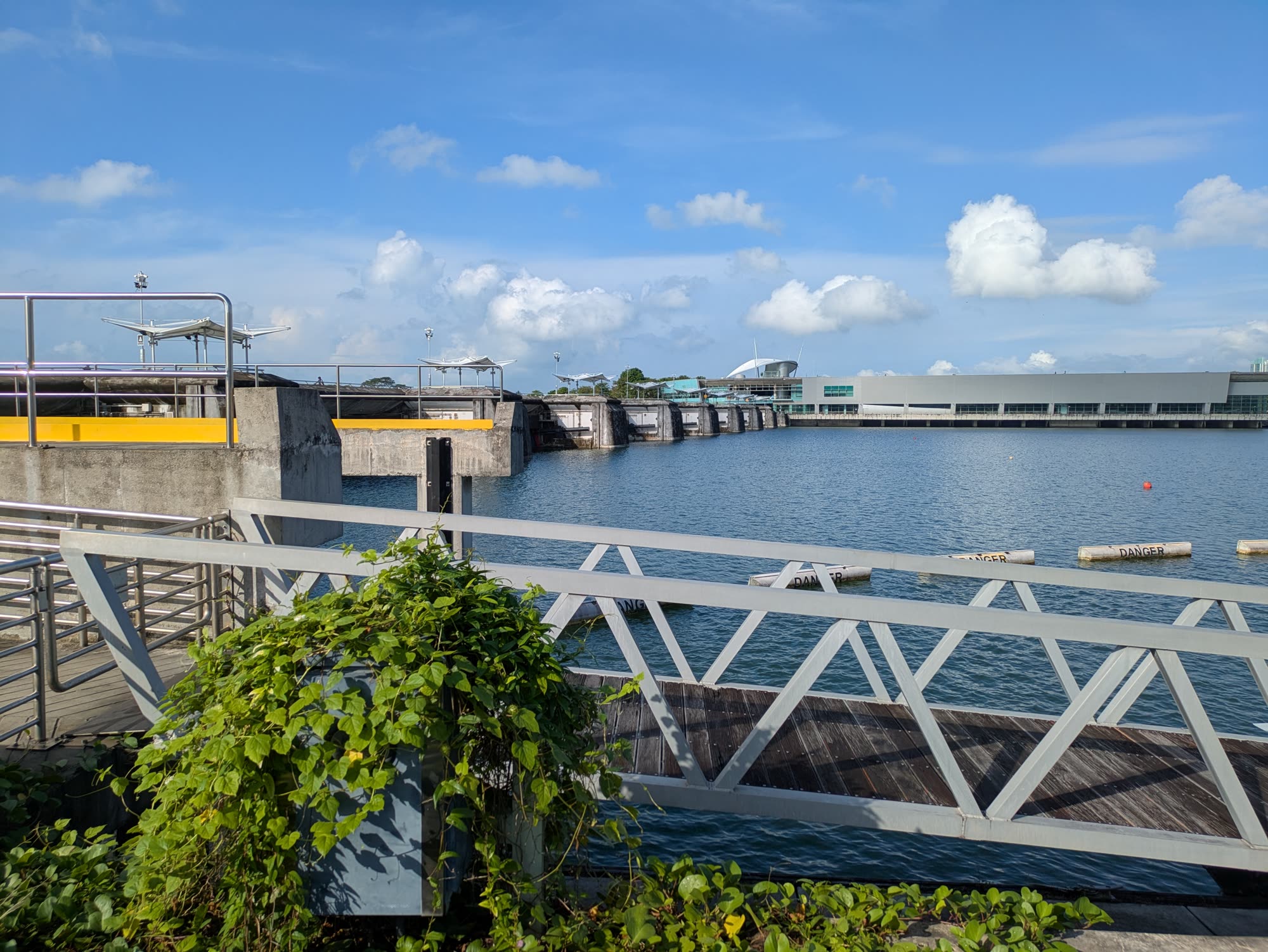
The barrage’s crest gates and pump housings, seen from the crest walkway. (Photo: Chris Lee)
Nine 30-metre, 5-metre-high crest gates span the channel, each weighing 70 tonnes. Seven drainage pumps, 28 tonnes apiece, can together move 280 cubic metres of water a second. Under normal conditions the gates stay shut, holding the reservoir level constant. When it rains hard at low tide, the gates open and gravity does the work, flushing storm runoff out to sea. When it rains hard at high tide, the gates stay shut and the pumps take over, forcing the runoff out against the incoming tide. The same mechanism that keeps the reservoir fresh also functions as flood relief for low-lying downtown districts — Chinatown, Jalan Besar, Geylang — that used to flood regularly before it existed. It is a dam, a floodgate and a pumping station, built to look, from the top, like nothing more than a long concrete promenade.
The anxiety that came before it
For most of Singapore’s history as an independent state, its fresh water has crossed a border to get here. During the Japanese invasion in February 1942, retreating British forces demolished the pipeline carrying water across the Causeway from Johor, and Singapore’s supply ran desperately short within days — a demonstration, unplanned but total, of exactly how exposed the arrangement was. Water kept crossing that same Causeway for decades afterward under two agreements: the Tebrau and Scudai Rivers Agreement, signed 2 October 1961, entitling Singapore to draw water from those rivers in exchange for returning a share of it treated; and the Johor River Agreement of 1962, entitling Singapore to up to 250 million gallons of raw water a day, on similar terms. The 1961 agreement expired in August 2011 and was not renewed. The 1962 agreement runs until 2061.
 The pipelines that still carry water across the Causeway today. (Mohamed Shaaz, CC BY-SA 2.0, via Wikimedia Commons)
The dependency was never just a matter of engineering. Days after Singapore’s separation from Malaysia in August 1965, Malaysian Prime Minister Tunku Abdul Rahman told reporters that if Singapore’s foreign policy proved prejudicial to Malaysia’s interests, “we could always bring pressure to bear on them by threatening to turn off the water in Johor.” The threat was never carried out, but Lee Kuan Yew later said it convinced him that as long as Singapore depended entirely on Malaysia for water, it would always be a satellite state, not a fully independent one. Water security stopped being a utilities question and became, in the government’s own framing, a question of sovereignty.
Building a way out
Lee Kuan Yew is credited with first conceiving a barrage across the Marina and Kallang basins as far back as 1987, two decades before it was built — a sign of how long “engineer the dependency away” had been sitting on the drawing board rather than arriving as a sudden response to any one crisis. By 2008, at a public water event, he put the underlying priority as plainly as he ever did in office: “Every other policy has to bend at the knees for our water survival.”
That priority took the eventual shape of PUB’s “Four National Taps” strategy: local catchment, imported water, reclaimed water (NEWater, launched commercially in 2003), and desalination. Each tap could be expanded or shrunk independently of the others, so no single failure — technical, political or otherwise — could leave the country dry. Marina Barrage’s contribution was to the first tap: by damming off the mouth of the Kallang Basin and Singapore River, it converted a stretch of the city’s own stormwater runoff, previously discharged straight into the sea, into a stable freshwater catchment. Combined with the smaller Punggol and Serangoon reservoirs, it added roughly a sixth of Singapore’s total land area to the island’s water catchment.
What the barrage actually changed
Construction ran from March 2005 to October 2008, at a cost of S$226 million for the barrage structure itself (a larger, roughly S$3 billion transformation of the wider Marina Bay and Kallang Basin area was under way around it at the same time, and is often quoted alongside it). Once the gates closed for good, the tidal, brackish river mouth behind them became Marina Reservoir: a 240-hectare freshwater body with a 10,000-hectare catchment, its level held constant regardless of the tide outside.

Standing on the crest itself: reservoir and skyline on one side, open sea and anchored ships on the other — the entire function of the barrage in one frame. (Photo: Chris Lee)
A level reservoir also meant the water could be used in ways a tidal river never allowed: dragon boat racing, kayaking, the National Day Parade fireworks reflected on flat water instead of mud at low tide. None of that was the reason the barrage was built, but it turned out to be one of the more visible things it enabled.
A dam most people visit without noticing
Ask most Singaporeans what Marina Barrage is, and a fair number will describe a rooftop lawn: a wide-open stretch of grass where families picnic, kids fly kites, and couples come for the skyline view, all sitting more or less directly above the gates and pump rooms doing the actual work underneath. That’s not a coincidence — the rooftop lawn is landscaped over the pumping station on purpose, part of the same brief that asked for a piece of water infrastructure that would also double as public space. Most people standing on it are enjoying exactly what they think they’re enjoying; very few are thinking about crest gates or the 1962 agreement at all.
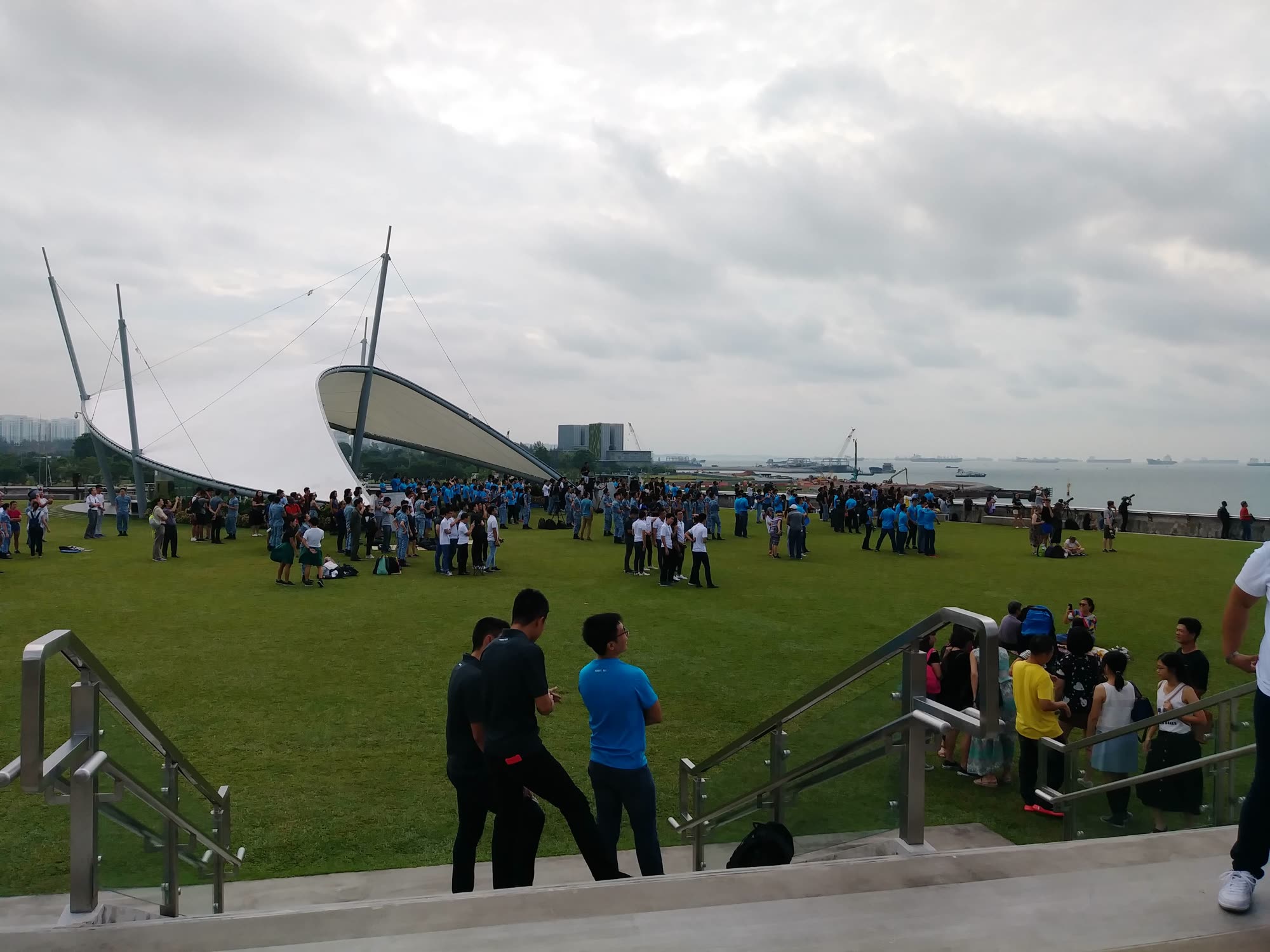
The rooftop lawn, doing its other job as a public park. (Photo: Chris Lee)
I remember the first time I actually saw it, on a visit back to Singapore after years away. What struck me wasn’t the lawn or the view — it was a real sense of pride in the accomplishment itself, and underneath that, something closer to reassurance: that the government had both the will and the ability to end a decades-long dependency, whatever it cost to do it. That’s not a small thing to feel about a piece of civil infrastructure.
It’s also, quite separately, one of the most beautiful spots in Singapore after dark. The crest gates and pump housings light up along the water, the reservoir goes still and black, and out past the barrage the anchorage lights of ships waiting offshore sit on the horizon like a second, dimmer skyline. I’ve been back a few times since that first visit, and the night view is the one that’s stayed with me.
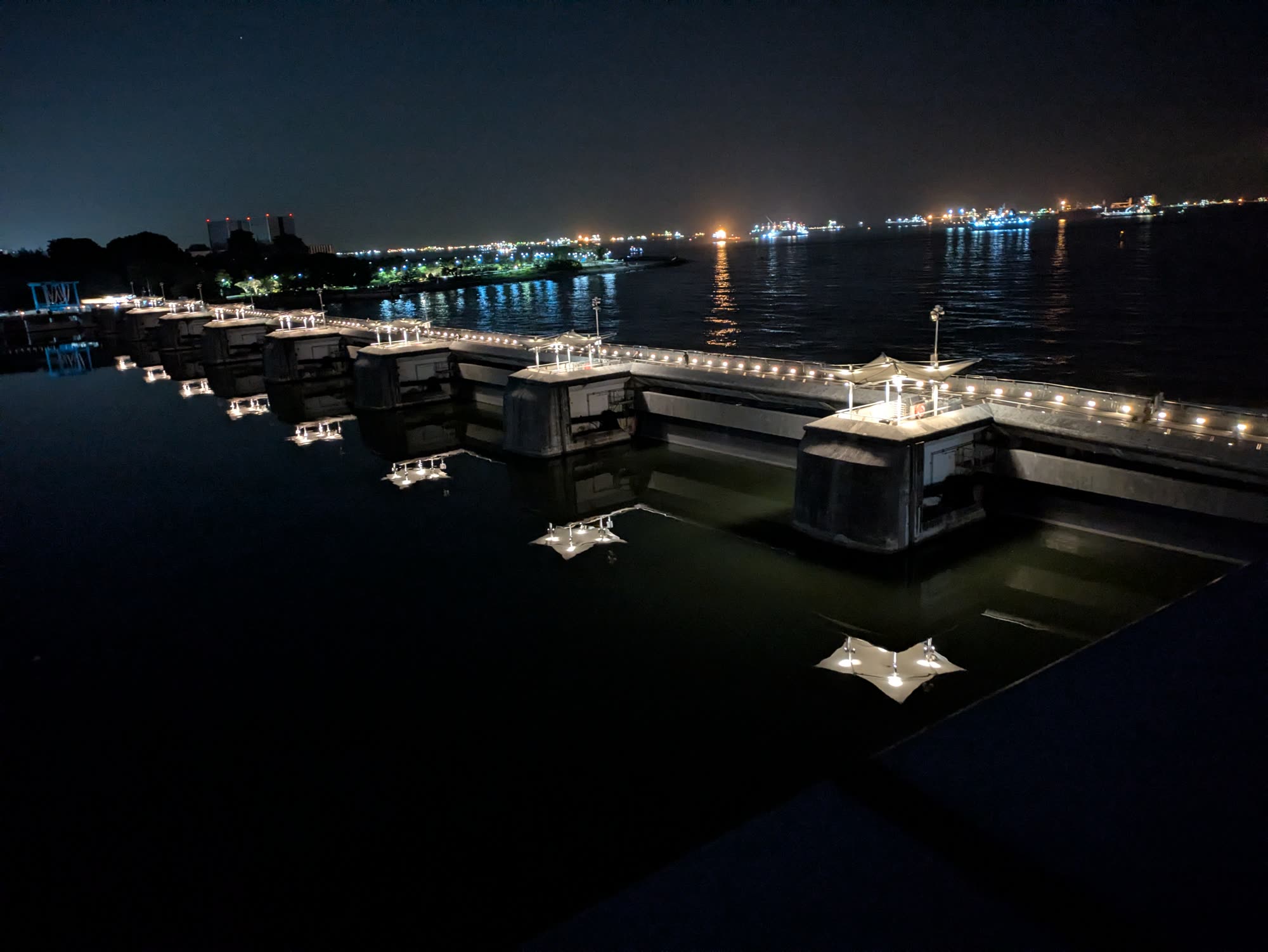
The barrage at night — reservoir dark and still on one side, anchorage lights on the horizon beyond it. (Photo: Chris Lee)
See more photos of Marina Barrage →
Why it matters today: the anxiety this post is named for hasn’t fully disappeared — the 1962 agreement still has 35 years left to run, and the Four Taps strategy is itself an ongoing balancing act, not a finished one. But the barrage is the moment that anxiety stopped being purely defensive. It’s a rare case of a government’s most existential worry getting converted, in full public view, into a place people go on a Sunday afternoon without a second thought.
Sources:
- Marina Barrage, PUB, Singapore’s National Water Agency
- Marina Barrage, Wikipedia
- Marina Barrage, Singapore Infopedia, National Library Board
- Four National Taps, Singapore Infopedia, National Library Board
- Water Agreements, Ministry of Foreign Affairs, Singapore
- Singapore-Malaysia water agreements, National Library Board
- File:Causeway pipeline.jpg, Wikimedia Commons
