St James Power Station: The Coal-Fired Station of 1926
Ask a Singaporean about St James Power Station and you will likely hear about a nightclub, or about Dyson. Both answers are right, and both skip the point. The red-brick building at HarbourFront began as a coal-fired power station — Singapore’s first municipal power station — and its first generator was commissioned a century ago, on 30 September 1926. For fifty years it made the town’s electricity. The parties and the technology headquarters came later, and they are only the building’s second and third lives.

St James Power Station at night, January 2007. (alex.ch, CC BY 2.0, via Wikimedia Commons)
The lights before St James
Electricity came to Singapore in small pieces. In 1878 the Tanjong Pagar Dock Company built a small power station outside its dock and put up an arc lamp at the wharves, so that ships could be worked and watched at night. A generation later, the tramway-era station on Mackenzie Road was generating for the electric trams by 1905, and in 1906 its current lit Raffles Place and the Esplanade — the town’s first electric street lamps, with the Municipality buying power in bulk and laying the distribution network.
By the early 1920s that arrangement had run out of road. Mackenzie Road was overtaxed and could not grow, and in 1921 the Municipal Engineer-in-Chief warned that “the backward state of the electrical situation is holding back the progress of the town”. Singapore needed a proper power station, built for the town rather than borrowed from the docks and the trams.
A swamp at Cape St James
In October 1923 the Municipal Commissioners sent the London consulting engineers Preece, Cardew and Rider to find a site. They chose Cape St James, a tidal-swamp headland on Telok Blangah Bay beside Keppel Harbour, on land that had once belonged to the Temenggong. The reasons were practical ones. The sea provided cooling water. Wharves at the doorstep could land sea-borne coal. And the Federated Malay States Railway station nearby could bring in coal and materials by rail.
In 1924 the Municipality bought the 65,000 square foot site for $375,000. The swamp was reclaimed and levelled, foundation work began late that year, and by Christmas 1925 the foundations of the boiler house, turbine house and switchgear house were complete.

The shoreline at St James before the station: a period postcard view across Telok Blangah Bay. (Max H. Hilckes, KITLV, CC BY 4.0, via Wikimedia Commons)
Built ahead of itself
The station was designed by the Chief Municipal Architect, Alexander Gordon — the architect of City Hall — with Preece, Cardew and Rider advising. Behind an Edwardian red-brick facade with full-length tinted-glass windows stood a steel skeleton of some 820 tons, six British boilers, and three turbines: one of 2,000 kilowatts and two of 5,000 kilowatts each.
Demand would not wait for the full plant. The first unit, the 2,000 kilowatt generator, was installed and commissioned on 30 September 1926, running only from 6 to 11 in the evening to shave the peak. As it ramped up, Mackenzie Road’s supply was wound down and ceased on 29 October 1926. By 1 June 1927 St James was supplying the whole existing system. The Commissioners, foreseeing still more demand, authorised an additional 10,000 kilowatt set that June, bringing the plant to about 22,000 kilowatts — almost seven times the roughly 3,200 kilowatts of everything that had come before. The building itself was designed to be extended to 40,000 kilowatts.
On 7 November 1927 the station was officially opened by Sir Hugh Clifford, Governor of the Straits Settlements, who marked the novelty of the age with a story about a servant in Nigeria asking to bring his wife to see a kettle boil water from “a peg into the wall”. The power reached some 28,255 people, besides street lighting, tramways, the port and industry. Tariffs fell from 14 cents a unit in 1927 to 6.2 cents in 1932, and in 1928 the Electricity Department opened an office on Orchard Road to teach the public to use — and to lease — electric cookers, fans and water heaters.
The coal, briefly
St James burned coal delivered by sea to its own doorstep, and the supply line reached further than most people would guess. Singapore’s coal initially arrived from Manchuria, shipped through Japanese firms that were the lowest tenderers, until that supply stopped in the late 1930s; after that, coal came from Peninsular Malaysia. But coal costs were rising, and in 1940 the station switched from coal to fuel oil, with two boilers converted for oil-firing.
So the famous coal-fired station burned coal for only about fourteen of its fifty years. The label is not wrong — coal is what it was built for, and coal shaped its site, its wharves and its early working life — but the greater part of its career ran on oil, and its last machines were gas turbines.

Keppel Harbour in 1952, the harbour the station served. (Terry Fitzpatrick, CC BY-SA 4.0, via Wikimedia Commons)
Breakdowns, blackouts and war
The early years were troubled. There were blackouts as early as 1928, and one shutdown that November was traced to the negligence of junior shift engineers, who were dismissed. Working the station was hard, round-the-clock labour, and staff were expected to answer a fault “in a matter of ten minutes or so”.
Then came the war. When the expatriate engineers were interned in Changi, local staff kept the station and the distribution network running under the Japanese — two Japanese supervisors over the distribution section, and Singaporean foremen and assistants below them, improvising spare parts off the black market. One wireman, Lim Loo Cheong, recalled being fetched from home for cable faults and paid in rice and vegetables. The war wrecked the plant all the same: by 1945 the turbines were “all very seriously damaged” and the boiler house “in deplorable condition”.
Demand jumped by about half after the war, while the machinery was still on temporary repairs, and the failures made headlines. On 7 February 1948 a generator breakdown cut power for eight and a half hours across all non-city areas — the Straits Times mourned the melted ice-cream. On 19 September 1950 a single generator failure cascaded into an island-wide blackout of about an hour and a half: babies were delivered by lamplight at Kandang Kerbau Hospital, and a play at the Victoria Memorial Hall was lit by a car’s headlamps reflected in a mirror. In January 1951 a welding accident at the station killed two men and injured four. The engineers, meanwhile, fought the Monday-morning demand spike — the Monday Syndrome — by starting their sets at three or four in the morning.
Rebuilt, then overtaken
By the mid-1950s the verdict was inefficiency: in 1955 St James generated at 3.57 cents a unit against the newer Pasir Panjang station’s 1.4 cents. The station closed for upgrading in 1956, and the renovated plant was reopened on 2 July 1960 by the Finance Minister, Goh Keng Swee, with new machines that increased output by 18,000 kilowatts. The two tall chimneys that define the building today date from this rebuild; the west chimney, 32 metres high, now houses the station’s heritage gallery. In 1963 the Public Utilities Board was formed to manage Singapore’s electricity, water and gas, and St James ran under the PUB for its remaining years.

Keppel Harbour from the hill, 1971. (wilford peloquin, CC BY 2.0, via Wikimedia Commons)
It was not enough to keep the old station in the front rank. With the full opening of Pasir Panjang Power Station in 1966, and Jurong Power Station following, St James was gradually phased out. The last of its gas turbines was decommissioned in 1976 — fifty years after the first small generator had been switched on to cover the evening peak.
The warehouse years
The building was not demolished. In the early 1980s the Port of Singapore Authority converted it into a high-bay, semi-automated warehouse — described as Southeast Asia’s first fully automated commercial warehouse — which opened in 1983 and served the PSA until 1992. After that the station sat largely vacant, while the HarbourFront precinct was replanned around it.
The nightclub years
The second life began with nightlife entrepreneur Dennis Foo, investing through Dennon Entertainment with partners that included the state-owned Mapletree Investments. The conversion cost about S$40 million — half from Mapletree, primarily for conservation, and half from the other investors for the interiors. Keeping the name St James Power Station, the complex officially launched on 24 September 2006 with 12 outlets for live entertainment, music and dining, holding more than 10,000 people. In its later years it was described as 11 nightclubs and live-entertainment venues under one roof — Dragonfly for Mandopop, The Boiler Room for rock and R&B among them.

The station weeks after the complex opened, November 2006. (Sengkang, Copyrighted free use, via Wikimedia Commons)

The complex at night, January 2007. (alex.ch, CC BY 2.0, via Wikimedia Commons)
Midway through the party years, the building received its formal protection. On 11 November 2009 the National Heritage Board gazetted St James Power Station a national monument — the 60th building or site so gazetted — while the nightclubs were still trading inside it. In 2010 the conversion won the URA Architectural Heritage Award. The clubs ran on until the lease expired, and the complex closed in September 2018.

An event night at the complex, September 2009. (William Cho, CC BY-SA 2.0, via Wikimedia Commons)
The third life: Dyson
In November 2019 Mapletree announced that the monument would be restored with Dyson as its tenant, as part of the Greater Southern Waterfront transformation. The restoration inserted floating floor slabs and atriums into the cavernous halls, conserved the facade and chimneys, fitted a heritage gallery into the west chimney and laid a heritage trail around the building.
On 25 March 2022 Prime Minister Lee Hsien Loong officially opened Dyson’s new global headquarters at St James, with the company’s founder, James Dyson, present. The restored monument holds 110,000 square feet; more than 1,400 Dyson people work in Singapore, 560 of them engineers and scientists, and the company announced a further S$1.5 billion of Singapore investment over four years. The heritage gallery opened the following month, and the restoration won the URA Architectural Heritage Award for Conservation and Innovation (Distinction) in 2022 — the building’s second heritage award. A century after its first generator was commissioned, the coal station is a technology company’s world headquarters, and its chimney carries the word “dyson”.
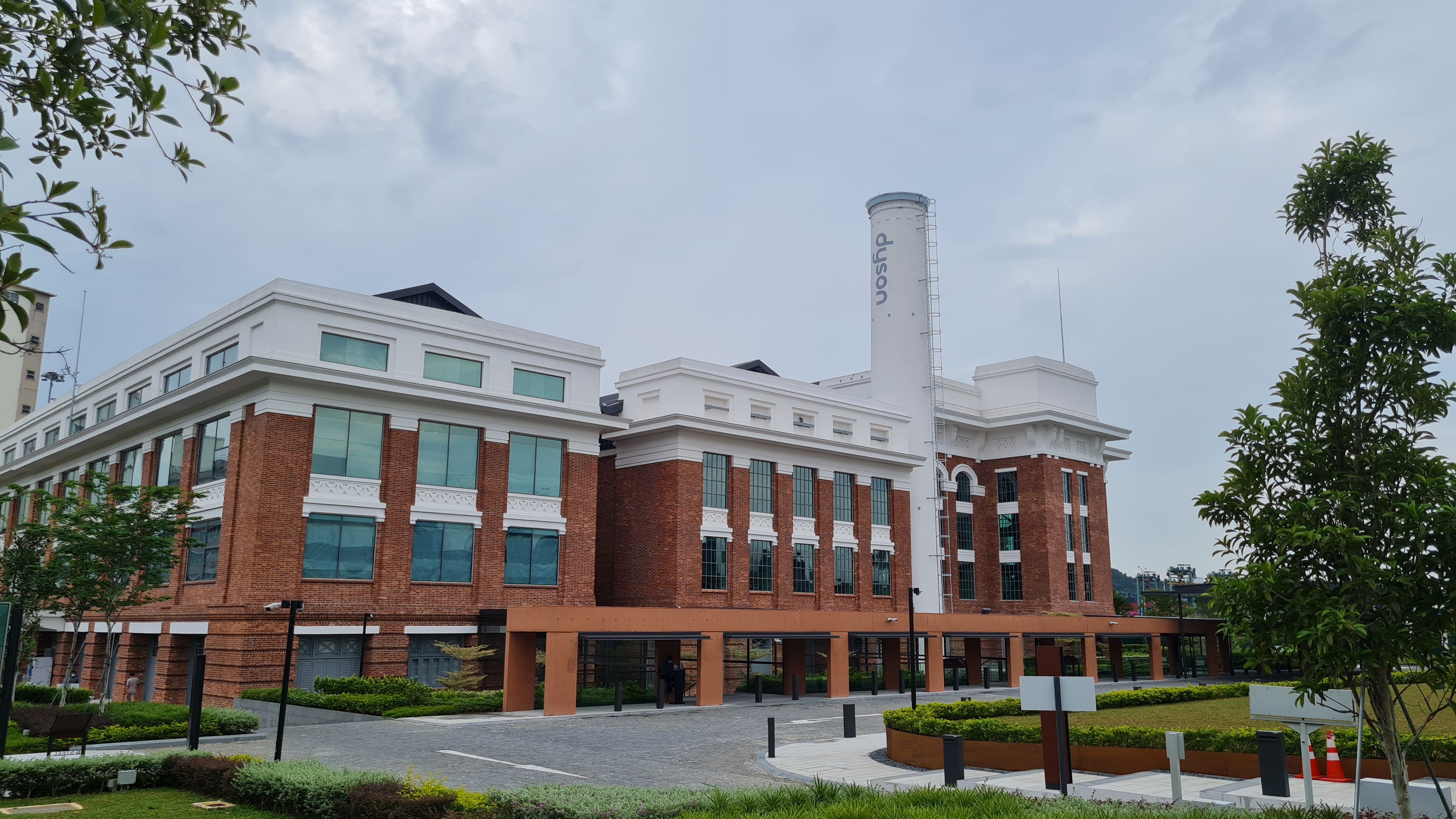
Dyson’s global headquarters, March 2022. (Westliche, CC BY-SA 4.0, via Wikimedia Commons)

St James Power Station today, October 2025. (GoAheadFan95, CC BY-SA 4.0, via Wikimedia Commons)
The harbour at its doorstep has changed as completely as the building. The coal wharves are gone; the gas that now does the work coal once did arrives by pipeline and by ship at a terminal on Jurong Island — a story this blog has told in The Pipelines That Feed Singapore and The LNG Terminal. St James stands at the start of that arc: the place where Singapore first built power at municipal scale, in brick, on a reclaimed swamp.
A century on, Singapore’s best-known power station is famous for everything except power — the nightclub it became, the headquarters it now houses — but each of its lives has run inside the same Edwardian shell that first lit the town.
Sources:
- Former St James Power Station, National Monuments, Roots, National Heritage Board
- Still Generating Interest: St James Power Station at 100, BiblioAsia, National Library Board
- St James Power Station, Singapore Infopedia, National Library Board
- Let There Be Light: street lighting in Singapore, BiblioAsia, National Library Board
- Trams in Singapore, Singapore Infopedia, National Library Board
- Celebrating 25 Years of Powering Possibilities, Energy Market Authority
- St James Power Station, sponsoring organisations, Ministry of Education
- St James Power Station, Mapletree
- Industrial Heritage II: Power Stations and Jurong Industrial Estate, Docomomo Singapore
- Party’s over for St James Power Station, The Straits Times, 6 September 2018
- National Monuments of Singapore: St James Power Station, Wonderwall, National Heritage Board
- Mapletree creates another destination with Dyson at St James Power Station, Mapletree, November 2019
- PM Lee Hsien Loong officially opens Dyson’s new global headquarters at St James Power Station, Economic Development Board, March 2022
- Dyson opens its new global headquarters at St James Power Station, Dyson, March 2022
- St James Power Station, Singapore, at night - 20070127-01.jpg, Wikimedia Commons
- Singapore. View from St. James, KITLV 1404953, Wikimedia Commons
- Singapore - Keppel Harb 1952.jpg, Wikimedia Commons
- Singapore Harbour from Frasers Hill 1971, Wikimedia Commons
- Saint James Power Station, Nov 06.JPG, Wikimedia Commons
- St James Power Station, Singapore, at night - 20070127-02.jpg, Wikimedia Commons
- St James Power Station, Singapore - 20090926.jpg, Wikimedia Commons
- SJPSDay.jpg, Wikimedia Commons
- St. James Power Station, October 2025.jpg, Wikimedia Commons
- St. James Power Station.JPG, Wikimedia Commons
- St. James Power Station 2.JPG, Wikimedia Commons
- St. James Power Station 3.JPG, Wikimedia Commons
- SJPSNight.jpg, Wikimedia Commons
- St. James Power Station, Sentosa Gateway, October 2025.jpg, Wikimedia Commons
- HarbourFront and Keppel Harbour, panorama, Aug 06.jpg, Wikimedia Commons
- Keppel Harbour, panorama, Aug 06.jpg, Wikimedia Commons


