Eu Tong Sen: The Eu Yan Sang King Whose Name Is on the Street
Every day, thousands of people walk, drive or ride down Eu Tong Sen Street in Chinatown without giving the name a thought. It belongs to a Penang-born tin magnate who died in Hong Kong in 1941 — and unlike most of the men whose names are on Singapore’s streets, the business he built is still trading. Eu Yan Sang, the Chinese medicine firm his father founded in a Malayan tin town in 1879, marked its 147th anniversary in October 2026, still headquartered in Singapore, still chaired by one of his descendants. This is the story of the man, the empire behind the medicine shops, and the name that outlived him in three cities.

The Yue Hwa Building at the junction of Eu Tong Sen Street and Upper Cross Street, built in 1927 as the Nam Tin Building. (Bahnfrend, CC BY-SA 4.0, via Wikimedia Commons; photographed 2025)
A medicine shop in a tin town
Eu Tong Sen’s father, Eu Kong, left Foshan in Guangdong for Penang in 1873, and his first ventures — textile dyeing, a bakery — failed. He worked collecting debts for a grocery shop, drifted into the tin country of Perak, and in 1879, in the mining town of Gopeng, he opened a small shop selling traditional Chinese medicine. Its customers were the Chinese tin-mine workers of the Kinta Valley, many of them addicted to opium, and the name he chose was a promise: Yan Sang, from the characters for benevolence and life — “caring for mankind”.

Gopeng, the Perak tin town where Eu Kong opened the first Yan Sang shop in 1879, seen around 1910. (C. J. Kleingrothe, Public domain, via Wikimedia Commons; photographed c. 1910)
The shop’s own history, as the company tells it today, begins and ends with that act of care. The National Library Board’s account adds the harder edge the company version leaves out. In 1882 Eu Kong obtained a general tax farm for the Batang Padang district — a licence to collect the government’s taxes on opium, gambling, alcohol and pawnbroking — and it was the farm’s revenues that financed his tin mines and the growth of the medicine business. The medicine shop for opium addicts and the opium tax farm were two sides of the same enterprise. Both belong in the story.
The son who rebuilt it
 Eu Tong Sen (1877–1941). (Unknown author, Public domain, via Wikimedia Commons)
Eu Tong Sen was born in Penang on 23 July 1877. At four he was sent to Foshan for a Chinese education — where he acquired the lifelong love of Cantonese opera that later shaped his Singapore building projects — and he was brought back to Malaya in 1892. His father had died in 1890, and the business he finally took control of, on turning 21 in 1898, was depleted: the tax farms were being phased out, the family mines were worked out, and his uncles had run down Yan Sang’s cash and stock.
His answer was to start again at the rock face. From 1898 to 1900 he prospected for tin in the Kinta Valley, riding out daily on elephant back with his uncle, and his first discovery came in 1900. By 1908 he owned 11 mines — eight in Perak, two in Selangor, one in Negri Sembilan — employing some 12,000 workers, and he was known as the King of Tin. He was among the first Chinese mine owners to invest in Western hydraulic machinery, and he set up a foundry and a smelting company. Rubber followed: some 15,000 acres of plantations across Malaya, their estates named after his wives, daughters and other female relatives.
The quiet fortunes
The medicine shops were the famous part of the empire, but not the most profitable. In 1906 Eu opened a remittance office in Ipoh, sending miners’ earnings home through agents in Hong Kong and Canton; the volume grew from HK$33,000 in 1914 to more than HK$3 million in 1935, and by the late 1920s remittances were his most profitable business, with Eu Yan Sang counted among the biggest remittance agencies in Southeast Asia. In 1920 he co-founded Lee Wah Bank in Singapore, as its largest shareholder and first chairman; his family ran it until it merged into United Overseas Bank in 1973.
The opium question followed him through all of it. The National Library Board records that in the early 1900s Eu held shares in opium farms in Singapore and Penang while serving as vice-president of the Perak Anti-Opium Society, and while his shops distributed a free anti-opium cure in the campaign of 1906. His own justification, as recorded, was the obligation he felt as a leading towkay; later writers have read the shareholding as a way to control the trade and price opium out of reach. The record carries both, and this post leaves them side by side.
Eu Yan Sang comes to Singapore
Under Eu Tong Sen the medicine chain spread beyond Perak — to Penang, Ipoh, Kuala Lumpur, and in 1909 to Hong Kong, its first overseas branch. Singapore followed in 1910, at 265 to 271 South Bridge Road: a row of four shophouses designed by Alfred Bidwell of Swan and Maclaren, the architect of the Raffles Hotel. The Singapore branch worked in three parts — remittance, wholesale Chinese herbs, and pharmaceutical retail — and it was in this period that Eu attached his family name to the shop’s, making Yan Sang into Eu Yan Sang. In 1910 he moved his headquarters, and himself, from Perak to Singapore.

The Eu Yan Sang Building at 265–271 South Bridge Road, his first Singapore shop, opened in 1910 and for most of the group’s life its headquarters. (Chainwit., CC BY 4.0, via Wikimedia Commons; photographed 2023)
The street that took his name
The street through Kreta Ayer was then called Wayang Street, after the Chinese opera theatres — wayang — that lined it. Eu took an interest in it the way he took an interest in everything: he bought property along it. In 1918 he improved part of the street, adding a bridge, railings for the monsoon drains and back lanes for theatres, and in 1919 the street was renamed Eu Tong Sen Street — in his lifetime, when he was about 42.
The National Library Board keeps two explanations for the honour, and both may be true. The first is his First World War giving: he funded a tank and a scout fighter plane for the British war effort, and the tank was painted with “Chinese eyes”, a marking later adopted by a battalion of the Royal Tank Regiment. The second is the street itself: he rebuilt it, and bought over its two opera theatres, Heng Seng Peng and Heng Wai Sun, whose site is now People’s Park Complex. A third version circulates as anecdote — that a theatre troupe offended his eighth wife, and Eu bought up the street in response — and it is best left where it belongs, as the story that is told.

A dragon decoration over Eu Tong Sen Street at Chinese New Year, the street sign carrying his name below. (JoElise (Sivanjali Sivapatham), CC BY-SA 3.0, via Wikimedia Commons; photographed 2012)
In 1927 his own theatre rose on the street at number 80: the Majestic, built as Tien Yien Moh Toi, a Cantonese opera house with an Art Deco façade of glazed tiles, blue dragons and opera figures, designed by Swan and Maclaren. The official Chinatown trail tells why: he built it for his wife, after she was reportedly refused admittance to an opera performance elsewhere. The two theatres he had bought were demolished long ago; the Majestic survives, conserved, standing beside People’s Park Complex — a cinema and then a mall behind its tiled façade.

The Majestic at 80 Eu Tong Sen Street, built by Eu in 1927 as a Cantonese opera theatre. (Bahnfrend, CC BY-SA 4.0, via Wikimedia Commons; photographed 2018)
The hotel at the junction — where the record disagrees with itself
At the junction with Upper Cross Street stands the street’s other 1927 landmark: the six-storey Nam Tin Building, opened that February as the Great Southern Hotel — then the tallest building in Chinatown, the first Chinese hotel in Singapore with a lift, and nicknamed the Raffles of Chinatown. Today it is the Yue Hwa Building, the Singapore flagship of the Hong Kong Chinese-products emporium.
Was it Eu’s building? Here the record disagrees with itself, and the disagreement is worth printing. The National Library Board’s biography of Eu counts the Great Southern Hotel among his prominent Singapore buildings, and its BiblioAsia magazine calls the Yue Hwa building one of his landmarks. But the Board’s own history of the hotel, and the national heritage portal Roots, say the Nam Tin Building was owned by Lum Chang Holdings and leased to its tenants. The Majestic’s attribution to Eu is solid; this one is not, and no honest version of his story can claim the hotel outright. What is documented is the building’s later life: Lum Chang sold it in 1993 for about S$25 million to the Yue Hwa group, the hotel closed in 1994, and the rebuilt store opened in October 1996, winning a national Architectural Heritage Award the following year.
The name on the hill
Eu’s giving reached beyond Chinatown. When Singapore raised funds for Raffles College — the colony’s centenary memorial, opened in 1929 at Bukit Timah — he was among the business leaders who pledged money from 1919, and his own contribution was $100,000. The college named three of its buildings for its great donors, and one of them, a student hostel around the Upper Quadrangle, took his name: the Eu Tong Sen Building. The six college buildings were gazetted together as a National Monument in 2009, and his building served for years as the entrance of the National University of Singapore’s law faculty, before the faculty’s move to Kent Ridge in January 2026.
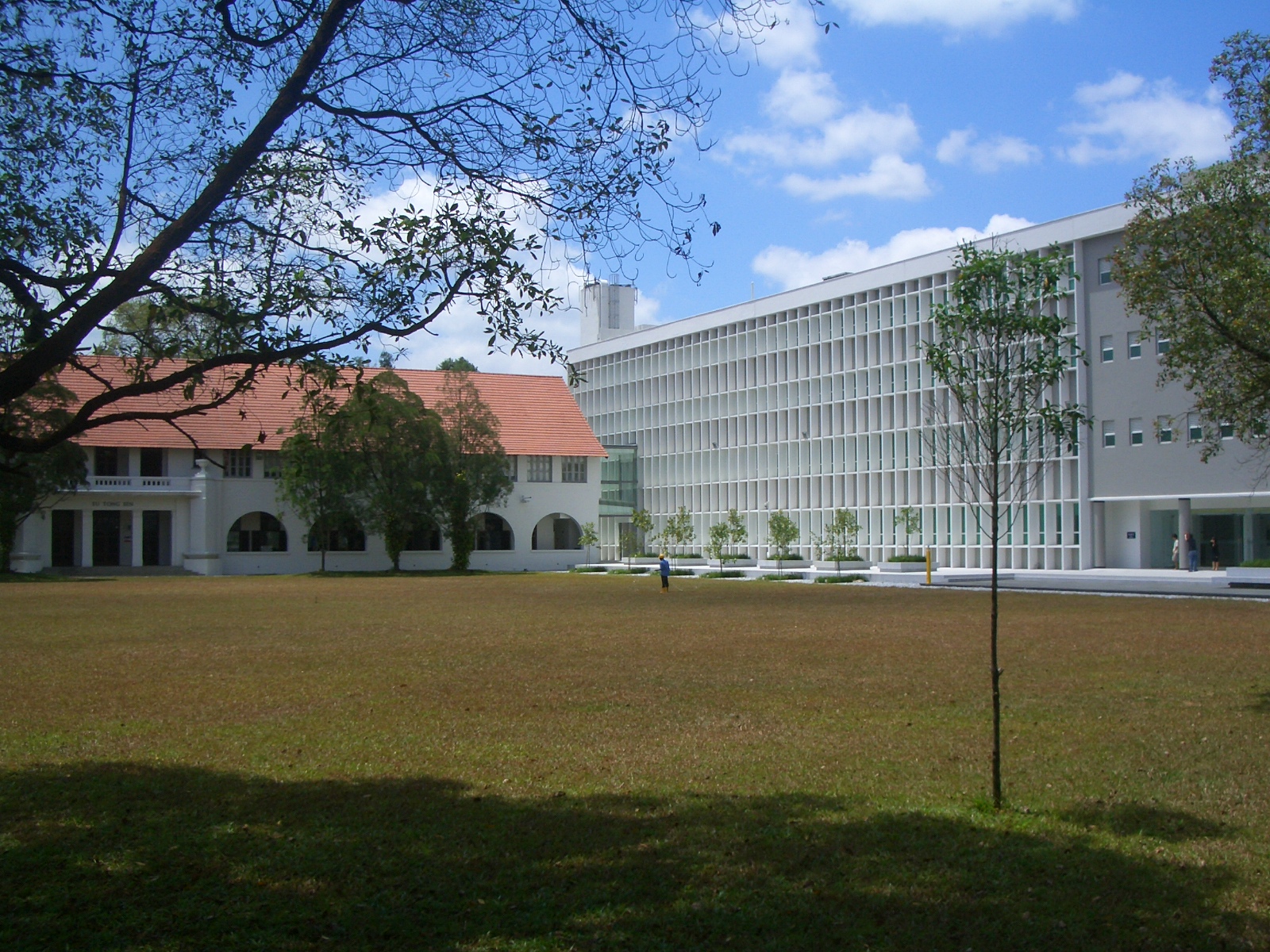 The Eu Tong Sen Building at 469 Bukit Timah Road, one of the former Raffles College buildings named for the college's donors. (Chensiyuan, CC BY-SA 3.0, via Wikimedia Commons; photographed 2007)
In Hong Kong, his verified gift was of the same kind: $30,000 for a gymnasium at the University of Hong Kong, opened in 1936 and bearing his name until the site was redeveloped. A larger figure — $55,000, dated 1918 — circulates in reference works, but no University of Hong Kong source supports it, and the gymnasium is the gift the university’s own records confirm.
Hong Kong: mansions, death, and a school sign
In the late 1920s — the sources give 1927, 1928 and 1930 — Eu moved his base to Hong Kong, to run the remittance business more closely, in poor health, and, the Board’s account adds, with enemies made by his political neutrality. He built three mansions there, all called Yu Garden in Chinese: Eucliff at Repulse Bay, Euston on Bonham Road, and Sirmio at Tai Po, the largest of them. The business he left increasingly to senior managers and to his eldest son, Eu Keng Chee, a Cambridge-trained accountant. On 11 May 1941, at Sirmio, Eu Tong Sen died of heart failure, aged 63. He was buried in the grounds; when the mansion was sold and demolished in the 1970s, his descendants moved his remains to the Chinese Permanent Cemetery at Tsuen Wan. He never returned to Singapore.

The former Shuen Wan Eu Tong Sen School at Shuen Wan, Tai Po, photographed in 2015, two decades after it closed. (Chong Fat, CC BY-SA 3.0, via Wikimedia Commons; photographed 2015)
One Hong Kong namesake resists explanation. A village school at Shuen Wan, in the same Tai Po district where Sirmio stood, bore his name — the Shuen Wan Eu Tong Sen School — until it closed in 1994. No source we could find, government, university or press, records why. Local accounts date the school building to 1950, almost a decade after his death, which would make the naming a memorial rather than a donor’s gift; the documented overlap is only geography. The site has since been rebuilt as “Good House”, a transitional housing project completed in December 2024 — his name gone from the gate, the ground put to housing the people the district now has.
The business comes back without him
What returned to Singapore was not the man but the firm. His estate was divided into 13 equal shares among his sons, a settlement that left no one in control, and most of the empire — the mines, the estates, the theatres — was sold off over the years. The medicine business split in two: a Hong Kong firm, and a Singapore and Malaysia firm, which incorporated in the 1950s and listed on the Singapore stock exchange in 1973. Lee Wah Bank, the other survivor, had merged into UOB that same year.
The Singapore line’s second founder was his grandson. Richard Eu, fourth generation of the family, was born in Hong Kong in 1947 and has lived in Singapore since he was two; a merchant banker and venture capitalist, he joined the family firm as general manager in 1989. In 1990 the Lum Chang group — the same name that appears in the Nam Tin Building’s history — had taken over Eu Yan Sang Holdings. In 1993 Richard Eu led the family’s buyback of the medicine business for S$21 million, re-incorporated it in Singapore as Eu Yan Sang International, folded the Hong Kong arm back in during 1996 and 1997 — reuniting the two halves for the first time in more than 50 years — and listed the group on the SGX mainboard in July 2000. The headquarters moved to Tai Seng Drive in 2013; the old South Bridge Road building, the group’s home for a century, was sold in 2019 and reopened in 2022 as a co-working space, its façade and its 1910 date still in place.

A Eu Yan Sang store in a heritage shophouse in George Town, Penang — the city where Eu Tong Sen was born, and where the chain still trades. (LEE 003, CC BY 4.0, via Wikimedia Commons; photographed 2026)
Eu Yan Sang today
The company’s own milestones tell its history more tidily than the record does — they give Eu Kong’s departure from Foshan a different year, hand the business to Eu Tong Sen eight years early, and never mention the tax farm at all. The business itself has had a busier recent history than its heritage pages suggest. In 2016 the group was taken private, at a valuation of about S$269 million, by a consortium of Tower Capital Asia, Temasek and members of the Eu family. In June 2024 it changed hands again: Japan’s Rohto Pharmaceutical took about 60 per cent and Mitsui about 30 per cent, in a deal valuing the company at roughly S$808 million. The Eu family’s remaining stake, about 10 per cent, was rolled over by Richard Eu and his son Richie Eu, of the fifth generation — and Richard Eu, the grandson who bought the business back in 1993, remains its chairman today.
The 2024 sale documents counted more than 170 retail outlets and 30 traditional Chinese medicine clinics across Singapore, Hong Kong and Malaysia, with 43 stores in Singapore alone. The shelves hold the old standbys — bottled bird’s nest, Bak Foong pills, essence of chicken — beside collagen, NMN supplements and ready-to-drink soups. In October 2026 the company marked its 147th anniversary, and its management was already talking about the 150th, in 2029.
Where it fits in the bigger story: Eu Tong Sen’s mansions are demolished, his mines and estates sold, his name carried now by a street most people hurry down, a hostel block on a monument campus, and a Hong Kong school sign that no longer exists. But the smallest thing his family built — one medicine shop in a Perak tin town, opened by his father in 1879 — is still open for business, 147 years on: Japanese-owned, Singapore-headquartered, and chaired by his grandson. The empire went; the shop endured.
Sources:
- Eu Tong Sen — Singapore Infopedia, National Library Board
- Eu Tong Sen Street — Singapore Infopedia, National Library Board
- Great Southern Hotel — Singapore Infopedia, National Library Board
- Richard Eu — Singapore Infopedia, National Library Board
- Eu Tong Sen and His Business Empire — BiblioAsia, National Library Board
- Prominent People in Street Names — BiblioAsia, National Library Board
- Yue Hwa (Nam Tin) Building — Roots, National Heritage Board
- Former Raffles College (now NUS campus at Bukit Timah) — Roots, National Heritage Board
- With Honours, of 469 Bukit Timah Road — Roots, National Heritage Board
- Street Corner Heritage Galleries: Chinatown — Roots, National Heritage Board
- The Majestic Theatre in Singapore — Culturepaedia, Singapore Chinese Cultural Centre
- Eu Tong Sen Gymnasium — University of Hong Kong Archives
- Former Shuen Wan Eu Tong Sen School — Town Planning Board paper, Hong Kong
- Transitional Housing Project at “Good House”, Shuen Wan — Housing Bureau, Hong Kong
- Our Milestones — Eu Yan Sang
- Sale of Eu Yan Sang by Righteous Crane Holding to a consortium led by Rohto Pharmaceutical and Mitsui — Tower Capital Asia
- Completion of sale of Eu Yan Sang — Tower Capital Asia
- The Great Room opens at the Eu Yan Sang Building — EdgeProp
- Yue Hwa Building, Singapore, 2025 — Wikimedia Commons
- Gopeng, circa 1910 — Wikimedia Commons
- Eu Tong Sen portrait — Wikimedia Commons
- Eu Yan Sang Building, South Bridge Road, 2023 — Wikimedia Commons
- Chinese New Year dragon decoration along Eu Tong Sen Street — Wikimedia Commons
- The Majestic, Singapore, 2018 — Wikimedia Commons
- Eu Tong Sen Building, Bukit Timah — Wikimedia Commons
- Shuen Wan Eu Tong Sen School — Wikimedia Commons
- Eu Yan Sang, George Town — Wikimedia Commons
- Eu Tong Sen Street, 2025 — Wikimedia Commons
- Eu Tong Sen Street and New Bridge Road at night — Wikimedia Commons
- The Majestic, 2005 — Wikimedia Commons
- The Majestic, 2025 — Wikimedia Commons
- Yue Hwa Building, 2005 — Wikimedia Commons
- Yue Hwa Chinese Products Singapore Store — Wikimedia Commons
- Old Eu Yan Sang Building, South Bridge Road, 2025 — Wikimedia Commons
- Eu Yan Sang Headquarters, 2010 — Wikimedia Commons
- Eu Yan Sang, Hong Kong, 2007 — Wikimedia Commons
- Eu Yan Sang, Sham Shui Po — Wikimedia Commons
- Eu Yan Sang counter, Suzhou — Wikimedia Commons


