The COE: Paying for Permission to Own a Car, Then Paying Again to Drive It
The gantries are coming down. Since October 2026, work crews have been unbolting the grey-blue frames that have spanned Singapore’s expressways and city streets for a generation, and by the middle of November a dozen were already gone. The last working gantries will go on charging until 31 December 2026; from 1 January 2027 the charge arrives by satellite instead, and the sign that a charged road lies ahead will be an oval of blue paint on the tarmac. It is the end of the most visible piece of a system that does something no other country attempts in quite the same way: it makes a driver pay for permission to own a car, and then pay again, per trip, to drive it. The two charges have different names, different histories and one shared reason. This is the story of both.
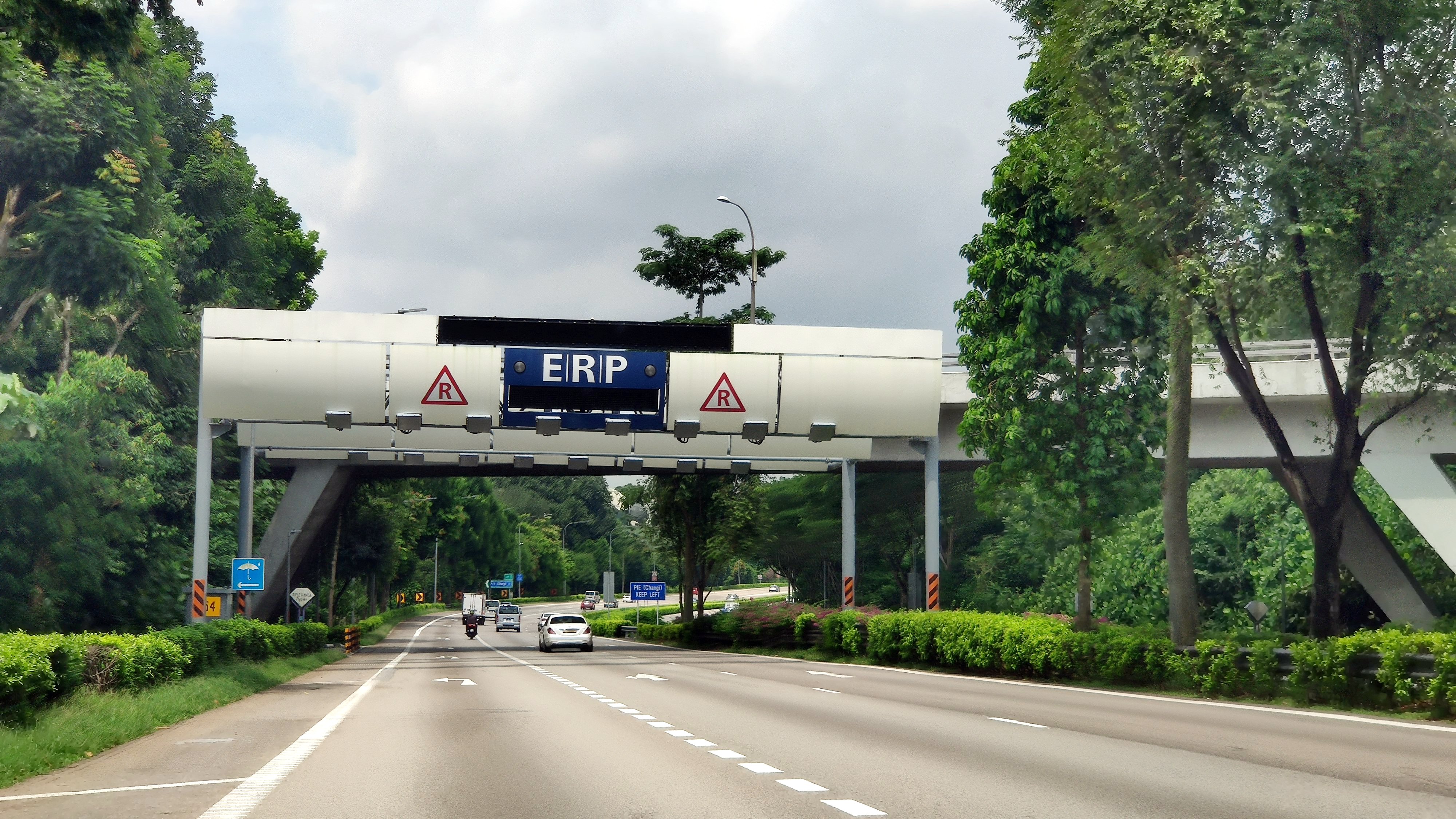 An ERP gantry over the Bukit Timah Expressway. (Jnzl, CC BY 2.0, via Wikimedia Commons)
A paper licence, and a world first
Singapore began pricing congestion earlier than anywhere else, and with almost no technology at all. On 2 June 1975 the Area Licensing Scheme (ALS) began: to drive into a Restricted Zone of about 6.7 square kilometres around the city centre during the morning peak, a motorist bought a paper licence — S$3 a day, or S$60 a month — and displayed it on the windscreen. Police at the zone’s entry points checked for it by eye. It was the world’s first congestion-pricing scheme put successfully into practice, and its effect was immediate: vehicles entering the zone between 7.30 and 9.30 in the morning fell from about 32,500 to about 7,700, a drop of roughly 76 per cent, far beyond the 25 to 30 per cent the planners had aimed for.
 The Restricted Zone warning sign of the ALS era. (Woodennature, public domain, via Wikimedia Commons)
The scheme ran for 23 years, but its limits were built in. A monthly licence, once bought, made every extra trip free. The charge could not vary by time of day or by how crowded the road actually was, and enforcement meant a human being looking at windscreens. What the paper licence could never do was price the driving itself, trip by trip. That problem would eventually be solved electronically. First, though, Singapore attacked the other half of the question: not how much its cars were driven, but how many of them there were.
Permission to own
Through the 1980s, rising incomes put cars within reach of more and more families, and by 1990 the car population was growing at about 12 per cent a year. There were already some 280,000 cars, and roads took up about 12 per cent of the island’s land. A parliamentary select committee on land transport recommended rationing the fleet itself, and on 27 February 1990 the Vehicle Quota System was announced. The first bidding exercise was held on 2 April 1990, and from 1 May that year nobody could register a car in Singapore without first winning the right to: a Certificate of Entitlement, the COE.
The certificate is an auction product. The Land Transport Authority (LTA) sets a quota for each period from a simple formula — the allowed growth in the vehicle population, plus the number of vehicles expected to be deregistered, plus adjustments — and motorists and dealers bid for the certificates within categories, seven at the start and five since 1999: A for smaller cars, B for larger ones, C for goods vehicles and buses, D for motorcycles, and E, the open category. Bidding was a sealed tender at first; open bidding, where everyone can watch the current price, replaced it in 2001. A COE lasts ten years. At the end of the term the owner either pays the Prevailing Quota Premium — a moving average of recent premiums — to renew for five or ten years, or deregisters the car, collecting a rebate of part of the car’s Additional Registration Fee that shrinks with the car’s age.
The growth allowance inside the quota is where the long tightening shows. It began at 3 per cent a year. It was cut to 1.5 per cent in 2009, 1 per cent in 2012, 0.5 per cent in 2013, 0.25 per cent in 2015, and from February 2018 it has been zero for cars and motorcycles: the fleet is not permitted to grow at all. Every new car on the road replaces one that has left it.
The rollercoaster
Because the supply of certificates follows deregistrations — which bunch, ten years on, behind past sales booms — the COE premium does not move like a price so much as like a tide. In December 1994, amid speculation, premiums broke S$100,000 for the first time, the largest-car category reaching S$110,500. In December 1997, as the Asian financial crisis bit, one category’s premium collapsed from S$64,100 to S$50 in a single exercise; a doctor used his S$50 certificate to register a new Honda Integra Type R, and the transport minister of the day called such results “flukes, aberrations” of the blind-bidding system. In November 2008, after the global financial crisis and an over-estimate of deregistrations flooded the quota, Category A closed at S$2.
The swings have not gentled with age. On 18 October 2023, Category B set an all-time record of S$150,001 and the open category S$158,004 — the certificate alone costing more than most cars. Three weeks later, with a larger quota released, Category B fell S$40,000 in one exercise, the steepest drop since 1995. Since 2023 the LTA has tried to sand the edges off the cycle with a “cut-and-fill” adjustment, bringing forward certificates from future deregistrations to fatten lean quarters. It has not flattened the tide: on 4 November 2026, Category A reached S$139,001, its highest ever, closing above Category B. Singaporeans have long treated the cycle as folk wisdom — buy in the trough years, hold through the peaks — and plan their cars’ ten-year lives around it.
Pricing the drive
The paper licence’s electronic successor arrived on 1 April 1998, when Electronic Road Pricing (ERP) was switched on at two points on the East Coast Parkway. By September that year the first phase was complete — 33 gantries across the city and the main expressways — and the last ALS gantries had come down. It was the world’s first electronic road-pricing system used for congestion charging, built at a capital cost of S$197 million. Every vehicle carried an In-vehicle Unit with a stored-value CashCard; passing under a gantry debited the card automatically, no stopping, no windscreen licence, no one watching. Traffic responded as it had in 1975: expressway volumes fell by about 15 per cent, and average speeds in the charged hours rose from 35 to 55 kilometres an hour.
 An ERP gantry after dark. (Jeremyfoo, CC BY 2.0, via Wikimedia Commons)
Unlike the flat paper licence, ERP prices each trip, and prices it by evidence. The LTA reviews rates every quarter against target speed bands — 45 to 65 kilometres an hour on expressways, 20 to 30 on city and arterial roads — raising a charge where traffic runs too slowly and lowering it where the road has room. Graduated rate steps, introduced in 2003, softened the cliff edges between one half-hour’s price and the next; evening-peak charging followed from 2005. The network grew to more than ninety charging locations. Other cities came to learn: London’s congestion charge, launched in 2003, was modelled on Singapore’s system after its officials visited, Stockholm followed with a trial and a referendum, and New York’s Manhattan pricing began only in January 2025 — thirty years after the paper licence, twenty-seven after the gantry.
 The in-vehicle unit every car carried, with its CashCard slot — the gantry's other half. (Ominae, CC BY-SA 4.0, via Wikimedia Commons)
A pair of levers
The two systems are designed as a pair, and the LTA says so in as many words: the Vehicle Quota System “regulates vehicle ownership, while ERP manages usage”. One caps the stock of cars; the other prices the flow of them. And the two levers are traded against each other in the open. When ERP arrived and congestion eased, the government released some 10,500 extra COEs between 1997 and 2003 beyond the growth allowance. In October 2024 the same logic ran again: up to 20,000 additional certificates were announced from February 2025, justified in part by the better usage management expected from ERP’s satellite successor, even as the growth rate itself stayed at zero. As the transport minister put it in Parliament in 2023, the vehicle population cannot keep increasing, because the alternatives are to set aside ever more land for roads, or to accept the congestion of other big cities. Roads already take about an eighth of the island.
The satellite system also makes a third possibility technically available — charging by distance travelled, rather than at fixed points — and the government has been careful to say it has not decided to use it: there are, in its words, no immediate plans, and the launch changes the hardware, not the framework.
What it costs, and the argument about it
The result is the most expensive place in the world to buy a car, by a wide margin. A Toyota Corolla-class car that costs about US$26,300 in the United States costs roughly US$156,800 in Singapore; the next dearest city is not close. A worked example from late 2025: a Corolla Altis at about S$173,000 divides into roughly S$25,000 of the car’s open-market value, S$40,000 of registration taxes, and S$109,000 of COE. The money is not trivial to the state either — quota premiums brought in S$4.66 billion in the 2023 financial year, alongside S$2.60 billion in motor vehicle taxes.
 A gantry of the current generation — the generation now being removed. (ANIA0719, CC BY-SA 4.0, via Wikimedia Commons)
The criticisms are longstanding and are aired in Parliament regularly: that the system rations road space by wealth, that a certificate can cost more than the car it permits, that premiums swinging S$40,000 in a fortnight make planning impossible, and that private-hire fleets bidding in the same pool push prices up for families. The replies are also on the record: that the practical alternative to pricing is rationing by congestion or by queue; that rates and quotas follow measured speeds and land, not revenue targets; that residents took 84 per cent of successful car COE bids between 2022 and late 2024; and that supply smoothing now tempers the cycle. The newest attempt to adjust the balance came in October 2026, when the LTA proposed merging Categories A and B into one, with a value-based rebate or surcharge of up to S$15,000 so that expensive cars pay more of the premium. Consultation closed on 2 November 2026; the outcome is still undecided.
The house at the far end of the expressway
No study we could find measures whether ERP charges change where people choose to live; the research on housing choices points to the MRT, to schools, to the distance to work and to parents. But charges do not need a study to reach into a family’s decisions, and in one family the writer knows, they did.
Two years ago, visiting Singapore, I caught up with a widower who lives in a landed estate in the north of the island, a long way from the city centre. When his wife was alive the big house was full. After she died, their son left for a career in Europe, and their daughter built her own career in Singapore; the house stands mostly empty, with him in it. The daughter had at first thought she would live with her father. Then she did the sums on the daily drive — the long run in to work, down the Central Expressway and under its gantries, twice a day — and found it cheaper to rent a place of her own, chosen so that no long daily drive is needed. The family home was there, and hers for the living in. The price of using the road outweighed it. That is the second lever working at a scale no statistic captures: not deciding whether she drives, but where she lives.
The gantries come down
The gantry network is over twenty-five years old and at the end of its life. Its satellite successor has been in preparation for a decade: studied since about 2013, contracted in February 2016 for S$556 million to a consortium of NCS and Mitsubishi Heavy Industries, and fitted to the fleet from November 2023, after the first public showing of its on-board unit — a three-piece set for cars, with a processing unit, an antenna and a touchscreen display — drew sharp public criticism of its bulk in 2020. Fitting took the design as it was but answered the loudest complaint, drivers reaching across to a card unit in the passenger footwell, with a choice of placement and a button to deactivate the card for parking. By late 2026 more than 98 per cent of eligible vehicles carried the new unit, and every new vehicle has come pre-fitted since May 2024.
 The gantry’s successor: the ERP 2.0 on-board unit display, showing a card balance and a road warning in traffic. (Sgconlaw, CC BY-SA 4.0, via Wikimedia Commons)
So the frames come down in two waves. The 62 gantries that no longer charge went first, from October 2026 — among the early removals CNA named were Bencoolen Street, Geylang Bahru, Republic Boulevard, the Kallang–Paya Lebar Expressway and Dunearn Road. The 33 still working stand until charging ends on 31 December 2026. By June 2027 all 95 will be removed or modified, a few frames kept standing as masts carrying support equipment where satellite signals are weak. In their place on the road: an oval blue “ERP” symbol painted on each lane, and “ERP Charge Zone” signs. The on-board unit warns the driver before a charging point, shows the charge, and confirms it afterwards. The NETS CashCard, the card in every in-vehicle unit since the 1990s, stops working on the same day the old system does.
 Dunearn Road at the Wayang Satu flyover in 2006, its gantry overhead. Dunearn Road is among the first places named for gantry removal in 2026. (CC BY-SA 3.0, via Wikimedia Commons; photographed 2006)
On 1 January 2027, charging by satellite begins at the same locations, at rates under the same framework — the first adjustment of the new era is a S$1 rise at two locations on the Central and Pan-Island Expressways from 4 January. Nothing about the two levers changes. Only the furniture does: a generation of drivers who steered by the gantry’s beep will steer by a painted blue oval instead.
Where it fits in the bigger story: Singapore’s answer to an island that ran out of road was never to ban the car, nor to let the jams decide. It was to price both halves of driving — a certificate for the owning, a charge for the using — and to keep adjusting the pair against each other for fifty years, from a paper licence checked by eye to a satellite that needs no gantry at all. The hardware keeps retiring. The arithmetic doesn’t.
Sources:
- NLB Infopedia: Area Licensing Scheme
- NLB Infopedia: Electronic Road Pricing system
- Wikipedia: Certificate of Entitlement
- Wikipedia: Area Licensing Scheme
- Menon & Guttikunda, “Electronic Road Pricing: Experience & Lessons from Singapore” (2010)
- Chu Sing Fat, “Zero car growth: only in Singapore?”, Policy Forum (2017)
- LTA: Injection of Additional COE Quota with Reduced Usage & ERP 2.0 Transition (29 Oct 2024)
- LTA: One-time Adjustment to Reduce Volatility for COE Categories A and B (May 2023)
- LTA: New Road Markings and Signs to Support Transition to ERP 2 from October 2026 (28 Sep 2026)
- MOT: Oral Reply on COE Demand and Supply (Nov 2023)
- MOT: Written Reply on Additional COEs and Distance-Based Charges (Nov 2024)
- CNA: ERP gantries come down as Singapore prepares for satellite-based charging (18 Nov 2026)
- MOF: Analysis of Revenue and Expenditure, FY2024 (Feb 2024)
- Motorist: COE results, 18 Oct 2023
- ToolSG: COE prices and all-time highs (Nov 2026)
- Torque: The $50 COE
- Numbeo: Car prices by country (Nov 2026)
- MTA: New York congestion pricing launch (5 Jan 2025)
- Image: ERP gantry on the BKE
- Image: Restricted Zone warning sign (ALS)
- Image: Singapore’s ERP gantry at night
- Image: ERP IU unit back side
- Image: ERP new
- Image: ERP 2.0 On Board Unit display
- Image: Dunearn Road, Wayang Satu flyover, 2006


