The Pipelines That Feed Singapore
On Saturday the 24th of October 2026, Indonesia cut the natural gas it sends to Singapore by pipeline, to keep its own power stations running after a long blackout on Batam. In Singapore, nothing went dark. The Energy Market Authority said the cut came to less than 2% of the gas the country uses each day, and that there was enough gas to go round. That it barely registered goes back to three pipes laid under the sea between 1992 and 2003, and a backup built on Jurong Island ten years later.

Senoko Power Station on Singapore’s northern shore, where the first pipeline gas from Malaysia arrived in 1992, photographed in 2007. (Terence Ong, CC BY 2.5, via Wikimedia Commons)
Who keeps the lights on
If you grew up in Singapore, you probably think of the PUB as the people who look after the water, the electricity and the gas. For more than three decades it was. Today the system is split between several organisations, and it works roughly like this.
Imported by pipeline from Malaysia and Indonesia, or by ship as LNG. A government-owned company, Singapore GasCo, buys it for the power stations.
Run by generating companies, which burn the gas and sell the electricity every half hour in a wholesale market.
SP Group runs the national grid of cables and substations that carries the power to every building.
Paid to SP Group at the regulated tariff, or to a retailer you choose in the Open Electricity Market.
Over all four stands the Energy Market Authority, which regulates the industry and runs the control centre that keeps supply and demand in balance.
Almost all of Singapore’s electricity, about 95%, is made by burning natural gas. Singapore has no gas of its own, so every bit of it is imported. The gas goes to the power stations, which are run by a handful of generating companies, among them Senoko Energy, YTL PowerSeraya and PacificLight. They sell their electricity into a wholesale market that is settled every half hour. SP Group, the successor to the PUB’s power business, runs the national grid that carries the power to every building, under a licence from the Energy Market Authority. Households either buy from SP Group at a regulated tariff or, since the Open Electricity Market reached the whole island in 2018, choose a retailer.

A gas-fired power station on Jurong Island, run by one of Singapore’s generating companies, in 2015. (PLP2016, CC BY-SA 4.0, via Wikimedia Commons)
The PUB itself has been the national water agency since 2001. Energy now has a ministry in its name: from the 1st of October 2026, the Ministry of Trade and Industry became the Ministry of Energy, Trade and Industry.
The oil years
The PUB was set up on the 1st of May 1963 to take over the electricity, gas and water services of the old City Council. For most of its history, its power stations burned fuel oil, from the older stations at Pasir Panjang to the offshore station on Pulau Seraya, whose first oil-fired units came into service in the late 1980s. Oil was easy to ship in and to store, and Singapore was already one of the world’s great refining centres. But it was also expensive, and its price swung with every crisis in the Middle East.

The decommissioned Pasir Panjang Power Station in 2018. (Jnzl’s Photos, CC BY 2.0, via Wikimedia Commons)
Natural gas burned more cleanly and could run more efficient power stations. The problem was getting it to an island with no gas fields of its own.
The first pipe, 1992
The answer came from Malaysia. Petronas, Malaysia’s national oil company, was building the Peninsular Gas Utilisation system to carry gas from its fields off the coast of Terengganu down the length of the peninsula. Its southern end reached Pasir Gudang in Johor, and from there an undersea line was laid across the Johor Strait to the PUB’s power station at Senoko. Gas was due to start flowing on the 29th of January 1992, about 150 million cubic feet of it a day.

Senoko Power Station seen across the Johor Strait from Johor Bahru in 2008. The first gas pipeline crossed this strait. (Arash Toudeshki, CC BY 3.0, via Wikimedia Commons)
A few years later the PUB itself was broken up. On the 1st of October 1995, its electricity and gas businesses were turned into companies under a new holding company, Singapore Power, owned by the government’s investment company Temasek Holdings. In 2001 the Energy Market Authority was set up to regulate the industry, and the PUB became the water agency it is today.
West Natuna, 2001
 The Natuna Sea, between the Malay peninsula and Borneo, on an Indonesian government map of 2017. (Badan Informasi Geospasial Republik Indonesia, public domain, via Wikimedia Commons)
The second source lay far out in the South China Sea. In the West Natuna fields, off Indonesia’s Natuna Islands, a group of oil companies led by Conoco and Indonesia’s state oil company Pertamina had found gas. In 1998 they agreed to sell it to SembGas, a consortium led by Singapore’s Sembawang Corporation: 325 million cubic feet a day for 22 years, under a contract worth about 8 billion US dollars.
To deliver it, the companies laid a pipeline about 640 kilometres long across the seabed to Singapore’s waters, with a short final stretch to Jurong Island and its petrochemical industry. The gas began to flow in 2001.

A pipelaying ship of the kind that lays gas pipelines across the seabed, the Sapura Jade, photographed in Rotterdam in 2015. It is shown here as an example, not as one of the ships that laid Singapore’s pipelines. (Frans Berkelaar, CC BY-SA 2.0, via Wikimedia Commons)
Grissik, 2003
The third pipe came from the south. In 2001 Singapore Power signed an agreement with Pertamina, through its company Gas Supply Pte Ltd, to buy gas from fields in South Sumatra, starting at 150 million cubic feet a day and rising to 350 million by 2009, for 20 years. The pipeline, a joint project of Singapore Power’s PowerGas and Indonesia’s state gas company PGN, runs about 470 kilometres from the gas plant at Grissik, by way of the island of Batam, to Singapore. It was formally opened on the 4th of August 2003, and the gas arrived about a month later than planned.
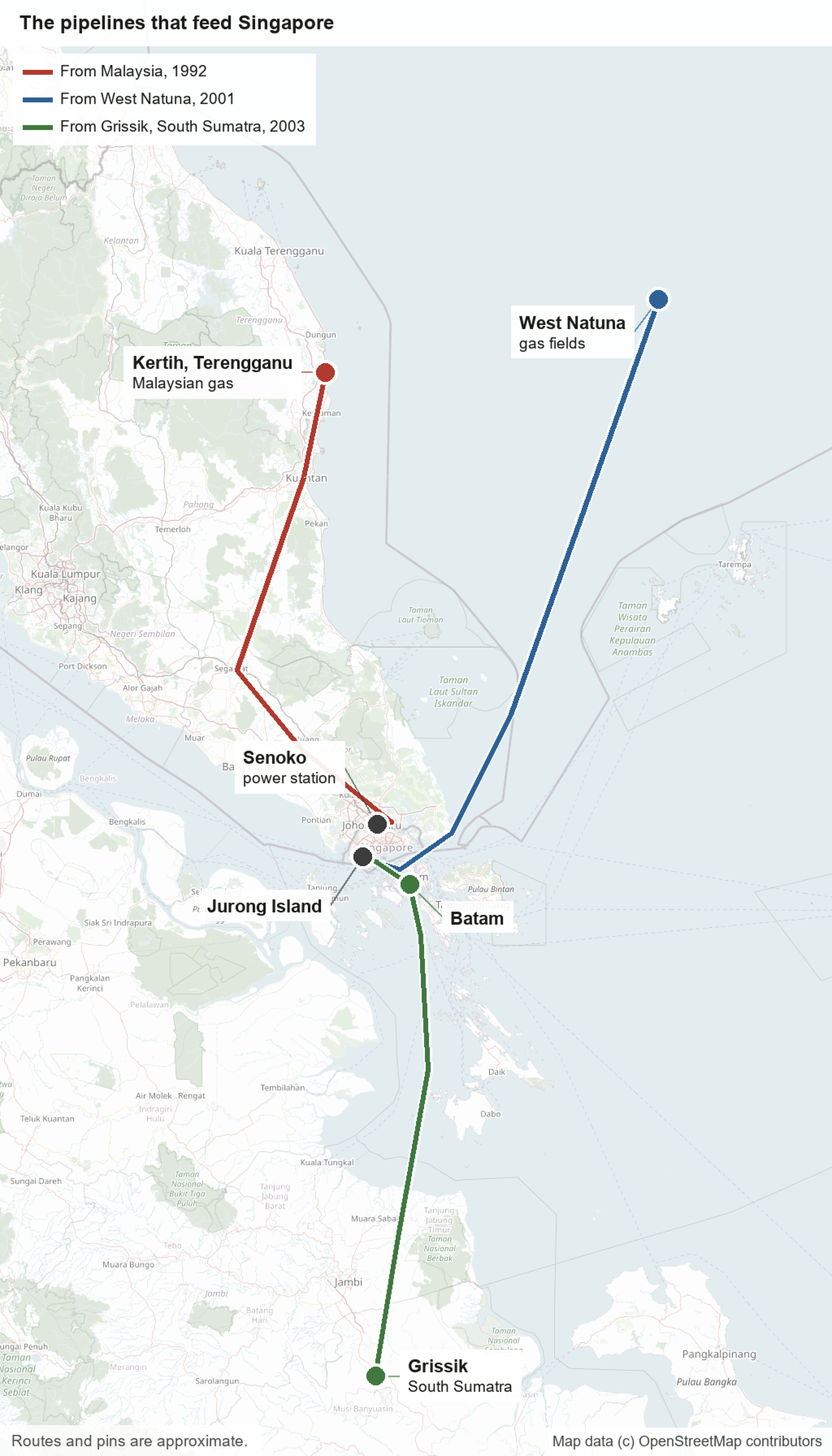
The three pipelines that bring gas to Singapore, drawn by hand on today’s map. Routes are approximate. (Map data © OpenStreetMap contributors)
With three pipes running, gas took over from oil very quickly. In 2001 it made about a quarter of Singapore’s electricity. By 2003 it made more than half, and by 2014 almost all of it.
How much of Singapore's electricity comes from gas
Natural gas's share of the fuel used to generate electricity
Sources: SG101; Energy Market Authority, Singapore Energy Statistics (2011, 2015, 2025). The rest was mostly fuel oil.
View as table
| Row | Value | Detail |
|---|---|---|
| 2001 | 26% | In 2001 natural gas made about 26% of Singapore's electricity; oil made most of the rest |
| 2003 | 62% | 62% in 2003, after the West Natuna and Grissik pipelines opened |
| 2009 | 82% | 82% in 2009 |
| 2010 | 79% | 79% in 2010 |
| 2014 | 95.5% | 95.5% in 2014, the year after the LNG terminal opened |
| 2024 | 94% | 94% in 2024 |
The insurance policy, 2013
By then, every molecule of that gas came by pipe from just two neighbours. In 2006 the government decided to build a terminal for liquefied natural gas, or LNG: gas cooled until it turns to liquid, so that it can be shipped across the world in tankers and turned back into gas on arrival. The S$1.7 billion terminal on Jurong Island took its first commercial cargo on the 7th of May 2013.

Jurong Island at night, seen from Jurong Hill in 2009. The LNG terminal and several power stations stand on the island. (William Cho, CC BY-SA 2.0, via Wikimedia Commons)
The balance has shifted since. In 2025, according to the Energy Market Authority, about 57% of Singapore’s gas imports arrived as LNG from around the world, and about 43% by pipeline from Malaysia and Indonesia. Under an agreement made in 2022, Indonesia agreed to keep supplying gas by pipeline until 2028, at lower volumes than before.
October 2026
The cut announced on the 24th of October was about 31 million cubic feet a day, according to Indonesia’s upstream regulator, SKK Migas. Part of it came from the Natuna line and part from the Sumatra line, and the gas was to go instead to power stations on Batam, Bintan and Sumatra. Earlier in the month a 16-hour blackout on Batam had cut power to more than 411,000 customers, and Indonesia’s government said it was putting its own energy needs first.
In Singapore, the Energy Market Authority said the reduction reported by the importers, expected to last 18 days, came to less than 2% of the country’s total daily gas demand, and that Singapore GasCo could bring in more LNG at any time. Prime Minister Lawrence Wong said Singapore expected the commercial contracts to be honoured, and pointed to the LNG terminal as the reason the country could cope. Earlier in the year the system had already absorbed a different shock. War in the Middle East had halted production at Qatar’s Ras Laffan gas plant since March, though the authority said Qatari gas had met less than 10% of Singapore’s electricity needs.
Tan See Leng, the minister in charge of energy, said electricity prices were not expected to rise for now, and that a second LNG terminal was being built.

Jurong Island seen from the top of the Jurong Hill tower in 2021. (Wzhkevin, CC BY-SA 4.0, via Wikimedia Commons)
Further ahead, Singapore is studying sources of power beyond gas, nuclear among them. In 2012 a government pre-feasibility study concluded that the nuclear technologies then available were “not yet suitable for deployment in Singapore.” Two years later the Singapore Nuclear Research and Safety Initiative was set up to build expertise, and more than 150 million dollars has gone into its research since. Singapore has signed agreements with the United States, France, the United Arab Emirates and Sweden to build up its ability to assess nuclear power, and it is watching the development of small modular reactors, a newer, smaller kind of nuclear plant. The government says it has not yet made any decision on whether to use nuclear energy.
See more photos of Singapore’s power stations, Jurong Island and the Natuna Sea →
Where it fits in the bigger story: Singapore has always imported its fuel, from the coal of the colonial era to the oil of the PUB years and the gas of today. What changed over those three decades was not the dependence but the number of ways in, from one pipe in 1992 to three by 2003, and then to ships from around the world. That is why a cut that would once have been a crisis came to less than 2% of a day’s demand in 2026.
Sources:
- PUB brand story, PUB
- Public Utilities Board (PUB), National Archives of Singapore
- Public Utilities Board, Singapore Infopedia, National Library Board
- SP Group, Wikipedia
- Celebrating 25 Years of Powering Possibilities, Energy Market Authority, 2026
- Energy Market Authority, Wikipedia
- Open Electricity Market rolls out nationwide from November 2018, Energy Market Authority
- Changes to Cabinet and Other Appointments, and the Renaming of the Ministry of Trade and Industry, Prime Minister’s Office, July 2026
- Pulau Seraya power station, Global Energy Monitor
- “Singapore to get Petronas gas supply from Jan 29”, New Straits Times, January 1992, via Klik
- “Malaysia eyes third peninsula gas line”, Oil & Gas Journal, February 1992
- Peninsula Gas Utilisation, Wikipedia
- “W. Natuna gas project marks progress”, Oil & Gas Journal, 3 August 1998
- “Pertamina and Singapore Power sign sales agreement for supply of natural gas to Singapore”, Gas Supply Pte Ltd, 12 February 2001
- Speech by Prime Minister Goh Chok Tong at the inauguration ceremony, 4 August 2003, Ministry of Foreign Affairs
- “Singapore firm seeks compensation from Indonesia”, Petromindo
- Gresik-Batam-Singapore Gas Pipeline, Global Energy Monitor
- “Our Energy Security”, SG101
- Launch of the inaugural Singapore Energy Statistics, Energy Market Authority, 2011
- Singapore Energy Statistics 2015, Singapore International Energy Week
- Singapore Energy Statistics, chapter 2, Energy Market Authority
- “Singapore’s LNG terminal starts commercial operations”, Singapore Government press release, May 2013, National Archives of Singapore
- “Singapore Gets First Commercial LNG Cargo at Jurong Island”, gCaptain
- “Singapore GasCo Pte Ltd established to centralise procurement and supply of natural gas to power sector of Singapore”, Allen & Gledhill, 2025
- “Singapore’s power prices may rise on US-Iran conflict”, Argus Media
- “Indonesia begins trimming pipeline gas exports to Singapore”, Bloomberg via BusinessMirror, 25 October 2026
- “Electricity prices unlikely to be hit by Indonesia’s gas supply cuts: Minister”, Tabla, October 2026
- Nuclear Energy, Ministry of Energy, Trade and Industry
- “Second Minister S Iswaran’s reply to Parliament Question on Nuclear Energy Pre-feasibility Study in Singapore”, Ministry of Trade and Industry, October 2012
- “Singapore and US Sign Civil Nuclear Agreement”, US-ASEAN Business Council, 2024
- “Singapore Deepens Cooperation with the United States on Nuclear Energy Capability Building”, Singapore International Energy Week, 27 October 2025
- Map data © OpenStreetMap contributors
- File:Senoko Power Station.JPG
- File:PLPPowerPlant.jpg
- File:Pasir Panjang Power Station.jpg
- File:Panorama view of Singapore Senoko power station from in front of Zon Hotel in Malaysia - panoramio.jpg
- File:Map North Natuna Sea.jpg
- File:Pipelay vessel Sapura Jade - Heijplaat - Heysehaven - Rotterdam (22416866235).jpg
- File:Aerial view of Jurong Island from Hill top.jpg
- File:Jurong Island viewed from the top of Jurong Hill Tower.jpg
- File:Senoko Power Station located on the northern coast of Singapore.jpg
- File:Pasir Panjang Power Station (decommissioned) 20251015 150041.jpg
- File:Kertih 05.04.12.JPG
- File:Admiralty Chart No 1348 Kepulauan Natuna, Published 1968.jpg
- File:Admiralty Chart No 2104 Tanjung Bayung to Tanjung Datu including South Natuna Islands, Published 1909.jpg
- File:Pipelay vessel Seven Sun - Koninklijke IHC - Kinderdijk (18346811469).jpg
- File:LNG Carrier DSME.jpg
- File:Power Seraya Power Station.jpg
- File:Jurong Island, Singapore - 20110227-01.jpg
- File:Ships near Jurong Island, Singapore, at sunset - 20110227-01.jpg
- File:St. James Power Station, October 2025.jpg
- File:Jurong Island June 2026.jpg


