The Sisters' Islands and Singapore's First Marine Park
Two small wooded islands sit side by side south of Sentosa, so close together that from the sea they look like a pair. A Malay legend says they were once two sisters who drowned there in a storm. In the colonial era soldiers fired howitzers at targets on them, in the 1970s they were reclaimed into picnic islands with swimming lagoons, and since 2014 they have been the heart of Singapore’s first marine park, where hawksbill turtles now nest and hatch.

The Sisters’ Islands from the sea, with Small Sister’s Island on the left and Big Sister’s Island on the right, in September 2025. (Stefan Fussan, CC BY-SA 4.0, via Wikimedia Commons)
Two islands and a legend
The islands are Pulau Subar Laut, Big Sister’s Island, which faces the open sea, and Pulau Subar Darat, Small Sister’s Island, which faces the mainland. In Malay, laut means seaward and darat landward. A narrow but deep channel runs between them, with currents strong enough to make swimming across dangerous.
The best-known version of the legend, as the National Library tells it, is about two sisters, Minah and Linah. A pirate chief seized Linah and carried her off in his boat. Minah swam after them and was overcome by a wave, and Linah threw herself overboard to join her sister. After a storm, two islands appeared where the sisters had drowned, and the villagers named them after the pair. Other versions differ in the details, but in all of them the sisters end up together as the two islands.

“St. John’s Island & the Sisters, from Tanjong Katong,” a watercolour by John Edmund Taylor, dated the 6th of May 1879. (John Edmund Taylor, Wellcome Collection, CC BY 4.0, via Wikimedia Commons)
Targets, picnics and reclamation
Before the 1970s the islands were smaller than they are today, and in the colonial era they had a military use. In March 1905 the Straits Times carried a notice that howitzer practice would be held “at the targets on Sisters Island” the following week.
After independence the Southern Islands were turned into places for recreation. In 1974 and 1975, reclamation added about 5.4 hectares to the two islands, and seawalls were built along the reef edges to enclose sandy swimming lagoons. A 1975 report in the Straits Times described Belgian contractors helping to reclaim Kusu, the Sisters, Hantu, Sebarok and Coney. From 1976 the Sentosa Development Corporation looked after the islands, and by the late 1970s community centres and youth groups were running Sunday picnics there.

A lagoon and beach on Big Sister’s Island, enclosed by one of the seawalls built in the 1970s, in September 2025. (Stefan Fussan, CC BY-SA 4.0, via Wikimedia Commons)
Reefs under pressure
The reclamation that made the beaches also buried much of the islands’ reef flats. Across Singapore, the reefs suffered far more from decades of land reclamation, dredging of shipping channels and dumping of earth, which clouded the water and smothered corals. Marine scientists at the National University of Singapore estimate that the country’s reef area shrank from about 39.85 square kilometres in 1953 to about 13.25 square kilometres in 2012. Underwater visibility, which was about 10 metres in the early 1960s, fell to 2 or 3 metres, and corals now grow only in shallower water. Most of the reefs that survive fringe the Southern Islands, among them the Sisters.
View as table
| Year | Reef area (km²) |
|---|---|
| 1953 | 39.85 |
| 2012 | 13.25 |
In 2009, a group of marine scientists and nature enthusiasts put forward a Blue Plan for Singapore’s seas, which called for protected areas for the remaining reefs.
Singapore’s first marine park
On the 12th of July 2014, at the Festival of Biodiversity, the Minister of State for National Development, Desmond Lee, announced that Singapore would establish its first marine park. The Sisters’ Islands Marine Park covers about 40 hectares: the two islands and the waters around them, and the western reefs of St John’s Island and Pulau Tekukor. Free guided walks on the islands’ intertidal shores began in August 2014, a public gallery on St John’s Island opened in July 2015, and two dive trails, a shallow one and a deeper one, opened in September 2015.
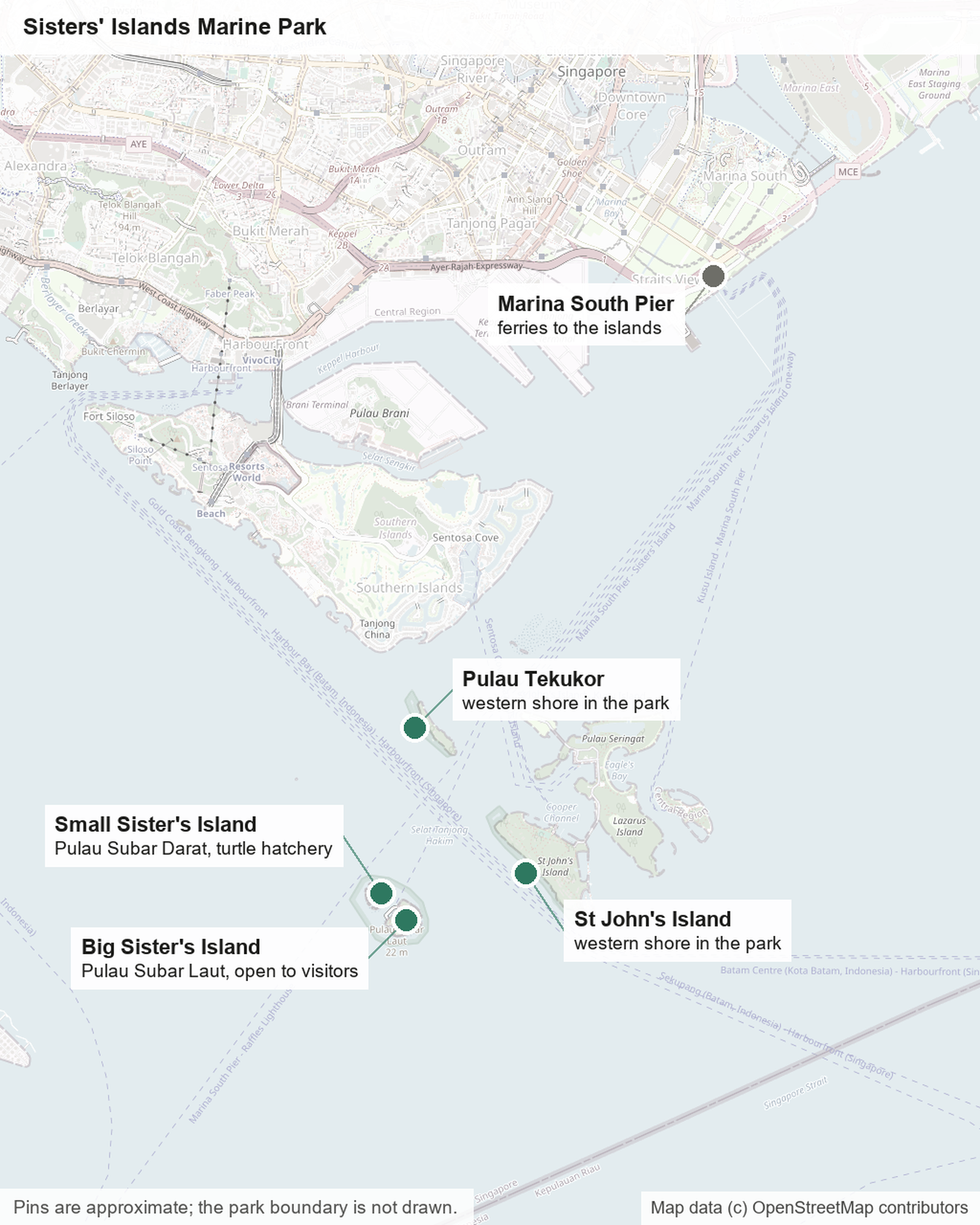
The Sisters’ Islands, the neighbouring shores in the marine park, and Marina South Pier, plotted on today’s map. Pins are approximate. (Map data © OpenStreetMap contributors)
The park has become a base for research and restoration. In 2011 a Neptune’s cup sponge, a giant goblet-shaped sponge thought to have died out after 1908, was found again off St John’s Island. In 2018 NParks and JTC began lowering eight artificial reef structures, each about 10 metres tall, into the park’s waters, for corals to grow on.
Turtles and a new island
 A banded damselfish off Big Sister's Island in November 2024. (Huey, via iNaturalist, CC BY 4.0, via Wikimedia Commons)
In 2018 NParks opened Singapore’s first turtle hatchery on Small Sister’s Island. Eggs from nests at risk, laid too close to the waterline or in busy places, are moved there into buried cages and watched until they hatch. Hawksbill turtles, which are critically endangered, nest on several of Singapore’s shores, including Big Sister’s Island. In the 2026 season, by the middle of August, 25 nests had been recorded across Singapore, and 294 hatchlings had emerged from the hatchery.
In 2021 the islands closed for rebuilding, and Big Sister’s Island reopened on the 28th of October 2024. It now has a floating boardwalk that rises and falls with the tide, with coral panels and moon pools, a lagoon turned into a tidal pool, a coastal forest trail and a view deck on the island’s highest point. Solar panels power a small desalination plant. Small Sister’s Island stays closed to the public as a zone for conservation and research. Visitors reach Big Sister’s Island by ferry from Marina South Pier, a trip of about half an hour that stops at St John’s Island.

The floating boardwalk and Small Sister’s Island, seen from Big Sister’s Island in September 2025. (Stefan Fussan, CC BY-SA 4.0, via Wikimedia Commons)
See more photos of the Sisters’ Islands and their neighbours →
Where it fits in the bigger story: The Sisters’ Islands have been remade several times, from a legend to an artillery target, a reclaimed picnic spot and now a marine park. Their story mirrors that of Singapore’s reefs as a whole, which lost most of their area to the growth of the city and the port, and the park is one of the ways the country is trying to keep what remains.
Sources:
- Sisters’ Islands, Wikipedia
- Sisters’ Islands Marine Park, Wikipedia
- Sisters’ Islands, Singapore Infopedia
- The Sisters Islands, wildsingapore
- Southern Islands, Wikipedia
- Chin Soon Lionel Ng, Tai Chong Toh and Loke Ming Chou, Current Status of Coral Reef Restoration in Singapore (2013), National University of Singapore
- Singapore identifies first marine park, TTG Asia, 14 July 2014
- Revamped Sisters’ Islands Marine Park opens to public, Mothership, October 2024
- How we protect turtle hatchlings, National Parks Board
- Keep on swimming: 42 critically-endangered hawksbill turtles released off Singapore’s Sisters’ Islands, The Straits Times via The Star, 14 August 2026
- Notice of howitzer practice at the targets on Sisters Island, The Straits Times, 29 March 1905 (NewspaperSG)
- Report on Belgian contractors reclaiming Kusu, Sisters, Hantu, Sebarok and Coney islands, The Straits Times, 16 November 1975 (NewspaperSG)
- Notices of community picnics at Sisters’ Island, The Straits Times, 15 and 18 November 1978 (NewspaperSG)
- Paying respects to our Big Sister, wild shores of singapore, February 2025
- Map data © OpenStreetMap contributors
- File:Sisters Islands, Singapore SF0001.jpg
- File:John Edmund Taylor, St. John’s Island & the Sisters. From Tanjong Katong Singapore (1879, Wellcome V0037483).jpg
- File:Big Sisters’ Islands, Southwest Beach SF0001.jpg
- File:Banded Damselfish, Big Sisters’ Island, Southern Islands, Singapore imported from iNaturalist photo 457161894.jpg
- File:View from Big Sisters’ Islands SF0001.jpg
- File:Big Sisters’ Islands, Southeast Beach SF0001.jpg
- File:Sisters Islands.JPG
- File:STET Polaris berthed at Sisters’ Island in 2015.jpg
- File:Tekukor-Island-750x500.jpg
- File:FMIB 33102 “Great Oyster” (giant clam; Tridacna gigas) from Singapore, International Fisheries Exhibition, London, 1883.jpg
- File:Saint John’s Island (Singapore) SF0001.jpg
- File:View of Singapore from St John’s Island in 2023.jpg
- File:Saint John’s Island in Singapore facing the city.jpg
- File:Hawksbill turtle hatchlings making their way to the sea.jpg


